
Rollups Explained: How Ethereum Is Scaling
Learn how Ethereum Rollups work, why they reduce gas fees, and the difference between Optimistic Rollups and ZK Rollups. A complete beginner-friendly guide to Ethereum Layer 2 scaling.
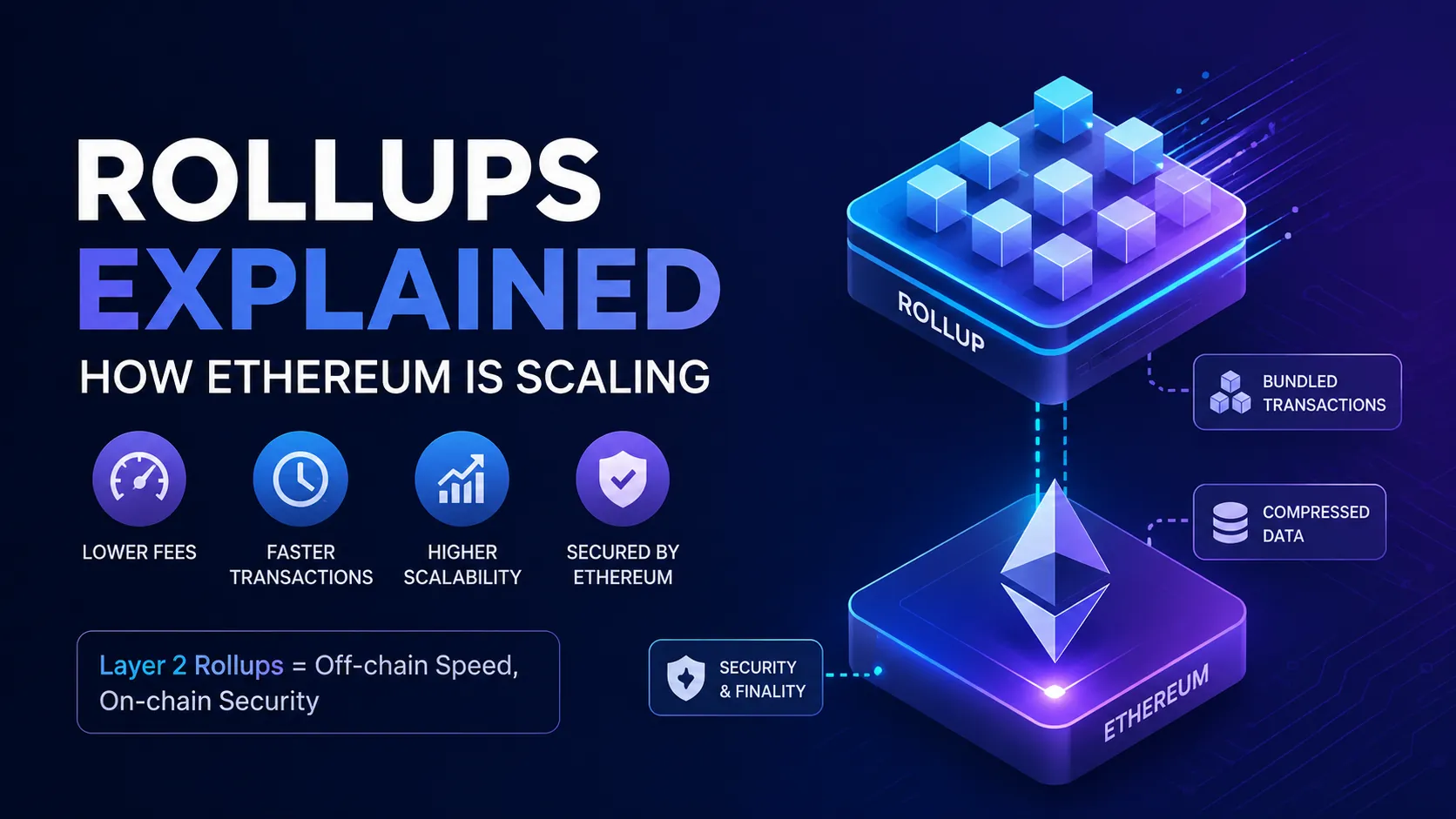
Table of Content
Table of Content
Ethereum has become the foundation of decentralized finance, NFTs, blockchain gaming, DAOs, and thousands of decentralized applications. Every day, millions of users rely on Ethereum to send transactions, interact with smart contracts, and build innovative applications. While Ethereum is one of the most secure and decentralized blockchain networks in the world, it has faced one major challenge since its early days: scalability.
If you have ever used Ethereum during periods of high demand, you may have noticed expensive gas fees and slower transaction confirmations. This happens because every transaction competes for limited block space on the Ethereum mainnet.
Instead of making Ethereum itself dramatically larger or sacrificing decentralization, developers introduced a smarter solution called Rollups. Today, rollups are considered the future of Ethereum scaling and are already processing millions of transactions every day.
In this guide, you will learn what rollups are, how they work, why they matter, the different types of rollups, their advantages and disadvantages, and why Ethereum's long-term roadmap is centered around rollup technology.
Why Does Ethereum Need Scaling?
Ethereum was designed with security and decentralization as its highest priorities. Every node in the network verifies every transaction, ensuring that nobody can cheat or manipulate the blockchain.
While this makes Ethereum extremely secure, it also limits how many transactions can be processed every second.
Imagine a small highway with only two lanes. During normal traffic, everything works well. But when millions of cars try to use the same highway at the same time, traffic jams become unavoidable.
Ethereum experiences a similar situation.
When network activity increases because of NFT launches, meme coin trading, DeFi activity, or gaming applications, users compete by paying higher gas fees to have their transactions processed faster.
This creates three major problems:
- High transaction fees
- Slower confirmations
- Poor user experience for small transactions
If blockchain technology is going to support billions of users worldwide, Ethereum must process far more transactions without sacrificing its security.
This is exactly where rollups come into the picture.
What Are Rollups?
A rollup is a Layer 2 scaling solution that processes transactions outside Ethereum's main blockchain while still relying on Ethereum for security.
Instead of every single transaction being executed directly on Ethereum, rollups execute hundreds or even thousands of transactions separately.
After processing them, the rollup compresses all the transaction data into a small summary and sends it back to Ethereum.
Think of it like mailing documents.
Imagine sending 1,000 letters individually. Each letter requires its own envelope, stamp, and shipping cost.
Now imagine putting all 1,000 letters into one large package.
Shipping one package is much cheaper than shipping every letter separately.
Rollups work in almost the same way.
Thousands of transactions become one compressed package that Ethereum stores securely.
This dramatically reduces costs while increasing transaction throughput.
How Rollups Work Step by Step
Understanding rollups becomes much easier when broken into simple steps.
Step 1: User Sends a Transaction
A user interacts with a decentralized application exactly like they would on Ethereum.
Examples include:
- Swapping tokens
- Minting NFTs
- Playing blockchain games
- Sending crypto
- Borrowing assets
Instead of going directly to Ethereum, the transaction goes to the rollup network.
Step 2: Rollup Processes Transactions
The rollup collects transactions from thousands of users.
Instead of processing each transaction individually on Ethereum, it executes them locally on its own Layer 2 network.
This is significantly faster because the rollup environment is designed for high performance.
Step 3: Transactions Are Bundled Together
After processing many transactions, the rollup groups them into one batch.
Rather than sending every transaction separately to Ethereum, only compressed information is submitted.
This greatly reduces storage requirements.
Step 4: Data Is Submitted to Ethereum
The compressed batch is posted to Ethereum.
Ethereum permanently stores the transaction data.
This ensures anyone can verify the transactions later.
Step 5: Ethereum Secures Everything
Although execution happened outside Ethereum, Ethereum still acts as the security layer.
If someone tries to cheat, Ethereum's security guarantees protect users' funds.
This combination of off-chain execution and on-chain security makes rollups extremely powerful.
Why Are Rollups So Important?
Rollups solve several of Ethereum's biggest problems at the same time.
Lower Gas Fees
Since thousands of transactions share one Ethereum transaction, every user pays only a fraction of the cost.
This makes decentralized applications much more affordable.
Faster Transactions
Transactions no longer wait in Ethereum's crowded queue.
Users experience much faster confirmations.
Better User Experience
Cheap transactions make blockchain applications feel closer to traditional web applications.
Users can interact more frequently without worrying about high fees.
Ethereum Remains Secure
Unlike completely separate blockchains, rollups inherit Ethereum's security.
Users do not need to trust an entirely new blockchain.
Supports Massive Growth
As blockchain adoption grows, Ethereum alone cannot process billions of transactions.
Rollups make this scale possible.
Types of Rollups
There are two major categories of Ethereum rollups.
- Optimistic Rollups
- Zero-Knowledge (ZK) Rollups
Both achieve the same goal but use different methods.
Optimistic Rollups Explained
Optimistic rollups assume every transaction is valid by default.
Instead of verifying every batch immediately, they trust that transactions are honest unless someone proves otherwise.
This idea greatly reduces computational work.
If a malicious transaction appears, anyone can submit a fraud proof.
Ethereum then checks the proof and rejects invalid transactions.
Because fraud detection requires time, withdrawals usually take several days.
Popular Optimistic Rollups include:
- Optimism
- Arbitrum
These networks are widely used across DeFi applications.
How Optimistic Rollups Work
Imagine a teacher collecting homework.
Instead of checking every assignment immediately, the teacher assumes everyone completed their work honestly.
If another student reports cheating with evidence, only then does the teacher investigate.
This saves a huge amount of time.
Optimistic rollups follow the same principle.
Most batches are accepted instantly because fraud is relatively rare.
Advantages of Optimistic Rollups
- Easy compatibility with Ethereum applications
- Lower development complexity
- Large ecosystem
- Proven technology
- Lower transaction fees
Limitations of Optimistic Rollups
The biggest drawback is withdrawal time.
Since fraud challenges must remain possible, users may need to wait several days before moving funds back to Ethereum.
Zero-Knowledge Rollups (ZK Rollups)
Zero-Knowledge Rollups take a completely different approach.
Instead of assuming transactions are valid, they generate mathematical proofs showing every transaction is correct.
Ethereum verifies the proof instead of verifying every transaction individually.
This makes verification extremely efficient.
The proof itself is very small but guarantees correctness.
Popular ZK Rollups include:
- zkSync
- Starknet
- Polygon zkEVM
- Linea
How ZK Rollups Work
Imagine a calculator solving one million math problems.
Instead of showing every calculation, it simply provides the correct answers along with mathematical evidence proving every answer is correct.
The teacher only checks the proof.
The teacher does not need to solve all one million problems again.
This is exactly how ZK rollups reduce computation.
Advantages of ZK Rollups
- Extremely fast verification
- Lower transaction costs
- Higher scalability
- Faster withdrawals
- Strong cryptographic security
Limitations of ZK Rollups
Building ZK technology is technically challenging.
Generating mathematical proofs requires advanced cryptography and significant engineering effort.
Some applications are still adapting to this newer technology.
Rollups vs Ethereum Mainnet
Ethereum Mainnet processes every transaction individually.
Rollups process transactions separately and only submit compressed summaries.
As a result:
- More transactions fit into Ethereum blocks.
- Users pay much lower gas fees.
- Applications become faster.
- Ethereum remains decentralized.
Rather than replacing Ethereum, rollups extend its capabilities.
Rollups vs Sidechains
Many beginners confuse rollups with sidechains.
Although both improve scalability, they are fundamentally different.
Sidechains have their own validators and security model.
If a sidechain experiences security issues, Ethereum cannot directly protect users.
Rollups rely on Ethereum's security.
Even though execution happens elsewhere, Ethereum still secures transaction data.
This makes rollups significantly more trust-minimized.
Real-World Use Cases of Rollups
Rollups are already powering many blockchain applications.
Decentralized Finance
Users can trade tokens, lend crypto, provide liquidity, and stake assets with much lower fees.
NFT Marketplaces
Minting and trading NFTs becomes affordable.
Artists no longer need to spend large amounts on gas.
Blockchain Gaming
Games require frequent transactions.
Rollups allow players to interact without paying expensive fees every few minutes.
Payments
Small crypto payments become practical because transaction fees remain low.
Social Applications
Decentralized social platforms generate many user interactions.
Rollups make these interactions inexpensive and scalable.
Ethereum's Rollup-Centric Roadmap
Ethereum developers now view rollups as the primary scaling solution.
Rather than making Layer 1 infinitely larger, Ethereum focuses on becoming the best settlement layer.
Future upgrades improve data availability, allowing rollups to become even cheaper.
This approach keeps Ethereum secure while enabling massive scalability.
Instead of competing with Layer 2 networks, Ethereum and rollups work together as one ecosystem.
Challenges Rollups Still Face
Although rollups are improving rapidly, several challenges remain.
Bridging Complexity
Moving assets between Ethereum and different rollups can confuse new users.
Wallets are making this process easier.
Liquidity Fragmentation
Assets are spread across multiple rollups.
Cross-rollup communication is improving but is still evolving.
User Education
Many newcomers still do not understand the differences between Layer 1 and Layer 2 networks.
Better educational resources are helping solve this issue.
Ecosystem Competition
Many rollups compete for developers and users.
Over time, stronger interoperability will reduce fragmentation.
The Future of Rollups
The future looks extremely promising.
As Ethereum continues introducing upgrades that reduce data costs, rollups will become even faster and cheaper.
Developers are also building technologies that allow different rollups to communicate seamlessly.
Eventually, users may not even realize which rollup they are using.
Applications will automatically choose the fastest and cheapest network while Ethereum quietly provides security in the background.
This vision could allow Ethereum to support millions of transactions every second across many Layer 2 networks.
Final Thoughts
Rollups have fundamentally changed how Ethereum scales. Instead of forcing every transaction onto the main blockchain, they execute work efficiently on Layer 2 while still benefiting from Ethereum's security. This approach delivers lower fees, faster transactions, and a much better experience for users without compromising decentralization.
Both Optimistic Rollups and Zero-Knowledge Rollups play important roles in Ethereum's ecosystem. Optimistic Rollups are mature and widely adopted, while ZK Rollups offer cutting-edge cryptographic efficiency and continue to improve rapidly.
As blockchain adoption grows, rollups are expected to become the standard way people interact with Ethereum. Whether you are trading crypto, building decentralized applications, creating NFTs, or exploring Web3 for the first time, understanding rollups gives you a clearer picture of how Ethereum is preparing for the future.
Frequently Asked Questions (FAQs)
1. What is an Ethereum rollup?
An Ethereum rollup is a Layer 2 scaling solution that processes transactions outside the Ethereum mainnet, bundles them together, and submits compressed transaction data back to Ethereum. This reduces gas fees while maintaining Ethereum's security.
2. What is the difference between Optimistic Rollups and ZK Rollups?
Optimistic Rollups assume transactions are valid unless challenged with a fraud proof, while ZK Rollups generate cryptographic proofs that mathematically verify every transaction before it is finalized. ZK Rollups usually offer faster withdrawals but are more technically complex.
3. Are rollups secure?
Yes. Rollups inherit Ethereum's security because transaction data is ultimately stored and verified on the Ethereum blockchain. This makes them much more secure than many independent sidechains.
4. Why are gas fees lower on rollups?
Gas fees are lower because thousands of user transactions are combined into a single batch before being submitted to Ethereum. Users share the cost of that batch instead of paying for individual on-chain transactions.
5. Will rollups replace Ethereum?
No. Rollups are designed to work alongside Ethereum, not replace it. Ethereum remains the secure settlement layer, while rollups handle most transaction processing to improve speed and reduce costs.