AI Prompts for Writing Meeting Notes and Summaries

Table of Content
Table of Content
Introduction
Meetings are an essential part of modern workplaces, whether they take place in person or through virtual platforms like Zoom, Microsoft Teams, or Google Meet. They help teams collaborate, discuss ideas, solve problems, and make important decisions. However, one challenge almost every professional faces is documenting those discussions accurately. Taking detailed notes while actively participating in a meeting is difficult, and reviewing long recordings afterward can consume hours of valuable time.
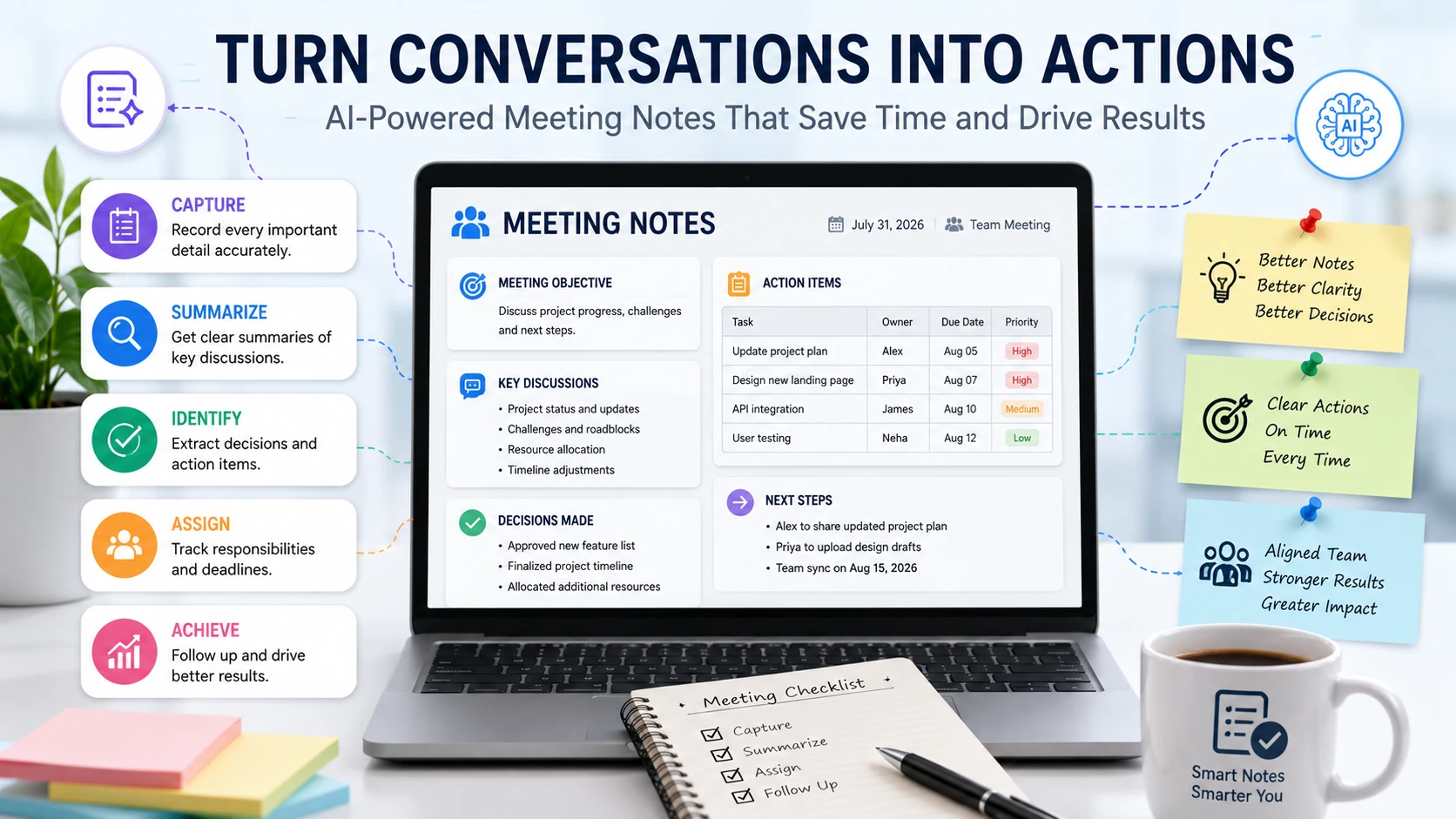
This is where Artificial Intelligence is transforming workplace productivity. Modern AI assistants can organize discussions, summarize key decisions, identify action items, and generate professional meeting notes within minutes. Instead of manually writing pages of notes, professionals can use carefully crafted AI prompts to convert raw meeting transcripts into structured, easy-to-read summaries.
Whether you're a project manager, business analyst, HR professional, software developer, freelancer, entrepreneur, or student, AI-powered meeting summaries can significantly improve efficiency and communication across teams.
In this guide, you'll discover five carefully designed AI prompts that help generate professional meeting notes, executive summaries, action plans, and follow-up documents. Each prompt is written to produce high-quality, organized, and actionable outputs while reducing manual effort.
Why AI Is Changing Meeting Documentation
Traditional meeting documentation usually involves one person typing notes while trying to keep up with the conversation. This often results in missing details, inconsistent formatting, and incomplete records.
AI changes this workflow by processing meeting transcripts quickly and presenting information in a structured format. Rather than simply shortening conversations, modern AI tools can identify the most important topics, organize decisions, highlight responsibilities, and prepare follow-up documentation.
Benefits include:
- Saves hours of manual work
- Produces consistent meeting documentation
- Improves collaboration across teams
- Makes action items easier to track
- Helps absent team members catch up quickly
- Reduces misunderstandings
- Creates searchable meeting records
Organizations that regularly document meetings effectively often make better decisions because important discussions remain accessible long after the meeting ends.
What Makes a Good AI Prompt?
The quality of an AI-generated summary depends heavily on the prompt you provide. A vague instruction usually produces a generic response, while a detailed prompt generates structured, professional, and useful documentation.
A strong prompt should specify:
- The AI's role
- The input format
- The desired structure
- The target audience
- The writing style
- Required sections
- Level of detail
The prompts below follow these principles to help you generate reliable meeting documentation.
AI Prompt 1: Professional Meeting Notes Generator
This prompt is ideal for weekly meetings, client discussions, project planning sessions, sprint reviews, internal team meetings, and department updates.
Prompt
Act as an experienced business meeting documentation specialist.

Analyze the following meeting transcript and create professional meeting notes.

Include the following sections:

• Meeting Title
• Date
• Participants
• Meeting Objective
• Agenda Covered
• Key Discussion Points
• Decisions Made
• Challenges Discussed
• Action Items
• Responsible Person
• Priority Level
• Deadlines
• Risks Identified
• Next Meeting Topics
• Final Summary

Organize the information using clear headings and bullet points.

Write in a professional, concise, and easy-to-read tone. Do not include unnecessary repetition or filler content. If certain information is unavailable, mention it as "Not Specified" instead of making assumptions.

Meeting Transcript:

[Paste Transcript Here]
Why This Prompt Works
Instead of asking AI to simply "summarize the meeting," this prompt requests a complete documentation structure.
It transforms lengthy conversations into organized records that teams can easily review later.
This prompt works especially well for:
- Weekly team meetings
- Agile sprint meetings
- Product planning sessions
- Marketing discussions
- HR meetings
- Client calls
- Internal business reviews
The structured format ensures important information is never buried inside long paragraphs.
Example Use Case
Imagine your software development team has just completed a one-hour sprint planning meeting involving developers, designers, QA engineers, and project managers.
Rather than manually writing notes, you paste the transcript into the AI.
Within minutes, the AI organizes:
- Sprint goals
- Assigned tasks
- Feature priorities
- Deadlines
- Blockers
- Team responsibilities
- Upcoming milestones
Everyone receives the same consistent documentation, reducing confusion and improving accountability.
AI Prompt 2: Executive Meeting Summary Generator
Senior executives rarely have time to read full meeting transcripts. They usually need a concise summary that highlights only the most important business outcomes.
This prompt is designed specifically for executive leadership.
Prompt
Act as an executive assistant responsible for preparing meeting summaries for senior leadership.

Review the following meeting transcript and prepare an executive summary.

The summary should include:

• Overall Meeting Purpose
• Business Objectives Discussed
• Major Decisions
• Key Risks
• Financial or Operational Impact
• Important Deadlines
• High-Priority Action Items
• Responsible Teams
• Recommendations
• Executive Summary (200-300 words)

Use clear business language suitable for directors, executives, stakeholders, and senior managers.

Focus only on strategic information. Remove repetitive discussions, informal conversations, and unnecessary details.

Meeting Transcript:

[Paste Transcript Here]
Why This Prompt Works
Executives are interested in outcomes rather than every conversation that occurred during a meeting.
This prompt filters unnecessary details and presents information in a strategic format that supports faster decision-making.
Instead of reading dozens of pages of discussion, leadership receives a document that immediately answers questions such as:
- What happened?
- What decisions were made?
- What requires approval?
- What risks exist?
- What actions should be monitored?
Example Use Case
Suppose a company holds a quarterly business review involving multiple department heads.
The discussion covers:
- Sales performance
- Product roadmap
- Hiring plans
- Marketing campaigns
- Budget allocation
- Customer feedback
- Operational challenges
The transcript may exceed several thousand words.
Using this prompt, AI transforms the conversation into a concise executive report highlighting strategic priorities, financial implications, critical decisions, and next steps.
Leadership can review the summary in just a few minutes instead of reading an entire transcript.
Best Practices When Using AI for Meeting Notes
Although AI is incredibly effective, following a few best practices improves output quality.
Provide Clear Input
Whenever possible, use clean meeting transcripts with speaker labels and timestamps. Well-formatted input helps AI understand context more accurately.
Include Meeting Context
Mention whether the meeting is related to sales, engineering, HR, finance, education, or project management. Context allows AI to use more appropriate terminology.
Specify the Audience
Documentation for executives differs from documentation prepared for team members.
Always tell AI who will read the summary.
Review Before Sharing
AI can dramatically reduce documentation time, but human review remains important before distributing meeting notes to stakeholders.
A quick review ensures names, dates, responsibilities, and deadlines are accurate.
AI Prompt 3: Action Item and Task Tracker Generator
Meetings often end with multiple tasks assigned to different people. Unfortunately, these action items are sometimes forgotten because they are buried inside long meeting notes.
This prompt extracts every important task from a meeting and organizes them into a structured action plan.
Prompt
Act as a professional project coordinator.

Review the meeting transcript below and create a detailed Action Item Report.

For each action item include:

• Task Title
• Task Description
• Assigned To
• Priority (High, Medium, Low)
• Deadline
• Current Status (Pending)
• Dependencies
• Expected Outcome
• Suggested Next Step

At the end, provide:

• Overall Project Progress
• Immediate Priorities
• Risks That May Delay Completion

Present everything using tables and bullet points for easy readability.

Meeting Transcript:

[Paste Transcript Here]
Why This Prompt Works
One of the biggest reasons projects fall behind schedule is unclear ownership of tasks. Team members may remember discussing an idea but forget who was responsible for completing it.
Instead of forcing managers to manually search through meeting notes, this prompt automatically extracts every commitment and organizes them into a practical task tracker.
The generated report makes it much easier to:
- Monitor project progress
- Assign responsibilities
- Track deadlines
- Follow up with team members
- Reduce missed deliverables
Example Use Case
Imagine your product development team holds a sprint planning meeting.
During the discussion:
- The frontend developer agrees to redesign the dashboard.
- The backend developer commits to optimizing API performance.
- The QA engineer plans regression testing.
- The UI designer promises updated mockups.
- The project manager schedules the next sprint review.
Rather than manually creating a task list afterward, AI automatically generates an organized report with responsibilities, priorities, and deadlines.
AI Prompt 4: Client Meeting Summary Generator
Client meetings often contain valuable business discussions, project updates, budget conversations, timelines, and future expectations.
Sending a professional summary after every meeting improves communication and builds trust.
Prompt
Act as a professional client success manager.

Review the following client meeting transcript and prepare a polished meeting summary.

Include:

• Meeting Objective
• Client Requirements
• Business Challenges Discussed
• Proposed Solutions
• Features Requested
• Decisions Finalized
• Pending Questions
• Deliverables
• Timeline
• Responsibilities
• Next Meeting Date (if available)

Write professionally using simple business English suitable for emailing directly to the client.

End with a short appreciation message thanking the client for their time.

Meeting Transcript:

[Paste Transcript Here]
Why This Prompt Works
Clients appreciate clear communication. Instead of sending long, unorganized notes, this prompt generates a professional document that highlights only the most important outcomes.
It ensures both your team and the client have a shared understanding of:
- What was discussed
- What has been approved
- What still needs clarification
- Who is responsible for each deliverable
- Expected timelines
This reduces misunderstandings and keeps projects moving smoothly.
Example Use Case
Suppose a digital marketing agency meets with a client to discuss a new website redesign.
Topics include:
- Brand identity
- Homepage layout
- SEO improvements
- Blog strategy
- Timeline
- Budget
- Content responsibilities
After the meeting, AI creates a concise summary that can be emailed directly to the client, confirming the agreed scope and next steps.
This saves time while demonstrating professionalism.
AI Prompt 5: Meeting Minutes with Follow-up Email Generator
Meeting notes are useful internally, but participants often expect a follow-up email summarizing the discussion.
This prompt combines both tasks into a single workflow.
Prompt
Act as an experienced business communication specialist.

Analyze the meeting transcript below.

First, generate structured meeting minutes including:

• Meeting Title
• Participants
• Agenda
• Key Discussions
• Important Decisions
• Action Items
• Deadlines
• Next Steps

Then write a professional follow-up email that includes:

• Appreciation for attending
• Summary of major discussions
• Action items
• Deadlines
• Upcoming milestones
• Invitation for additional feedback

Write in a friendly yet professional tone suitable for business communication.

Meeting Transcript:

[Paste Transcript Here]
Why This Prompt Works
Instead of using AI twice once for meeting minutes and once for an email this prompt completes both tasks in a single request.
This saves additional time while ensuring consistency between internal documentation and external communication.
The generated email can usually be reviewed quickly and sent with only minor edits.
Example Use Case
A software consulting company finishes a project kickoff meeting with a new client.
Topics include:
- Project objectives
- Technology stack
- Timeline
- Budget
- Communication process
- Milestones
- Team introductions
Within minutes, AI generates:
- Internal meeting documentation for the project team.
- A polished follow-up email confirming the agreed deliverables and thanking the client.
This creates a professional first impression and improves project transparency.
Common Mistakes to Avoid When Writing AI Prompts
Although AI can produce excellent meeting summaries, poor prompts often lead to generic or incomplete results.
Avoid these common mistakes:
Being Too Vague
Instead of writing:
"Summarize this meeting."
Provide clear instructions about the desired output, audience, and format.
Ignoring the Target Audience
A summary written for executives should differ from one written for developers or clients.
Always specify who will read the final document.
Forgetting Action Items
Meetings should produce outcomes, not just summaries.
Request that AI identify responsibilities, deadlines, and next steps whenever appropriate.
Using Unorganized Transcripts
Clean transcripts with speaker labels and proper punctuation produce significantly better results than poorly formatted notes.
Skipping Human Review
AI can save considerable time, but reviewing important business documents before sharing them helps ensure names, deadlines, and decisions are accurate.
Tips for Getting Better Results from AI
To consistently generate high-quality meeting documentation:
- Mention the meeting type (project, sales, HR, client, planning, review, etc.).
- Define the expected output structure.
- Specify the preferred writing style.
- Ask AI to remove repetitive conversations.
- Request concise language.
- Include action items and deadlines.
- Ask for professional formatting with headings and bullet points.
These small improvements dramatically increase the quality of AI-generated documentation while making the results easier to read and share.
Advanced Tips for Using AI Effectively
AI performs best when it receives clear instructions and well-structured input. While modern AI models are incredibly capable, a few simple practices can significantly improve the quality of the generated output.
Always Provide Context
Before pasting a meeting transcript, explain what the meeting is about.
For example:
- Weekly project meeting
- Sprint planning session
- Sales strategy discussion
- Client onboarding meeting
- HR recruitment meeting
- Financial review meeting
Providing context helps AI understand the purpose of the discussion and generate more relevant summaries.
Request a Specific Output Format
Rather than asking AI to "summarize this meeting," specify exactly what you need.
For example:
- Executive summary
- Detailed meeting minutes
- Action item tracker
- Decision log
- Follow-up email
- Client report
- Project update
Clear instructions produce far more useful results.
Use Speaker Labels
Whenever possible, include speaker names in the transcript.
Example:
Project Manager: Welcome everyone.
Developer: The authentication module has been completed.
Designer: The dashboard redesign will be finished by Friday.
Speaker labels improve readability and help AI attribute decisions and action items correctly.
Break Long Meetings into Sections
For meetings lasting several hours, divide the transcript into logical sections before processing it with AI.
Examples include:
- Introduction
- Project Updates
- Budget Discussion
- Technical Review
- Risks
- Action Items
- Closing Remarks
Smaller sections often produce more accurate and organized summaries.
Best AI Tools for Writing Meeting Notes
Today, several AI-powered tools help professionals document meetings more efficiently. Each platform offers unique strengths depending on your workflow.
ChatGPT
ChatGPT is one of the most versatile AI assistants available. It can transform raw meeting transcripts into structured summaries, action plans, executive reports, client updates, and follow-up emails using well-designed prompts.
It is especially useful because you can customize the output format according to your team's needs.
Microsoft Copilot
Organizations using Microsoft 365 can benefit from Copilot, which integrates with Outlook, Teams, Word, and other Microsoft applications.
It helps summarize discussions, organize meeting outcomes, and improve workplace productivity within the Microsoft ecosystem.
Google Gemini
Google Gemini integrates well with Google Workspace and assists users in creating meeting summaries, organizing notes, and generating collaborative documents.
Teams that rely on Google Docs, Gmail, and Google Meet often find this integration particularly convenient.
Otter.ai
Otter.ai specializes in meeting transcription and collaborative note-taking.
It automatically records conversations, identifies speakers, and generates searchable transcripts, making it easier to review discussions later.
Notion AI
Notion AI is useful for teams that already manage projects and documentation inside Notion.
It helps convert meeting notes into organized pages, task lists, knowledge bases, and project documentation.
Who Can Benefit from AI Meeting Summaries?
AI meeting documentation is valuable across many industries.
Project Managers
- Sprint reviews
- Planning meetings
- Team coordination
- Progress tracking
Business Analysts
- Requirement gathering
- Stakeholder discussions
- Documentation
- Process improvement
HR Professionals
- Candidate interviews
- Performance reviews
- Employee meetings
- Recruitment planning
Marketing Teams
- Campaign planning
- Content strategy
- Performance reviews
- Client presentations
Sales Teams
- Discovery calls
- Proposal discussions
- Client follow-ups
- Quarterly reviews
Software Development Teams
- Sprint planning
- Daily stand-ups
- Retrospectives
- Technical discussions
Freelancers and Agencies
Freelancers often manage multiple clients simultaneously.
AI-generated meeting summaries help maintain professional communication while saving valuable administrative time.
Benefits of AI Meeting Documentation
Organizations adopting AI-powered meeting documentation experience numerous advantages.
Some of the biggest benefits include:
- Saves hours of manual note-taking
- Produces consistent documentation
- Reduces human error
- Improves team communication
- Simplifies project tracking
- Enhances accountability
- Creates searchable knowledge bases
- Supports remote collaboration
- Improves decision-making
- Increases overall productivity
Rather than replacing employees, AI allows professionals to focus on strategic thinking instead of repetitive documentation.
Future of AI in Meeting Management
Artificial Intelligence continues to evolve rapidly, and meeting documentation is becoming increasingly intelligent.
Future AI systems are expected to:
- Detect discussion topics automatically
- Prioritize important decisions
- Generate project timelines
- Track action item completion
- Integrate with project management tools
- Provide real-time meeting insights
- Support multilingual meeting summaries
- Improve collaboration across global teams
As AI technology advances, meeting documentation will become faster, smarter, and more personalized.
Conclusion
Meetings play a critical role in business communication, but documenting every discussion manually can be time-consuming and inconsistent. AI-powered meeting note generation solves this challenge by transforming lengthy conversations into organized, actionable, and professional documentation within minutes.
The five prompts covered in this guide provide practical solutions for a wide range of scenarios, including project planning, executive reporting, client communication, action tracking, and follow-up emails. By combining clear prompts with high-quality meeting transcripts, professionals can significantly reduce administrative work while improving collaboration and accountability.
However, AI should be viewed as an assistant rather than a replacement for human judgment. Reviewing generated summaries before sharing them ensures that important names, dates, decisions, and responsibilities remain accurate.
As organizations continue to embrace digital collaboration, AI-powered meeting documentation will become an essential productivity tool for businesses of every size.
Frequently Asked Questions (FAQs)
1. Can AI automatically write meeting notes?
Yes. Modern AI assistants can analyze meeting transcripts or recordings and generate structured meeting notes, summaries, action items, and follow-up documents. Human review is still recommended to verify important details before sharing.
2. What should a good meeting summary include?
A professional meeting summary typically includes the meeting objective, participants, agenda, key discussion points, important decisions, action items, assigned responsibilities, deadlines, and next steps. Organizing information with clear headings improves readability.
3. Which professionals benefit the most from AI meeting summaries?
Project managers, software developers, HR professionals, business analysts, sales teams, marketing teams, consultants, freelancers, educators, and business owners can all save time by using AI to document meetings and organize follow-up tasks.
4. Are AI-generated meeting notes accurate?
AI can produce highly accurate summaries when provided with clear and complete meeting transcripts. The quality of the output depends on the transcript, prompt design, and context supplied. Reviewing the final document helps ensure correctness.
5. How can I improve the quality of AI-generated meeting summaries?
Use well-structured transcripts, include speaker names when possible, specify the meeting type, clearly define the desired output format, and request sections such as decisions, action items, deadlines, and next steps. Detailed prompts consistently produce better results.