Top 141 Python Interview Questions and Answers PDF with Program Examples
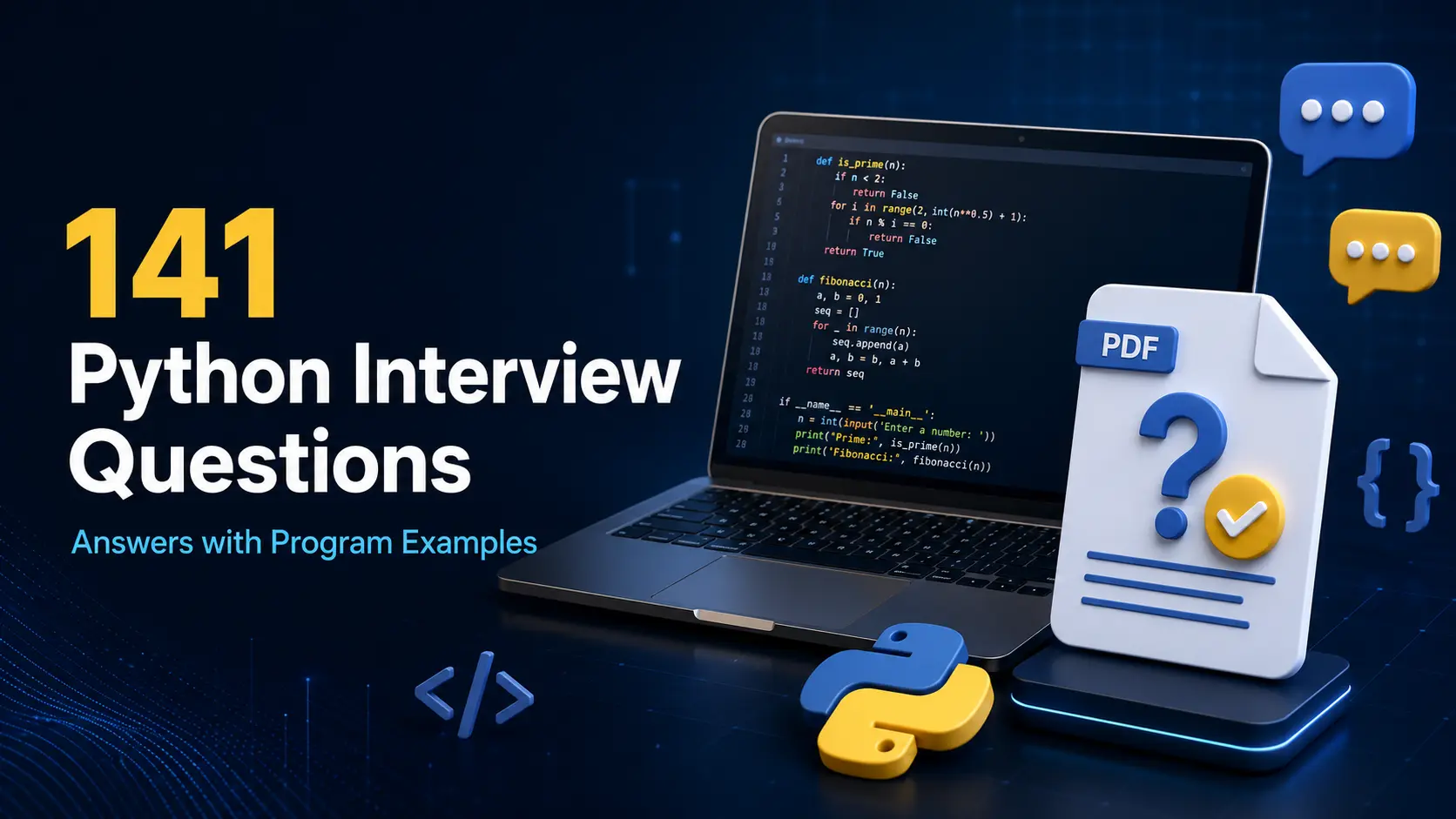
Download 141 Python interview questions and answers PDF with runnable programs covering fundamentals, OOP, files, decorators, generators, databases, testing, concurrency and async Python.
Python is one of the most popular programming languages among students, freshers, software developers, data professionals, automation engineers, and artificial intelligence enthusiasts. Its clean syntax and extensive ecosystem make it suitable for everything from small automation scripts to large web applications and machine learning systems.
Learning Python syntax, however, is only the beginning. During a technical interview, candidates are expected to explain how Python works, choose suitable data structures, write readable programs, handle errors, use object-oriented programming, and solve practical coding problems.
Interviewers may begin with basic questions about variables, strings, lists, and functions. As the discussion continues, they may ask about decorators, generators, iterators, exception handling, file operations, database connectivity, testing, concurrency, and asynchronous programming.
Preparing all these subjects through scattered tutorials can become confusing. To make preparation more organized, we created a detailed Python Interview Questions and Answers PDF containing 141 questions, clear explanations, and runnable program examples.
The guide covers beginner, intermediate, and advanced concepts. Instead of giving only one-line definitions, it shows how important concepts work through properly structured Python programs.
Why Are Python Interview Questions Important?
Technical interviews are designed to test more than memory. Interviewers want to know whether you can understand a problem, select an appropriate solution, explain your decisions, and write code that other developers can maintain.
For example, you may know that both lists and tuples can store multiple values. A stronger answer explains that lists are mutable while tuples are immutable, discusses how that difference affects their use, and provides an example of when each structure would be appropriate.
Similarly, defining a generator is not enough. You should be able to explain how the yield keyword works, why generators produce values lazily, and when they may be more memory-efficient than building a complete list.
Practising Python interview questions helps you improve your understanding of:
- Python syntax and execution
- Built-in data types and collections
- Functions and scope
- Object-oriented programming
- Error and exception handling
- Files, modules, and packages
- Iterators and generators
- Decorators and closures
- Database connectivity
- Testing and debugging
- Threads, processes, and asynchronous programming
- Common coding problems
- Writing readable and maintainable code
These questions also improve your communication skills. Even if you know the correct solution, you need to explain it clearly during an interview.
What Is Included in the Python Interview PDF?
The PDF contains 141 carefully organized Python interview questions with answers and program-based examples. The questions move from essential language concepts toward more advanced development topics.
Major sections include:
- Python fundamentals
- Variables and data types
- Operators and control flow
- Strings
- Lists, tuples, sets, and dictionaries
- Functions and arguments
- Scope and namespaces
- Object-oriented programming
- Exception handling
- File handling
- Modules and packages
- Iterators and generators
- Lambda functions
- Decorators and closures
- Comprehensions
- Regular expressions
- Testing and debugging
- Database programming
- Multithreading and multiprocessing
- Asynchronous programming
- Common Python coding problems
Each answer uses straightforward English and focuses on the points a candidate should understand. Relevant questions include complete programs with correct indentation, real operations, and visible output.
This makes the PDF useful for students, fresh graduates, internship candidates, Python developers, backend developers, data analysts, automation engineers, and anyone preparing for a Python-based technical role.
Python Fundamentals Every Candidate Should Know
A Python interview usually begins with fundamental questions. These help the interviewer evaluate whether the candidate understands the language beyond copying code from tutorials.
You should be able to explain that Python is a high-level, general-purpose programming language known for readable syntax and a large standard library. It supports multiple programming styles, including procedural, object-oriented, and functional programming.
Important fundamental topics include:
- Variables and dynamic typing
- Numeric and Boolean data types
- Strings and sequence operations
- Conditional statements
forandwhileloops- Functions
- Type conversion
- Input and output
- Indentation
- Comments and docstrings
- Mutable and immutable objects
Python uses indentation to define blocks of code. Incorrect indentation can change program structure or produce an error, so it is part of the language rather than optional formatting.
Candidates should also understand dynamic typing. A variable name is not permanently restricted to one declared type. However, this flexibility does not mean types are unimportant. Objects still have types, and incompatible operations can produce errors at runtime.
Understanding Python Data Structures
Selecting the correct data structure is an important programming skill. Python provides several built-in collections, and each one has different behavior.
Lists
A list is an ordered and mutable collection. It can contain duplicate values and objects of different types. Lists are useful when items may need to be added, removed, replaced, sorted, or processed by position.
Common list operations include:
- Appending an element
- Inserting at a position
- Removing an item
- Slicing
- Sorting
- Searching
- Iterating over values
- Creating list comprehensions
Tuples
A tuple is ordered but immutable. After creating a tuple, you cannot replace, add, or remove its elements through normal tuple operations.
Tuples are suitable for fixed collections of related information, such as coordinates or configuration values. Their immutability can communicate that the values are not expected to change.
However, saying that a tuple can never contain a changing value would be misleading. A tuple itself is immutable, but it may contain a reference to a mutable object such as a list.
Sets
A set stores unique hashable elements and does not provide indexed access. Sets are valuable for removing duplicates, testing membership, and performing union, intersection, and difference operations.
A practical example is comparing two groups of skills to find which abilities are common and which are missing.
Dictionaries
A dictionary stores key-value pairs. It is useful when data should be retrieved through meaningful keys rather than numeric positions.
For example, an employee record may use keys such as name, role, and experience. Candidates should understand dictionary creation, lookup, updates, iteration, membership testing, and methods such as get().
A strong interview answer does not simply name a data structure. It explains why that structure fits the requirement.
Functions, Arguments, and Scope
Functions allow developers to divide a program into reusable units. They make code easier to test, understand, and maintain.
Python functions may accept:
- Positional arguments
- Keyword arguments
- Default arguments
- Variable-length positional arguments using
*args - Variable-length keyword arguments using
**kwargs
Candidates should understand the difference between defining a parameter and passing an argument. They should also know why mutable default arguments can create unexpected behavior.
For example, using an empty list directly as a default parameter may cause the same list object to be reused across function calls. A safer pattern is to use None as the default and create a new list inside the function.
Scope is another frequently discussed subject. Python commonly follows the LEGB lookup order:
- Local
- Enclosing
- Global
- Built-in
You should understand when the global and nonlocal keywords are used, but they should not become a replacement for clean program design. Excessive reliance on shared mutable state can make code difficult to test and debug.
Object-Oriented Programming in Python
Object-oriented programming is important for Python development roles. It organizes related data and behavior inside classes and objects.
A class acts as a blueprint, while an object is an instance of that class. The __init__ method is commonly used to initialize instance attributes.
Important object-oriented topics include:
- Classes and objects
- Instance attributes
- Class attributes
- Instance methods
- Class methods
- Static methods
- Inheritance
- Method overriding
- Encapsulation
- Abstraction
- Polymorphism
- Composition
- Special methods
- Properties
Suppose you are building an employee management system. An Employee class may store the employee’s name and salary and provide a method for calculating an annual amount. A Manager class may extend the behavior with team-related information.
Candidates should understand that inheritance is not always the best solution. Composition is often more suitable when one object uses another object’s functionality without representing a true “is-a” relationship.
Python does not enforce private attributes in the same strict way as some languages. Naming conventions and name mangling communicate that certain attributes are intended for internal use. Properties can provide controlled access while keeping a clean public interface.
Exception Handling and Reliable Programs
Errors are unavoidable in real applications. Files may be missing, user input may be invalid, network requests may fail, and database operations may not succeed.
Python uses try, except, else, finally, and raise for structured exception handling.
The try block contains code that might fail. An except block handles a relevant error. The optional else block runs if no exception occurs, while finally is normally used for cleanup work that should happen regardless of the result.
Candidates should avoid catching every possible error without understanding it. A broad except block can hide programming mistakes and make debugging difficult. It is better to catch specific exceptions that the program can handle meaningfully.
Custom exceptions are useful when an application has domain-specific failure conditions. For example, an account system may raise an InsufficientBalanceError when a withdrawal cannot be completed.
Exception handling should not be used to silently ignore errors. A reliable program provides useful feedback, records relevant details, cleans up resources, and leaves the application in a predictable state.
File Handling in Python
File operations are common in automation, data processing, reporting, logging, and backend applications.
Python can open files in modes such as read, write, append, text, and binary. The with statement is generally preferred because it manages the file resource and closes it when the block finishes, including when an exception occurs.
Candidates should understand:
- Reading an entire file
- Reading line by line
- Writing and appending content
- Working with text and binary files
- File paths
- JSON and CSV processing
- Resource cleanup
- Handling missing files
A runnable file-handling program gives learners a much clearer understanding than a single method call. It can create a file, write multiple records, read them back, process the content, and display the result.
Iterators and Generators
Iteration is central to Python. A for loop works with iterable objects such as lists, tuples, strings, dictionaries, files, and generators.
An iterable can provide an iterator. An iterator produces values one at a time and raises StopIteration when no values remain.
A generator is a convenient way to create an iterator using a function and the yield keyword. Unlike a normal function that returns one final result, a generator can pause its execution and resume later.
Generators are helpful when:
- Processing large files
- Producing a sequence gradually
- Building data pipelines
- Avoiding creation of a large collection in memory
- Representing a potentially long or infinite sequence
They are not automatically better in every situation. If a program repeatedly needs random access to every produced value, storing the results in a list may be more convenient.
Decorators and Closures
Decorators are common in frameworks and libraries, so they frequently appear in intermediate and advanced interviews.
A decorator wraps or modifies the behavior of another function or class without directly changing its source code. Decorators are used for logging, authentication checks, timing, caching, validation, and access control.
To understand decorators properly, candidates should first understand that functions are objects in Python. They can be assigned to variables, passed as arguments, returned from other functions, and defined inside functions.
A closure is created when an inner function retains access to values from its enclosing scope even after the outer function has completed.
Instead of memorizing decorator syntax, build a complete program. For example, create a timing decorator that records when a function starts, runs the function, calculates the duration, returns the original result, and preserves useful function metadata.
Comprehensions, Lambda Functions, and Functional Tools
Python provides concise tools for transforming and filtering data.
List comprehensions can create lists through compact expressions. Set and dictionary comprehensions provide similar functionality for their respective collections.
A lambda expression creates a small anonymous function. It is often used as a sorting key or with tools that accept a function argument.
Candidates should be familiar with:
- List, set, and dictionary comprehensions
- Lambda expressions
map()filter()sorted()any()andall()- Functions as arguments
Concise code is not always better code. If an expression contains several conditions or transformations, a regular loop or named function may be clearer. Readability should remain the priority.
Testing and Debugging Python Code
Professional development requires confidence that code behaves correctly. Testing helps detect problems before users encounter them and makes future changes safer.
Python candidates should understand:
- Unit testing
- Test cases
- Assertions
- Test fixtures
- Mocking
- Edge cases
- Debugging
- Logging
- Code coverage
A good test checks one meaningful behavior and communicates what went wrong if the result is incorrect. Candidates should test normal values, boundary cases, invalid input, and expected failures.
For example, a function that divides two values should be tested with positive numbers, negative numbers, decimal values, and a zero denominator.
Printing values can help during initial learning, but professional debugging may also involve breakpoints, stack traces, structured logging, and test isolation.
Concurrency and Asynchronous Programming
Advanced Python interviews may include threads, processes, and asynchronous programming.
Multithreading can be helpful for I/O-bound work, such as waiting for network responses or reading multiple files. Multiprocessing can run work in separate processes and may be suitable for CPU-intensive tasks.
Asynchronous programming uses tools such as async, await, and an event loop. It allows a program to manage many waiting operations without assigning a separate operating-system thread to every task.
Candidates should understand that concurrency does not automatically make a program faster. It adds coordination, error-handling, and debugging complexity. The correct approach depends on whether the work is CPU-bound or I/O-bound, how tasks share data, and what performance measurements show.
Shared mutable data can create race conditions. Locks and other synchronization mechanisms may protect critical operations, but poor locking strategies can reduce performance or create deadlocks.
Database Programming with Python
Many Python roles require interacting with a database. A typical database program needs to:
- Open a connection.
- Create a cursor or session.
- Prepare a query.
- Provide parameter values safely.
- Execute the operation.
- Read or update data.
- Commit or roll back the transaction.
- Close resources.
Queries containing user-provided values should use parameterization rather than unsafe string construction. This improves reliability and helps protect the application from SQL injection.
Candidates should also understand transactions. If a workflow requires multiple database updates, a failure in the middle may require a rollback so that the database does not remain partially updated.
The PDF includes practical database examples so learners can see how connections, queries, parameters, results, and cleanup fit together.
Why Runnable Program Examples Matter
Definitions help learners recognize a concept, but programs show how the concept behaves.
Consider a question about inheritance. A theoretical answer may explain that a child class can reuse behavior from a parent class. A complete program can define both classes, create an object, override a method, call the methods, and display the result.
Program examples help candidates:
- Understand syntax in context
- Observe the flow of execution
- Learn correct indentation
- Connect theory with output
- Modify values and experiment
- Find and correct mistakes
- Remember concepts for longer
- Prepare for live coding rounds
The PDF uses runnable examples instead of filling every example box with a sentence or isolated expression. This makes it more useful as both an interview guide and a practical revision resource.
How to Use the Python Interview PDF Effectively
Do not attempt to memorize all 141 answers at once. Divide your preparation into manageable sections.
Start with Python fundamentals, strings, and collections. Continue with functions, scope, OOP, exceptions, and files. After building a strong foundation, study decorators, generators, testing, databases, concurrency, and asynchronous programming.
Use this process for each question:
- Read the question without looking at the answer.
- Explain the concept aloud in your own words.
- Compare your explanation with the provided answer.
- Type the accompanying program manually.
- Predict the output before running it.
- Change the input or logic and observe the result.
- Explain where the concept may be used in a real project.
Classify every question as confident, needs revision, or difficult. Spend more time on the final two categories.
It is also useful to build a small project that combines multiple topics. You might create an expense tracker, student management system, file organizer, API client, or command-line task manager.
A project gives you practical examples to mention during an interview and shows how individual concepts work together.
Common Python Interview Mistakes to Avoid
One common mistake is memorizing definitions word for word. Interviewers often change the wording or ask follow-up questions, so memorized answers can quickly become difficult to use.
Other frequent mistakes include:
- Confusing a list with a tuple
- Using
iswhen value comparison requires== - Ignoring mutable default argument behavior
- Catching exceptions too broadly
- Modifying a collection incorrectly during iteration
- Writing deeply nested comprehensions
- Calling every function a method
- Confusing an iterable with an iterator
- Claiming generators are always faster
- Assuming threads are ideal for every type of work
- Using unsafe string formatting in database queries
- Giving theory without a practical example
Avoid claiming that one tool or approach is always best. Strong answers acknowledge requirements, benefits, limitations, and trade-offs.
If you do not know a particular detail, explain the part you understand and be honest about what you would verify. A careful partial answer is better than an incorrect answer delivered confidently.
Final Thoughts
Preparing for a Python interview becomes easier when the topics are organized and supported by practice.
The 141 Python Interview Questions and Answers PDF brings fundamental, intermediate, and advanced concepts into one structured resource. Its runnable programs help learners move beyond definitions and see how Python behaves in realistic situations.
Use the PDF for daily revision, but do not rely on reading alone. Type the programs, change them, debug them, and connect the concepts to projects you have built.
During an interview, begin with a direct explanation, describe how the concept works, provide a practical example, and mention an important limitation when relevant. This structure keeps your answer clear and demonstrates genuine understanding.
Python interview success does not depend on remembering every possible question. It depends on having strong fundamentals, writing understandable code, solving problems logically, and communicating your reasoning with confidence.
Frequently Asked Questions
1. How many questions are included in the Python interview PDF?
The PDF contains 141 Python interview questions with clear answers and runnable program examples. It covers beginner, intermediate, and advanced concepts.
2. Is this Python interview PDF suitable for freshers?
Yes. Freshers can begin with fundamentals, data types, strings, collections, functions, and OOP before moving to advanced areas such as decorators, generators, databases, concurrency, and async programming.
3. Does every question include a Python program?
The guide contains program-based examples for the questions, with complete logic, proper indentation, and practical operations. These examples help readers understand how each concept works instead of learning only a definition.
4. Which Python topics should I prepare first?
Begin with syntax, variables, data types, strings, lists, tuples, sets, dictionaries, loops, and functions. Next, study OOP, exceptions, files, modules, iterators, generators, decorators, testing, databases, and concurrency.
5. Are 141 questions enough to clear a Python interview?
The questions provide a strong preparation foundation, but candidates should also practise coding problems, build projects, revise role-specific topics, and conduct mock interviews. Success depends on conceptual knowledge, problem-solving, communication, and practical experience.