Top 70 C Programming Interview Questions PDF for Freshers
Download 70 C Programming Interview Questions PDF for freshers. Revise important topics like pointers, arrays, functions, strings, structures, and memory.
 Aditya Chavhan
Top 70 C Programming Interview Questions PDF for Freshers
C is one of the best programming languages for understanding how software works at a fundamental level. It introduces learners to variables, data types, functions, loops, arrays, pointers, memory management, structures, and file handling. These concepts are not limited to C. They also help students understand many other programming languages and computer science subjects.
For this reason, C programming questions are still commonly asked during technical interviews, campus placements, college viva examinations, internships, and entry-level developer assessments. An interviewer may begin with a simple question about variables or loops and gradually move toward pointers, recursion, structures, and dynamic memory allocation.
To help students and freshers prepare efficiently, we have created a PDF containing 70 important C programming interview questions. It brings the most useful topics together in one place, making it easier to revise before an interview or examination.
This guide explains what the PDF covers, why C remains important, which topics deserve the most attention, and how you can prepare for a C programming interview with greater confidence.
Why Is C Programming Still Important?
C was developed several decades ago, but it continues to be widely used and taught. It provides better control over system resources and memory than many high-level programming languages.
The language has influenced several popular technologies and programming languages. Its syntax and concepts can be found in C++, Java, JavaScript, C#, and other modern languages. A student who understands C usually finds it easier to learn new programming languages.
C is used in areas such as:
- Operating system development
- Embedded systems
- Device drivers
- Firmware development
- Database systems
- Compilers
- Networking tools
- Game engines
- Internet of Things devices
- Performance-sensitive applications
More importantly, C teaches programmers to think about how data is stored and processed inside a computer. You learn how variables occupy memory, how functions receive information, how arrays are organized, and how pointers access addresses.
These skills are valuable even if you eventually work with Java, Python, JavaScript, or another programming language.
Why Do Interviewers Ask C Programming Questions?
Interviewers use C programming questions to evaluate more than your ability to remember syntax. They want to see whether you understand programming logic and can apply basic concepts correctly.
A C interview can help an interviewer evaluate your knowledge of:
- Program structure and compilation
- Data types and memory usage
- Conditions and decision-making
- Loops and program flow
- Functions and modular programming
- Arrays and strings
- Pointers and memory addresses
- Structures and user-defined data types
- Dynamic memory allocation
- File operations
- Errors and debugging
For fresher positions, interviewers do not always expect advanced system programming knowledge. However, they usually expect you to explain the fundamentals clearly and write small programs without depending entirely on an IDE.
You may also receive output-based questions. In these questions, the interviewer provides a small code snippet and asks you to predict its output. Such questions reveal whether you genuinely understand execution order, operators, variable scope, loops, pointers, and functions.
About the 70 C Programming Interview Questions PDF
The downloadable PDF contains 70 carefully selected C programming interview questions. It is designed for quick revision and self-assessment.
The questions begin with beginner-level topics, including the history, features, structure, variables, and data types of C. They then move toward control statements, functions, arrays, strings, pointers, structures, unions, and memory allocation.
The PDF is useful for:
- Students preparing for campus placements
- Fresh graduates attending technical interviews
- BCA and MCA students
- BSc Computer Science students
- BTech and BE students
- Diploma students
- Internship applicants
- Programming beginners
- Students preparing for practical viva examinations
- Developers revising C fundamentals
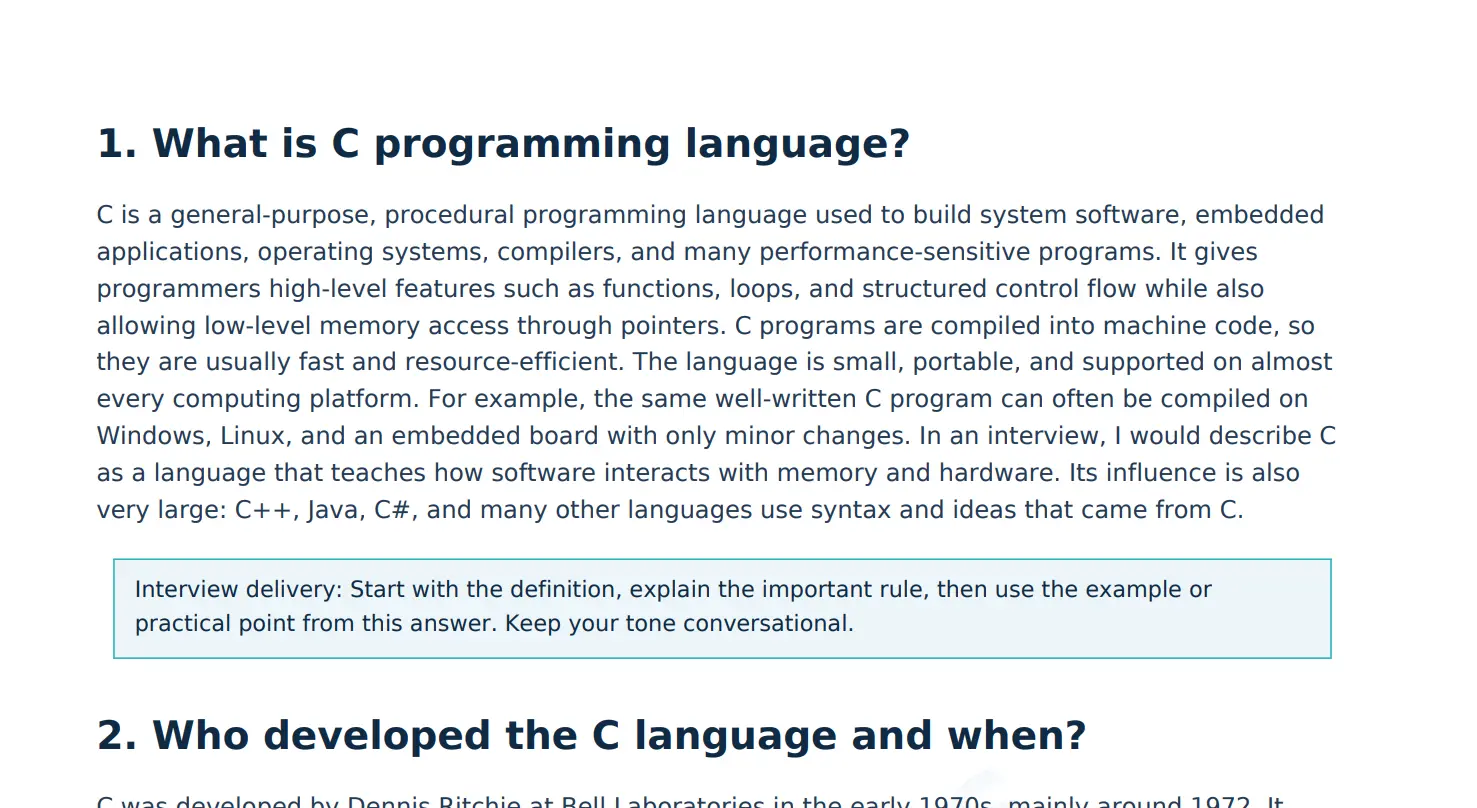
Because the PDF contains questions without unnecessarily long explanations, it can be used as an interview checklist. Try answering every question in your own words. If you cannot answer one confidently, return to that topic and study it in more detail.
C Programming Fundamentals
Every C interview usually begins with fundamental questions. You may be asked what C is, who developed it, or why it is considered a middle-level programming language.
You should understand the basic structure of a C program. A typical program can contain header files, macro definitions, global declarations, the main() function, user-defined functions, and return statements.
Interviewers may also ask about the compilation process. A C source file does not run directly. It generally goes through preprocessing, compilation, assembly, and linking before becoming an executable program.
Other important foundational concepts include tokens, keywords, identifiers, constants, and variables. Tokens are the smallest meaningful components of a C program. They include keywords, identifiers, constants, strings, operators, and special symbols.
Do not memorize these definitions mechanically. Try to identify each component in a small program. This makes the concept easier to remember and explain.
Data Types, Variables, and Type Conversion
A data type determines what kind of information a variable can store. The main basic data types in C include char, int, float, and double.
Interviewers frequently ask candidates to compare int, float, and double. You should know what kind of values they store and how their precision differs. However, avoid assuming that every data type always has the same size on all systems. Its exact size can depend on the platform and compiler.
The sizeof operator helps determine how many bytes a data type or variable occupies in a specific environment.
Type conversion is another essential topic. Implicit conversion is performed automatically by the compiler. Explicit conversion, also called type casting, is intentionally requested by the programmer.
For example, dividing two integers can produce a different result from dividing two floating-point values. Understanding conversion rules will help you prevent unexpected output in calculations.
Operators and Expressions
Operators perform operations on values and variables. C supports arithmetic, relational, logical, assignment, bitwise, and conditional operators.
A very common beginner-level question is the difference between = and ==. The assignment operator = stores a value in a variable, while the equality operator == compares two values.
You should also understand prefix and postfix increment operators. Both increase a value by one, but they behave differently when used inside larger expressions.
Operator precedence determines which operation is performed first. Associativity determines the evaluation direction when multiple operators have the same precedence.
Instead of memorizing the complete precedence order at once, practise evaluating simple expressions. In real programs, parentheses can make expressions clearer and reduce mistakes.
Bitwise operators are especially important for embedded systems and low-level programming. They work directly on individual bits. Common bitwise operators include AND, OR, XOR, NOT, left shift, and right shift.
Decision-Making Statements
Decision-making statements allow programs to execute different code based on conditions.
The main conditional statements in C are:
ifif-else- Nested
if else-ifladderswitch
The if-else statement is useful when decisions depend on ranges, complex expressions, or multiple logical conditions. A switch statement is often easier to read when one expression is compared against several constant cases.
Interviewers may ask about the differences between switch and if-else. You should be able to explain their allowed conditions, readability, flexibility, and appropriate use cases.
Remember that break is usually placed after a case block to prevent execution from continuing into the next case. This continuation is called fall-through. It can sometimes be intentional, but beginners often create it accidentally.
Loops and Control Flow
Loops execute a block of code repeatedly. C provides for, while, and do-while loops.
A for loop is commonly used when the number of iterations is known. A while loop works well when repetition depends on a condition. A do-while loop executes its body at least once because its condition is checked after the first iteration.
You should also know how break and continue affect loop execution. The break statement immediately exits the nearest loop or switch. The continue statement skips the remaining code in the current iteration and moves to the next iteration.
The goto statement transfers control to a labeled statement. Although it is supported by C, excessive use can make a program difficult to read, debug, and maintain.
Interviewers may ask you to write loop-based programs for:
- Printing number patterns
- Calculating factorials
- Checking prime numbers
- Reversing a number
- Generating the Fibonacci sequence
- Finding the sum of digits
- Checking a palindrome
Practising these programs develops both syntax knowledge and logical thinking.
Functions and Recursion
Functions divide a large program into smaller, reusable units. This makes code easier to understand, test, debug, and maintain.
You should understand the difference between a function declaration, definition, and call. A function prototype informs the compiler about the function’s name, return type, and parameters before it is used.
Candidates are often asked about actual and formal parameters. Actual parameters are the values or expressions supplied during a function call. Formal parameters are the variables defined in the function declaration or definition that receive those values.
C passes function arguments by value. This means the function normally receives copies of the original values. If a function needs to modify an original variable, its address can be passed through a pointer.
Recursion occurs when a function calls itself. Every recursive solution needs an appropriate base condition. Without it, the function can continue calling itself until the program exhausts the available stack space.
Recursion is useful for certain mathematical problems, tree traversal, and divide-and-conquer algorithms. However, an iterative solution may use less memory in many simple cases.
Storage Classes and Scope
Storage classes describe the scope, visibility, and lifetime of variables and functions. Important storage classes in C include auto, static, extern, and register.
An automatic local variable generally exists only while its block is executing. A static local variable preserves its value between function calls. The extern keyword is used to declare an object or function that is defined elsewhere. The register keyword suggests that a frequently used variable may be stored for quick access, although modern compilers decide the actual optimization.
You should also understand local and global variables. A local variable is accessible within its block or function, while a global variable is declared outside functions and may be available to multiple functions, depending on its linkage and declarations.
Scope and lifetime are related but different. Scope describes where a name can be accessed in source code. Lifetime describes how long its object exists during execution.
Arrays and Strings
An array stores multiple elements of the same type in contiguous memory locations. Array indexing in C begins at zero.
A one-dimensional array can represent a list of values. A multidimensional array can represent matrices, tables, and other structured collections.
C does not automatically check whether an array index is within the valid range. Accessing memory outside an array’s boundaries results in undefined behaviour and may cause incorrect output, data corruption, or crashes.
A string in C is an array of characters terminated by the null character \0. That terminating character is essential because standard string functions use it to identify where the string ends.
Common string functions include:
strlen()for calculating string lengthstrcpy()for copying stringsstrcat()for joining stringsstrcmp()for comparing strings
You should understand the difference between strlen() and sizeof(). The strlen() function counts characters before the null terminator. The sizeof operator reports the number of bytes occupied by its operand or its type, depending on how it is used.
Always consider buffer capacity while copying or joining strings. Writing beyond the available space can create serious reliability and security problems.
Pointers in C
Pointers are one of the most important topics in a C programming interview. A pointer is a variable that stores a memory address.
The address operator & obtains the address of an object, while the dereference operator * accesses the value stored at the pointed-to address.
You should be familiar with different pointer-related terms:
- A null pointer does not point to a valid object.
- A void pointer can hold an address without specifying a concrete pointed-to type.
- A wild pointer has not been properly initialized.
- A dangling pointer refers to an object whose lifetime has ended or to released memory.
- A pointer to a pointer stores the address of another pointer.
Pointer arithmetic is meaningful primarily within arrays. When a pointer is incremented, it moves according to the size of the pointed-to type, not necessarily one byte.
Arrays and pointers are closely related, but they are not identical. In many expressions, an array name is converted to a pointer to its first element. However, an array is still an array object with fixed storage, while a pointer is a separate object capable of storing and changing an address.
Strong pointer knowledge is useful for understanding arrays, strings, functions, linked lists, dynamic memory, and system-level programming.
Structures, Unions, Enumerations, and Typedef
A structure groups related variables of different data types under one name. It can be used to represent real-world records such as students, employees, products, or books.
A union also groups different members, but its members share the same storage. This means only one member’s stored value is normally meaningful at a given time. A structure provides storage for all its members, although padding can affect its total size.
An enumeration defines a group of named integer constants. It can make code more readable when a value represents one option from a known collection.
The typedef keyword creates an alias for an existing type. It does not create a completely new data type, but it can simplify complex declarations and improve readability.
Dynamic Memory Allocation
Dynamic memory allocation allows a program to request memory during execution. This memory comes from the heap and must be managed carefully by the programmer.
The main functions are:
malloc()to allocate a block of memorycalloc()to allocate space for multiple elements with zero-initialized bytesrealloc()to resize an allocated blockfree()to release allocated memory
These functions return a pointer to the allocated memory. The result should be checked before the program uses it because allocation can fail.
A memory leak occurs when allocated memory is no longer needed but is not released, and the program loses the ability to access or free it. Repeated leaks can increase memory consumption and harm long-running applications.
After calling free(), the old pointer value should not be dereferenced. Setting it to NULL can reduce the risk of accidentally using the released address through that pointer, though it does not fix other copies of the same address.
File Handling in C
File handling allows a program to store information permanently and retrieve it later. C represents a file stream using the FILE type.
Frequently used file functions include:
fopen()to open a filefclose()to close itfprintf()andfscanf()for formatted operationsfgets()andfputs()for text operationsfread()andfwrite()for binary data
A program should always verify whether fopen() returned a valid pointer. File opening can fail because of an incorrect path, unavailable file, insufficient permission, or storage-related problem.
Students should practise creating a file, writing records, reading them back, and handling failures safely.
How to Use the PDF for Interview Preparation
Do not try to memorize all 70 questions in a single session. Divide them into smaller topic-based groups.
Start with fundamentals, data types, operators, conditions, and loops. After that, study functions, arrays, and strings. Finally, spend additional time on pointers, structures, dynamic memory allocation, and file handling.
For each question, follow this process:
- Answer it aloud in your own words.
- Write a small example when applicable.
- Compile and test the example.
- Note any errors or confusing behaviour.
- Revise the question again after one or two days.
Speaking answers aloud is useful because technical interviews require communication as well as knowledge. Aim to give a direct definition first, followed by a short explanation and a practical example.
Common Mistakes to Avoid
Many students read interview questions but do not write any programs. This creates a gap between theoretical knowledge and practical ability.
Avoid these common mistakes:
- Memorizing definitions without understanding them
- Ignoring compiler warnings
- Skipping pointers because they seem difficult
- Confusing assignment with comparison
- Forgetting the null terminator in strings
- Accessing an array outside its bounds
- Using uninitialized pointers
- Failing to check memory allocation
- Forgetting to release dynamically allocated memory
- Writing recursive functions without a base condition
- Assuming data type sizes are identical on every platform
- Practising only easy questions
A good interview preparation plan includes theory, coding, debugging, output prediction, and verbal explanation.
Final Thoughts
The 70 C Programming Interview Questions PDF is a practical revision resource for students, freshers, and internship applicants. It covers the essential topics that commonly appear in technical interviews and programming viva examinations.
However, the PDF should be the starting point of your preparation, not the end. Use every question as an opportunity to explore the underlying concept. Write programs, test different inputs, analyse errors, and practise explaining your approach clearly.
C programming becomes much easier when you understand how different topics connect. Variables store data, arrays organize it, pointers access its location, functions process it, structures group it, and dynamic allocation manages it during runtime.
Build your knowledge gradually and revise consistently. With a clear understanding of these concepts and enough hands-on practice, you will be better prepared to handle C programming interview questions with confidence.
Frequently Asked Questions
1. Is this C programming interview questions PDF suitable for freshers?
Yes. The PDF is designed primarily for beginners, students, and fresh graduates. It starts with basic concepts and also includes important intermediate topics such as pointers, structures, recursion, and dynamic memory allocation.
2. How many questions are included in the PDF?
The PDF contains 70 C programming interview questions. They cover fundamentals, data types, operators, control statements, loops, functions, arrays, strings, pointers, structures, memory allocation, and file handling.
3. Are these questions useful for college viva examinations?
Yes. Many of the questions cover the same fundamental concepts commonly asked in BCA, BSc, BTech, BE, MCA, diploma, and other computer science practical viva examinations.
4. How should I prepare for C coding interview questions?
First understand the concept, then write and compile a small program based on it. Practise programs involving numbers, loops, arrays, strings, functions, pointers, structures, and files. You should also practise predicting the output of short code snippets.
5. Is learning pointers necessary for a C programming interview?
Yes. Pointers are a central part of C and are connected to arrays, strings, functions, structures, and dynamic memory allocation. Fresher interviews often include basic pointer questions, so you should understand addresses, dereferencing, null pointers, pointer arithmetic, and dangling pointers.