
How to Protect Yourself From Phone Scams and Suspicious Calls in 2026
how to identify and avoid phone scams and suspicious calls in 2026. Discover warning signs of fake bank calls, OTP scams, caller ID spoofing, AI voice-cloning scams, and practical steps to protect your money, accounts, and personal information.

Table of Content
Table of Content
A phone call used to feel more trustworthy than a random email or social media message. If your bank's name appeared on the screen, you probably assumed your bank was calling. If someone knew your full name, address, or a few details about your account, they sounded legitimate.
In 2026, that assumption can be dangerous.
Phone scams have become more convincing because scammers now combine traditional social engineering with leaked personal data, caller ID spoofing, artificial intelligence, automated calling systems, fake customer-support numbers, and even realistic voice cloning.
A suspicious call may no longer sound like an obvious scam. The caller might speak professionally, know details about you, use the name of a real company, and create a situation that feels urgent enough to stop you from thinking clearly.
The good news is that most phone scams still depend on one thing: getting you to react before you verify.
Learning to slow down, recognize manipulation, and independently verify a caller can prevent many scams before they cause financial or personal damage.
This guide explains how modern phone scams work, the warning signs you should watch for, and the practical steps you can take to protect yourself and your family in 2026.
Why Phone Scams Are More Convincing in 2026
Scammers do not necessarily need sophisticated hacking skills to steal money. In many cases, their main tool is social engineering.
Social engineering means manipulating a person into voluntarily sharing information, approving a transaction, installing software, or taking another action that benefits the attacker.
A scammer may already know your name, phone number, email address, employer, city, relatives, or other publicly available or leaked information. Knowing those details does not prove that the caller is legitimate.
The U.S. Federal Trade Commission specifically warns that scammers may possess information such as your name, address, or account-related details and use it to make a fraudulent story appear believable.
Technology has made this manipulation easier.
Scammers can spoof phone numbers so that your screen displays the name of a bank, company, government department, police station, or even a local number. The number appearing on your caller ID therefore cannot be treated as proof of identity.
Artificial intelligence has created another challenge.
Voice-cloning tools can imitate the voice of a real person using audio available from videos, social media posts, podcasts, voice notes, or other recordings. The FTC has warned that criminals can use AI-generated voices in fake family emergency scams.
This means the question in 2026 is no longer simply, "Does the caller sound real?"
The better question is:
"Can I independently verify what this person is telling me?"
Common Phone Scams You Should Recognize
Scammers constantly change their stories, but many attacks follow similar patterns.
1. Fake Bank Fraud Calls
This is one of the most dangerous types of phone scam because the caller creates fear around something people care deeply about: their money.
You may receive a call claiming that an unusual transaction has appeared on your debit card, credit card, UPI account, or bank account.
The caller may say something like:
"Someone is trying to transfer money from your account."
Then they offer to "secure" the account.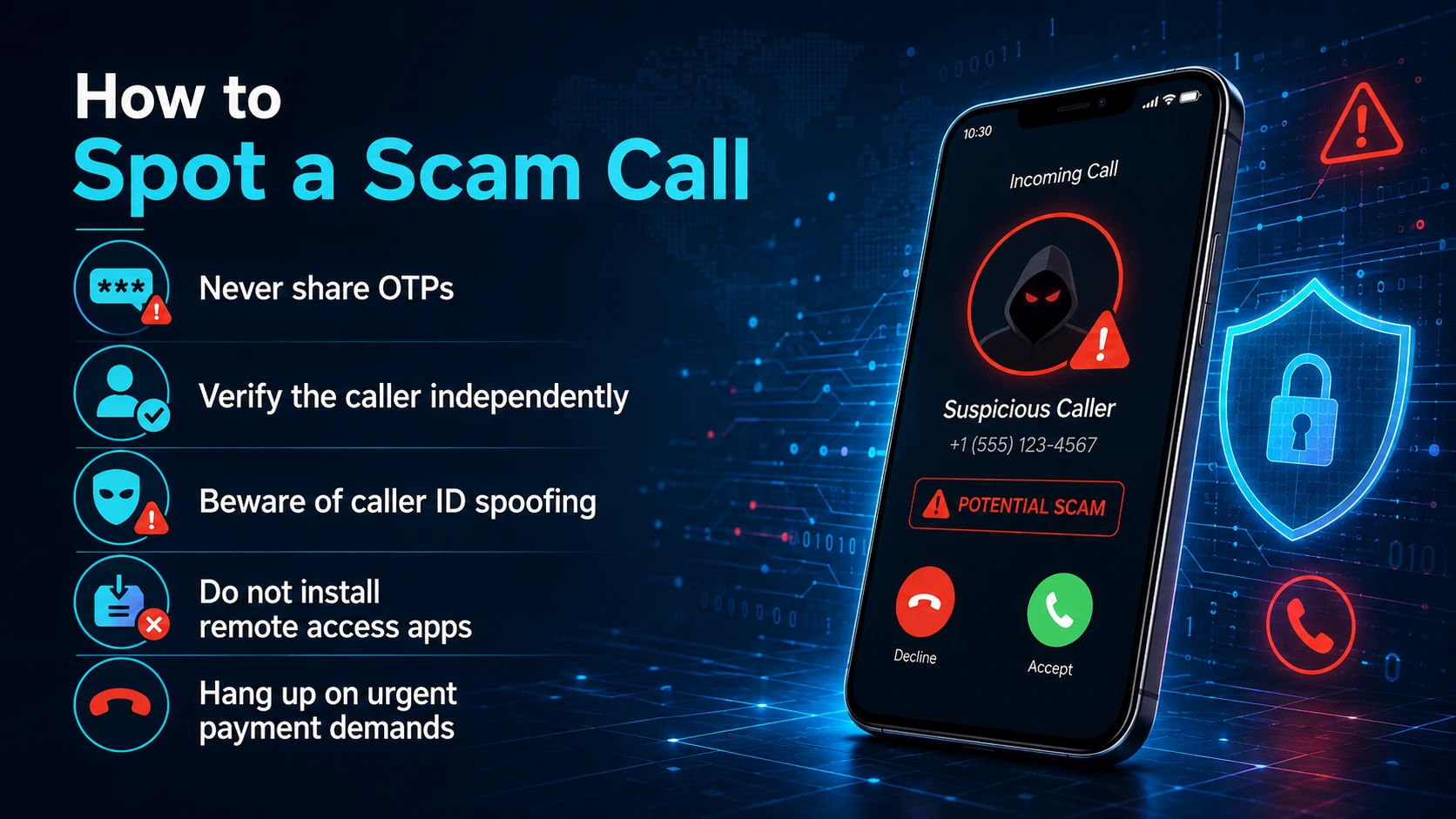
The trap usually appears in the next step. They may ask for an OTP, PIN, card number, CVV, verification code, login information, or approval inside your banking application.
In some scams, the attacker tells the victim to transfer money into a "safe account."
A legitimate financial institution may contact you about suspicious activity, but you should never rely solely on an unexpected incoming call.
Hang up and contact your bank through its official mobile application, website, the number printed on your bank card, or another contact method you already know is genuine.
FTC guidance issued in 2026 specifically recommends independently contacting the bank after an unexpected call claiming that your money is at risk.
2. OTP and Verification Code Scams
One-time passwords are designed to prove that you control an account or phone number.
That makes them extremely valuable to criminals.
A scammer might claim to be calling from your bank, mobile network, delivery company, payment service, employer, or customer-support department.
During the conversation, you suddenly receive a legitimate verification code.
The scammer then says:
"Please read the code so I can verify your identity."
Never do it.
The code may actually be authorizing the scammer to log into your account, reset your password, register a device, approve a payment, or complete another sensitive action.
Treat OTPs and account verification codes like passwords.
If you did not personally initiate the action that generated the code, do not approve it.
3. AI Voice-Cloning and Family Emergency Scams
Imagine receiving a call late at night.
The person on the other end sounds exactly like your son, daughter, sibling, parent, or friend.
They sound frightened.
They say they were arrested, injured, robbed, or involved in an accident.
Then another person comes on the phone claiming to be a police officer, lawyer, doctor, or hospital employee.
They demand money immediately.
This emotional pressure is intentional.
Modern voice-cloning technology can make these scams much more believable, and official consumer guidance has specifically warned about criminals cloning the voices of family members for emergency scams.
Create a family verification system before an emergency occurs.
For example, agree on a private family word or ask a question that someone outside the family is unlikely to answer correctly.
Most importantly, hang up and call the family member directly using a number already stored in your contacts.
4. Government and Police Impersonation Calls
Another common scam begins with intimidation.
The caller claims to represent the police, tax department, customs department, court, telecommunications authority, immigration department, or another government organization.
They may claim that a package containing illegal items has been registered in your name or that your identification has been connected to criminal activity.
Some attackers threaten immediate arrest unless payment is made.
Fear is the weapon.
Scammers may even spoof a real government phone number or use the name of a real officer.
The FTC has documented scams in which callers impersonate local law enforcement and demand payments through cash, cryptocurrency, gift cards, payment applications, or similar methods.
Do not allow a threatening caller to keep you trapped in a conversation.
End the call and contact the relevant agency independently through its official website or publicly verified telephone number.
5. Fake Customer-Support Calls
You receive a call claiming that your Amazon account, email account, mobile wallet, computer, subscription, or cloud account has been compromised.
The caller offers technical assistance.
Then they ask you to install screen-sharing or remote-access software.
Once remote access is granted, the attacker may be able to view sensitive information, manipulate what appears on your screen, access saved passwords, or guide you into transferring money.
Never install remote-access applications simply because an unexpected caller tells you to.
If you genuinely have an account problem, end the call and contact the company's official support service yourself.
6. Fake Investment and Trading Calls
"You have been selected for an exclusive investment opportunity."
"Guaranteed daily returns."
"Our expert will manage everything for you."
These claims should immediately make you cautious.
Scammers frequently use phone calls, messaging applications, social media groups, and fake investment platforms together.
At first, victims may be shown fake profits. They may even be allowed to withdraw a small amount to build confidence.
After the victim invests more money, withdrawals suddenly become impossible.
Never make an investment decision simply because someone contacted you unexpectedly.
Research the company independently, confirm regulatory registration where applicable, and be extremely skeptical of anyone guaranteeing returns.
7. Prize, Lottery, Refund, and Reward Scams
"You've won a prize."
"You have an unclaimed refund."
"You've been selected for a special reward."
The scam usually requires you to pay a processing charge, tax, delivery fee, security deposit, or verification payment before receiving the supposed reward.
That should be a major warning sign.
A prize that requires you to unexpectedly send money before receiving it may not be a prize at all.
The Biggest Warning Signs of a Phone Scam
Different scammers use different stories, but their psychological techniques are surprisingly similar.
Watch carefully when a caller does one or more of the following:
- Creates extreme urgency and tells you to act immediately.
- Threatens arrest, account closure, service suspension, or financial loss.
- Requests an OTP, PIN, password, CVV, recovery code, or verification code.
- Tells you to transfer money to a "safe" or "secure" account.
- Demands payment through cryptocurrency, gift cards, unusual payment applications, or another difficult-to-reverse method.
- Asks you to install remote-access or screen-sharing software.
- Tells you not to speak with your bank, family, colleagues, or authorities.
- Claims that hanging up will make the situation worse.
- Refuses to let you independently call the organization back.
- Uses caller ID as proof that the call is genuine.
- Promises guaranteed profits, prizes, refunds, or rewards.
- Pressures you to make an important decision while staying on the call.
One red flag does not automatically prove fraud, but several of them appearing together should make you extremely cautious.
Never Trust Caller ID Alone
One of the most important habits you can develop is understanding that the phone number displayed on your screen may be fake.
Caller ID spoofing allows scammers to manipulate the information shown to the person receiving the call.
A call may appear to come from your bank, a local business, a police department, or a telephone number with the same area code as yours.
The FCC and FTC both warn consumers about fraudulent use of caller ID spoofing.
Therefore, never think:
"The correct number is showing, so the caller must be genuine."
Instead, hang up and initiate a completely new call using verified contact information.
Use the Hang-Up-and-Verify Rule
This may be the most useful rule in this entire guide.
Whenever an unexpected caller asks you to take an important action involving money, passwords, account access, personal information, or software installation:
Hang up. Verify independently. Then decide what to do.
Suppose someone claiming to be from your bank says your account has been compromised.
Do not continue simply because they sound professional.
End the call.
Open your bank's official application yourself or call the number printed on your card.
There is another important detail here.
Do not automatically search something such as "XYZ Bank customer care" and call the first number shown in a search result.
The FTC warned in 2026 that scammers may use paid search advertisements to place fraudulent customer-support information prominently in search results.
Whenever possible, use an official app, a bookmarked website, a statement, your physical bank card, or another source you already trust.
Protect Your Phone and Important Accounts
Avoiding suspicious conversations is only one layer of protection.
Your accounts should also be prepared for situations in which passwords or personal details are exposed.
Use unique passwords for your important accounts instead of repeating one password everywhere.
Enable multi-factor authentication whenever it is available.
Where possible, authentication applications, passkeys, or hardware-based authentication can provide stronger protection than relying only on passwords.
Keep your phone's operating system and applications updated because updates frequently contain security fixes.
Use screen-lock protection such as a strong PIN or biometric authentication.
Also review which applications can access your microphone, contacts, messages, call history, photographs, and other sensitive information.
If you no longer use an application, removing it can reduce unnecessary exposure.
Use Spam Detection and Call Blocking
Modern smartphones and many telecom providers include tools that identify or filter suspected spam calls.
Turn these features on when available.
The FTC recommends considering call-blocking and call-labeling technologies to reduce unwanted scam calls.
However, treat these systems as an additional protection layer rather than a guarantee.
A call that is not labelled "Spam" can still be fraudulent.
Likewise, legitimate calls are sometimes incorrectly labelled.
Your own judgment and independent verification remain important.
Be Careful About What You Share Publicly
Scammers frequently build believable stories using information gathered from public sources.
Think about how much someone could learn from your social media profile.
Your full name, workplace, relatives, birthday, location, travel plans, school, pet's name, and photographs may all help an attacker create a convincing story or guess security questions.
This does not mean you need to disappear from the internet.
It simply means privacy settings are worth reviewing.
Avoid publicly posting unnecessary personal details, especially information commonly used for account recovery or identity verification.
Families should also be careful about publicly sharing children's names, school information, travel schedules, phone numbers, and similar details.
Create a Family Anti-Scam Plan
Phone scams often succeed because the victim is isolated and pressured to make a decision quickly.
Families can reduce this risk by discussing scams before one happens.
Agree that nobody in the family will be offended if another family member hangs up and verifies an unusual call.
Create a private verification phrase for genuine emergencies.
Older relatives may benefit from knowing that legitimate organizations generally will not object to them saying:
"I will call the organization back using the official number."
Younger family members should also understand that receiving an OTP does not mean they should share it with someone claiming to be customer support.
A ten-minute family conversation can prevent a very expensive mistake.
What to Do If You Already Shared Information
If you realize that you may have interacted with a scammer, speed matters.
Do not stay embarrassed or wait to see what happens.
If money was transferred, contact your bank or payment provider immediately and explain that the transaction may have resulted from fraud.
If you shared a password, change it immediately and change the password anywhere else you reused it.
If you shared an OTP or authentication code, check recent account activity, sign out unknown sessions, and contact the service provider.
If you installed remote-access software, disconnect the device from the internet, remove the software, review account activity from a trusted device, and consider getting professional security assistance if sensitive information may have been exposed.
Save useful evidence such as phone numbers, screenshots, messages, transaction IDs, dates, and approximate call times.
Then report the incident through the appropriate cybercrime or fraud-reporting service in your country.
For people in India, the Government of India operates the National Cyber Crime Reporting Portal and the 1930 cybercrime helpline for reporting financial cyber fraud. Government information published in July 2026 confirms that 1930 remains operational for assistance with online cybercrime complaints.
Reporting quickly can be particularly important after a financial transfer.
The 10-Second Rule That Can Save You From a Scam
Before doing anything requested during an unexpected phone call, stop for ten seconds.
Ask yourself:
Who contacted whom?
If you contacted your bank using its official application and started the conversation yourself, the situation is very different from receiving an unexpected call claiming that your account is in danger.
Then ask:
Why does this need to happen immediately?
Scammers dislike delays because time gives victims an opportunity to think, verify the story, or talk to someone else.
Finally ask:
Can I independently confirm this?
If the answer is yes, hang up and verify.
If the caller tries to prevent you from doing that, treat it as a serious warning sign.
Technology Helps, but Your Behavior Matters More
Spam filters, caller identification systems, artificial intelligence detection, security applications, and telecom protections will continue improving.
Scammers will continue adapting as well.
That is why the strongest protection is not a particular application.
It is a habit.
Do not make sensitive decisions simply because an unexpected caller sounds convincing.
Do not trust urgency.
Do not trust caller ID.
Do not trust a voice simply because it sounds familiar.
Do not share OTPs or passwords.
Do not transfer money because someone tells you it must be moved immediately for "security."
Verify independently.
That small habit changes the advantage. Instead of allowing the caller to control the conversation, you control the verification process.
Final Thoughts
Phone scams in 2026 can be polished, personal, and surprisingly believable.
A scammer may know your name. They may know where you live. Their number may appear genuine. They may sound like a bank employee, government official, police officer, technical-support agent, or even someone from your own family.
None of those things should replace independent verification.
When a call involves money, account credentials, OTPs, personal documents, remote access, investments, or threats, your safest response is usually simple:
Stop. Hang up. Verify using a trusted source.
You do not have to prove that the caller is a scammer before protecting yourself.
You only need enough doubt to verify the situation independently.
Learning that habit and teaching it to the people around you can make your phone a much safer place in 2026.
Frequently Asked Questions
1. How can I tell whether a phone call is a scam?
Look for unusual urgency, threats, requests for OTPs or passwords, demands for immediate payments, instructions to install remote-access software, or pressure not to speak with anyone else. Caller ID alone cannot confirm that a call is genuine because phone numbers can be spoofed. If you are uncertain, end the call and contact the organization independently through a verified number.
2. Can scammers really copy someone's voice using AI?
Yes. AI voice-cloning technology can be used to imitate a person's voice, and authorities have warned about its use in family-emergency scams. Never rely only on voice recognition when someone unexpectedly asks for money. Hang up, call the person directly, or verify the situation using a private family question or code word.
3. What should I do if someone claiming to be my bank calls me?
Do not provide passwords, PINs, OTPs, CVVs, or verification codes. Ask for basic information about the supposed issue, end the call, and contact your bank independently using its official application, website, card, or statement. Do not use a phone number supplied by the suspicious caller.
4. What should I do if I accidentally gave an OTP or banking information to a scammer?
Contact your bank or financial service provider immediately. Change affected passwords, check recent transactions, remove unknown devices or sessions, and secure connected accounts. If money has been transferred, report the fraud as quickly as possible. In India, financial cyber fraud can be reported through the National Cyber Crime Reporting Portal and helpline 1930.
5. Should I answer calls marked "Spam" or "Scam Likely"?
It is generally safer to avoid answering suspicious unsolicited calls when you are not expecting them. Call-blocking and spam-labeling features can reduce unwanted calls, but they are not perfect. If a legitimate organization needs to contact you about something important, independently check through its official app, website, account dashboard, or verified customer-support number rather than trusting an unexpected caller.