Powerful AI Prompts for Social Media Content Creation
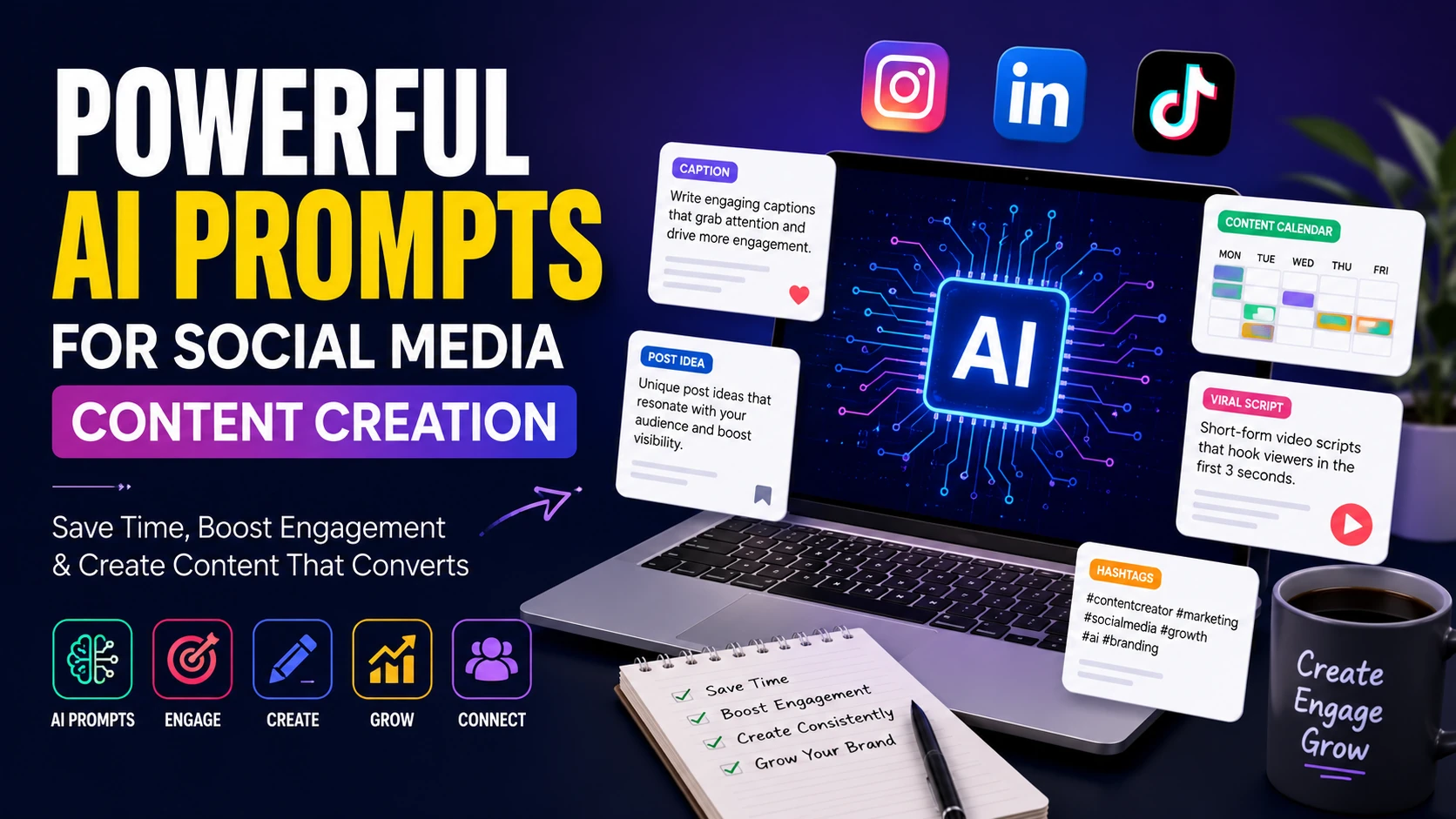
Table of Content
Table of Content
Introduction
Social media has become one of the most powerful marketing channels for businesses, creators, freelancers, and personal brands. Whether you are trying to grow an audience on Instagram, LinkedIn, Facebook, X (formerly Twitter), YouTube, or TikTok, consistently publishing valuable content is the key to long-term success.
The challenge is that creating high-quality social media posts every day requires creativity, time, and research. Many creators spend hours brainstorming ideas, writing captions, choosing hooks, and deciding on the right call to action. This process often leads to burnout and inconsistent posting schedules.
Artificial Intelligence has changed this workflow dramatically. Modern AI tools like ChatGPT, Claude, Gemini, and other large language models can help generate engaging content within minutes. However, the quality of AI-generated content depends almost entirely on the quality of the prompt you provide.
A simple instruction like:
"Write an Instagram caption."
will usually produce a generic result that sounds similar to thousands of other posts.
A detailed, well-structured prompt, on the other hand, gives AI enough context to generate unique, engaging, and audience-focused content that aligns with your brand voice.
This guide explores five carefully designed AI prompts that help marketers, business owners, influencers, and content creators produce better social media content without sacrificing quality. Each prompt can be customized for different industries and platforms, allowing you to save time while maintaining authenticity.
Why Good AI Prompts Matter
Many people believe AI is responsible for poor content quality. In reality, the problem usually lies in vague instructions.
Think of AI as a professional writer joining your marketing team. If you only say,
"Create a post."
the writer has almost no information about your audience, objectives, platform, or writing style.
Instead, if you specify:
- Target audience
- Platform
- Brand personality
- Goal
- Desired tone
- Content format
- Call to action
the AI has enough information to generate significantly better content.
A strong prompt transforms AI from a text generator into a creative marketing assistant capable of producing high-quality posts that resonate with your audience.
Benefits of Using AI for Social Media Content
Businesses of every size are now using AI to streamline their content workflows. Instead of replacing creativity, AI enhances it by handling repetitive tasks while allowing creators to focus on strategy and storytelling.
Some major benefits include:
Faster Content Creation
Instead of spending an hour writing a caption, AI can generate multiple high-quality variations in just a few minutes.
Improved Consistency
Posting consistently is one of the biggest challenges in social media marketing. AI helps maintain a steady publishing schedule by generating content ideas and complete posts whenever needed.
Better Engagement
Well-designed prompts encourage AI to include storytelling, emotional triggers, persuasive hooks, and stronger calls to action, leading to more engaging content.
Saves Creative Energy
Creators no longer need to start from a blank page every time. AI provides a solid first draft that can be refined into something unique.
Platform-Specific Optimization
Different social media platforms require different writing styles. AI can easily adapt the tone and structure for LinkedIn, Instagram, Facebook, TikTok, or X.
Common Mistakes When Writing AI Prompts
Before looking at the prompts themselves, it is important to understand why many AI-generated posts feel repetitive.
1. Giving Very Little Context
Bad Prompt:
Write a social media post.
Better Prompt:
Write an Instagram caption promoting an online fitness coaching program for beginners. Use an energetic tone, include a motivational hook, tell a short story, and end with a strong call to action encouraging users to join.
The second prompt provides clear direction, making the output much more relevant.
2. Ignoring the Target Audience
A post for college students should sound very different from one written for CEOs or business executives.
Always mention your intended audience.
Examples include:
- College students
- Small business owners
- Developers
- Freelancers
- Parents
- Fitness enthusiasts
- Marketing professionals
The more specific the audience, the better the AI can tailor its language and examples.
3. Forgetting the Platform
Every platform has unique expectations.
Instagram favors visually engaging captions with emotional storytelling.
LinkedIn performs well with professional insights and thoughtful discussions.
X rewards concise, impactful writing.
Facebook often benefits from conversational and community-focused posts.
Mentioning the platform helps AI generate content in the appropriate format.
4. Not Defining the Goal
Every post should serve a purpose.
Common goals include:
- Increase engagement
- Generate leads
- Build brand awareness
- Educate the audience
- Promote a product
- Increase website traffic
- Encourage newsletter signups
- Build authority
When AI understands the objective, it produces more strategic content instead of generic text.
Prompt 1: Generate High-Engagement Social Media Posts
One of the biggest challenges creators face is consistently producing engaging posts that encourage likes, comments, shares, and saves.
This prompt helps AI create platform-specific content with strong hooks, storytelling, emotional appeal, and effective calls to action.
Prompt
Act as an experienced social media strategist.

Create a high-engagement social media post for [platform].

Topic:
[Your topic]

Target audience:
[Audience]

Goal:
[Brand awareness, engagement, leads, website traffic, etc.]

Requirements:

Start with a powerful hook.

Use a conversational and human tone.

Include storytelling where appropriate.

Keep paragraphs short.

Provide value instead of obvious promotion.

End with an engaging call to action.

Suggest five relevant hashtags.

Generate three headline variations.
Why This Prompt Works
Unlike a generic instruction, this prompt clearly explains:
- Who the audience is
- What platform is being used
- What outcome is expected
- How the content should be structured
As a result, AI generates posts that feel more authentic and are significantly more engaging.
Example Use Case
Imagine a freelance web developer launching a new portfolio website.
Instead of writing:
"My website is live."
AI could produce something like:
Most websites don't lose customers because of poor products. They lose them because visitors don't trust what they see in the first five seconds.
After weeks of planning, designing, testing, and optimizing, I'm excited to launch my brand-new portfolio website.
Every page was built with speed, user experience, and clean design in mind because first impressions matter.
I'd love your honest feedback. Visit the site and tell me what you think in the comments.
This version tells a story, creates curiosity, and naturally invites engagement.
Best Practices
For even better results:
- Mention your niche.
- Specify your preferred writing style.
- Include your brand personality.
- Request multiple content variations.
- Ask AI to avoid clichés and repetitive phrases.
Prompt 2: Create Viral Instagram Captions
Instagram captions should do much more than describe a photo. A great caption captures attention, builds emotion, encourages interaction, and strengthens your brand identity.
This prompt helps AI create captions that are informative, relatable, and optimized for engagement without sounding robotic.
Prompt
You are an expert Instagram content creator.

Write an Instagram caption for:

Topic:
[Your topic]

Audience:
[Your audience]

Brand tone:
[Friendly, premium, humorous, educational, inspirational]

Requirements:

Start with an attention-grabbing first sentence.

Write naturally and conversationally.

Include a relatable story or insight.

Provide one actionable takeaway.

End with a question that encourages comments.

Include relevant emojis where appropriate.

Suggest ten niche-specific hashtags.

Keep the caption engaging without sounding salesy.
Why This Prompt Works
Instagram users often decide within the first few seconds whether to continue reading a caption. This prompt ensures that the opening line creates curiosity while the rest of the caption delivers genuine value instead of relying on clickbait.
It also encourages conversation by ending with a question, which can help increase comments and overall engagement. Additionally, specifying the brand tone allows the AI to match the personality of your business or personal brand, making the content feel more authentic and consistent across posts.
Prompt 3: Write Professional LinkedIn Thought Leadership Posts
LinkedIn is very different from platforms like Instagram or TikTok. Users visit LinkedIn to learn something new, discover industry trends, connect with professionals, and build their careers. Content that performs well on LinkedIn usually shares personal experiences, practical lessons, data-backed insights, or unique perspectives rather than promotional messages.
If your goal is to build authority in your industry, attract recruiters, generate B2B leads, or grow your professional network, this prompt can help you create thoughtful and engaging LinkedIn posts.
Prompt
Act as an experienced LinkedIn content strategist.

Create a professional LinkedIn post using the following information.

Topic:
[Topic]

Industry:
[Industry]

Target Audience:
[Audience]

Goal:
[Build authority, generate leads, educate, personal branding]

Requirements:

Start with an interesting hook.

Write in a professional but conversational tone.

Share practical insights and lessons.

Include a short personal story if appropriate.

Keep paragraphs short for LinkedIn readability.

End with a question that encourages discussion.

Include five relevant hashtags.
Why This Prompt Works
This prompt gives AI enough context to write content that feels authentic instead of promotional. It encourages storytelling, practical advice, and discussions—all of which perform well on LinkedIn.
Unlike generic AI outputs, the generated content is more likely to start conversations and position you as someone who shares valuable knowledge rather than someone who constantly promotes products or services.
Example Use Case
Suppose you recently completed a website redesign for a client.
Instead of posting:
"Completed another project."
AI could generate something like this:
Most website redesign projects fail because they focus only on appearance.
During my latest client project, I realized that performance optimization, accessibility, and user experience had a much bigger impact than visual changes alone.
By reducing unnecessary scripts and improving loading speed, the website became faster, easier to navigate, and more enjoyable for visitors.
Great design isn't just about how a website looks. It's about how people experience it.
What's one lesson you've learned while working on a recent project?
This type of content naturally encourages engagement while demonstrating expertise.
Customization Tips
You can improve results by mentioning:
- Your experience level
- Industry trends
- Statistics
- Real project examples
- Lessons learned
- Common misconceptions
- Practical advice
The more personal and specific the prompt becomes, the more authentic the generated content feels.
Prompt 4: Generate a Weekly Social Media Content Calendar
One of the biggest reasons businesses stop growing on social media is inconsistency. Posting only when inspiration strikes often leads to long gaps between posts and reduced audience engagement.
A structured content calendar helps maintain consistency while ensuring that different types of content are published throughout the week.
Instead of asking AI for individual posts every day, you can ask it to create an entire weekly content strategy in one prompt.
Prompt
Act as a professional social media content planner.

Create a seven-day content calendar.

Business:
[Business Name]

Industry:
[Industry]

Target Audience:
[Audience]

Platforms:
[List Platforms]

Goals:
[Increase followers, engagement, website traffic, leads]

For each day provide:

Content idea

Post format

Caption summary

Suggested call to action

Recommended hashtags

Best posting time

Content objective
Why This Prompt Works
Rather than producing random content ideas, this prompt builds a balanced posting schedule that includes educational, promotional, entertaining, and community-focused content.
A planned content calendar helps maintain audience interest while preventing repetitive posts.
Example Weekly Schedule
A technology company might receive suggestions like:
Monday
Industry Tip
Share one practical productivity technique.
Tuesday
Behind-the-Scenes
Show your development process.
Wednesday
Customer Success Story
Highlight a real client achievement.
Thursday
Educational Carousel
Explain an industry concept.
Friday
Trending Topic
Share your perspective on recent industry news.
Saturday
Interactive Poll
Ask followers about their biggest challenges.
Sunday
Weekly Reflection
Share lessons learned and encourage audience participation.
This balanced approach creates a healthier content mix instead of promoting products every day.
Additional Improvements
Ask AI to include:
- Seasonal campaigns
- Product launches
- Trending hashtags
- Industry events
- Holidays
- Awareness days
- User-generated content ideas
This makes the content calendar even more valuable.
Prompt 5: Create Viral Short-Form Video Scripts
Short-form videos have become one of the fastest-growing content formats across social media. Instagram Reels, YouTube Shorts, TikTok, and Facebook Reels reward videos that capture attention quickly and keep viewers watching until the end.
Creating these videos consistently can be challenging, especially when you need fresh ideas and engaging scripts. This prompt helps AI generate concise, high-retention video scripts that are easy to record and edit.
Prompt
You are a professional short-form video script writer.

Create a 60-second video script.

Topic:
[Topic]

Target Audience:
[Audience]

Platform:
[Instagram Reels, TikTok, YouTube Shorts]

Goal:
[Educate, entertain, generate leads, increase followers]

Requirements:

Begin with a strong hook within the first five seconds.

Use simple language.

Divide the script into clear scenes.

Include audience engagement questions.

End with a strong call to action.

Suggest an attention-grabbing title.

Recommend background visuals and on-screen text.
Why This Prompt Works
The first few seconds of a short-form video often determine whether viewers continue watching or scroll away. This prompt prioritizes a compelling opening while keeping the script concise and engaging.
It also requests visual suggestions and on-screen text, making the output easier to convert into a polished video without spending extra time brainstorming creative elements.
Example Use Case
Imagine you run a digital marketing agency and want to create a Reel about improving website conversions.
Instead of simply listing tips, AI might produce a script that starts with:
"Did you know most visitors decide whether to trust your website in less than five seconds?"
The script could then explain one practical improvement, such as optimizing page speed or simplifying navigation, before ending with a call to action like:
"Follow for more practical website growth tips."
This structure captures attention, delivers value, and encourages viewers to interact with your content.
Tips for Better Results
To make the scripts even more effective, consider adding details such as:
- Preferred video length (30, 45, or 60 seconds)
- Brand personality
- Speaking style (energetic, educational, storytelling, humorous)
- Desired pacing
- Target platform
- Keywords to include
- Products or services to mention naturally
- Visual style (minimal, cinematic, tutorial, vlog, infographic)
The more context you provide, the more tailored and engaging the final script will be.
How to Get Better Results from AI Prompts
Even the best prompts can be improved with additional context. Instead of using the same prompt repeatedly, customize it based on your audience, platform, and campaign objectives.
For example, you can ask AI to:
- Write in your brand's tone of voice.
- Include industry-specific examples.
- Avoid generic phrases and overused buzzwords.
- Use storytelling instead of direct promotion.
- Create multiple variations for A/B testing.
- Suggest captions optimized for different platforms.
- Include keyword-rich language for discoverability.
- Recommend hashtags based on your niche.
- Generate follow-up posts from the same topic.
- Adapt content for both organic posts and paid campaigns.
These refinements help transform AI from a simple writing assistant into a strategic content creation partner.
Advanced Techniques to Get Better Results from AI
Using a well-written prompt is only the beginning. The real advantage comes from refining the AI's output until it aligns perfectly with your brand voice and business goals. Professional marketers rarely accept the first response generated by AI. Instead, they treat AI as a collaborative writing partner, providing feedback and requesting revisions until the content feels natural and engaging.
Here are several advanced techniques you can use to improve the quality of AI-generated social media content.
1. Define Your Brand Voice
Every brand communicates differently. A technology company may use a professional and informative tone, while a lifestyle brand might sound casual and friendly.
When writing prompts, always mention your preferred tone. For example:
- Professional and authoritative
- Friendly and conversational
- Inspirational and motivational
- Humorous and entertaining
- Educational and informative
This simple addition helps AI create content that remains consistent across all your social media channels.
2. Ask for Multiple Variations
Instead of requesting a single caption or post, ask AI to generate three or five different versions. This gives you options to choose from and makes it easier to test which style performs best.
For example, you might ask for:
- One storytelling version
- One educational version
- One humorous version
- One promotional version
- One short and concise version
Comparing different approaches can help you discover what resonates most with your audience.
3. Include Real Experiences
AI-generated content becomes much more authentic when it includes real experiences or achievements.
Instead of saying:
Write a post about website development.
Provide context such as:
I recently completed a responsive e-commerce website that improved page speed by 40%. Write a LinkedIn post highlighting the lessons learned during the project.
Specific details make the content more credible and relatable.
4. Repurpose Content Across Platforms
One idea can be transformed into multiple pieces of content.
For example, a single blog post can become:
- An Instagram carousel
- A LinkedIn article
- An X (Twitter) thread
- A Facebook post
- A YouTube Shorts script
- An Instagram Reel
- A newsletter
- A Pinterest infographic
AI can help repurpose your existing content into different formats, allowing you to maximize the value of every piece you create.
5. Review Before Publishing
Although AI is an excellent writing assistant, it should not replace human judgment.
Before publishing, always check:
- Grammar and spelling
- Accuracy of facts
- Brand consistency
- Tone of voice
- Call to action
- Hashtags
- Platform-specific formatting
A quick review ensures that your content reflects your brand professionally and avoids potential errors.
Common Mistakes to Avoid
Even powerful prompts can produce average results if they're used incorrectly. Here are some common mistakes to watch out for.
Using Generic Prompts
A vague instruction like "Write a social media post" gives AI very little direction.
Instead, specify the platform, audience, objective, tone, and desired structure.
Ignoring Audience Needs
Content should always address the interests, challenges, or goals of your audience. Writing without considering who you're speaking to often results in low engagement.
Overusing AI Without Personalization
Publishing AI-generated content exactly as it is can make your posts feel generic. Add your own opinions, stories, and experiences to create a more authentic connection with your audience.
Focusing Only on Promotion
People follow social media accounts because they want entertainment, education, inspiration, or useful insights—not constant advertisements.
A healthy content strategy balances promotional posts with valuable educational and engaging content.
Not Measuring Performance
Track metrics such as:
- Reach
- Impressions
- Engagement rate
- Saves
- Shares
- Comments
- Website clicks
- Conversion rate
These insights help you understand what content works best and refine your future prompts accordingly.
Final Thoughts
Artificial Intelligence has transformed the way individuals and businesses create social media content. Instead of spending hours brainstorming ideas, writing captions, or planning weekly schedules, creators can use thoughtfully designed prompts to streamline the entire process.
However, the true value of AI doesn't come from generating content faster—it comes from generating better content. Well-crafted prompts provide the context AI needs to create posts that educate, inspire, entertain, and encourage meaningful engagement.
The five prompts shared in this guide cover some of the most common social media tasks, including high-engagement posts, Instagram captions, LinkedIn thought leadership, content calendars, and short-form video scripts. By customizing these prompts with your brand voice, audience, and goals, you can produce content that feels authentic rather than automated.
Remember that AI is most effective when it works alongside human creativity. Combine AI-generated drafts with your own experiences, insights, and personality to build trust with your audience. Over time, this approach will help you create a consistent content strategy, strengthen your online presence, and achieve sustainable growth across multiple social media platforms.
Whether you're a freelancer, entrepreneur, marketer, business owner, or content creator, investing time in writing better prompts will significantly improve the quality of your social media content and save countless hours in your content creation workflow.
Frequently Asked Questions (FAQs)
1. Can AI completely replace human social media content creators?
No. AI is an excellent assistant for brainstorming ideas, drafting captions, planning content calendars, and improving productivity. However, human creativity, personal experiences, strategic thinking, and emotional understanding are still essential for building authentic relationships with an audience. The best results come from combining AI efficiency with human expertise.
2. Which AI tool is best for creating social media content?
Several AI tools are effective, including ChatGPT, Claude, Google Gemini, and Microsoft Copilot. The right choice depends on your workflow and preferences. Regardless of the tool you use, the quality of the prompt plays a major role in determining the quality of the final output.
3. How can I make AI-generated social media posts sound more natural?
Provide detailed context in your prompts, define your brand voice, specify your target audience, and include real examples or experiences. After generating the content, edit it by adding your own opinions, stories, and personality to make it feel more authentic and engaging.
4. Can these prompts be used for different social media platforms?
Yes. The prompts in this guide are flexible and can be customized for platforms such as Instagram, LinkedIn, Facebook, X (formerly Twitter), TikTok, YouTube Shorts, Pinterest, and Threads. Simply mention the platform in your prompt so the AI can adjust the format, tone, and style accordingly.
5. Why are detailed AI prompts more effective than simple prompts?
Detailed prompts provide AI with important information such as the audience, platform, goal, tone, content structure, and desired outcome. This allows the AI to generate more accurate, engaging, and high-quality content that aligns with your objectives instead of producing generic responses.