
Cybersecurity Mesh & AI in Security: Complete Guide to Modern Cyber Defense
how Cybersecurity Mesh and Artificial Intelligence are transforming modern cyber defense through distributed security, AI-powered threat detection, Zero Trust, behavioral analytics, automated incident response, and stronger protection for cloud environments.

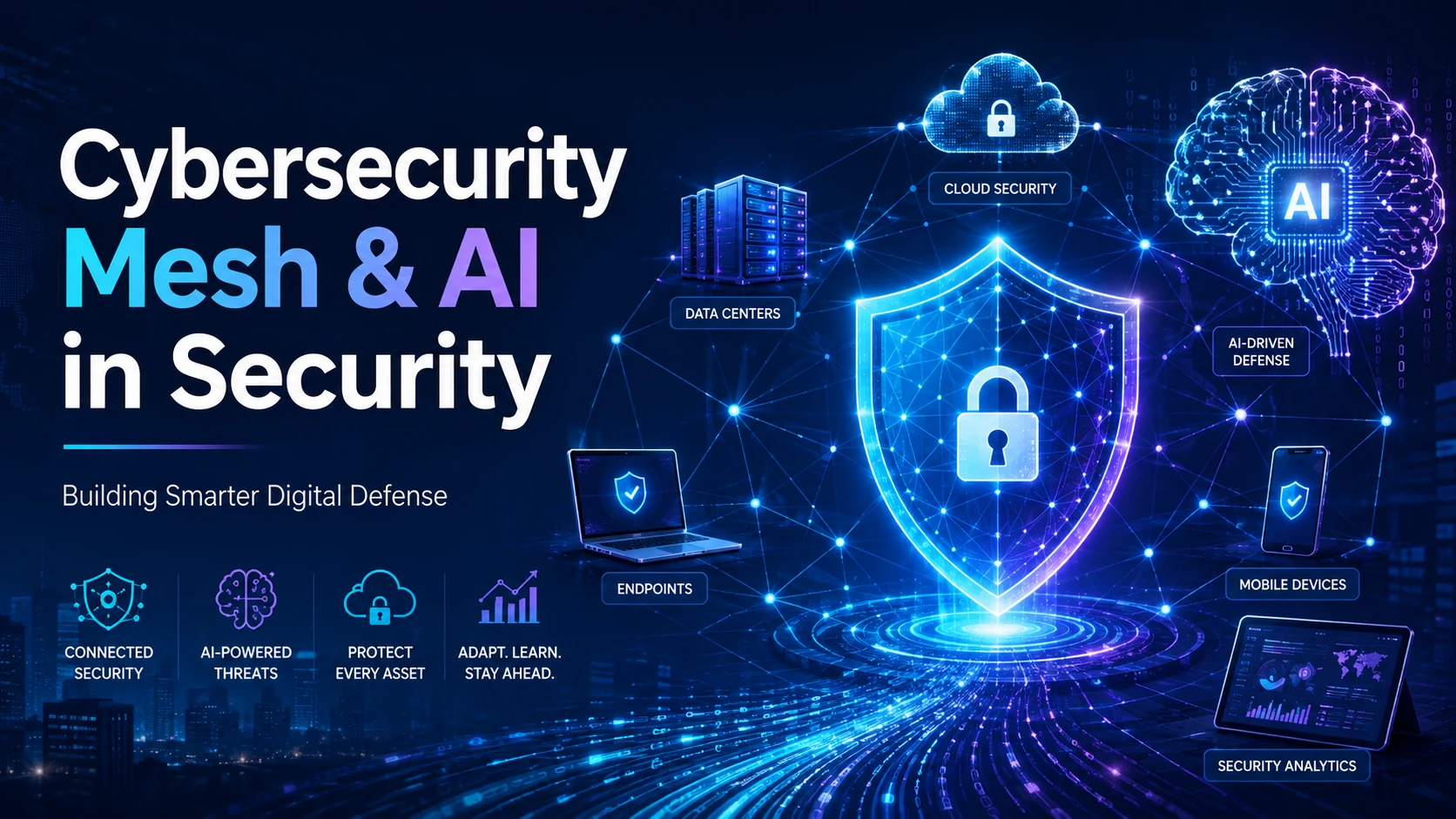
Table of Content
Table of Content
Cybersecurity is no longer about putting a strong firewall around an office network and assuming everything inside is safe.
Modern organizations operate very differently. Employees work from home, applications run across multiple cloud platforms, teams use dozens of SaaS services, mobile devices access company data, APIs connect business systems, and AI-powered tools are becoming part of everyday workflows.
Because of this shift, the traditional idea of a single security perimeter is becoming less effective.
A company might have its website hosted on one cloud provider, customer data stored somewhere else, employees using Microsoft 365 or Google Workspace, developers accessing GitHub, and customers connecting from different countries. Security teams somehow have to protect all of these systems without slowing the business down.
This is where Cybersecurity Mesh Architecture (CSMA) becomes useful.
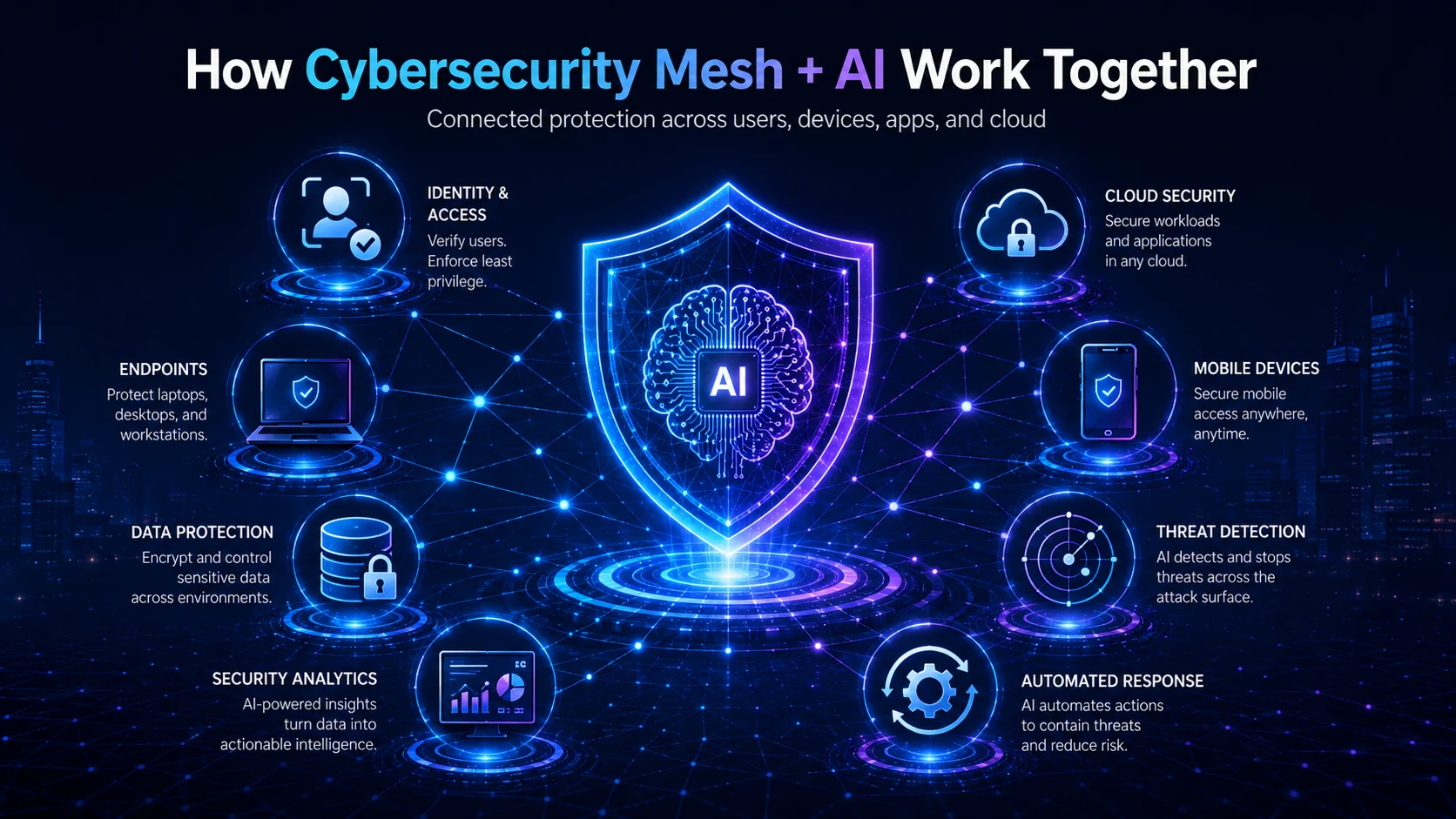
Cybersecurity Mesh is an approach that brings different security controls together so that users, devices, applications, cloud resources, APIs, and data can be protected wherever they exist. Artificial Intelligence makes this architecture even more powerful by helping organizations analyze huge amounts of security data, recognize unusual activity, prioritize threats, and automate parts of the response process.
Together, Cybersecurity Mesh and AI in security represent an important direction for modern cyber defense.
What Is Cybersecurity Mesh?
Cybersecurity Mesh is a distributed approach to cybersecurity.
Instead of building security around one corporate network, protection is placed closer to the individual resources that need it. Those resources may include employees, devices, databases, applications, cloud workloads, APIs, or servers.
Imagine a large organization using:
- AWS for its customer-facing application
- Microsoft Azure for internal business systems
- Google Workspace for employees
- GitHub for development
- Several SaaS applications
- Employee laptops and smartphones
- APIs connecting different services
Traditional security tools might protect each environment separately.
The problem is that an attacker rarely stays inside just one system.
A stolen employee account could be used to access email, reset another password, reach a cloud dashboard, obtain an API credential, and eventually access sensitive business data.
If every security system works independently, security teams may receive several unrelated alerts without immediately realizing that they are part of the same attack.
Cybersecurity Mesh aims to make these security systems work together.
For example, if endpoint protection detects suspicious activity on an employee's laptop, that information could automatically influence the company's identity platform. Access to sensitive applications could be restricted, additional authentication could be required, and the security operations team could receive a correlated incident rather than several disconnected alerts.
The real value of cybersecurity mesh is therefore not simply adding more security tools. It is creating better coordination between existing security capabilities.
Why Traditional Network Security Is Becoming Less Effective
For many years, cybersecurity followed a simple model: keep trusted systems inside the network and block suspicious activity coming from outside.
That model made sense when employees worked from offices and applications were hosted inside company-owned data centers.
Today, those boundaries are much harder to define.
A remote employee might access a cloud application from a personal internet connection. A developer might manage infrastructure through a browser. A mobile application may communicate directly with cloud APIs. A third-party contractor might require temporary access to business systems.
Network location alone can no longer determine whether someone should be trusted.
This is one reason modern security strategies increasingly focus on identities, devices, resources, and context rather than simply asking whether someone is "inside the network."
This approach is closely connected with Zero Trust Security.
NIST describes zero trust as a model where no implicit trust is given solely because a user or device is inside a particular network. Authentication and authorization should happen before access to enterprise resources is established.
Cybersecurity Mesh can help organizations apply these ideas across different environments.
How Cybersecurity Mesh Works
Cybersecurity Mesh should not be understood as one product that you install.
It is an architecture where different security technologies share information, apply consistent policies, and respond together.
Several layers are especially important.
1. Identity and Access Management
Identity has become one of the most important security boundaries.
Organizations need to know exactly who or what is requesting access.
That identity might belong to:
- An employee
- Administrator
- Customer
- Mobile device
- Server
- Cloud workload
- API
- Software service
- AI agent
Access should then be provided according to the actual requirement.
For example, a customer-support employee may need access to customer tickets but should not automatically receive database administrator permissions.
This principle of providing only the access that is actually required is known as least privilege.
Cybersecurity Mesh makes identity information available to different security systems so that access decisions can consider more than a username and password.
2. Security Analytics and Monitoring
Modern businesses generate huge amounts of security information every day.
Logs can come from cloud platforms, servers, laptops, applications, network equipment, authentication systems, APIs, databases, and security tools.
A typical security environment may monitor events such as login attempts, file downloads, application access, privilege changes, malware detections, unusual network connections, and cloud configuration changes.
Individually, many of these events may look harmless.
The challenge is connecting them.
Suppose an employee logs in from a new laptop. That alone may not be dangerous.
But what happens if the same account then accesses an unusual application, downloads thousands of files, changes account permissions, and attempts to connect to an administrative service?
Those events together become much more suspicious.
This is an area where Artificial Intelligence becomes extremely useful.
How Artificial Intelligence Is Changing Cybersecurity
Cybersecurity teams face a serious data problem.
Security products can generate thousands or even millions of events. Human analysts cannot manually investigate every login, network connection, file modification, or cloud request.
Artificial Intelligence can process these signals at a much larger scale.
AI can help security teams identify patterns, find abnormal behavior, prioritize alerts, and investigate incidents faster.
Common applications of AI in cybersecurity include:
- Threat detection
- User behavior analysis
- Phishing detection
- Malware analysis
- Fraud detection
- Alert prioritization
- Threat intelligence analysis
- Automated response
- Vulnerability management
AI does not necessarily replace cybersecurity professionals.
Instead, its most valuable role is often helping professionals process information faster and focus their attention on situations that actually require human judgment.
AI-Powered Behavioral Threat Detection
Traditional security systems often depend heavily on predefined rules and known attack signatures.
For example, antivirus software may recognize malware because it matches a known malicious signature.
That approach remains useful, but attackers constantly create new techniques.
AI-based behavioral systems can look for activity that is unusual even when it does not match a previously known attack.
Imagine an employee who normally:
- Logs in between 9 AM and 6 PM
- Uses the same company laptop
- Accesses five specific applications
- Downloads fewer than 50 files per day
One night, the account suddenly logs in at 2:30 AM from a new device.
Shortly afterward, it attempts to open administrative tools and downloads 8,000 files.
A traditional authentication system may see a successful password and consider the login valid.
A behavioral system sees something very different.
It recognizes that the activity does not match the user's normal behavior and can increase the risk level of the session.
This type of analysis is commonly associated with User and Entity Behavior Analytics (UEBA).
Within a cybersecurity mesh, that risk information could be shared with multiple security controls immediately.
AI Can Help Reduce Alert Fatigue
One of the biggest problems inside security operations centers is alert fatigue.
Security tools generate warnings continuously.
A security analyst might receive alerts about failed authentication attempts, unusual IP addresses, suspicious emails, malware detections, cloud configuration changes, blocked network traffic, and dozens of other events.
The problem is that not every alert represents a serious attack.
If analysts spend most of their time investigating low-risk events, they may miss something genuinely dangerous.
AI can help prioritize incidents by examining additional context.
For example, an AI-driven security system might evaluate:
- How important the affected asset is
- Whether the account has administrator privileges
- Whether similar activity happened before
- Whether the IP address has a malicious reputation
- Whether the device is managed by the company
- Whether another security system generated a related alert
- Whether sensitive information was accessed
An unusual login on a testing account may receive a moderate risk score.
The same login behavior involving a global administrator account connected to production infrastructure could receive a critical score.
This allows security teams to focus on the incidents that could have the greatest impact.
Cybersecurity Mesh and Automated Incident Response
Fast detection is valuable, but fast response is equally important.
If attackers gain access to a system, every additional minute can give them more time to move deeper into the environment.
Security orchestration combined with AI can automate parts of the response process.
For example, when an account appears compromised, a connected security architecture might automatically:
- Revoke active login sessions
- Require additional authentication
- Block access to sensitive resources
- Isolate an infected device
- Disable a suspicious API token
- Block a malicious domain or IP
- Preserve logs for investigation
- Create an incident ticket
However, full automation should be used carefully.
AI can make incorrect decisions.
If an automated system mistakenly disables an important production administrator account or shuts down a business-critical server, the response itself could cause serious disruption.
A practical strategy is to automate low-risk defensive actions while requiring human approval for high-impact decisions.
For example, increasing monitoring or requesting MFA might happen automatically, while shutting down a production system may require approval from a security analyst.
Cybersecurity Mesh in Multi-Cloud Environments
Cloud computing makes security significantly more complicated.
A company may use several cloud providers at the same time.
One application may run on AWS while another runs on Azure. Data analytics could happen on Google Cloud, while employees rely on several external SaaS services.
Every platform can have different:
- Permission systems
- Security tools
- Logging formats
- Configuration settings
- Identity mechanisms
This makes consistent security difficult.
NIST's guidance for zero trust in cloud-native multi-cloud environments highlights a shift away from relying primarily on IP addresses, network segments, and traditional perimeters toward identities for users, applications, and services.
A Cybersecurity Mesh approach supports this by connecting security policies across environments.
Instead of treating every cloud platform as a separate world, organizations can work toward common identity, monitoring, access, and response policies.
AI can then analyze activity across those environments.
An attacker moving between cloud services may appear normal when each event is viewed separately. When the information is combined, the attack pattern becomes much easier to recognize.
AI Agents Are Creating a New Security Challenge
The rapid growth of AI is introducing another type of identity that organizations need to secure: the AI agent.
AI agents can do more than generate text.
Depending on how they are designed, they may interact with company databases, APIs, internal documentation, code repositories, customer systems, cloud environments, or business applications.
That creates a serious security question.
How much access should an AI agent receive?
An organization should not simply give an AI agent unlimited permissions because it is operating on behalf of an employee.
AI agents should ideally have:
- Individual identities
- Clearly defined permissions
- Limited access scopes
- Activity logs
- Approval requirements
- Rate limits
- Security monitoring
For example, an AI customer-support agent may need permission to read order information but should not automatically receive the ability to export an entire customer database.
Cybersecurity Mesh can help organizations apply similar identity and access policies to humans, applications, services, and autonomous AI systems.
AI Is Also Being Used by Cybercriminals
Artificial Intelligence benefits defenders, but attackers can also use it.
Generative AI can make certain cybercrime activities faster and easier.
Attackers may use AI to assist with phishing messages, social engineering, target research, malicious code modification, or large-scale scam campaigns.
A phishing email written several years ago might have contained obvious grammar mistakes.
Modern AI-generated phishing content can look much more natural.
Attackers can potentially personalize messages using publicly available information about a company or employee.
This makes employee awareness and technical security controls even more important.
Organizations increasingly need systems capable of examining not only the content of a message but also sender reputation, destination links, authentication information, communication patterns, and user behavior.
Protecting AI Systems Is Just as Important
There are really two sides to AI cybersecurity:
AI for security means using AI to defend systems.
Security for AI means protecting AI applications themselves.
Organizations deploying generative AI applications need to consider threats such as prompt injection, sensitive-data leakage, insecure integrations, excessive permissions, unauthorized model access, and manipulation of tools connected to AI agents.
Consider an AI assistant connected to an internal database.
If that assistant has unrestricted database permissions, a malicious input could potentially cause it to expose information that the user should never receive.
AI systems therefore need the same security principles applied to other enterprise technologies.
These include authentication, authorization, monitoring, input validation, access control, logging, encryption, and least privilege.
NIST's AI Risk Management Framework provides a broader structure for organizations managing risks created by AI systems. NIST also released a Generative AI Profile in July 2024 and, as of 2026, continues work around updated AI-risk guidance and AI use in critical infrastructure.
A Real-World Cybersecurity Mesh Example
Imagine an e-commerce company with hundreds of employees.
Its infrastructure includes a cloud-hosted website, payment services, customer databases, employee laptops, GitHub repositories, internal applications, APIs, and remote workers.
One developer accidentally enters their credentials into a phishing website.
The attacker now has the correct username and password.
At 1 AM, the attacker logs into the developer account from an unfamiliar device.
With a traditional setup, successful credentials might initially allow access.
A Cybersecurity Mesh supported by AI could evaluate the situation differently.
The identity system notices a new device and unusual login time. Behavioral analytics identifies activity that differs from the developer's normal behavior. Cloud monitoring observes requests for sensitive resources. Endpoint security cannot verify the device as company managed.
AI correlates these signals and raises the risk score.
The system could then automatically require stronger authentication, revoke suspicious sessions, restrict access to production resources, and alert the security team.
Instead of waiting for an employee to manually connect four different alerts, the organization receives a single, high-priority security incident.
That is the practical value of combining Cybersecurity Mesh with AI.
Benefits of Cybersecurity Mesh and AI
When implemented properly, combining Cybersecurity Mesh with Artificial Intelligence can provide several important benefits.
Faster Threat Detection
AI can analyze security activity continuously and identify abnormal behavior sooner.
Better Visibility
Cybersecurity Mesh connects information from different systems, giving security teams a broader view of attacks.
Stronger Identity Security
Security decisions can consider identity, device status, location, behavior, and resource sensitivity instead of relying only on passwords.
Reduced Manual Work
AI and automation can process repetitive alerts and perform basic response actions.
Better Protection for Distributed Businesses
Cloud resources, remote employees, SaaS platforms, APIs, and devices can be protected using more consistent policies.
Improved Incident Response
Security tools can work together instead of forcing analysts to manually move between multiple dashboards.
Challenges of Implementing Cybersecurity Mesh
Cybersecurity Mesh is powerful, but implementing it is not always easy.
One major challenge is integration.
Organizations may already have dozens of security products from different vendors. These platforms do not always communicate smoothly.
Another challenge is data quality.
Artificial Intelligence is only useful when it receives reliable security information. Missing logs, incorrect configurations, or incomplete identity data can produce inaccurate conclusions.
Companies must also consider privacy.
AI-based behavioral monitoring may collect significant amounts of employee and customer activity. Organizations need clear data-handling policies and appropriate legal and privacy controls.
Cost and technical complexity can also be important, particularly for smaller organizations.
Companies should therefore avoid implementing cybersecurity mesh simply because it is a popular term.
The architecture should solve real security problems.
How Organizations Can Start Building a Cybersecurity Mesh
Organizations do not need to replace their entire security infrastructure.
A gradual approach is usually more practical.
Start by identifying critical users, applications, data, cloud resources, and devices.
Next, establish strong identity management. Multi-factor authentication, least-privilege permissions, privileged access management, and good account lifecycle processes create an important foundation.
Security teams should then improve visibility by collecting logs from critical systems.
After basic visibility is established, organizations can begin integrating their identity, endpoint, cloud, network, and security monitoring tools.
AI should be introduced where it produces measurable value rather than simply being added everywhere.
Good starting points include behavioral analytics, alert correlation, phishing detection, and incident prioritization.
Finally, automation should be introduced gradually.
High-confidence, low-impact actions can be automated first. More sensitive responses should remain under human supervision.
Will AI Replace Cybersecurity Professionals?
AI will automate more security work, but cybersecurity professionals will continue to play an important role.
Cybersecurity involves decisions that require context, experience, creativity, and business understanding.
AI may identify suspicious behavior, but a human analyst may still need to determine why the behavior occurred and whether it represents a real attack.
Security professionals will increasingly work with AI rather than against it.
Their work may shift away from manually reviewing thousands of individual alerts toward investigating complex incidents, designing security architecture, validating AI decisions, performing threat hunting, managing risk, and building stronger security strategies.
Professionals who understand both cybersecurity fundamentals and AI-enabled security tools are likely to become increasingly valuable.
The Future of Cybersecurity Mesh and AI
The future of cybersecurity is likely to become more distributed and more automated.
Organizations will continue moving applications and data into cloud environments. Remote access will remain common. APIs will connect more systems, IoT devices will continue expanding, and AI agents will begin performing increasingly complex business tasks.
Security systems therefore need to become more context-aware.
Instead of asking only:
"Is this password correct?"
Modern security will increasingly ask:
"Is this user, device, application, or AI agent behaving normally, and should it be allowed to perform this specific action right now?"
Cybersecurity Mesh provides the architecture for connecting those decisions across distributed environments.
Artificial Intelligence provides the ability to analyze enormous volumes of security information and recognize patterns much faster.
Neither technology is a complete cybersecurity solution by itself.
However, together they can help organizations build security systems that are faster, smarter, more adaptive, and better suited to modern digital environments.
Conclusion
Cybersecurity Mesh represents an important shift away from the idea that security can be built around one fixed network perimeter.
Modern organizations operate across cloud platforms, remote devices, applications, APIs, SaaS services, and increasingly AI-powered systems. Security therefore needs to follow users and resources wherever they are located.
Artificial Intelligence strengthens this approach by helping organizations understand massive amounts of security information.
AI can identify suspicious behavior, correlate alerts, prioritize threats, detect anomalies, and automate parts of incident response.
But organizations should not treat AI as a replacement for strong security architecture.
AI still requires good data, proper access controls, monitoring, human oversight, and clearly defined security policies.
The strongest future security model is likely to combine distributed security controls, Zero Trust principles, strong identity management, Artificial Intelligence, automation, and skilled human security professionals.
Cyber threats will continue evolving.
Security architecture needs to evolve with them.
Frequently Asked Questions
1. What is Cybersecurity Mesh in simple terms?
Cybersecurity Mesh is a security approach that protects individual users, devices, applications, APIs, cloud workloads, and data instead of depending on one traditional network boundary. Different security systems share information so that threats can be identified and handled more effectively.
2. How is AI used in cybersecurity?
AI is used to analyze security data, identify unusual behavior, detect phishing and malware, prioritize alerts, calculate risk, investigate threats, and automate certain incident-response activities. It is especially useful when organizations generate more security data than human analysts can review manually.
3. Is Cybersecurity Mesh the same as Zero Trust?
No. They are related but not identical. Zero Trust is based on continuously verifying access rather than automatically trusting users because of their network location. Cybersecurity Mesh is a broader architectural approach that connects distributed security capabilities. A cybersecurity mesh can help organizations implement Zero Trust principles across different systems.
4. Can AI completely replace cybersecurity professionals?
No. AI can automate repetitive work and assist with threat detection, but human cybersecurity professionals are still required for investigation, security strategy, architecture, risk decisions, incident management, and validation of automated decisions. AI is more effective as a tool that supports security teams rather than replacing them.
5. What is the biggest benefit of combining Cybersecurity Mesh with AI?
The biggest benefit is better coordination and faster decision-making. Cybersecurity Mesh collects and connects security information from different environments, while AI helps analyze that information and identify threats. Together, they can detect attacks faster and help organizations respond before significant damage occurs.