
5 AI Prompts to Assist with Research Paper Writing
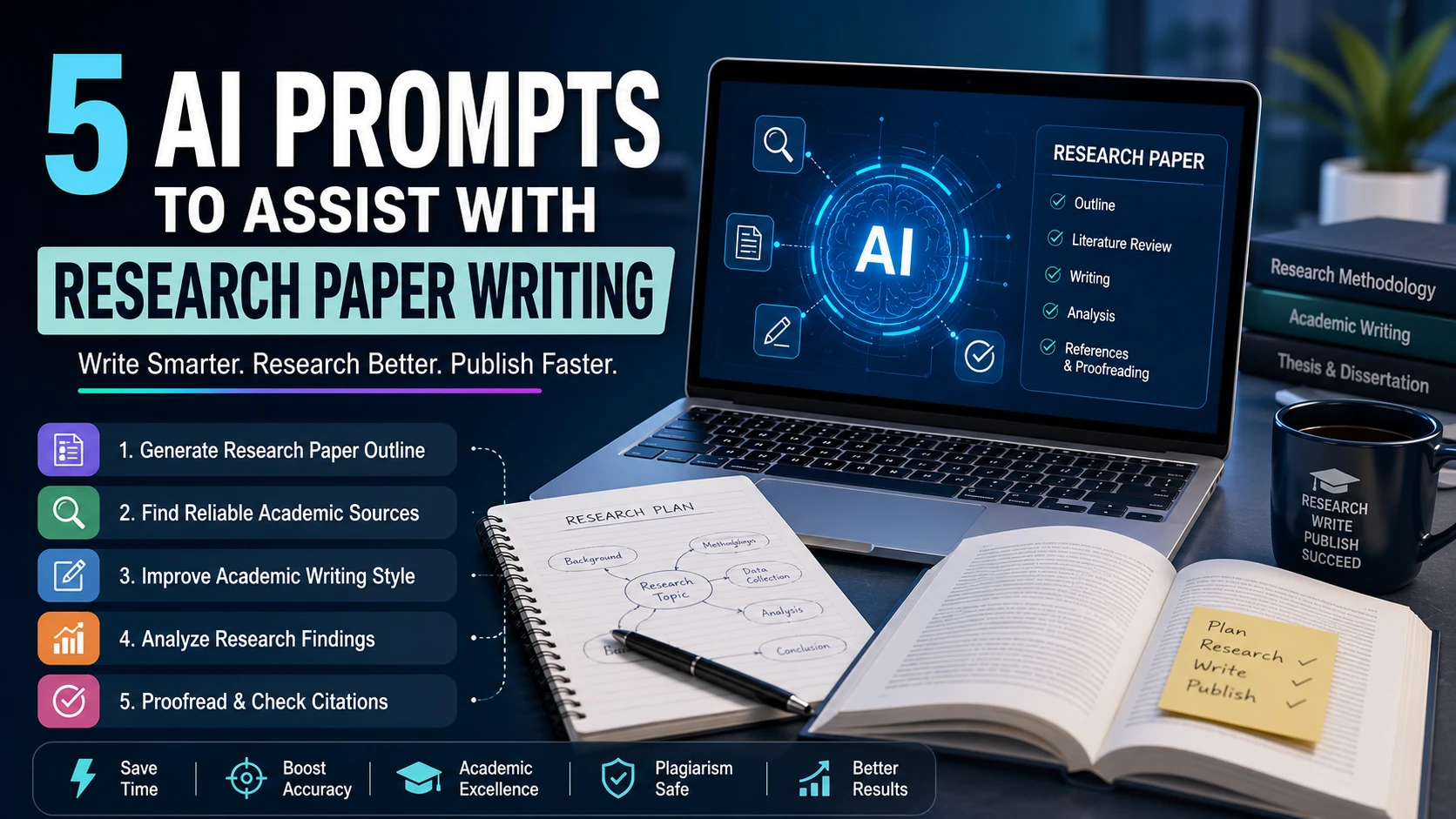
Table of Content
Table of Content
Writing a research paper is one of the most challenging tasks for students, researchers, educators, and professionals. It requires extensive reading, critical thinking, careful planning, proper citations, and the ability to present ideas in a logical and academically acceptable format. Whether you are preparing a university assignment, a master's thesis, a PhD dissertation, or a journal article, the process can often feel overwhelming.
Artificial Intelligence has transformed the way researchers work. Modern AI assistants can help organize ideas, summarize complex information, improve writing quality, identify research gaps, generate structured outlines, and even assist with proofreading. However, the quality of AI-generated output depends heavily on the instructions you provide. A vague prompt usually leads to generic responses, while a well-crafted prompt produces detailed, accurate, and useful results.
That is why prompt engineering has become an essential skill for students and researchers. Instead of spending hours rewriting prompts or correcting incomplete responses, you can use carefully designed prompts that guide AI toward generating high-quality academic content.
In this guide, you will discover five powerful AI prompts specifically created for research paper writing. These prompts are suitable for undergraduate students, postgraduate researchers, PhD scholars, educators, and professionals working on academic publications. Each prompt has been designed to improve productivity while maintaining academic integrity and encouraging original thinking.
Remember that AI should be used as a research assistant not as a replacement for your own analysis, critical thinking, or ethical research practices. Always verify information, cite original sources, and follow your institution's academic guidelines.
Why AI Is Useful for Research Paper Writing
Research paper writing involves multiple stages, and AI can provide valuable support during almost every step of the process.
Faster Research Planning
Many students struggle with deciding where to begin. AI can generate structured outlines, identify major research themes, suggest relevant subtopics, and organize ideas into a logical framework. This helps researchers spend less time planning and more time conducting meaningful research.
Better Literature Review Preparation
Finding relevant academic studies often requires searching through hundreds of research papers. AI can help summarize scholarly articles, identify recurring themes, compare research findings, and highlight areas where additional research is needed. While researchers should always verify information using trusted databases such as Google Scholar or institutional libraries, AI can significantly speed up the review process.
Improved Academic Writing
Academic writing requires clarity, precision, and a formal tone. AI can improve sentence structure, remove grammatical errors, reduce repetition, and enhance readability while maintaining the original meaning of your work.
Stronger Organization
A well-organized research paper follows a logical progression from introduction to conclusion. AI can recommend improved transitions, section structures, and content flow, making papers easier to understand.
Enhanced Productivity
Instead of spending hours formatting paragraphs or brainstorming section ideas, researchers can use AI to automate repetitive tasks and focus on analysis, experimentation, and original contributions.
Better Proofreading
Before submission, AI can identify grammar mistakes, awkward wording, punctuation errors, inconsistent terminology, and formatting issues that might otherwise be overlooked.
Ethical Research Support
When used responsibly, AI supports learning rather than replacing it. Researchers remain responsible for verifying facts, avoiding plagiarism, citing sources correctly, and ensuring the originality of their work.
Prompt 1: Generate a Complete Research Paper Outline
One of the biggest challenges researchers face is structuring a paper effectively. A strong outline serves as the blueprint for the entire project, ensuring that ideas flow logically and that no essential sections are overlooked.
This prompt helps AI create a comprehensive academic outline before writing begins.
AI Prompt
Act as an experienced academic researcher and university professor.

Help me create a detailed research paper outline on the following topic:

[Insert Research Topic]

Include:

• A compelling research title
• Abstract structure
• Introduction
• Background information
• Problem statement
• Research objectives
• Research questions
• Literature review headings
• Research methodology
• Data collection methods
• Data analysis approach
• Expected findings
• Discussion structure
• Conclusion
• Future research recommendations
• References section

The outline should follow academic standards and be suitable for publication in a university research paper.
Why This Prompt Works
Unlike simple prompts such as "Write an outline," this version clearly specifies every major section expected in an academic paper. By defining the required structure, AI is more likely to produce a complete and organized response that aligns with university standards.
This prompt is particularly useful when starting a new research project because it provides a roadmap before any writing begins.
Example Use Case
Imagine you are researching:
"The Impact of Artificial Intelligence on Higher Education."
Instead of wondering how to organize your paper, AI can generate a logical structure that includes the introduction, literature review, methodology, expected outcomes, and conclusion. You can then customize each section based on your own research and findings.
Pro Tip
After receiving the outline, ask AI follow-up questions such as:
- Expand the literature review section.
- Suggest additional research questions.
- Recommend suitable research methods.
- Identify possible limitations.
- Improve the research objectives.
Using AI iteratively often produces better results than requesting everything in a single prompt.
Prompt 2: Find Reliable Academic Sources
Finding trustworthy references is one of the most time-consuming parts of research. While AI should never replace academic databases, it can help researchers identify relevant authors, journals, keywords, and foundational studies that deserve further investigation.
This prompt is designed to guide AI toward suggesting credible academic resources instead of generic websites.
AI Prompt
Act as an academic research librarian.

Help me find reliable scholarly resources for the following research topic:

[Insert Topic]

For each recommendation include:

• Author(s)
• Publication year
• Research objective
• Key findings
• Why this source is important
• Suggested keywords for Google Scholar
• Related research topics
• Recommended journals for further reading

Only recommend credible academic books, peer-reviewed journals, conference papers, government reports, and recognized institutional publications.

Avoid blogs, opinion articles, and unreliable websites.
Why This Prompt Works
Many AI prompts simply ask for "sources," which can result in incomplete or unreliable recommendations. This prompt encourages AI to focus on scholarly material and provide additional context for each suggested resource.
Instead of just listing references, AI explains why each source matters, making it easier to prioritize reading and understand its relevance to your topic.
Example Scenario
Suppose your research topic is:
"Cybersecurity Challenges in Cloud Computing."
The AI may recommend exploring studies on cloud security models, data encryption, identity management, zero-trust architecture, and regulatory compliance. It can also suggest keywords such as:
- Cloud Security
- Zero Trust Architecture
- Data Encryption
- Identity Access Management
- Multi-Factor Authentication
- Secure Cloud Infrastructure
- Cyber Risk Management
These keywords can then be used in academic search engines like Google Scholar, IEEE Xplore, SpringerLink, ACM Digital Library, or institutional databases to locate original peer-reviewed research.
Best Practices
Whenever AI recommends a paper or author:
- Verify that the publication actually exists.
- Read the original research paper instead of relying solely on AI summaries.
- Cross-check publication dates, author names, and journal information.
- Prefer recent studies for rapidly evolving fields such as AI, blockchain, cybersecurity, and cloud computing.
- Use reference management tools like Zotero, Mendeley, or EndNote to organize your sources efficiently.
A strong literature review is built on verified academic evidence, and AI should serve as a guide rather than the final authority.
Prompt 3: Improve Academic Writing Style
One of the biggest differences between an average research paper and an excellent one is the quality of its writing. Even if your research is strong, unclear sentences, informal language, grammatical mistakes, or repetitive wording can reduce the overall impact of your paper.
Academic writing should be formal, concise, objective, and easy to understand. AI can help refine your writing without changing the meaning of your work, making your paper more professional and publication-ready.
This prompt is ideal for improving drafts after you've written the first version of your paper.
AI Prompt
Act as an experienced academic editor and university professor.

Review the following research paper section and improve it by:

• Using a formal academic tone
• Correcting grammar and punctuation
• Improving sentence structure
• Increasing clarity and readability
• Removing repetitive phrases
• Improving logical flow
• Strengthening academic vocabulary
• Maintaining the original meaning

Do not invent new information or change the research findings.

Text:

[Paste Your Paragraph Here]
Why This Prompt Works
Many students simply ask AI to "rewrite this paragraph," which often changes the original meaning or introduces unsupported claims.
This prompt specifically instructs AI to preserve your ideas while improving writing quality. As a result, the revised content becomes more suitable for journals, dissertations, and university submissions.
Example Use Case
Imagine your original paragraph is:
AI helps students write research papers faster because it provides ideas and improves grammar.
After using this prompt, AI might produce something like:
Artificial Intelligence enhances the research writing process by assisting students with idea generation, improving grammatical accuracy, and refining the overall clarity of academic content. When used responsibly, AI serves as a valuable research assistant while preserving the importance of independent critical thinking.
Notice how the second version is more formal, detailed, and suitable for academic writing without changing the original message.
Best Practices
To get the best results:
- Edit one section at a time instead of the entire paper.
- Ask AI to explain significant changes if you're unsure why they were made.
- Read the revised version carefully before accepting every suggestion.
- Keep your own writing style while improving readability.
- Ensure that AI does not accidentally introduce unsupported facts or references.
Prompt 4: Analyze Research Findings
Collecting data is only one part of the research process. The real value comes from interpreting the results and explaining what they mean.
Many researchers struggle to identify patterns, compare findings, discuss limitations, or connect results with previous studies.
AI can help organize observations and suggest possible interpretations while leaving the final conclusions to the researcher.
AI Prompt
Act as an experienced research analyst.

Analyze the following research findings.

Provide:

• Summary of the results
• Major patterns and trends
• Significant observations
• Possible explanations
• Comparison with existing research
• Practical implications
• Research limitations
• Suggestions for future research

Do not fabricate data or unsupported conclusions.

Research Findings:

[Paste Your Data Here]
Why This Prompt Works
Instead of simply summarizing data, this prompt encourages AI to think like a research analyst.
It helps researchers:
- Identify hidden trends
- Explain unusual results
- Compare findings with previous studies
- Suggest practical applications
- Highlight research limitations
This saves considerable time during the discussion section of a research paper.
Example Scenario
Suppose your research shows that students using AI-assisted learning platforms scored significantly higher than those using traditional study methods.
Rather than merely stating this result, AI can help explain possible reasons, such as:
- Personalized learning experiences
- Faster feedback
- Improved engagement
- Better access to educational resources
- Increased learning efficiency
These insights can strengthen the discussion section while helping researchers think more critically about their findings.
Pro Tip
After receiving the initial analysis, ask follow-up questions like:
- What alternative explanations exist?
- What biases could affect these findings?
- How do these results compare with studies published after 2023?
- What additional experiments should be conducted?
This iterative approach produces deeper and more meaningful research insights.
Prompt 5: Proofread and Check Citations
Many excellent research papers lose marks because of simple mistakes that could have been corrected before submission.
These mistakes include:
- Grammar errors
- Citation formatting issues
- Inconsistent terminology
- Weak transitions
- Typographical mistakes
- Missing references
- Incorrect in-text citations
- Formatting inconsistencies
AI can perform a comprehensive review before you submit your work.
AI Prompt
Act as a professional academic proofreader.

Review my research paper and check for:

• Grammar mistakes
• Spelling errors
• Punctuation issues
• APA, MLA, IEEE, or Chicago citation formatting
• In-text citation consistency
• Reference formatting
• Logical flow
• Academic tone
• Clarity
• Readability
• Repetitive content
• Plagiarism risks

Suggest improvements while preserving the original meaning.

Research Paper:

[Paste Your Research Paper]
Why This Prompt Works
Instead of asking AI to "proofread my paper," this prompt clearly specifies every aspect that needs review.
This ensures AI checks not only grammar but also formatting, consistency, and citation quality.
It is especially useful before submitting:
- University assignments
- Master's dissertations
- PhD theses
- Conference papers
- Journal manuscripts
- Technical reports
Example Scenario
Suppose your paper contains inconsistent citations such as:
- (Smith, 2021)
- Smith et al., 2021
- [15]
AI can identify these inconsistencies and recommend using a single citation style throughout the paper.
Similarly, AI may notice repeated phrases, passive voice overuse, or awkward transitions that reduce readability.
Common Issues AI Can Detect
Some frequently overlooked problems include:
- Missing figure references
- Duplicate references
- Broken citation order
- Weak conclusion paragraphs
- Overly long sentences
- Informal language
- Repeated keywords
- Inconsistent headings
- Undefined abbreviations
- Formatting inconsistencies
Correcting these issues before submission can significantly improve the professionalism of your research paper.
Combining All Five Prompts Into a Complete Research Workflow
The real power of these prompts becomes clear when they are used together as part of a structured workflow.
A typical research process might look like this:
- Use Prompt 1 to generate a detailed research paper outline.
- Use Prompt 2 to identify reliable academic sources and relevant literature.
- Write your first draft based on your own research and analysis.
- Apply Prompt 3 to improve the academic writing style and clarity.
- Use Prompt 4 to analyze your research findings and strengthen the discussion section.
- Finally, run Prompt 5 to proofread the entire paper, check citations, and improve overall quality.
Following this workflow helps researchers stay organized, improve writing quality, and reduce the time spent on repetitive editing tasks while maintaining academic integrity.
Best Practices for Using AI in Research Paper Writing
Artificial Intelligence can significantly improve the research process, but its effectiveness depends on how responsibly it is used. AI should enhance your productivity rather than replace your critical thinking or original research. Following best practices ensures that your work remains accurate, ethical, and academically valuable.
1. Use AI as a Research Assistant, Not an Author
AI is excellent at brainstorming ideas, organizing content, improving writing, and summarizing information. However, the core research including data collection, analysis, interpretation, and conclusions should always come from you.
Think of AI as an assistant that helps you work faster, not a tool that writes your entire paper for you.
2. Verify Every Fact
Although AI models are powerful, they can occasionally generate inaccurate or outdated information. Before including any statistic, quotation, or factual claim in your paper, verify it using trusted academic sources such as:
- Google Scholar
- IEEE Xplore
- SpringerLink
- ACM Digital Library
- ScienceDirect
- PubMed
- University Library Databases
Never rely solely on AI-generated information without checking the original source.
3. Read the Original Research Papers
If AI summarizes a journal article or suggests a study, always read the original publication before citing it.
Doing so helps you:
- Understand the research methodology
- Interpret findings correctly
- Avoid misrepresenting the author's conclusions
- Build a stronger literature review
Original research should always be your primary source of information.
4. Avoid Plagiarism
Academic integrity is one of the most important aspects of research.
Even if AI generates original-looking text, you should:
- Rewrite ideas in your own words.
- Add your own analysis and insights.
- Properly cite all referenced sources.
- Follow your institution's plagiarism policies.
Using plagiarism detection tools before submission is also a good practice.
5. Write in Your Own Voice
AI-generated writing can sometimes sound generic or repetitive.
After using AI:
- Personalize the content.
- Add your own examples.
- Include observations from your research.
- Explain concepts using your own understanding.
This makes your paper more authentic and demonstrates genuine subject knowledge.
6. Keep Detailed Research Notes
While working with AI, maintain notes that include:
- Research questions
- Important findings
- Source links
- Citation details
- Key ideas
- Personal observations
Organized notes make writing and referencing much easier later.
7. Use AI Throughout the Entire Research Process
Instead of using AI only at the end, incorporate it into different stages:
- Topic selection
- Brainstorming
- Outline creation
- Literature review planning
- Draft improvement
- Grammar checking
- Citation review
- Final proofreading
Using AI strategically throughout the project leads to better results than relying on it for only one task.
Common Mistakes to Avoid
While AI offers many advantages, researchers should avoid several common mistakes that can reduce the quality of their work.
Relying Entirely on AI
Submitting AI-generated content without reviewing or editing it is a serious mistake. Research papers require critical thinking, independent analysis, and original contributions that AI cannot replace.
Using Fake References
One of the most common issues with AI is the generation of nonexistent journal articles or incorrect citations.
Always verify:
- Author names
- Publication titles
- Journal names
- DOI numbers
- Publication dates
before adding references to your bibliography.
Ignoring University Guidelines
Different institutions have different requirements regarding:
- Citation style
- Formatting
- Word count
- Section structure
- AI usage policies
Always follow your university's official guidelines instead of relying solely on AI suggestions.
Asking Vague Prompts
Poor prompts often produce poor results.
For example:
❌ Bad Prompt
Write my research paper.
✅ Better Prompt
Act as a university professor. Help me improve the clarity and academic tone of my literature review while preserving my original meaning.
The more specific your prompt is, the more useful the AI's response will be.
Skipping Proofreading
Even after using AI, always proofread your work manually.
Check for:
- Typographical errors
- Formatting issues
- Citation consistency
- Logical flow
- Missing references
A final review helps catch mistakes that automated tools might miss.
Overusing AI
AI should support learning, not replace it.
Developing your own research, writing, and analytical skills remains essential for long-term academic and professional success.
Final Thoughts
Artificial Intelligence is changing the way research papers are planned, written, and refined. Tasks that once required hours of manual effort such as organizing ideas, improving grammar, identifying scholarly sources, or proofreading drafts can now be completed much more efficiently with the help of well-designed AI prompts.
However, the true value of AI lies in collaboration rather than automation. The strongest research papers are created when researchers combine AI-powered assistance with critical thinking, careful analysis, verified evidence, and original insights. AI can organize information, suggest improvements, and streamline repetitive tasks, but it cannot replace the creativity, judgment, and expertise of a human researcher.
The five prompts shared in this guide provide a complete workflow for research paper writing. From creating a structured outline and finding reliable academic sources to refining writing style, analyzing findings, and performing a thorough proofreading check, these prompts can significantly improve both productivity and the overall quality of your work.
As AI technology continues to evolve, researchers who learn how to write precise and effective prompts will gain a valuable advantage in academia. By using AI responsibly, verifying every source, maintaining academic integrity, and contributing your own original ideas, you can produce research papers that are not only well-written but also credible, impactful, and ready for publication.
Frequently Asked Questions (FAQs)
1. Can AI write an entire research paper?
AI can assist with outlining, brainstorming, editing, proofreading, and improving writing quality. However, the research, analysis, conclusions, and final responsibility should always belong to the researcher.
2. Is it acceptable to use AI for academic writing?
Many institutions allow AI-assisted writing for tasks such as grammar improvement, brainstorming, and editing, but policies vary. Always review your university's AI guidelines and disclose AI use if required.
3. Which AI tools are most useful for research paper writing?
Popular AI tools include ChatGPT, Claude, Gemini, Microsoft Copilot, Perplexity AI, and Elicit. They are commonly used for brainstorming, summarizing literature, improving academic writing, and organizing research ideas.
4. How can I avoid plagiarism when using AI?
Use AI-generated content as a starting point rather than submitting it directly. Rewrite information in your own words, verify every fact, cite original sources, and run a plagiarism check before submitting your paper.
5. What is the biggest advantage of using AI prompts for research writing?
Well-crafted AI prompts save time, improve organization, enhance writing quality, support literature review planning, and streamline editing while allowing researchers to focus on original thinking and meaningful analysis.
Conclusion
Writing a high-quality research paper requires time, dedication, and a systematic approach. AI cannot replace the expertise and critical thinking of a researcher, but it can become a powerful productivity partner when guided with effective prompts.
The five prompts covered in this guide help at every major stage of the research process from planning and source discovery to writing, analysis, and proofreading. When combined with verified academic sources, ethical practices, and your own original insights, they can make the research journey faster, more organized, and far more efficient.
Whether you're preparing a college assignment, a master's thesis, a doctoral dissertation, or a journal publication, learning to use AI responsibly will become an increasingly valuable skill. By balancing technology with academic integrity, you'll be better equipped to produce research papers that are accurate, well-structured, and ready to make a meaningful contribution to your field.