AI Prompts for Creating Professional Presentations
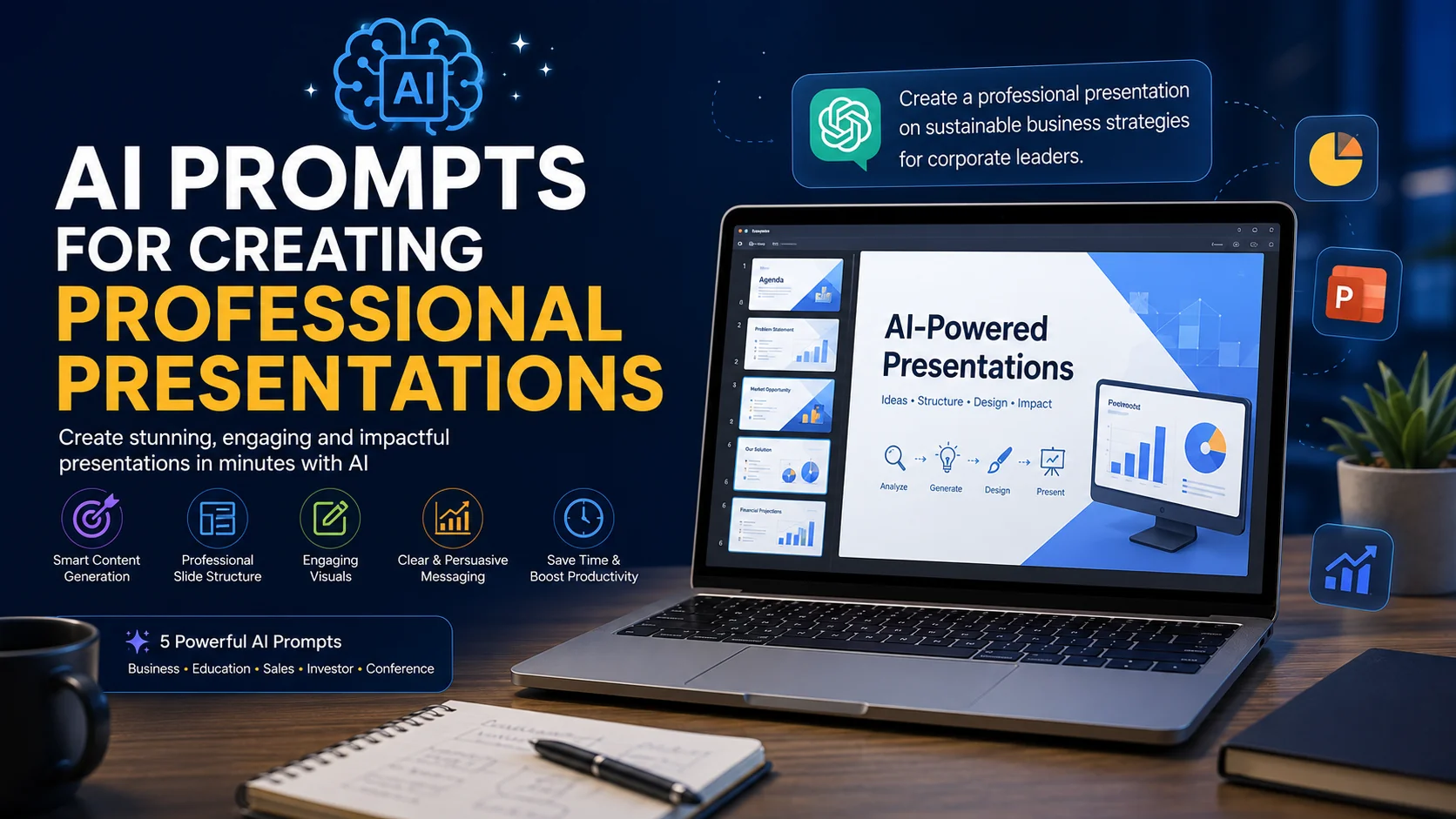
Table of Content
Table of Content
Presentations have become one of the most important communication tools in today's digital world. Whether you're pitching a startup idea, presenting quarterly business results, teaching students, conducting employee training, or showcasing a product to potential customers, the quality of your presentation can directly influence how your audience responds.
Unfortunately, creating a professional presentation isn't always easy. Many people spend hours searching for the right structure, writing compelling content, selecting visuals, and arranging slides. Even after investing significant time, the final presentation may still feel cluttered, inconsistent, or difficult to follow.
This is where Artificial Intelligence is making a remarkable difference.
Modern AI tools like ChatGPT, Claude, Gemini, Microsoft Copilot, and other presentation-focused assistants can help generate outlines, improve storytelling, suggest visuals, write speaker notes, create engaging slide content, and even recommend design ideas in minutes. However, the quality of AI-generated presentations depends largely on the prompts you provide.
A vague prompt such as "Create a presentation about AI" usually results in generic slides. On the other hand, a well-crafted prompt containing the audience, purpose, tone, number of slides, and desired outcomes can produce presentation-ready content that requires minimal editing.
In this guide, you'll discover five carefully designed AI prompts that help you create professional presentations for different scenarios. Instead of generic one-line prompts, each prompt is designed to provide detailed instructions that guide AI toward producing structured, engaging, and audience-focused presentations.
Why Prompt Quality Matters for Presentation Creation
AI doesn't automatically know what type of presentation you want. It responds to the instructions you provide.
Consider these two examples.
Weak Prompt
Create a presentation about cybersecurity.
The result will likely be a basic presentation with generic information.
Strong Prompt
Create a 15-slide professional presentation explaining cybersecurity fundamentals for small business owners. Use simple language, include real-world examples, speaker notes, recommended visuals, key statistics, practical security tips, and a strong conclusion with actionable recommendations.
The second prompt gives AI clear context, resulting in far more useful content.
A strong presentation prompt typically includes:
- Presentation objective
- Target audience
- Desired tone
- Number of slides
- Content depth
- Visual suggestions
- Speaker notes
- Call-to-action
- Formatting preferences
The more context you provide, the better the AI output becomes.
Benefits of Using AI for Professional Presentations
Businesses, educators, freelancers, marketers, and students increasingly rely on AI because it dramatically reduces preparation time while improving consistency.
Some major advantages include:
- Faster presentation creation
- Better storytelling
- Logical slide structure
- Consistent formatting ideas
- Professional language
- Audience-specific messaging
- Automatic speaker notes
- Creative visual recommendations
- Improved productivity
- Easier collaboration
Rather than replacing creativity, AI acts as a brainstorming and productivity assistant.
Prompt 1: Create a Complete Business Presentation
One of the most common use cases for AI is preparing professional business presentations. Whether you're presenting a project update, business proposal, investment pitch, product launch, or annual report, this prompt helps AI generate well-organized slides with persuasive content.
Prompt
Act as an experienced business presentation consultant.

Create a professional PowerPoint presentation about [TOPIC].

The presentation should contain 15–18 slides.

For every slide provide:

• Slide title
• Main content in concise bullet points
• Speaker notes
• Suggested chart, icon, or illustration
• Key takeaway

The presentation should follow this structure:

1. Title
2. Agenda
3. Problem Statement
4. Current Industry Situation
5. Data & Statistics
6. Proposed Solution
7. Benefits
8. Implementation Plan
9. Cost Analysis
10. Timeline
11. Risks
12. Future Opportunities
13. Case Study
14. Summary
15. Call to Action

Use professional business language suitable for executives.

Avoid unnecessary jargon.

Keep slides visually clean.

Recommend where charts, graphs, diagrams, and icons should be placed.

End with a strong conclusion.
Why This Prompt Works
This prompt tells AI exactly what type of presentation to generate instead of leaving important decisions open.
It specifies:
- Audience
- Structure
- Slide count
- Design guidance
- Speaker notes
- Visual recommendations
- Business tone
As a result, the generated presentation is much closer to something that could be used in a real meeting.
Best Use Cases
This prompt is ideal for:
- Startup founders
- Managers
- Consultants
- Marketing teams
- Product managers
- Sales professionals
- Business analysts
- Corporate trainers
Prompt 2: Create an Educational Presentation
Educational presentations require a different approach than business presentations. Instead of focusing on persuasion, they should simplify complex ideas, maintain student engagement, and encourage learning.
The following prompt helps AI generate classroom-ready educational content.
Prompt
Act as an experienced educator and instructional designer.

Create a detailed educational presentation about [TOPIC].

The presentation should contain 20 slides.

For each slide include:

• Slide title
• Easy-to-understand explanation
• Real-world example
• Key facts
• Visual suggestion
• Classroom discussion question
• Speaker notes

Use simple English.

Break complex concepts into smaller sections.

Include comparison tables where appropriate.

Add interesting facts throughout the presentation.

Include one quiz slide after every five slides.

Finish with:

• Summary
• Key learning points
• Revision questions
• Additional learning resources
Why This Prompt Works
Instead of simply asking AI to explain a topic, this prompt creates an interactive learning experience.
It encourages AI to:
- Simplify difficult concepts
- Include engaging examples
- Promote classroom discussion
- Add quizzes
- Improve retention
- Organize information logically
This produces a presentation that is useful for both teachers and learners.
Best Use Cases
This prompt works well for:
- Teachers
- Professors
- Online course creators
- Corporate trainers
- Coaching institutes
- Educational YouTubers
- Workshop organizers
- Students preparing seminars
Common Mistakes to Avoid When Using AI for Presentations
Even with powerful AI tools, the final quality depends on how you use them. Avoid these common mistakes:
1. Giving Vague Instructions
Prompts like "Make a presentation on marketing" often produce generic results. Always include the audience, purpose, slide count, and tone.
2. Overloading Slides
AI may generate too much text if you don't specify concise bullet points. Ask for clear, presentation-friendly content instead of long paragraphs.
3. Ignoring the Audience
A presentation for executives should look very different from one designed for school students. Mention the intended audience in every prompt.
4. Skipping Visual Guidance
Request suggestions for charts, icons, diagrams, infographics, and images. Strong visuals make presentations more engaging and easier to understand.
5. Publishing Without Reviewing
AI-generated content should always be reviewed for accuracy, updated data, and brand consistency before presenting it to an audience.
Prompt 3: Create a High-Converting Sales & Marketing Presentation
Sales presentations have one primary goal—convincing the audience to take action. Whether you're introducing a new product, pitching a service, or presenting a marketing strategy, every slide should build trust and move the audience closer to a decision.
Instead of simply listing product features, great sales presentations explain customer problems, demonstrate value, provide evidence, and conclude with a clear call to action.
Prompt
Act as a senior sales strategist and presentation designer.

Create a persuasive sales presentation about [PRODUCT OR SERVICE].

The presentation should contain 15–18 professional slides.

For every slide include:

• Slide title
• Presentation content
• Customer pain point
• Solution explanation
• Product benefits
• Recommended visuals
• Speaker notes
• Call-to-action

The presentation should follow this structure:

1. Title
2. Agenda
3. Industry Challenge
4. Customer Problems
5. Market Opportunity
6. Product Overview
7. Key Features
8. Competitive Advantages
9. Case Study
10. Customer Testimonials
11. Pricing Strategy
12. ROI Analysis
13. Frequently Asked Questions
14. Next Steps
15. Closing Slide

Use persuasive but professional language.

Keep bullet points concise.

Recommend charts, product mockups, icons, and infographics wherever appropriate.
Why This Prompt Works
Most AI-generated sales presentations fail because they focus only on features.
This prompt encourages AI to structure the presentation around the customer's journey.
Instead of saying:
"Our software has many features."
AI explains:
- What problem exists
- Why it matters
- How the solution helps
- Evidence supporting the claims
- Business value
- Return on investment
- Next action
This storytelling approach keeps the audience engaged from beginning to end.
Best Use Cases
This prompt works particularly well for:
- Product launches
- SaaS demonstrations
- Agency proposals
- Sales meetings
- Marketing campaigns
- Client presentations
- Business development
- Service proposals
Prompt 4: Create a Winning Investor Pitch Deck
Investor presentations require clarity, confidence, and compelling storytelling. Investors don't just evaluate an idea—they assess the market opportunity, business model, scalability, and the team's ability to execute.
A strong pitch deck should answer the questions investors are already thinking about before they ask them.
Prompt
Act as an experienced startup advisor and venture capital presentation expert.

Create a professional investor pitch deck for a startup called [STARTUP NAME].

Generate 12–15 slides.

For every slide include:

• Slide title
• Key bullet points
• Investor-focused messaging
• Speaker notes
• Recommended visuals
• Data suggestions

Structure the presentation as follows:

1. Title
2. Vision
3. Problem
4. Solution
5. Product Demo
6. Market Size
7. Business Model
8. Competitive Landscape
9. Go-to-Market Strategy
10. Financial Projections
11. Team
12. Funding Ask
13. Roadmap
14. Closing

Use confident but realistic language.

Recommend charts, growth graphs, customer journey diagrams, market analysis visuals, and financial dashboards.

Keep slides investor-friendly and visually clean.
Why This Prompt Works
Many startup founders struggle because they overload investor presentations with technical details.
This prompt keeps the focus on what investors actually care about:
- Market opportunity
- Revenue model
- Growth strategy
- Financial sustainability
- Competitive differentiation
- Scalability
- Funding requirements
Instead of overwhelming the audience with unnecessary information, AI generates a presentation that communicates confidence while remaining easy to follow.
Best Use Cases
Ideal for:
- Startup founders
- Entrepreneurs
- Accelerator programs
- Seed funding
- Angel investors
- Venture capital meetings
- Innovation competitions
- Business plan presentations
Prompt 5: Create an Engaging Conference or Webinar Presentation
Conference presentations differ from traditional slide decks because the speaker is the main attraction. The slides should support the speaker—not replace them.
A great conference presentation uses storytelling, practical examples, audience interaction, and memorable takeaways instead of overwhelming the audience with dense text.
Prompt
Act as an award-winning keynote speaker and professional presentation coach.

Create a conference presentation about [TOPIC].

Generate 18–20 engaging slides.

For each slide provide:

• Slide title
• Presentation content
• Storytelling element
• Audience engagement idea
• Suggested visuals
• Speaker notes
• Memorable takeaway

Presentation flow:

1. Powerful opening
2. Agenda
3. Why the topic matters
4. Current trends
5. Major challenges
6. Practical solutions
7. Real-world examples
8. Case study
9. Interactive audience question
10. Live demonstration idea
11. Future predictions
12. Actionable advice
13. Summary
14. Final inspiration
15. Q&A slide

Use conversational language.

Recommend modern visuals, diagrams, icons, illustrations, and infographics.

Keep every slide visually minimal but impactful.
Why This Prompt Works
Many conference presentations fail because every slide contains large blocks of text.
This prompt encourages AI to create presentations that:
- Tell a story
- Maintain audience attention
- Encourage interaction
- Support the speaker
- End with memorable insights
The result is a presentation that feels engaging rather than overwhelming.
Best Use Cases
Perfect for:
- Industry conferences
- Technology events
- Corporate seminars
- Online webinars
- Public speaking
- Training workshops
- TED-style presentations
- Educational conferences
Advanced Tips for Better AI-Generated Presentations
Even the best prompt can produce average results if you don't provide enough context. These practical techniques help AI generate presentations that feel customized and professional.
1. Define the Audience Clearly
Instead of asking AI to create a presentation for "everyone," specify exactly who will attend. Mention whether the audience consists of executives, students, investors, clients, engineers, healthcare professionals, or marketing teams. Tailoring the audience allows AI to adjust the language, examples, and depth of explanation accordingly.
2. Specify the Desired Outcome
Every presentation should have a clear objective. Decide whether you want to educate, persuade, inspire, secure funding, close a sale, or train employees. AI produces stronger results when it understands the final goal.
3. Request Visual Recommendations
Ask AI to recommend where charts, icons, timelines, infographics, comparison tables, process diagrams, screenshots, or product mockups should appear. This makes the presentation easier to design later in PowerPoint, Google Slides, or Canva.
4. Include Brand and Design Preferences
If the presentation is for your company or organization, mention preferred colors, fonts, logo placement, and design style. AI can then create content that aligns more closely with your brand identity instead of producing a generic slide deck.
5. Ask for Speaker Notes
Speaker notes help presenters explain each slide naturally without reading directly from the screen. They also make presentations easier to rehearse and deliver with confidence.
How to Customize AI Prompts for Better Results
One of the biggest advantages of AI is flexibility. A single presentation prompt can be adapted for dozens of industries simply by changing a few details.
For example, if you're creating a presentation about digital marketing, you can ask AI to include recent trends, campaign examples, and performance metrics. If you're preparing a healthcare presentation, you can request medical case studies, clinical research, and simplified explanations for patients or healthcare professionals.
Similarly, startup founders can ask AI to focus on funding opportunities and market validation, while educators can request quizzes, discussion questions, and learning activities.
The more context you provide, the more personalized the output becomes.
Useful details to include in your prompts are:
- Industry or niche
- Target audience
- Number of slides
- Presentation objective
- Preferred design style
- Brand colors
- Presentation duration
- Desired tone
- Reading level
- Examples or case studies
- Call-to-action
- Speaker notes
These small additions significantly improve the quality of AI-generated presentations.
Common Mistakes to Avoid
AI can save hours of work, but relying on it without reviewing the output can lead to poor presentations. Here are some of the most common mistakes and how to avoid them.
1. Accepting the First Draft
AI generates a solid starting point, but the first version is rarely perfect. Review every slide, remove repetitive content, simplify complex explanations, and adjust the flow to suit your audience.
2. Using Too Much Text
One of the biggest presentation mistakes is overcrowding slides with paragraphs.
Instead, aim for:
- Short bullet points
- Visual diagrams
- Icons
- Charts
- Infographics
- High-quality images
Your spoken explanation should provide the detail—not the slide itself.
3. Ignoring Storytelling
Great presentations tell a story rather than simply presenting facts.
A simple storytelling structure is:
Problem → Challenge → Solution → Results → Future Opportunities
This keeps your audience engaged from beginning to end.
4. Not Verifying Information
AI occasionally produces outdated statistics or inaccurate information. Always verify:
- Numbers
- Research findings
- Company information
- Industry reports
- Market statistics
- Financial data
Using credible and up-to-date information improves both trust and professionalism.
5. Forgetting Visual Consistency
Professional presentations maintain a consistent visual identity.
Keep the following consistent across all slides:
- Font styles
- Color palette
- Icon style
- Image quality
- Alignment
- Spacing
- Heading sizes
Consistency makes the presentation easier to follow and creates a stronger impression.
Recommended AI Tools for Presentation Creation
Although ChatGPT is excellent for generating structured presentation content, combining it with specialized design tools can produce even better results.
Popular AI-powered presentation tools include:
- ChatGPT
- Microsoft Copilot
- Google Gemini
- Claude AI
- Canva Magic Design
- Gamma
- Beautiful.ai
- Tome
- Pitch
- Plus AI
Each platform offers different strengths. Some focus on content generation, while others specialize in slide design, templates, animations, or collaboration.
Choosing the right combination depends on your workflow and presentation goals.
Future of AI in Presentation Design
Artificial intelligence is rapidly changing how presentations are created. Instead of spending hours writing content and designing slides manually, professionals can now generate structured drafts within minutes.
In the near future, AI is expected to offer even more advanced capabilities, including:
- Automatic brand-compliant slide designs
- Voice-controlled presentation creation
- Real-time collaboration with AI assistants
- Personalized content based on audience profiles
- Interactive data visualizations
- AI-generated animations and graphics
- Smart presentation rehearsal with feedback
- Live translation and multilingual slide generation
- Automated presentation summaries
- Audience engagement analysis and optimization
As these technologies mature, creating professional presentations will become faster, more accessible, and more personalized than ever before.
Best Practices for Using AI Responsibly
While AI is a powerful productivity tool, it should complement human expertise rather than replace it.
Before finalizing any presentation:
- Review all generated content carefully.
- Verify facts, statistics, and references.
- Add your own experience and insights.
- Include real examples from your industry.
- Maintain your organization's branding.
- Adapt the language to your audience.
- Remove unnecessary repetition.
- Ensure visuals support the message rather than distract from it.
Presentations that combine AI efficiency with human creativity are far more impactful than those created by either alone.
Conclusion
Artificial intelligence has transformed the way presentations are planned, written, and designed. Instead of starting with a blank slide, professionals can now use AI to generate structured outlines, persuasive messaging, speaker notes, visual suggestions, and audience-focused content in a fraction of the time.
However, the true power of AI lies in the quality of the prompts you provide. Clear instructions about your audience, objectives, tone, slide count, and desired outcomes help AI produce presentations that are far more relevant, engaging, and presentation-ready.
The five prompts shared in this guide cover a wide range of professional scenarios, including business meetings, educational sessions, sales presentations, investor pitch decks, and conference talks. They provide a strong foundation that you can customize for virtually any industry or purpose.
As AI tools continue to evolve, presentation creation will become increasingly collaborative, combining intelligent automation with human creativity. By learning how to write better prompts and refining AI-generated content, you can create presentations that not only look professional but also communicate ideas clearly, capture attention, and inspire action.
Frequently Asked Questions (FAQs)
1. Can AI create an entire presentation from a single prompt?
Yes. Modern AI tools can generate complete presentations, including slide titles, content, speaker notes, visual recommendations, and presentation structure. However, reviewing and customizing the output is recommended for the best results.
2. Which AI tool is best for creating professional presentations?
There is no single best tool for every situation. ChatGPT is excellent for generating presentation content, while tools like Canva, Gamma, Beautiful.ai, Microsoft Copilot, and Tome are popular for designing visually appealing slides.
3. How can I improve the quality of AI-generated presentations?
Provide detailed prompts that include the presentation topic, audience, objective, tone, slide count, preferred visuals, and desired outcomes. More specific instructions generally lead to higher-quality results.
4. Are AI-generated presentations suitable for business meetings?
Yes. With proper editing, accurate data, and professional formatting, AI-generated presentations can be used for client meetings, executive briefings, product launches, investor pitches, training sessions, and conferences.
5. Can AI replace presentation designers?
AI is an excellent productivity tool, but it does not completely replace professional presentation designers. Human creativity, storytelling, branding, and strategic thinking remain essential for creating presentations that truly connect with an audience and achieve business goals.