Best AI Prompts for Writing Helpful Customer Support Replies
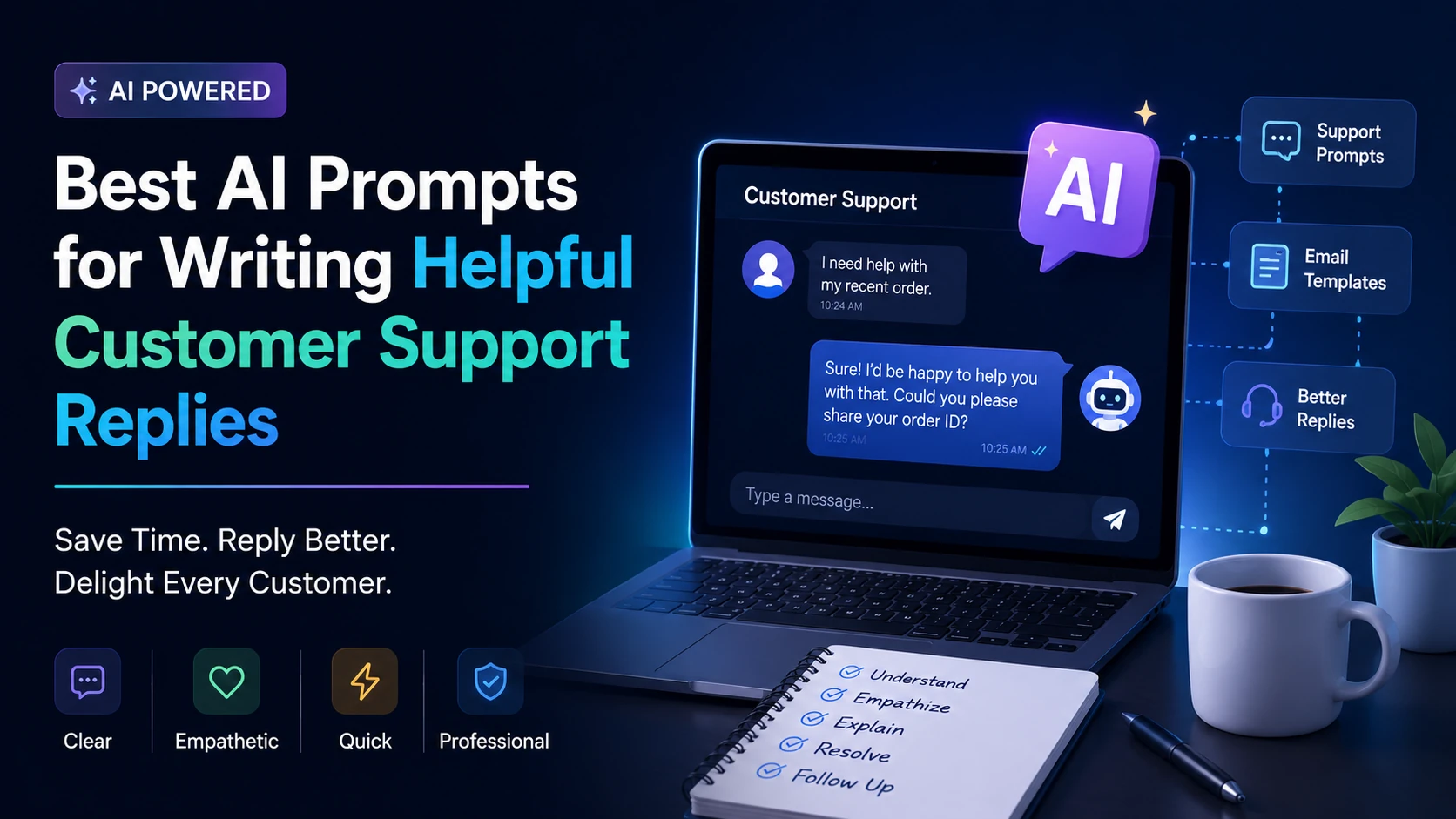
Table of Content
Table of Content
Customer support has always been one of the most important parts of any successful business. Whether you run an online store, a SaaS platform, a digital agency, or a small local business, the way you communicate with customers directly affects trust, retention, and long-term growth.
Today, artificial intelligence is changing how businesses handle customer communication. Instead of spending hours writing repetitive emails, apologizing for delays, answering common questions, or responding to complaints, support teams can use AI to create professional, empathetic, and personalized replies in seconds.
However, the quality of AI-generated responses depends heavily on the prompts you provide. A vague prompt usually produces a generic response, while a well-structured prompt can generate clear, human-like, and helpful customer support messages that save time without sacrificing quality.
This guide contains five carefully crafted AI prompts that can help businesses, freelancers, startups, customer support agents, and eCommerce sellers create better replies for a wide range of customer situations. Along with each prompt, you'll learn when to use it, why it works, and how to customize it for your own business.
Whether you're using ChatGPT, Gemini, Claude, Microsoft Copilot, or another AI assistant, these prompts will help you improve customer communication while maintaining a professional and friendly tone.
Table of Contents
- Why AI Is Transforming Customer Support
- Benefits of AI-Powered Customer Replies
- Best Practices Before Using AI
- AI Prompt #1 – Professional Customer Support Reply Generator
- AI Prompt #2 – Writing Apology Emails for Customer Complaints
- AI Prompt #3 – Responding to Refund Requests Professionally
- AI Prompt #4 – Creating Friendly Responses for Product Questions
- AI Prompt #5 – Writing Follow-Up Customer Support Emails
- Common Mistakes to Avoid
- Final Thoughts
- FAQs
Why AI Is Transforming Customer Support
Customer expectations have changed dramatically over the past few years.
People no longer want to wait several hours or even days for a response. They expect businesses to reply quickly, professionally, and accurately.
At the same time, customer support teams often deal with repetitive questions such as:
- Where is my order?
- Can I get a refund?
- My account isn't working.
- How do I reset my password?
- Is this product available?
- Can you explain your pricing?
Writing these responses manually every time is both repetitive and time-consuming.
This is where AI becomes valuable.
Instead of replacing human support agents, AI acts as an intelligent writing assistant that helps create clear, polite, and consistent responses. Support professionals can review, personalize, and send replies much faster, improving both productivity and customer satisfaction.
Benefits of Using AI for Customer Support Replies
When used correctly, AI offers several advantages for businesses of all sizes.
Faster Response Times
AI can draft professional replies within seconds, allowing support teams to respond more quickly and reduce customer wait times.
Consistent Brand Voice
By using structured prompts, businesses can maintain a consistent tone across all customer interactions, regardless of who handles the conversation.
Better Customer Experience
Well-written, empathetic replies make customers feel heard and respected, even when delivering bad news such as delays or unavailable products.
Increased Productivity
Instead of writing every email from scratch, support agents can focus on solving complex issues while AI handles repetitive drafting tasks.
Reduced Human Errors
AI can help improve grammar, clarity, and formatting, reducing mistakes that might otherwise appear in rushed responses.
Best Practices Before Using AI
Before copying any AI-generated response and sending it to a customer, keep these best practices in mind.
- Always verify factual information such as order status, pricing, and delivery dates.
- Personalize responses with the customer's name whenever possible.
- Remove any unnecessary generic phrases.
- Match your company's communication style.
- Double-check links, policies, and refund information.
- Review every response before sending it.
AI should assist your customer support process, not replace human judgment.
AI Prompt #1: Professional Customer Support Reply Generator
When to Use This Prompt
Use this prompt whenever you need a professional response to a customer's email, message, or support ticket.
It works well for:
- General inquiries
- Service questions
- Product support
- Technical assistance
- Account-related issues
- Business communication
Prompt
Act as a senior customer support specialist with over 10 years of experience.

Write a professional, empathetic, and human-like response to the following customer message.

Requirements:

• Understand the customer's concern before responding.
• Use a warm and respectful tone.
• Acknowledge the customer's frustration if applicable.
• Provide a clear and accurate solution.
• Keep the language simple and natural.
• Avoid robotic or repetitive phrases.
• End with an invitation for further questions.

Customer Message:

[Paste Customer Message Here]
Why This Prompt Works
This prompt encourages the AI to understand the customer's emotions before offering a solution. Instead of producing a cold or robotic response, it focuses on empathy, clarity, and professionalism.
Because it also instructs the AI to use simple language and invite further questions, the final response feels much more conversational and customer-friendly.
Example Use Case
Imagine a customer writes:
"I placed my order five days ago, but I still haven't received any shipping updates."
Using the prompt above, AI will generate a reassuring reply that acknowledges the delay, explains the situation clearly, and offers next steps without sounding defensive or impersonal.
AI Prompt #2: Write a Professional Apology Email for Customer Complaints
When to Use This Prompt
Every business occasionally faces situations where customers are unhappy. A delayed shipment, technical issue, billing mistake, or poor service experience can quickly damage trust if not handled properly.
This prompt helps you generate sincere, professional, and solution-focused apology emails that acknowledge the customer's frustration while maintaining your brand's credibility.
Use this prompt for:
- Delayed deliveries
- Service outages
- Product defects
- Incorrect orders
- Technical problems
- Poor customer experiences
- Billing mistakes
Prompt
Act as an experienced customer success manager.

Write a sincere, professional, and empathetic apology email for a customer who is unhappy with our service.

Requirements:

• Start by acknowledging the customer's frustration.
• Accept responsibility without sounding defensive.
• Clearly explain the issue if appropriate.
• Offer a practical solution or next step.
• Maintain a warm and respectful tone.
• Avoid generic apologies.
• End by thanking the customer for their patience and invite them to reach out again if needed.

Customer Issue:

[Paste Customer Complaint]
Why This Prompt Works
A poor apology often makes customers even more frustrated. This prompt encourages AI to focus on empathy before explanation. Instead of making excuses, it acknowledges the customer's experience and provides a clear path toward resolution.
The result is an email that feels genuine, respectful, and customer-focused.
Example Use Case
Customer Message:
"My order was supposed to arrive three days ago, but I haven't received it. Nobody replied to my previous email."
The AI-generated response would apologize sincerely, explain the shipping delay if known, provide an updated timeline, and reassure the customer that the issue is being actively resolved.
AI Prompt #3: Generate Professional Refund Request Responses
When to Use This Prompt
Refund requests are among the most sensitive customer interactions. A poorly written response can escalate frustration, while a thoughtful and transparent reply can preserve trust even if the refund cannot be approved.
This prompt helps businesses create balanced responses that explain policies clearly while remaining respectful and understanding.
Use this prompt for:
- Refund approvals
- Refund rejections
- Partial refunds
- Subscription cancellations
- Return requests
- Digital product refunds
- Service cancellations
Prompt
Act as a senior customer support representative.

Write a polite, transparent, and professional response to a customer requesting a refund.

Requirements:

• Carefully understand the customer's situation.
• Clearly explain the refund policy.
• If the refund is approved, explain the next steps.
• If the refund cannot be approved, explain why respectfully.
• Suggest alternative solutions whenever possible.
• Keep the tone calm, friendly, and professional.
• Avoid legal or robotic language.

Customer Request:

[Paste Refund Request]
Why This Prompt Works
Refund conversations require a balance between customer satisfaction and company policy. This prompt ensures the AI communicates decisions respectfully while avoiding language that may sound dismissive or confrontational.
It also encourages the AI to provide alternative solutions where appropriate, such as exchanges, store credit, or troubleshooting assistance.
Example Use Case
Customer Message:
"I bought your software yesterday, but it doesn't meet my requirements. I'd like a refund."
The AI would review the situation based on the provided policy and create a courteous response outlining the refund process or explaining alternative options in a professional manner.
AI Prompt #4: Respond to Product or Service Questions
When to Use This Prompt
Potential customers often ask questions before making a purchase. These conversations can directly influence buying decisions.
Instead of giving short or incomplete answers, businesses should provide informative, friendly, and confidence-building responses.
Use this prompt for:
- Product inquiries
- Pricing questions
- Feature explanations
- Compatibility questions
- Subscription plans
- Service availability
- Pre-sales support
Prompt
Act as a knowledgeable customer support specialist.

Write a friendly and informative reply to the customer's product or service question.

Requirements:

• Fully answer the customer's question.
• Use simple and easy-to-understand language.
• Highlight relevant product benefits naturally.
• Never pressure the customer into purchasing.
• Keep the tone conversational and helpful.
• End by asking if they have any additional questions.

Customer Question:

[Paste Customer Question]
Why This Prompt Works
Customers appreciate businesses that educate rather than sell aggressively. This prompt helps AI produce responses that build confidence by focusing on clarity and usefulness instead of promotional language.
Such replies often improve customer trust and increase the likelihood of future purchases.
Example Use Case
Customer Question:
"Can your software be used by small businesses with fewer than ten employees?"
The AI-generated response would explain the software's suitability for small teams, highlight relevant features, and invite the customer to ask follow-up questions if needed.
Tips for Personalizing AI-Generated Replies
Even the best AI-generated response should be reviewed before sending. Small personal touches can make a significant difference in how customers perceive your business.
Here are a few ways to personalize responses:
- Address customers by their name whenever possible.
- Reference their specific order, ticket, or issue.
- Mention relevant dates or timelines.
- Match your company's communication style.
- Add a genuine closing message from your support team.
- Avoid sending identical responses to different customers.
Personalization helps customers feel valued rather than treated as just another support ticket.
Avoid These Common Mistakes
Even with powerful AI tools, mistakes can happen if prompts are too generic or responses aren't reviewed.
Avoid these common issues:
- Sending responses without proofreading.
- Providing inaccurate information.
- Ignoring the customer's emotions.
- Using overly formal or robotic language.
- Copying the same reply for every situation.
- Making promises your business cannot fulfill.
AI should enhance customer service not replace careful human oversight.
Customers also want to feel understood.
Even if the issue cannot be resolved immediately, acknowledging frustration and showing empathy can significantly improve the overall experience.
3. Using Generic Responses
Customers quickly recognize repetitive messages.
Instead of sending identical replies to everyone, personalize responses with names, product details, or references to previous conversations.
4. Providing Incorrect Information
AI can generate convincing but inaccurate information if it doesn't have access to your latest policies or order details.
Always verify:
- Pricing
- Delivery timelines
- Refund eligibility
- Product availability
- Account information
Accuracy is essential for maintaining customer trust.
5. Sounding Too Robotic
Avoid phrases that feel overly scripted or repetitive.
Instead of:
"We apologize for any inconvenience caused."
Consider:
"I'm sorry you've had this experience, and I understand how frustrating it must be."
Natural language makes conversations feel more authentic and human.
Best AI Tools for Customer Support Prompting
The prompts shared in this guide work well across most modern AI assistants.
Popular options include:
- ChatGPT
- Google Gemini
- Claude AI
- Microsoft Copilot
- Perplexity AI
- Grok AI
Each platform has its strengths, but well-written prompts generally produce high-quality results regardless of the tool you choose.
Final Thoughts
Customer support is no longer just about answering questions it is about building lasting relationships. Every interaction shapes how customers perceive your brand, and timely, thoughtful communication can turn one-time buyers into loyal advocates.
Artificial intelligence makes this process faster and more efficient, but the quality of the output depends on the prompts you use. The five prompts shared in this guide are designed to help you handle common support scenarios such as general inquiries, complaints, refund requests, product questions, and follow-up emails with professionalism and empathy.
Remember that AI should be viewed as a writing assistant rather than a replacement for human judgment. Always review generated responses, personalize them with customer-specific details, and ensure they reflect your company's tone and policies.
By combining AI with genuine customer care, businesses can improve response quality, save valuable time, and deliver support experiences that customers appreciate and remember.
Frequently Asked Questions (FAQs)
1. Can I use these prompts with any AI chatbot?
Yes. These prompts are compatible with ChatGPT, Google Gemini, Claude AI, Microsoft Copilot, Grok AI, Perplexity AI, and most modern AI writing assistants.
2. Do I need to edit AI-generated customer support replies?
Yes. Always review and personalize AI-generated responses before sending them. Verify facts, add customer-specific details, and ensure the message aligns with your company's policies and brand voice.
3. Are these prompts suitable for small businesses?
Absolutely. Whether you're a freelancer, startup, eCommerce store, SaaS company, or large enterprise, these prompts can help improve the speed and quality of customer communication.
4. Can AI completely replace human customer support?
No. AI is best used to assist support teams by drafting responses and handling repetitive tasks. Human agents are still essential for resolving complex issues, making decisions, and providing empathy in sensitive situations.
5. Which prompt is the most useful for daily customer support?
The Professional Customer Support Reply Generator is the most versatile because it can handle a wide variety of customer inquiries. Combined with the other prompts for apologies, refunds, product questions, and follow-ups, it creates a comprehensive toolkit for delivering exceptional customer support.