
How AI Agent Models Work: Complete Guide to AI Agents, Tools, Memory & Planning
how AI agent models work, including their architecture, reasoning process, tools, memory, planning, RAG, function calling, agent loops, and real-world applications.

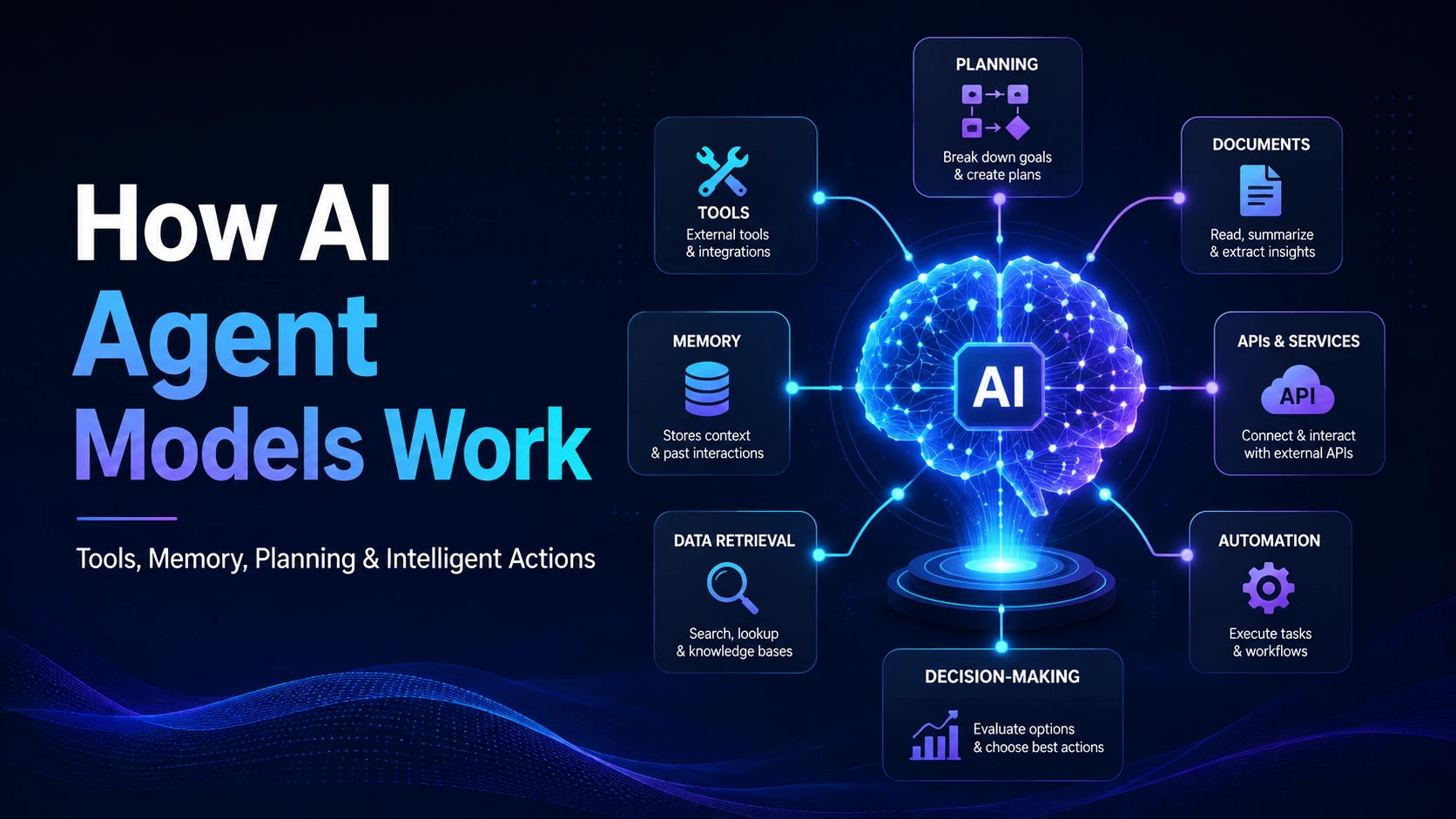
Table of Content
Artificial intelligence has moved far beyond simple chatbots that only answer questions. Today, we are entering the era of AI agents—systems that can understand a goal, make decisions, use tools, gather information, complete multiple steps, and sometimes perform actions with very little human involvement.
You may already have used an AI chatbot to write an email, explain code, summarize an article, or generate ideas. An AI agent goes a step further. Instead of simply producing an answer, it can work toward an outcome.
For example, imagine telling an AI:
“Find five affordable hotels near my conference, compare their ratings and facilities, and prepare a shortlist.”
A normal language model might explain how you could search for hotels. An AI agent, when properly connected to the necessary tools, could search for hotels, collect current information, compare the results, organize them, and return a useful shortlist.
This ability comes from combining an AI model with instructions, tools, memory, planning, data retrieval, and an execution loop.
Google Cloud describes the model as the reasoning engine or “brain” of an agent, while tools give it capabilities to interact with external systems. Modern agent architectures may also include grounding, memory, orchestration, and runtime infrastructure.
Understanding how AI agents work is becoming increasingly important for developers, students, businesses, and anyone interested in the future of artificial intelligence.
This guide explains the complete concept in simple language.
What Is an AI Agent?
An AI agent is a software system that uses artificial intelligence to pursue a goal and perform tasks on behalf of a user.
Instead of following only a fixed sequence of instructions, an AI agent can often determine which steps it should take next based on the current situation.
A modern AI agent may be able to:
- Understand natural-language instructions
- Break a large task into smaller steps
- Search for information
- Read documents
- Use APIs
- Run functions
- Query databases
- Analyze results
- Remember relevant context
- Correct mistakes
- Make decisions
- Perform approved actions
- Return a final result
The key concept is goal-oriented behavior.
A traditional application usually follows predefined rules.
For example:
User clicks button
↓
Application calls API
↓
API returns result
↓
Application displays result
The application does exactly what the programmer has specified.
An AI agent can work differently.
User provides a goal
↓
Agent understands the goal
↓
Agent creates or determines the next step
↓
Agent selects a tool
↓
Tool performs an action
↓
Agent observes the result
↓
Agent decides what to do next
↓
Process repeats
↓
Final result is produced
Anthropic describes agents as systems in which the model dynamically directs its own processes and tool usage rather than simply following a completely predefined workflow.
That decision-making loop is one of the most important ideas behind AI agents.
AI Model vs AI Agent
People often use the terms AI model and AI agent as if they mean the same thing.
They do not.
An AI model is usually the intelligence responsible for understanding input and generating output.
Examples include large language models that can:
- Write text
- Analyze information
- Generate code
- Summarize documents
- Answer questions
- Reason about problems
But by itself, a model may not have direct access to external systems.
Think of an AI model as a highly capable brain sitting inside a room.
It can think and communicate, but unless you give it access to tools, it cannot interact with the outside world.
An AI agent is more like:
AI Model + Instructions + Tools + Memory + Data + Execution Logic + Guardrails
The model provides intelligence.
The agent system provides the environment in which that intelligence can actually perform useful work.
For example, a language model may know how calendars generally work.
But an agent connected to a calendar API could potentially:
- Understand that you want to schedule a meeting.
- Check your calendar.
- Find free time.
- Compare availability.
- Create an event after receiving appropriate permission.
The intelligence still comes from the model, but the agent architecture enables action.
The Main Components of an AI Agent
Although different companies use different architectures, most modern AI agents contain several common components.
1. The AI Model
The model is the core reasoning component of the system.
It receives information such as:
- The user's request
- System instructions
- Available tools
- Previous conversation
- Retrieved documents
- Results from previous actions
It then determines what should happen next.
For example, suppose the user asks:
“Analyze my website and identify why traffic dropped.”
The model might determine that it needs:
- Website analytics
- Search performance data
- Recent technical changes
- Ranking information
Instead of immediately producing an unsupported answer, an agent can decide to gather the necessary information first.
The quality of the underlying model strongly affects how well the agent can reason, plan, interpret tool results, and recover from unexpected situations.
2. Instructions
An agent needs instructions describing what it should do and how it should behave.
Instructions may include:
- The agent's role
- What tasks it can perform
- What tools it can use
- What information it should prioritize
- What actions require confirmation
- What it must never do
- What format its output should follow
Imagine a customer-support agent.
Its instructions might say:
Help customers troubleshoot products. Use the knowledge base before answering technical questions. Never approve refunds above a specific value without human authorization.
Without good instructions, even a powerful model may behave inconsistently.
For production AI systems, instructions are therefore an important part of agent design.
3. Tools
Tools are what make AI agents dramatically more useful than ordinary conversational models.
A tool can be almost any function or external service the agent is allowed to access.
Examples include:
- Web search
- Calculator
- Database queries
- Calendar
- CRM systems
- File storage
- Code execution
- Payment APIs
- Weather services
- Maps
- Internal company software
- Search engines
- Document readers
Google Cloud describes tools as capabilities that allow agents to interact with external systems, including APIs, internal functions, databases, retrieval systems, and services.
Consider an ecommerce support agent.
It might have tools such as:
getOrderDetails()
checkDeliveryStatus()
searchProduct()
createSupportTicket()
requestRefund()
When a customer says:
“My order hasn't arrived yet.”
The agent can understand the request and choose:
getOrderDetails()
After receiving the order information, it may call:
checkDeliveryStatus()
Then it can explain what happened.
The model is not magically accessing the delivery database.
The developer has explicitly provided a secure tool that allows the agent to request the necessary information.
4. Function Calling
Function calling is an important mechanism used in many agent systems.
Instead of allowing the AI model to directly execute arbitrary operations, developers provide predefined functions.
For example:
getWeather(city)
The model might determine that the function needs to be called with:
city = "Pune"
The application executes the function.
The weather service returns something like:
Temperature: 27°C
Condition: Cloudy
That result is given back to the model.
The model then uses it to generate a useful response.
This architecture separates decision-making from execution.
The AI decides which tool is appropriate, while application code controls what that tool is actually allowed to do.
This is much safer than giving an AI system unrestricted access to everything.
You can Download Notes of : Model Context Protocol (MCP) Complete Notes
5. Memory
Memory allows an agent to preserve useful information.
Without memory, every interaction would effectively begin from zero.
There are several types of memory commonly used in agent systems.
Short-Term Memory
Short-term memory contains information relevant to the current conversation or task.
For example:
User:
“I want a laptop under ₹70,000.”
Later:
“Only show me ones with 16 GB RAM.”
The agent understands that the ₹70,000 budget still applies because it is part of the current context.
Long-Term Memory
Long-term memory can store useful information across separate interactions.
For example, an assistant might remember that a user prefers:
- React for frontend development
- MySQL for databases
- Ubuntu servers
- TypeScript projects
When appropriate and permitted, that information can make future assistance more relevant.
Task Memory
Agents may also maintain the current state of a complicated workflow.
Imagine an agent conducting research.
It might track:
Research question
Sources already analyzed
Important findings
Missing information
Tasks completed
Tasks remaining
Without this state, long-running tasks would become difficult to manage.
Modern enterprise agent architectures often distinguish between working memory for current context and persistent storage for longer-term information.
6. Knowledge Retrieval and RAG
An AI model cannot be expected to permanently contain every piece of information a company needs.
This is where Retrieval-Augmented Generation, commonly known as RAG, becomes useful.
Suppose a company has 20,000 internal documents.
Training a new model whenever a document changes would be extremely inefficient.
Instead, an agent can search the document collection when required.
The process may look like this:
User asks a question
↓
Agent identifies required information
↓
Search system retrieves relevant documents
↓
Relevant content is added to the model's context
↓
Model analyzes the information
↓
Agent generates an answer
This approach is commonly called grounding because the AI response is connected to external information rather than relying entirely on information learned during model training.
RAG is especially valuable for:
- Company documentation
- Product information
- Customer records
- Technical manuals
- Research papers
- Legal documents
- Internal policies
- Frequently changing information
7. Planning
Complex goals usually cannot be completed in one step.
Agents therefore need some form of planning or task decomposition.
Suppose you tell a research agent:
“Create a competitor analysis for my new food-delivery startup.”
The agent may internally break the task into areas such as:
- Identify major competitors.
- Understand their business models.
- Compare features.
- Compare pricing.
- Analyze strengths.
- Analyze weaknesses.
- Identify market gaps.
- Produce a structured report.
The agent does not necessarily need to write this complete plan visibly before doing anything.
Instead, it can determine the next useful action based on the goal and information available.
Planning becomes especially important when agents work on tasks involving many tools or many intermediate results.
The AI Agent Loop
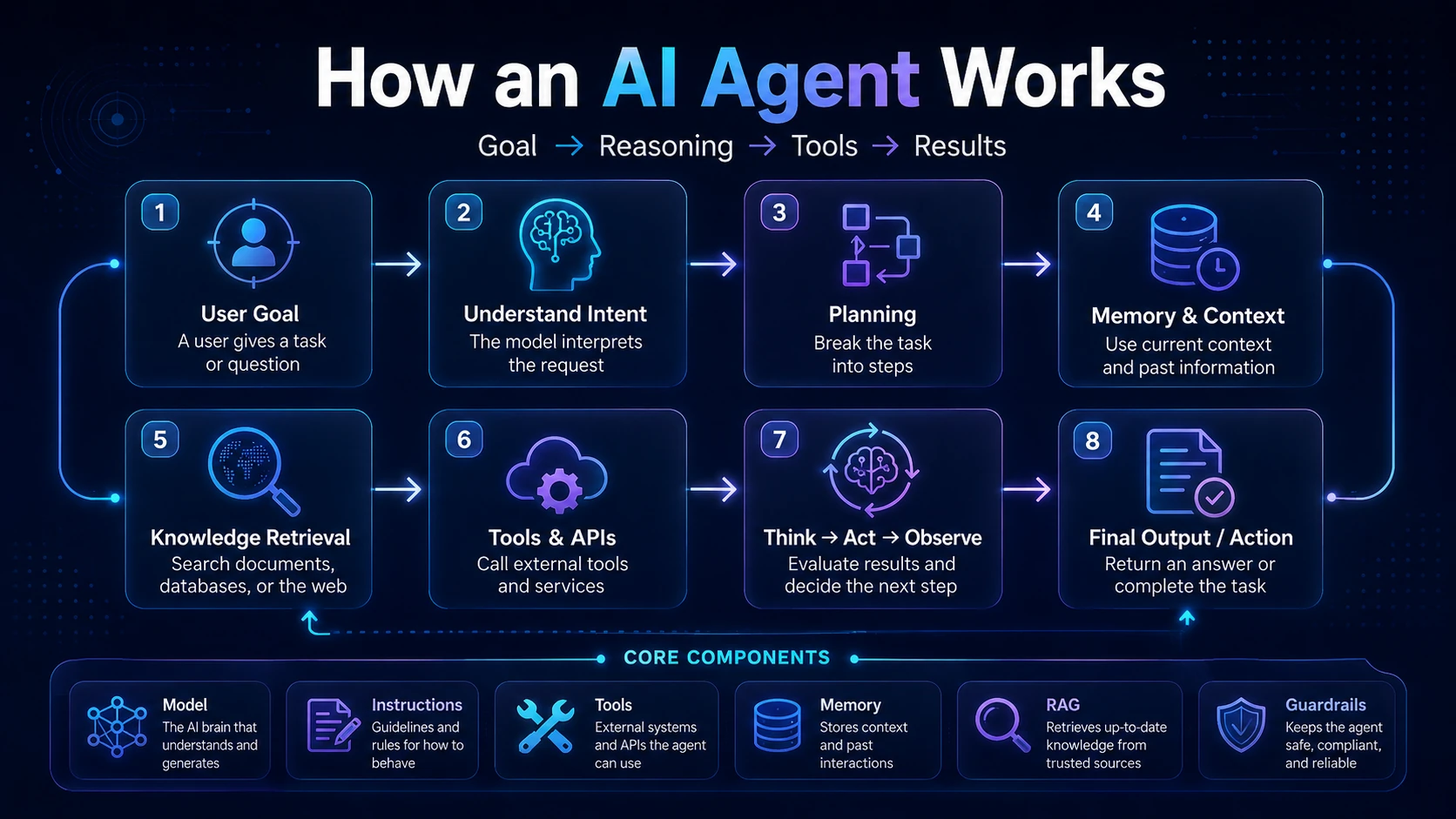
One of the easiest ways to understand an AI agent is through the agent loop.
A simplified version looks like this:
Goal
↓
Think / Decide
↓
Act
↓
Observe
↓
Evaluate
↓
Decide Again
↓
Continue or Finish
Google Cloud describes production-oriented agents as following a recurring pattern of thinking, acting, and observing, with each cycle helping the system refine its approach.
Imagine an agent has been asked:
“Find a highly rated wireless keyboard under ₹3,000.”
Step 1: Understand
The model extracts the important requirements:
- Product: wireless keyboard
- Maximum budget: ₹3,000
- Preference: strong ratings
Step 2: Decide
The agent determines that current product information is required.
Step 3: Act
It uses a product-search tool.
Step 4: Observe
The tool returns several keyboards.
Step 5: Evaluate
The agent notices that some products exceed the budget.
It removes those options.
Step 6: Continue
It may inspect specifications or reviews for the remaining products.
Step 7: Finish
It returns a shortlist and explains why each option is worth considering.
The important difference is that the AI did not simply generate an answer from memory.
It interacted with an environment while working toward a goal.
How an AI Agent Knows Which Tool to Use
Developers usually provide the AI model with descriptions of the available tools.
For example:
Tool: search_web
Purpose: Search the internet for current information.

Tool: calculator
Purpose: Perform mathematical calculations.

Tool: get_customer_order
Purpose: Retrieve customer order information.

Tool: create_ticket
Purpose: Create a customer support ticket.
The model receives both the user's request and these descriptions.
If the user says:
“Where is my order?”
The model can recognize that get_customer_order is probably the correct tool.
If the user asks:
“What is 18% of 45,000?”
The calculator tool is more appropriate.
Good tool descriptions are extremely important.
If several tools have confusing or overlapping descriptions, the model may select the wrong one.
Anthropic has emphasized that agent performance depends heavily on the quality and design of the tools available to it.
Error Handling and Self-Correction
Real-world systems fail.
An API may be unavailable.
A database may return no results.
A search query may be poor.
A file may not exist.
The user's instructions may be incomplete.
A capable agent should be designed to handle these situations.
For example:
Agent searches database
↓
No result found
↓
Agent checks whether search parameters are correct
↓
Agent tries an alternative search
↓
Result found
This ability to observe an intermediate result and adjust the next action is a major advantage of agent-based systems.
However, self-correction is not perfect.
An AI agent can still make mistakes, misunderstand information, or repeatedly choose an ineffective strategy.
Production systems therefore need limits, monitoring, testing, and fallback mechanisms.
AI Agent vs Traditional Automation
Traditional automation remains extremely useful.
Imagine this workflow:
New customer submits form
↓
Send welcome email
↓
Add customer to CRM
↓
Notify sales team
Every step is known beforehand.
There is little reason to let an AI agent decide what happens.
A normal automation workflow may be cheaper, faster, and more predictable.
Agents become more useful when the correct path depends on context.
For example:
“Analyze the customer inquiry, determine whether it is technical, sales-related, or billing-related, collect the necessary information, and route it appropriately.”
There may be many different paths.
The AI model can interpret the situation and dynamically determine the next step.
Anthropic recommends using the simplest architecture that solves the problem, noting that agents can add cost and latency compared with straightforward workflows.
That is an important lesson.
Not every application needs an AI agent.
Single-Agent Systems
The simplest architecture uses one primary AI agent.
For example:
User
↓
Main AI Agent
↓
Search Tool
Database Tool
Calculator
Email Tool
The agent controls all available tools.
This architecture works well for many applications.
Examples include:
- Research assistants
- Support agents
- Coding assistants
- Personal productivity agents
- Content research systems
- Business-analysis assistants
Single-agent systems are generally easier to build, test, monitor, and debug.
Multi-Agent Systems
More complicated applications may use multiple specialized agents.
Imagine building an automated marketing system.
It might contain:
Research Agent
Finds industry trends and competitor information.
Content Agent
Uses the research to create content.
SEO Agent
Checks search intent, keywords, headings, and optimization.
Review Agent
Checks quality, factual consistency, and formatting.
The workflow might become:
User Goal
↓
Research Agent
↓
Content Agent
↓
SEO Agent
↓
Review Agent
↓
Final Output
This approach is called a multi-agent system.
OpenAI's agent tooling, for example, supports patterns such as agent handoffs, configurable guardrails, and tracing for agent workflows.
Multi-agent architecture can be powerful, but developers should not use multiple agents simply because it sounds advanced.
Every additional agent increases:
- Complexity
- Cost
- Latency
- Debugging difficulty
- Communication overhead
- Possibility of unexpected behavior
A well-designed single agent is often better than a poorly designed team of agents.
Guardrails and Human Approval
Giving software the ability to take actions creates obvious risks.
Imagine an agent with access to:
- Banking
- Production servers
- Customer databases
- Company documents
You would not want it performing every possible action without restrictions.
This is why production AI agents require guardrails.
Guardrails may include:
- Tool permissions
- Spending limits
- Data-access rules
- Input validation
- Output validation
- Authentication
- Confirmation requirements
- Action logs
- Rate limits
- Sandboxed execution
For example, an agent might be allowed to:
Read invoices ✓
Calculate payment totals ✓
Draft payment request ✓
But:
Transfer money ✗ without approval
Human approval is especially important when an action is difficult or impossible to reverse.
High-impact activities such as financial transactions, deletion of important files, account changes, deployment to production, or sending sensitive communications should typically have stronger controls.
Modern agent platforms increasingly focus on controlled execution environments and infrastructure for safely running tool-based tasks. OpenAI's 2026 Agents SDK updates, for example, added infrastructure for agent work across files and tools within controlled sandbox environments.
Observability and Agent Tracing
Traditional applications can often be debugged by inspecting logs.
Agents are more challenging because the exact path may vary between runs.
Suppose an agent produces an incorrect result.
Developers may need to understand:
What information did the agent receive?

Which tool did it select?

What arguments did it send?

What did the tool return?

What happened next?

Where did the workflow fail?
Agent tracing records these steps.
It allows developers to understand an execution path rather than only seeing the final response.
This is particularly important in production environments because agent behavior is probabilistic.
Two similar requests may not always follow exactly the same path.
Evaluating AI Agents
Testing an AI agent is also more difficult than testing ordinary software.
With traditional code, you may write:
Input A → Expected Output B
Agents can produce several different but equally valid solutions.
Testing therefore needs to examine both the final result and the process.
Useful evaluation categories include:
- Task completion rate
- Accuracy
- Tool-selection accuracy
- Number of unnecessary actions
- Cost
- Response time
- Error recovery
- Safety
- User satisfaction
Evaluation becomes even more important as agents are given greater autonomy.
Anthropic notes that agents are particularly challenging to evaluate because they operate across multiple turns, use tools, change state, and adapt based on intermediate results.
Real-World Applications of AI Agents
AI agents are already useful across many industries.
Customer Support
Agents can:
- Understand customer problems
- Search knowledge bases
- Check account information
- Retrieve order details
- Troubleshoot common problems
- Create tickets
- Escalate difficult cases
Software Development
Coding agents can help:
- Explore codebases
- Find bugs
- Write code
- Run tests
- Modify files
- Explain errors
- Review implementations
- Prepare changes
Research
Research agents can:
- Search multiple sources
- Compare information
- Read documents
- Extract important details
- Organize findings
- Produce reports
Sales
Sales agents can assist with:
- Lead qualification
- CRM updates
- Prospect research
- Follow-up preparation
- Meeting summaries
- Account research
Ecommerce
Agents may help:
- Find products
- Compare products
- Track orders
- Answer product questions
- Process support requests
- Provide personalized recommendations
Data Analysis
Agents connected to databases can potentially:
- Translate natural language into queries
- Retrieve data
- Analyze trends
- Calculate metrics
- Generate summaries
- Prepare reports
The value of agents comes from connecting intelligent reasoning with real business systems.
Limitations of AI Agents
AI agents are powerful, but they are not perfect autonomous workers.
They have important limitations.
Hallucinations
AI models can generate incorrect information confidently.
External retrieval helps, but it does not eliminate every mistake.
Tool Errors
Agents depend on APIs and services.
If those systems fail, the agent may also fail.
Cost
A long agent workflow may involve:
- Many model calls
- Search operations
- Database queries
- API calls
- File processing
This can become significantly more expensive than a single chatbot response.
Latency
Every additional step takes time.
A simple answer might take seconds, while a complicated agent workflow could require many separate operations.
Security
The more systems an agent can access, the more carefully those permissions must be controlled.
Unpredictability
AI models are probabilistic rather than completely deterministic.
Developers cannot assume that every request will always follow exactly the same path.
These limitations are why well-designed agent systems combine AI flexibility with traditional software engineering.
A Simple AI Agent Architecture
A practical architecture might look like this:
USER
↓
APPLICATION
↓
AGENT ORCHESTRATOR
↓
LARGE LANGUAGE MODEL
↙ ↓ ↘
MEMORY TOOLS RETRIEVAL
↓
┌─────────┼──────────┐
↓ ↓ ↓
Search Database APIs
↓ ↓ ↓
└─────────┼──────────┘
↓
RESULT
↓
MODEL EVALUATES
↓
Continue or Finish
↓
USER
The orchestrator manages the overall loop.
The model provides reasoning.
Memory provides context.
Retrieval provides relevant knowledge.
Tools provide external capabilities.
Guardrails determine what is allowed.
Together, these components create what we call an AI agent.
The Future of AI Agents
The long-term direction of AI is likely to involve systems that do more than generate text.
We are already seeing agents that can work with:
- Browsers
- Files
- Applications
- Databases
- Development environments
- Enterprise systems
- Communication tools
However, the biggest improvement may not simply be giving agents more tools.
Successful AI agents will need to become:
- More reliable
- Easier to control
- Better at understanding context
- More secure
- Less expensive to operate
- Better at recognizing uncertainty
- Easier to evaluate
- Better at collaborating with humans
The most useful future AI systems will probably combine three things:
Human judgment + AI reasoning + Software automation
Humans define goals, permissions, and important decisions.
AI handles interpretation, reasoning, and flexible problem solving.
Traditional software performs deterministic operations safely and reliably.
That combination is far more realistic than imagining AI replacing every application with completely autonomous agents.
Final Thoughts
AI agents represent an important shift in how we interact with artificial intelligence.
A normal AI model mainly answers a request.
An AI agent can potentially work toward a goal.
It can understand what you want, determine what information it needs, select tools, perform actions, observe the results, adjust its approach, and continue until it reaches an acceptable outcome.
The core idea can be summarized like this:
AI Agent =
Model
+ Instructions
+ Context
+ Memory
+ Knowledge
+ Tools
+ Planning
+ Action Loop
+ Guardrails
The model provides intelligence, but everything around the model determines whether that intelligence becomes a useful and reliable system.
This is why building an excellent AI agent is not simply about choosing the most powerful language model.
Developers also need to think carefully about:
- Tool design
- Data quality
- Memory
- Permissions
- Security
- Error handling
- Evaluations
- Human oversight
- Cost
- User experience
As AI models continue to improve, agents will increasingly become capable of handling longer and more complicated workflows.
Still, the best approach is not to make every application autonomous.
A good AI system uses agents where flexible decision-making creates real value and uses traditional software where predictable automation works better.
Understanding that difference is one of the most important skills for anyone learning about the next generation of artificial intelligence.
Frequently Asked Questions
1. What is an AI agent model?
An AI agent model usually refers to an AI-powered system in which a language or reasoning model is combined with instructions, tools, memory, data retrieval, and execution logic. The underlying model understands the goal and makes decisions, while the surrounding agent system allows it to search for information, call APIs, access approved data, and perform multi-step tasks.
2. What is the difference between an AI chatbot and an AI agent?
A chatbot is primarily designed for conversation and typically responds directly to a user's message. An AI agent can go beyond conversation by determining what steps are required to achieve a goal, using external tools, examining intermediate results, and continuing the process until the task is completed. Modern systems can blur this distinction because a conversational interface can also have agent capabilities.
3. Do AI agents work without large language models?
Not every software agent requires an LLM, and agent concepts existed long before modern generative AI. However, most modern generative AI agents use a language or multimodal model as their reasoning component. The model gives the agent flexible natural-language understanding, reasoning, planning, and tool-selection capabilities.
4. Can AI agents make decisions by themselves?
AI agents can make bounded decisions within the tools, instructions, permissions, and environment provided by developers. They might decide which search to perform or which function to call next. However, high-impact actions should have appropriate safeguards and, when necessary, human approval. An agent's autonomy should therefore be treated as controlled software autonomy rather than unlimited independence.
5. Are AI agents the future of artificial intelligence?
AI agents are likely to become an important part of future AI applications because they allow models to interact with software, data, and real-world workflows. They are especially useful for research, coding, business operations, customer service, and repetitive knowledge work. However, agents will not replace traditional software everywhere. Fixed workflows remain better when a task requires maximum predictability, speed, or strict control.