
How to Add AEO to Your Website: Complete Answer Engine Optimization Guide
how to add AEO to your website with this complete 2026 guide. Discover practical Answer Engine Optimization strategies for Google Search, AI Overviews, AI-powered search engines, content structure, E-E-A-T, structured data, technical SEO, and better AI search visibility

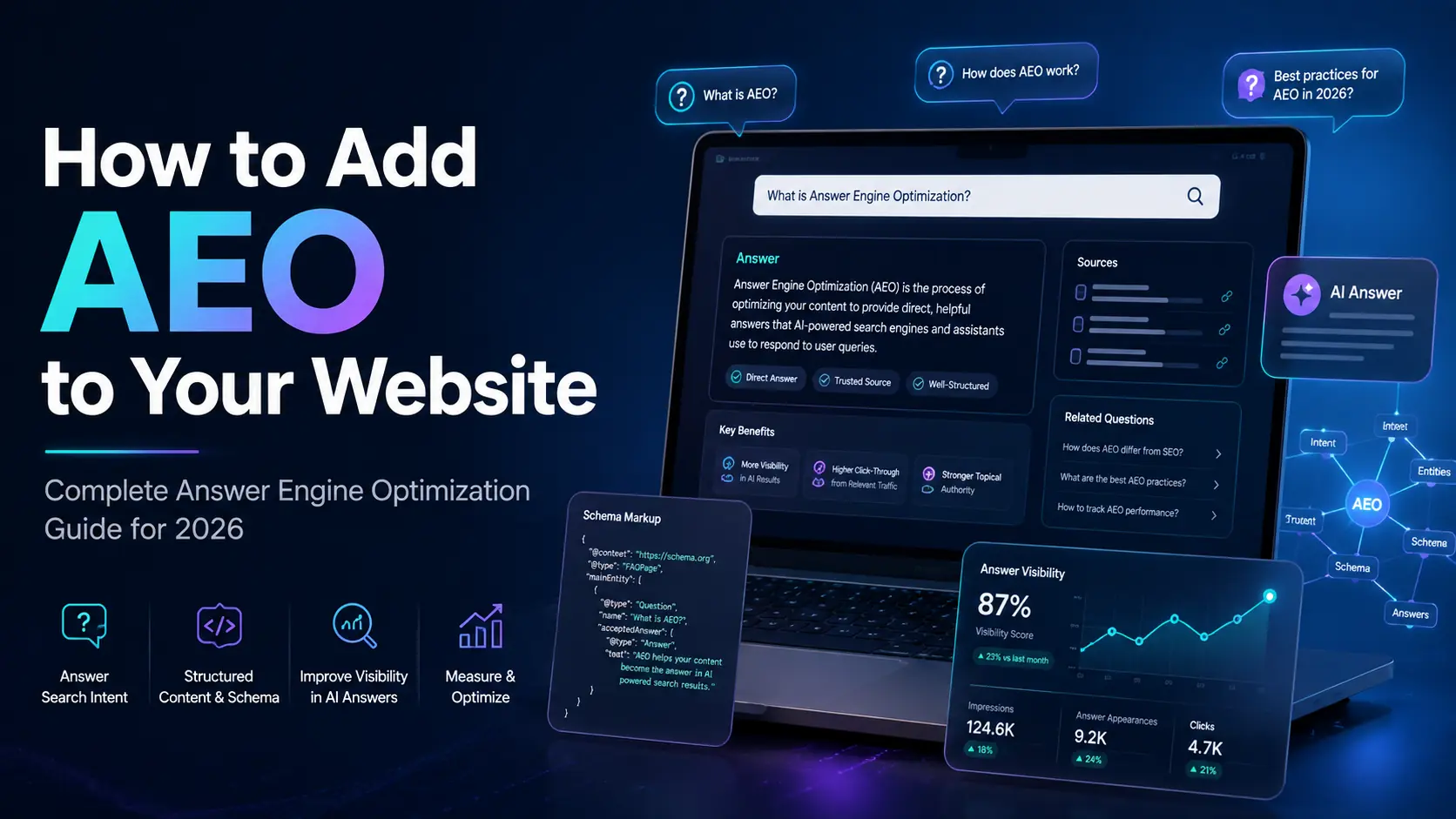
Table of Content
Table of Content
Search is changing faster than it has in years.
People are no longer using only traditional Google search results to find information. They are asking complete questions to AI-powered systems, reading Google AI Overviews, exploring Google AI Mode, using conversational search tools, and expecting immediate, well-supported answers instead of scrolling through ten different websites.
For website owners, bloggers, developers, marketers, and businesses, this shift creates a new challenge: it is no longer enough for your website to simply contain the right keywords. Your content needs to be easy for both people and search systems to understand, retrieve, evaluate, and use when answering questions.
This is where Answer Engine Optimization, commonly called AEO, becomes useful.
AEO does not replace traditional SEO. In fact, Google currently describes optimization for generative AI search as an extension of the same search fundamentals that have powered SEO for years. Google states that its generative AI search experiences, including AI Overviews and AI Mode, continue to rely on core Search ranking and quality systems.
The practical goal, therefore, is not to chase a mysterious "AI ranking hack." It is to build a website that clearly answers real questions, demonstrates genuine expertise, is technically accessible, and provides information that deserves to be referenced.
This guide explains how to add AEO to your website step by step, while keeping SEO, user experience, technical performance, and E-E-A-T at the center of your strategy.
What Is AEO?
Answer Engine Optimization is the process of improving website content so that search engines and AI-powered answer systems can easily understand it and use it to answer a user's question.
Traditional search behavior often looked like this:
"python interview questions"
A conversational search might look like this:
"What Python interview questions should a fresher prepare before applying for a software developer role?"
That difference matters.
The second query contains much more context. The user expects an answer that understands their experience level, objective, and situation.
AEO encourages publishers to create content that responds naturally to these detailed questions.
For example, instead of publishing a page containing nothing more than a list of Python definitions, you could answer:
- What is Python?
- Why is Python popular?
- Is Python easy for beginners?
- What are the most important Python concepts for interviews?
- What is the difference between a list and a tuple?
- When should a developer use Python?
- What are common mistakes beginners make in Python?
This creates a much richer information resource.
How Is AEO Different from Traditional SEO?
SEO and AEO have significant overlap.
Traditional SEO focuses on helping a page become discoverable and competitive in search results through factors such as:
- Helpful content
- Search intent
- Crawlability
- Indexability
- Internal links
- Backlinks
- Page titles
- Meta descriptions
- Website structure
- Page experience
- Structured data
- Authority and trust
AEO builds on those foundations but puts additional emphasis on whether a specific section of your content can clearly satisfy a question.
Google's current guidance is especially important here. Google says there are no additional technical requirements that a website must implement specifically to appear as a supporting link in AI Overviews or AI Mode. A page generally needs to be indexed, eligible for Google Search, and allowed to appear with a snippet.
This means you should be skeptical of anyone claiming that installing one AEO plugin or adding one special file will automatically make your website appear in AI-generated answers.
A strong AEO strategy is mostly about making excellent web content even easier to discover, interpret, and trust.
How AI Answer Engines Find Information
Modern AI-powered search systems may process information differently from a traditional blue-link search page.
Google explains that its generative search experiences can use techniques such as retrieval-augmented generation, often called RAG, where relevant and recent pages are retrieved from the Search index and used to help generate a grounded answer.
Google also describes a technique called query fan-out. Instead of processing only the user's exact wording, the system may generate multiple related searches to explore different parts of the topic.
Imagine someone asks:
"How should a beginner prepare for a cybersecurity interview?"
Related searches could explore topics such as:
- Basic cybersecurity interview questions
- Networking concepts for cybersecurity interviews
- SOC analyst interview preparation
- Cybersecurity projects for freshers
- Common security tools beginners should know
This has an important implication for publishers.
You do not need to create fifty nearly identical pages targeting every possible variation of a question. A better strategy is to create one genuinely comprehensive resource that covers the important subtopics naturally.
Start with Search Intent Instead of Keywords
Keywords are useful, but keywords should not become the entire content strategy.
Before writing a page, ask:
What is the visitor actually trying to accomplish?
Suppose your target keyword is:
"add AEO to website"
Possible intentions include:
- Understanding AEO
- Learning whether AEO is different from SEO
- Finding practical implementation steps
- Learning how to structure articles
- Understanding schema markup
- Improving visibility in AI search
- Knowing how to measure results
A strong article should address these related needs instead of repeating "AEO optimization" dozens of times.
This approach also makes your content sound natural.
Write for the person who arrived on your website because they have a real problem to solve.
Keywords should help you understand demand, not control every sentence you write.
Create Direct Answer Sections
One of the easiest improvements you can make is to answer important questions immediately.
For example:
What is Answer Engine Optimization?
Answer Engine Optimization is the practice of structuring and improving online content so search engines and AI-powered answer systems can understand the information and present it when answering relevant user questions.
That paragraph works because it is:
- Clear
- Self-contained
- Specific
- Easy to understand
- Free from unnecessary introduction
After giving the direct answer, you can expand with examples and deeper explanations.
Avoid beginning every informational section with paragraphs like:
"Technology has changed significantly over the past few years, and in today's fast-paced digital landscape it has become increasingly important..."
That type of introduction consumes space without answering the question.
Get to the useful information quickly.
Build Content Around Real Questions
Question-based headings are extremely useful when they match genuine user intent.
Instead of:
Python Benefits
Consider:
What Are the Main Benefits of Python?
Instead of:
AEO Implementation
Consider:
How Do You Implement AEO on a Website?
Instead of:
Cybersecurity Career
Consider:
How Can a Fresher Start a Career in Cybersecurity?
You do not need to turn every heading into a question. Doing that mechanically can make an article unnatural.
Use questions where people are actually likely to ask questions.
Then provide the answer immediately before expanding on it.
A useful content pattern is:
Question
Direct answer
Explanation
Example
Practical recommendation
Common mistake
Related topic
That structure works well for humans because readers can either scan for a fast answer or continue reading when they need more depth.
Create Unique and Non-Commodity Content
This may be the most important part of modern AEO.
Google's 2026 guidance for generative AI search specifically emphasizes creating valuable, unique, non-commodity content instead of simply recreating information that already exists everywhere online.
Commodity content is information that could easily be produced by almost anyone.
For example:
"10 Benefits of SEO"
If every article contains the same ten generic benefits with slightly different wording, there is little reason for a search or AI system to consider one particular page especially valuable.
Non-commodity content contains something distinctive.
That could include:
- Your own experiment
- First-hand experience
- Original screenshots
- A real project
- A practical workflow
- A case study
- Original code
- Original research
- A comparison based on actual testing
- Lessons learned from mistakes
- Data collected from your own website
- Industry-specific examples
- Expert commentary
For example, instead of writing:
"Internal linking improves SEO."
You could explain:
"On a programming education website, a Python loops tutorial can naturally link to Python syntax, functions, lists, and practice problems. This helps users continue learning in a logical sequence instead of returning to search after every concept."
The second version provides context and practical value.
If you have actually implemented something, describe what happened.
If you tested a strategy, explain your methodology.
If you built a project, show the implementation.
This is where genuine experience becomes difficult for generic content to imitate.
Improve E-E-A-T Signals
E-E-A-T stands for:
Experience, Expertise, Authoritativeness, and Trustworthiness.
Google explains that E-E-A-T itself is not a single specific ranking factor. Instead, its systems use multiple signals that can help identify content demonstrating these qualities. Google also notes that trust is the most important part of the concept.
For AEO-focused content, E-E-A-T should not be treated as a badge you add at the bottom of a blog.
It needs to be demonstrated throughout the website.
Experience
Show that the author has practical exposure to the topic.
For a developer article, you might include:
- Code you personally implemented
- Screenshots of the project
- Problems encountered
- Performance observations
- Deployment steps
- Testing results
Expertise
Demonstrate knowledge through accurate explanations and technical depth.
Do not make simple topics artificially complicated, but do provide enough context that the reader understands both what to do and why it works.
Authoritativeness
Authority develops gradually.
Useful signals can include:
- A focused website topic
- High-quality content library
- Relevant mentions
- Links from trustworthy websites
- Consistent author identity
- Recognized projects
- Industry participation
- Original research
Trustworthiness
Trust should influence almost everything.
Your website should have:
- Accurate author information
- Clear publication dates
- Updated dates when meaningful
- HTTPS
- Contact information
- About page
- Privacy policy
- Editorial standards
- Clear corrections when necessary
- Sources for factual claims
- No misleading promises
If an article discusses security, money, health, or another high-impact subject, accuracy becomes even more important.
Add Strong Author and Publisher Information
Google recommends making it clear who created content, particularly when readers would reasonably expect authorship information. Author bylines should ideally lead to more information about the person behind the article.
Instead of showing only:
"Admin"
use something meaningful:
Written by Aditya Chavhan
Then link the name to a genuine author page.
A useful author profile can include:
- Full name
- Professional introduction
- Primary areas of expertise
- Relevant skills
- Projects
- Experience
- Certifications where applicable
- Published articles
- Professional profiles
Avoid inventing credentials.
Real beginner experience can also be valuable.
For example, someone who has deployed several Next.js applications can legitimately explain the deployment problems they encountered without pretending to be a senior cloud architect.
Transparency is stronger than fabricated authority.
Your organization should also have a detailed About page explaining what the website does, who it helps, and why it exists.
Use Structured Data Correctly
Structured data provides search engines with explicit information about the meaning and type of a page. Google states that structured data can help it understand page content and can make pages eligible for supported search features.
For blog content, Article or BlogPosting structured data is often appropriate.
A simplified JSON-LD example looks like this:
<script type="application/ld+json">
{
  "@context": "https://schema.org",
  "@type": "BlogPosting",
  "headline": "How to Add AEO to Your Website",
  "description": "A complete guide to implementing Answer Engine Optimization on a website.",
  "author": {
    "@type": "Person",
    "name": "Aditya Chavhan",
    "url": "https://example.com/author/aditya-chavhan"
  },
  "publisher": {
    "@type": "Organization",
    "name": "Example Website"
  },
  "datePublished": "2026-09-03",
  "dateModified": "2026-09-03"
}
</script>
Google specifically supports Article, NewsArticle, and BlogPosting structured data for article-type pages and recommends providing properties that accurately represent the visible page content.
Structured data must represent the actual page. Do not create fake authors, reviews, ratings, dates, or information simply to produce more markup.
What About FAQ Schema?
This is an area where many AEO guides are now outdated.
Google deprecated its FAQ rich result feature on May 7, 2026. Therefore, adding FAQ structured data should not be sold as a modern trick for obtaining Google FAQ rich results.
You can still create an FAQ section for readers, and question-and-answer content remains extremely useful.
However, do not assume that adding FAQPage markup will give you a special Google search appearance.
Also avoid using QAPage incorrectly. Google says QAPage is intended for specific question-and-answer experiences, such as pages where users can submit answers. It should not be used for a normal blog article containing several publisher-written FAQs.
Structured data should describe content accurately, not manipulate search appearance.
Improve Your Website's Technical SEO
Excellent content still needs to be discoverable.
AEO cannot compensate for a website that search engines cannot crawl or index.
Make sure important pages:
- Return a successful HTTP response
- Are not accidentally marked
noindex - Are not blocked through robots.txt
- Have canonical URLs
- Are linked internally
- Appear in the XML sitemap
- Work without authentication
- Are mobile-friendly
- Load reliably
- Use HTTPS
Google states that pages generally need to be indexed and eligible to appear in Search with a snippet before they can appear as supporting links in AI features.
That makes technical SEO an essential part of AEO.
Improve Page Experience
A website should be pleasant to use.
Avoid:
- Huge intrusive popups
- Excessive ads above the content
- Layout shifts
- Slow images
- Broken navigation
- Tiny mobile text
- Buttons that move while loading
- Auto-playing distractions
- Pages overloaded with unnecessary JavaScript
Google recommends providing a strong overall page experience, including good Core Web Vitals, secure browsing through HTTPS, mobile usability, and avoiding intrusive interstitials and distracting ads.
Content quality and user experience should support each other.
Build Strong Internal Linking
Internal links help both users and search engines understand relationships between topics.
Imagine you run a programming education website.
Your main page could be:
Python Programming Guide
Supporting pages might include:
- Python Variables
- Python Data Types
- Python Lists
- Python Functions
- Python Loops
- Python OOP
- Python Projects
- Python Interview Questions
These pages should not exist as isolated islands.
Link them naturally.
For example:
"If you're new to Python functions, first review our guide to Python variables and data types."
This creates a logical learning path.
A search engine can also better understand that your website has depth around the broader Python topic.
Avoid inserting fifty unrelated internal links simply because a tool gives you a high SEO score.
Every link should make sense for the reader.
Add Original Examples, Images, and Visuals
Text is not the only useful format.
Google's current generative AI optimization guidance specifically recommends using high-quality images and video when they genuinely support the content because generative search experiences can surface multimedia as well as traditional page links.
For a technical tutorial, consider adding:
- Original screenshots
- Architecture diagrams
- Code output
- Before-and-after results
- Workflow diagrams
- Infographics
- Short demonstrations
Every image should provide a reason for existing.
Do not insert random stock images just to reach an arbitrary image count.
Use descriptive filenames and useful alt text.
Bad alt text:
image123
Better:
AEO content optimization workflow showing question research, direct answers, supporting evidence and technical SEO
Alt text should describe the image accurately rather than becoming another place to stuff keywords.
Optimize Existing Content for AEO
You do not need to rewrite your entire website.
Start with pages that already receive impressions or have strong potential.
Open an article and ask:
- Does the introduction quickly explain the topic?
- Does each major question have a clear answer?
- Is the information current?
- Are unsupported claims sourced?
- Is there first-hand insight?
- Does the article contain examples?
- Can someone understand the important points without reading unnecessary filler?
- Are related topics linked?
- Is the author clearly identified?
- Does structured data accurately describe the page?
- Does the article provide something competitors do not?
- Does the reader have a reason to trust the information?
Then improve weak sections.
Do not update the publication date simply to make old content look fresh. Google specifically warns against changing dates when the content has not actually been substantially updated.
Real updates should involve real improvements.
Make Your Website Easy to Crawl
Your information cannot be retrieved if crawlers cannot access it.
Maintain an XML sitemap containing canonical, indexable pages.
Example:
<url>
  <loc>https://example.com/blog/how-to-add-aeo-to-your-website</loc>
  <lastmod>2026-09-03</lastmod>
</url>
Only update lastmod when the page has genuinely changed.
Also check your robots.txt file.
For example:
User-agent: *
Allow: /

Sitemap: https://example.com/sitemap.xml
Your configuration will depend on your site, so do not copy robots.txt rules blindly.
After publishing important pages, use Google Search Console URL Inspection to see whether Google can access and index them.
Use IndexNow for Faster Discovery
If your site publishes or updates content regularly, IndexNow can be another useful discovery mechanism for search engines that support the protocol.
IndexNow lets a website notify participating search engines when a URL is:
- Added
- Updated
- Deleted
Its official documentation explains that submitted URLs are shared among participating IndexNow-enabled search engines. It also recommends using IndexNow for recently changed URLs while continuing to use XML sitemaps for broader site discovery.
This does not guarantee indexing or rankings.
It simply helps notify supported search engines that something changed.
For websites built with custom frameworks such as Next.js or Node.js, the submission process can also be automated after publishing or updating content.
Measure AEO Performance
AEO should be measured rather than treated as a one-time optimization.
Track metrics such as:
- Search impressions
- Organic clicks
- Click-through rate
- Queries generating impressions
- Indexed pages
- Engagement
- Conversions
- Returning visitors
- Branded searches
- Mentions and citations where measurable
Google's latest generative AI optimization guidance also recommends monitoring visibility through Search Console and its generative AI reporting capabilities where available.
Do not judge success solely by whether an AI answer quotes one sentence from your article.
A visitor discovering your brand, opening another page, subscribing, booking a service, downloading a resource, or returning later can be much more valuable.
Common AEO Mistakes to Avoid
1. Keyword Stuffing
Repeating phrases such as "best AEO optimization website strategy" in every paragraph does not create expertise.
Write naturally.
2. Creating Hundreds of Near-Duplicate Question Pages
Do not create separate pages for:
- What is AEO?
- What does AEO mean?
- Meaning of AEO
- AEO definition
- Define AEO
when one strong page can satisfy all of those intents.
Google warns against producing large volumes of pages mainly to manipulate rankings or generative AI responses.
3. Publishing Generic AI-Generated Content Without Added Value
AI can help with research, outlining, editing, and organization.
The problem begins when a website mass-publishes generic pages with no originality, expertise, or editorial effort.
Google's guidance says generative AI can be useful in content creation, but using it to generate many low-value pages can violate scaled content abuse policies.
4. Believing Structured Data Guarantees AI Citations
It does not.
Schema can help search engines understand a page, but there is no guaranteed "AI citation schema."
5. Ignoring Traditional SEO
AEO does not eliminate:
- Crawling
- Indexing
- Internal linking
- Technical SEO
- Search intent
- Page quality
- Authority
- User experience
Google explicitly says foundational SEO remains relevant for generative AI search.
6. Writing for Word Count Instead of Usefulness
There is no magical 1,500-word or 2,000-word threshold.
A topic requiring 500 words should not be stretched into 3,000 words of repetition.
Likewise, a complex topic should not be compressed into 400 words simply because short content is faster to publish.
The correct length is the length necessary to satisfy the reader thoroughly.
7. Hiding the Author
Anonymous content can make trust harder to establish when expertise matters.
Show who wrote the article and why readers should trust their work.
8. Using Fake Experience
Do not claim:
"We tested 30 tools"
if you did not test them.
Do not create fake screenshots, statistics, reviews, or personal stories.
AEO built on fabricated experience is fundamentally weak because trust is one of the most important qualities a website can develop.
Practical AEO Checklist for Your Website
Before publishing an informational page, check the following.
Content
- The page addresses a real user problem.
- The introduction clearly explains what the reader will learn.
- Important questions receive direct answers.
- The page provides meaningful depth.
- Information is accurate and current.
- Examples are included where useful.
- Generic filler has been removed.
- The article contains original value.
E-E-A-T
- A real author is displayed.
- The author has a profile page.
- Relevant experience is demonstrated.
- Important factual claims have credible sources.
- The website has an About page.
- Contact information is available.
- Publication and update dates are accurate.
- The website clearly explains its purpose.
Technical SEO
- The page is indexable.
- The canonical URL is correct.
- The page appears in the XML sitemap.
- Robots.txt does not accidentally block it.
- HTTPS works correctly.
- Mobile layout is usable.
- Performance is acceptable.
- Important content is accessible without login.
Structured Data
- Appropriate Article or BlogPosting markup is added when relevant.
- Author information matches the visible page.
- Dates are accurate.
- Images are valid.
- Structured data contains no fake information.
- Markup is tested before deployment.
Content Architecture
- Related pages link to each other.
- Anchor text is descriptive.
- Topic clusters are logical.
- Important pages are not orphaned.
- Headings represent genuine subtopics.
- Navigation helps people explore deeper information.
User Experience
- The answer is easy to find.
- Paragraphs are readable.
- Headings make the page scannable.
- Ads do not overwhelm the content.
- Images provide value.
- The page loads reliably.
- The visitor can easily identify the main content.
Final Thoughts
Answer Engine Optimization is not about finding a secret technique that forces ChatGPT, Google AI Overviews, AI Mode, Bing, or another answer engine to mention your website.
The strongest approach is much more sustainable.
Create content that deserves to be retrieved.
Answer real questions clearly.
Demonstrate first-hand experience where you have it.
Add expert explanation instead of repeating common information.
Show who created the content.
Support important claims with reliable sources.
Keep your website technically accessible.
Use structured data accurately.
Build logical relationships between topics.
Improve your pages when new information becomes available.
Most importantly, give visitors something they could not get from a generic summary.
The web is increasingly filled with articles that repeat the same information. That makes originality more valuable, not less.
A website that combines strong technical SEO, useful answers, genuine expertise, original examples, clear authorship, reliable sourcing, and a good user experience is building something much stronger than an "AEO optimized page."
It is building a resource that people and search systems have a reason to trust.
That is the foundation of sustainable visibility in modern search.
Frequently Asked Questions
1. What is AEO in SEO?
AEO stands for Answer Engine Optimization. It focuses on making website content clear, useful, trustworthy, and easy for search and AI-powered systems to understand when answering user questions. AEO works alongside traditional SEO rather than replacing it.
2. How do I add AEO to my website?
Start by identifying real user questions, answering them directly, organizing information with descriptive headings, adding original examples, improving author and trust signals, implementing appropriate structured data, building internal links, ensuring pages are crawlable and indexable, and regularly updating information when meaningful changes occur.
3. Does AEO help a website appear in Google AI Overviews?
Good AEO practices can align your website with the qualities useful for generative search, but they cannot guarantee inclusion. Google says there are no special technical requirements for AI Overviews or AI Mode beyond being eligible for normal Google Search with a snippet. Strong foundational SEO and high-quality, useful content remain central.
4. Do I need FAQ schema for AEO in 2026?
You do not need FAQ schema to implement AEO. A visible FAQ section can still be useful because it answers common reader questions clearly, but Google deprecated FAQ rich results in May 2026. Structured data should be added only when it accurately represents the content and serves a legitimate purpose, not because someone promises it will automatically produce AI visibility.
5. Is AEO better than SEO?
AEO and SEO should not be treated as competing strategies. SEO provides the technical, content, authority, and discovery foundations required for search visibility, while AEO emphasizes making information especially useful for question-based and AI-assisted search experiences. The strongest strategy combines both.