
How Blockchain Can Prevent AI Data Tampering
how blockchain prevents AI data tampering through immutable records, cryptographic verification, decentralized trust, and transparent audit trails. Explore real-world use cases, benefits, challenges, and future trends.

Table of Content
Table of Content
How Blockchain Can Prevent AI Data Tampering
Part 1: Understanding the Problem and Why Blockchain Matters
Artificial Intelligence (AI) has become one of the most influential technologies of this decade. It powers recommendation engines, detects fraud, assists doctors in diagnosing diseases, automates customer support, and even drives autonomous vehicles. Organizations across industries rely on AI systems to analyze enormous amounts of data and make decisions faster than humans ever could.
However, there is one fundamental truth that determines whether an AI system is trustworthy or dangerous:
An AI model is only as reliable as the data it learns from and the data it receives.
If someone intentionally changes, deletes, manipulates, or injects false information into an AI system, the AI can produce inaccurate predictions, unfair decisions, or even harmful outcomes. This issue is known as AI data tampering, and it has become one of the biggest security challenges in modern artificial intelligence.
As AI becomes more deeply integrated into healthcare, banking, government services, manufacturing, cybersecurity, and autonomous systems, protecting AI data is no longer optional it is essential. Traditional cybersecurity tools such as encryption, firewalls, and access control are valuable, but they cannot always provide complete transparency into whether data has been altered over time.
This is where blockchain technology offers a powerful solution.
Blockchain is widely known as the technology behind cryptocurrencies like Bitcoin, but its true strength extends far beyond digital currencies. At its core, blockchain creates a secure, transparent, and tamper-resistant record of information that is extremely difficult to modify without detection.
When blockchain is combined with artificial intelligence, organizations gain the ability to verify data integrity, establish trust, improve transparency, and significantly reduce the risk of malicious data manipulation.
In this guide, you'll learn how blockchain can prevent AI data tampering, why this combination matters for the future of trustworthy AI, and how industries are already exploring this powerful partnership.
What Is AI Data Tampering?
AI data tampering refers to the unauthorized modification of data used by an artificial intelligence system before, during, or after model training.
Because AI depends heavily on data, even small modifications can dramatically influence the decisions an AI system makes.
Unlike traditional software, AI systems continuously learn from information. If attackers can influence that information, they can indirectly control the AI's behavior.
Imagine teaching a student using incorrect textbooks for an entire year. Even if the student studies hard, the final knowledge will still contain mistakes.
AI behaves similarly.
When training data becomes corrupted, biased, incomplete, or intentionally manipulated, the AI model learns incorrect patterns.
The consequences can range from minor prediction errors to catastrophic business failures.
Why AI Depends on Data Integrity
Data integrity means that information remains:
- Accurate
- Complete
- Consistent
- Authentic
- Unchanged without authorization
Every AI project typically follows this pipeline:
Data Collection
↓
Data Storage
↓
Data Cleaning
↓
Model Training
↓
Model Validation
↓
Deployment
↓
Continuous Learning
If attackers tamper with data at any stage, the final AI output becomes unreliable.
For example:
- Wrong customer data produces poor recommendations.
- Modified medical records create incorrect diagnoses.
- Manipulated financial transactions lead to fraud detection failures.
- Fake sensor data causes autonomous vehicles to make unsafe decisions.
This demonstrates why protecting data throughout the AI lifecycle is far more important than simply protecting the AI model itself.
Types of AI Data Tampering
AI data tampering can occur in multiple ways depending on the target and the attacker's objective.
1. Training Data Poisoning
This is one of the most dangerous attacks.
Attackers secretly insert false or misleading data into the training dataset.
As the AI learns from poisoned information, its future predictions become inaccurate.
For example:
A spam detection model is trained using thousands of emails.
An attacker intentionally labels spam emails as "safe."
The AI gradually learns incorrect patterns and begins allowing malicious emails into users' inboxes.
The model appears to function normally but has been compromised from within.
2. Dataset Manipulation
Instead of injecting fake records, attackers modify existing data.
Examples include:
- Changing product prices
- Editing customer histories
- Altering medical records
- Modifying financial statements
- Replacing sensor readings
Since AI assumes historical data is accurate, these changes directly influence future predictions.
3. Data Deletion
Sometimes attackers simply remove important records.
Missing information creates blind spots in AI models.
For example:
Removing fraud cases from historical banking data causes fraud detection models to become less effective because they no longer learn from previous attacks.
4. Unauthorized Data Updates
Insiders or compromised administrators may change records after the AI model has already been deployed.
Without an audit trail, organizations may never discover when the modification occurred or who made it.
This lack of accountability creates significant security risks.
5. Synthetic Fake Data Injection
Generative AI can create realistic fake documents, images, videos, voice recordings, and datasets.
If these synthetic records enter AI training pipelines without verification, models begin learning from fabricated information.
This problem has become increasingly important with the rapid growth of AI-generated content.
Why Traditional Databases Are Vulnerable
Most AI systems still rely on centralized databases.
Although these databases include backups, authentication, and encryption, they often suffer from one major limitation:
Authorized users can still modify stored data.
If a privileged account becomes compromised, attackers may:
- Edit records
- Delete files
- Replace datasets
- Change timestamps
- Hide malicious activity
In many organizations, logs can also be altered.
This makes forensic investigations extremely difficult.
Imagine a company storing millions of customer transactions.
If an administrator changes thousands of records, detecting exactly which records changed and when can take days or even weeks.
In some cases, organizations may never discover the manipulation.
The Growing Cost of AI Data Tampering
The financial impact of compromised AI systems extends beyond technical failures.
Organizations may experience:
Financial Losses
Incorrect AI predictions can lead to:
- Wrong investment decisions
- Failed inventory planning
- Revenue loss
- Fraud
Even small data changes can influence millions of dollars in automated decisions.
Reputation Damage
Trust is difficult to earn and easy to lose.
If customers discover that an AI system made decisions using manipulated data, confidence in the organization declines rapidly.
This is especially serious for healthcare providers, banks, and government agencies.
Regulatory Compliance Issues
Many industries must comply with regulations requiring accurate records.
Examples include:
- Healthcare
- Finance
- Insurance
- Pharmaceuticals
- Government services
If organizations cannot prove that AI training data remained unchanged, they may face investigations, legal consequences, or financial penalties.
Ethical Concerns
Biased or manipulated datasets can produce unfair AI decisions.
Examples include:
- Hiring discrimination
- Loan approval bias
- Healthcare inequality
- Criminal justice errors
Maintaining trustworthy data is therefore not only a technical responsibility but also an ethical obligation.
Real-World Examples of AI Data Tampering Risks
Understanding real-world scenarios helps illustrate why protecting AI data is so important.
Healthcare
An AI model predicts cancer risk based on patient records.
If medical histories are altered before training, the AI may recommend incorrect treatments or fail to detect serious illnesses.
In healthcare, inaccurate predictions can directly affect patient safety.
Banking
Banks use AI to identify suspicious financial transactions.
If attackers manipulate historical fraud data, the AI may begin approving fraudulent transactions while blocking legitimate customers.
This increases both financial losses and customer dissatisfaction.
Autonomous Vehicles
Self-driving vehicles continuously process camera feeds, GPS information, and sensor data.
If attackers manipulate these inputs, the vehicle may misunderstand road conditions and make unsafe driving decisions.
Even a small amount of incorrect data can have serious consequences.
Manufacturing
Factories use predictive maintenance powered by AI.
Sensor data determines when machines require servicing.
If attackers modify sensor readings, equipment failures may go undetected, leading to unexpected downtime, expensive repairs, and production delays.
Cybersecurity
Modern security platforms use AI to detect malware and network intrusions.
If attackers poison training datasets, the AI may fail to recognize new threats, leaving entire networks vulnerable.
Ironically, AI designed to improve security can become a security risk itself if its data is compromised.
Why Trust Is Becoming the Most Valuable Asset in AI
As AI systems become more autonomous, users increasingly ask an important question:
"Can we trust the decisions this AI makes?"
The answer depends on whether organizations can prove that:
- The original data was authentic.
- Records were not secretly modified.
- Every update is traceable.
- The complete history of the data is preserved.
- Unauthorized changes can be detected immediately.
Traditional databases struggle to provide this level of transparency because administrators with sufficient privileges may still alter records or logs.
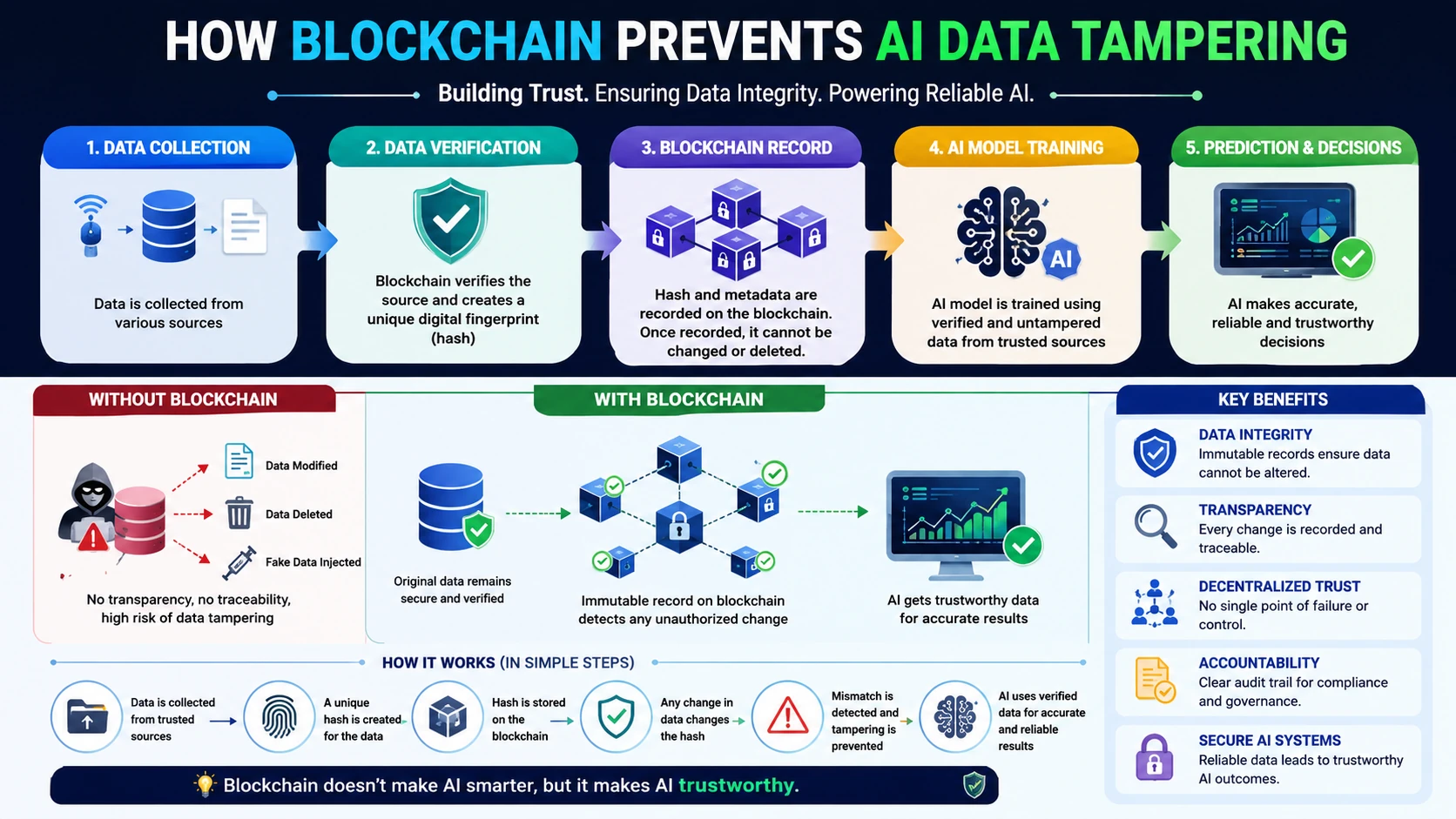
This is where blockchain introduces a fundamentally different approach. Instead of relying on trust in a single organization or database administrator, blockchain creates an immutable record that allows data integrity to be verified independently.
Understanding Blockchain in Simple Terms
Think of blockchain as a digital notebook shared across many computers.
Every time new information is added, it is recorded inside a block. Once that block is verified, it is linked to the previous block using advanced cryptographic techniques, forming a continuous chain.
Because every participant in the network stores the same copy of the blockchain, changing a past record becomes extremely difficult. Any attempt to modify a previous entry would create inconsistencies across the network, making the tampering immediately detectable.
Unlike traditional databases where authorized users may edit records, blockchain preserves the complete history of every transaction.
This immutability is exactly what AI systems need to ensure that training data and operational data remain trustworthy.
How Blockchain Protects AI Data
Blockchain secures AI data through multiple layers of protection rather than relying on a single security mechanism.
Let's explore each one.
1. Immutable Data Storage
One of blockchain's most important features is immutability.
Once information has been recorded and confirmed by the network, it cannot be secretly modified.
For AI systems, this means:
- Original training datasets remain unchanged.
- Historical records stay intact.
- Data lineage is preserved.
- Unauthorized edits become immediately visible.
Imagine an AI model trained on one million customer transactions.
If someone changes even one transaction later, blockchain detects the inconsistency because the cryptographic fingerprint no longer matches the original record.
Instead of silently accepting altered data, the system immediately identifies that something has changed.
2. Cryptographic Hash Verification
Blockchain protects every record using cryptographic hashing.
A hash is a unique digital fingerprint generated from data.
For example:
Original Data
↓

SHA-256 Hash

↓

A94F3D1F8A6C9E...
Even changing a single letter produces an entirely different hash.
For example:
Customer Balance = ₹10,000

↓

Hash A
If someone changes the balance to:
Customer Balance = ₹10,001

↓

Hash B
Hash A and Hash B become completely different.
This makes hidden modifications nearly impossible.
AI systems can compare stored hashes with current data before training or making predictions.
If the hashes don't match, the data has been altered.
3. Complete Audit Trail
Traditional databases often overwrite existing records.
Blockchain never does.
Instead of replacing information, every update is stored as a new transaction.
This creates a permanent history showing:
- Who added the data
- When it was added
- What changed
- Why it changed
- Which version AI used
This audit trail is especially valuable in industries that require accountability.
Examples include:
- Banking
- Healthcare
- Government
- Insurance
- Supply chain
- Pharmaceuticals
If regulators ask where a dataset originated, blockchain provides a verifiable history instead of relying on manually maintained logs.
4. Decentralization Reduces Single Points of Failure
Traditional AI systems usually depend on centralized servers.
If attackers compromise that server, they may gain access to the entire dataset.
Blockchain distributes identical copies across multiple nodes.
Instead of trusting one database, trust is shared across the network.
Benefits include:
- Higher availability
- Better fault tolerance
- Resistance to insider attacks
- Greater resilience against cyberattacks
Even if one node is compromised, the remaining nodes still maintain the correct version of the data.
5. Transparent Data Provenance
Data provenance answers an important question:
"Where did this data come from?"
For AI systems, knowing the origin of training data is critical.
Blockchain records:
- Data source
- Collection time
- Data owner
- Validation status
- Processing history
Organizations can therefore prove that AI models were trained using authentic and verified datasets.
This becomes increasingly important as AI-generated content becomes more common.
6. Smart Contracts for Automated Validation
Smart contracts are self-executing programs stored on a blockchain.
They automatically enforce predefined rules without requiring manual intervention.
For AI workflows, smart contracts can verify:
- Dataset authenticity
- Required approvals
- Data quality standards
- Access permissions
- Compliance policies
Example workflow:
New Dataset Uploaded
↓

Smart Contract Checks

↓

Source Verified?

↓

Integrity Verified?

↓

Quality Passed?

↓

Approved for AI Training
If any condition fails, the dataset is automatically rejected.
This reduces human error and strengthens security.
AI Lifecycle Protected by Blockchain
Blockchain can secure every stage of the AI lifecycle.
Data Collection
Sensors, IoT devices, business applications, and APIs generate data.
Blockchain records when and where each dataset originated.
Data Storage
Instead of trusting a single storage server, blockchain stores cryptographic proofs that verify data integrity.
Organizations often keep large datasets in secure cloud storage while storing their hashes on the blockchain.
This approach provides both scalability and verification.
Data Preparation
Cleaning and preprocessing are common steps before training.
Blockchain records every modification made during preprocessing.
Organizations can always trace how raw data became training data.
Model Training
Before training begins, AI verifies that every dataset matches its blockchain hash.
Only verified data enters the training pipeline.
Model Deployment
Blockchain records:
- Model version
- Training dataset version
- Deployment date
- Responsible team
This improves reproducibility and accountability.
Continuous Learning
Many AI systems continue learning after deployment.
Blockchain verifies every newly added dataset before allowing retraining.
This significantly reduces the risk of long-term data poisoning attacks.
Real-World Use Cases
Healthcare
Hospitals increasingly rely on AI for diagnostics and treatment recommendations.
Blockchain can record every patient record used for AI training.
Benefits include:
- Authentic medical histories
- Protected patient records
- Transparent data sharing
- Regulatory compliance
Doctors can trust that AI recommendations are based on verified information.
Financial Services
Banks process millions of transactions every day.
Blockchain ensures transaction histories remain authentic before AI analyzes them for:
- Fraud detection
- Credit scoring
- Risk assessment
- Anti-money laundering
This reduces the risk of manipulated financial data influencing AI decisions.
Supply Chain Management
Supply chain AI predicts inventory demand and shipping schedules.
Blockchain records every product movement from manufacturer to customer.
AI therefore works with trusted logistics information instead of potentially altered records.
Autonomous Vehicles
Self-driving vehicles generate massive amounts of sensor data.
Blockchain verifies:
- Sensor authenticity
- Software updates
- Vehicle logs
- Training datasets
This strengthens confidence in autonomous decision-making.
Cybersecurity
Security platforms powered by AI constantly learn from threat intelligence.
Blockchain verifies:
- Malware samples
- Threat reports
- Security events
- Incident timelines
This prevents attackers from poisoning threat intelligence databases.
Benefits of Combining Blockchain and AI
Organizations gain several long-term advantages when these technologies work together.
Increased Trust
Verified data leads to more trustworthy AI predictions.
Better Security
Tampering attempts become significantly easier to detect.
Higher Transparency
Every decision can be traced back to its original dataset.
Improved Compliance
Organizations can demonstrate data integrity during audits.
Reduced Fraud
Manipulating AI training data becomes much more difficult.
Stronger Collaboration
Multiple organizations can securely share verified datasets without relying entirely on a single trusted intermediary.
Challenges of Using Blockchain with AI
Although blockchain offers powerful security benefits, it is not a perfect solution.
Organizations must also consider its limitations.
Scalability
AI datasets are often enormous, ranging from gigabytes to petabytes.
Storing all this data directly on a blockchain is impractical.
A common solution is to store the actual data off-chain while recording cryptographic hashes on the blockchain.
Storage Costs
Public blockchains are expensive for large-scale storage.
Most enterprise AI systems use private or hybrid blockchain networks to reduce costs while maintaining integrity.
Performance
Blockchain transactions require validation before they are finalized.
Real-time AI applications may need optimized architectures that balance speed with security.
Privacy
Some AI datasets contain highly sensitive information.
Organizations must ensure confidential data remains protected, even while using blockchain for verification.
Techniques such as encryption, permissioned blockchains, and zero-knowledge proofs can help address these concerns.
Why Blockchain Is Becoming an Essential Layer for Trustworthy AI
Artificial intelligence is becoming more autonomous every year. It now influences decisions about healthcare, finance, cybersecurity, transportation, and public services.
As AI's role grows, trust becomes just as important as intelligence.
Blockchain provides that trust by ensuring data cannot be silently manipulated, every change is recorded transparently, and AI systems can verify the integrity of the information they rely on before making decisions.
Rather than replacing existing databases, blockchain complements them by acting as an independent verification layer that strengthens the entire AI ecosystem.
Artificial intelligence is evolving at an incredible pace. Every day, AI systems process more data, make more decisions, and automate more critical tasks across industries. At the same time, cyber threats are becoming increasingly sophisticated, targeting not only computer systems but also the data that powers AI.
This growing dependence on trustworthy data has created a new challenge: How can organizations prove that the information used by AI has not been altered?
Blockchain is emerging as one of the strongest answers to this question.
Rather than focusing only on preventing attacks, blockchain provides something equally valuable verifiable trust. It creates a transparent history of data that allows organizations, regulators, and users to confirm that AI systems are making decisions based on authentic information.
As businesses continue investing in AI-driven automation, the partnership between blockchain and artificial intelligence is expected to become an essential part of secure digital infrastructure.
The Future of Blockchain and AI
The integration of blockchain and AI is still in its early stages, but its future potential is enormous.
Over the next decade, these technologies are expected to work together in ways that improve transparency, security, automation, and collaboration across industries.
Some of the most promising developments include:
1. Trusted AI Training Pipelines
Future AI systems will increasingly verify every dataset before training begins.
Instead of blindly accepting uploaded data, AI platforms will check blockchain records to confirm:
- Data authenticity
- Source credibility
- Collection time
- Previous modifications
- Ownership
This reduces the chances of training on manipulated or low-quality data.
2. Explainable AI with Blockchain Records
One of the biggest challenges in AI today is explainability.
Many AI models make decisions that are difficult for humans to understand.
Blockchain can improve transparency by recording:
- Which dataset was used
- Which model version made the decision
- When the prediction occurred
- What updates happened afterward
This creates a complete decision history that auditors and developers can review.
3. Decentralized AI Networks
Today, most AI services are controlled by centralized companies.
In the future, decentralized AI marketplaces may allow individuals and organizations to:
- Share verified datasets
- Rent AI models
- Sell computing power
- Train collaborative AI systems
Blockchain enables these ecosystems by providing secure ownership records and automated payment systems through smart contracts.
4. Secure IoT and AI Integration
Billions of IoT devices generate data every second.
Examples include:
- Smart factories
- Smart cities
- Wearable devices
- Agricultural sensors
- Connected vehicles
Blockchain can verify that sensor data remains authentic before AI analyzes it.
This significantly improves decision-making in environments where data accuracy is critical.
5. Trusted AI in Government Services
Governments increasingly use AI for:
- Identity verification
- Tax processing
- Public health
- Traffic management
- Document verification
Blockchain provides immutable records that improve transparency while reducing opportunities for data manipulation.
This can increase public confidence in AI-powered government systems.
Emerging Industry Trends
Several trends indicate that blockchain and AI will become more closely connected in the coming years.
AI Governance
Organizations are creating policies that define how AI systems should be developed and monitored.
Blockchain helps maintain tamper-proof records required for governance and compliance.
Responsible AI
Businesses want AI systems that are:
- Fair
- Transparent
- Accountable
- Explainable
Blockchain supports these goals by preserving an auditable history of AI data and model updates.
Data Ownership
Individuals are becoming more aware of how companies use their personal information.
Blockchain can help users retain greater control over their data by recording ownership and consent.
Cross-Organization Collaboration
Healthcare providers, research institutions, and financial organizations often need to share data.
Blockchain enables secure collaboration while ensuring every participant accesses verified information.
Best Practices for Combining Blockchain and AI
Organizations should follow proven strategies to maximize the benefits of integrating blockchain with AI.
Verify Data Before Training
Never assume incoming datasets are trustworthy.
Validate:
- Data source
- Integrity
- Ownership
- Collection method
before AI training begins.
Store Large Files Off-Chain
Blockchain is excellent for verification but not ideal for storing massive datasets.
A common architecture is:
Large Dataset
│
▼
Secure Cloud Storage
│
▼
Generate Cryptographic Hash
│
▼
Store Hash on Blockchain
This approach combines scalability with strong data integrity.
Record Every Model Version
Whenever an AI model changes, record:
- Version number
- Training dataset
- Training date
- Hyperparameters
- Responsible team
This improves reproducibility and simplifies audits.
Use Permissioned Blockchains for Enterprise AI
Public blockchains are not always the best choice for business applications.
Permissioned blockchain networks offer:
- Better performance
- Lower costs
- Greater privacy
- Controlled access
These features make them well suited for enterprise AI deployments.
Implement Strong Access Controls
Blockchain alone cannot stop every attack.
Organizations should also implement:
- Multi-factor authentication
- Role-based access control
- Encryption
- Regular security audits
- Continuous monitoring
Security should always involve multiple protective layers.
Monitor AI Continuously
AI systems evolve over time.
Organizations should regularly monitor:
- Dataset quality
- Prediction accuracy
- Model drift
- Security events
- Blockchain verification logs
Continuous monitoring helps identify problems before they become major incidents.
Common Misconceptions About Blockchain and AI
"Blockchain Makes AI Smarter"
Not exactly.
Blockchain improves trust and security.
The intelligence still comes from AI algorithms.
"Blockchain Stores Every AI Dataset"
In most cases, it does not.
Large datasets are usually stored securely outside the blockchain.
The blockchain stores hashes and verification records instead.
"Blockchain Eliminates All Cyber Threats"
No technology can eliminate every threat.
Blockchain significantly reduces the risk of unauthorized data manipulation, but organizations still need comprehensive cybersecurity practices.
"Only Cryptocurrency Companies Need Blockchain"
This is one of the biggest myths.
Industries adopting blockchain include:
- Healthcare
- Banking
- Manufacturing
- Logistics
- Government
- Education
- Retail
- Insurance
- Energy
Its value lies in trust and transparency, not just digital currencies.
Key Takeaways
Before we conclude, let's summarize the most important points from this guide.
- AI systems are only as reliable as the data they use.
- Data tampering can lead to incorrect predictions, financial losses, and security risks.
- Blockchain provides immutable and transparent records that protect data integrity.
- Cryptographic hashes make unauthorized modifications easy to detect.
- Smart contracts automate data validation and compliance checks.
- Blockchain creates complete audit trails that improve accountability.
- The combination of blockchain and AI supports more trustworthy, explainable, and secure intelligent systems.
- Organizations should view blockchain as a trust layer that strengthens AI rather than replacing existing infrastructure.
Final Thoughts
Artificial intelligence is transforming how we work, learn, communicate, and solve complex problems. From healthcare diagnostics and financial risk analysis to cybersecurity and autonomous vehicles, AI is becoming deeply integrated into critical systems that affect millions of people every day.
However, no AI model can produce reliable results if the data it relies on has been manipulated. As cyber threats continue to evolve, protecting AI data is no longer just a technical challenge is a business necessity.
Blockchain offers a practical and powerful solution by ensuring that data remains transparent, verifiable, and resistant to unauthorized changes. Through immutable records, cryptographic verification, decentralized trust, and complete audit trails, blockchain helps organizations build AI systems that people can trust.
Although implementing blockchain requires careful planning and comes with challenges such as scalability and storage costs, its long-term value in strengthening AI security is significant.
As AI adoption accelerates, organizations that prioritize data integrity today will be better positioned to build reliable, ethical, and compliant AI solutions tomorrow. The future of artificial intelligence will not depend solely on smarter algorithms it will also depend on trustworthy data, and blockchain is poised to play a central role in making that trust possible.
Frequently Asked Questions (FAQs)
1. What is AI data tampering?
AI data tampering is the unauthorized modification, deletion, or insertion of data used by an AI system. This can happen before training, during deployment, or while the model is continuously learning. Tampered data can lead to inaccurate predictions, biased decisions, and security vulnerabilities.
2. How does blockchain protect AI data?
Blockchain protects AI data by creating immutable records, using cryptographic hashes to verify integrity, maintaining transparent audit trails, and distributing trust across multiple nodes. These features make unauthorized modifications much easier to detect and significantly improve data reliability.
3. Can blockchain completely prevent AI attacks?
No. Blockchain cannot stop every type of cyberattack, but it is highly effective at protecting data integrity and detecting unauthorized changes. Organizations should combine blockchain with encryption, access controls, monitoring, and other cybersecurity measures for comprehensive protection.
4. Which industries benefit most from combining blockchain and AI?
Many industries can benefit, including healthcare, banking, insurance, manufacturing, logistics, government, retail, cybersecurity, education, and supply chain management. Any sector that relies on accurate, trustworthy data can improve security and transparency by integrating blockchain with AI.
5. Is blockchain necessary for every AI application?
Not always. Small AI projects with low security requirements may not need blockchain. However, applications involving sensitive data, regulatory compliance, financial transactions, healthcare records, or mission-critical decision-making can gain significant advantages from blockchain's ability to verify data integrity and maintain transparent audit trails.