Real World Asset (RWA) Tokenization Explained: The Complete Beginner's Guide
Learn what Real World Asset (RWA) Tokenization is, how it works, its benefits, challenges, real-world examples, and why it is transforming the future of blockchain and finance. A complete beginner-friendly guide.
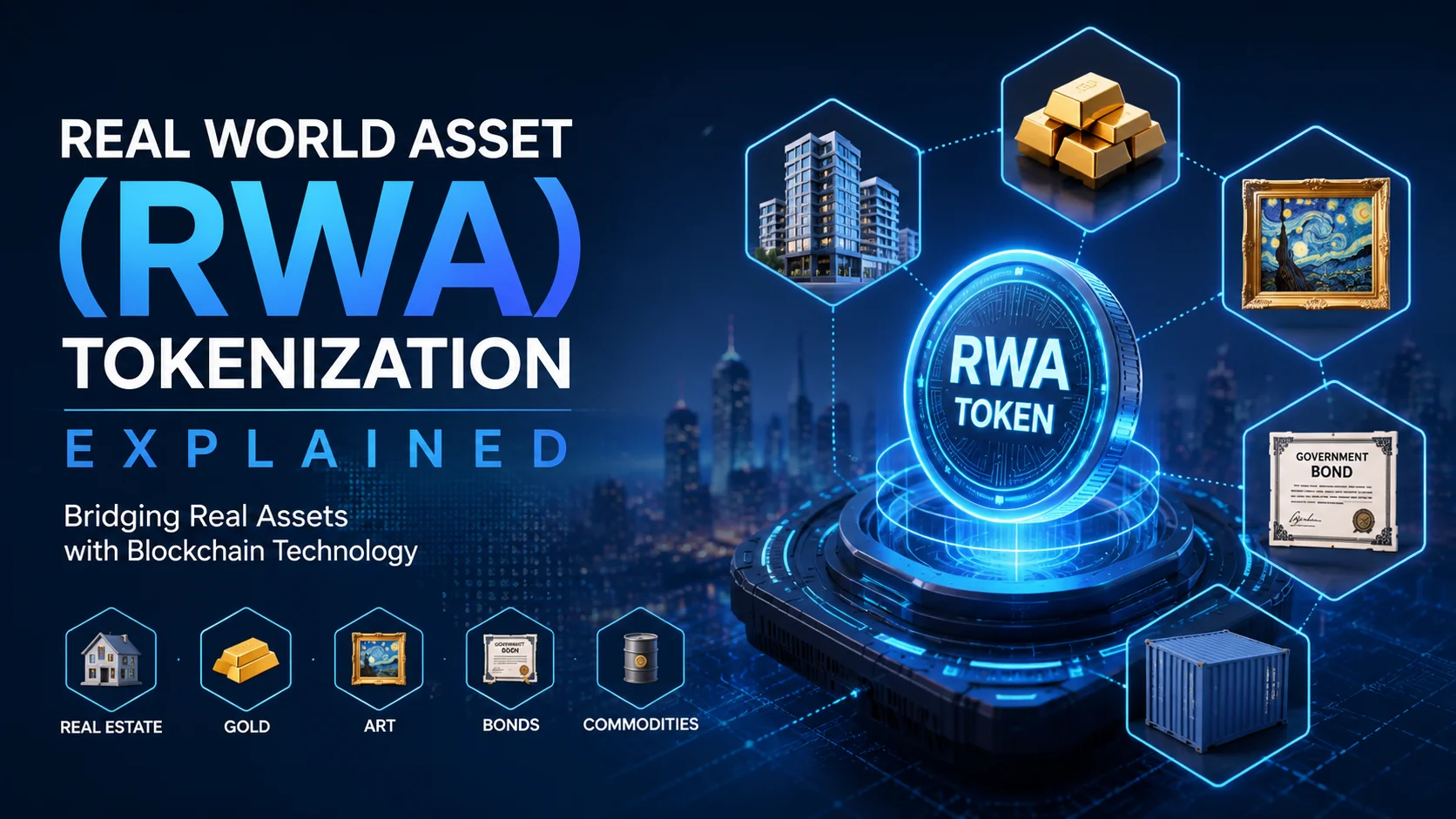
Table of Content
Table of Content
Introduction
Blockchain technology has evolved far beyond cryptocurrencies. While Bitcoin introduced the idea of decentralized digital money and Ethereum expanded it with smart contracts, a new innovation is now attracting serious attention from investors, businesses, financial institutions, and governments. This innovation is called Real World Asset (RWA) Tokenization.
If you have been following the Web3 space recently, you have probably seen the term "RWA" mentioned frequently. Many experts believe that tokenizing real-world assets could become one of the biggest use cases for blockchain over the next decade. Large financial companies, banks, investment firms, and even governments are actively experimenting with this technology.
But what exactly does RWA Tokenization mean?
How can a physical asset like a house, artwork, gold bar, or government bond exist on a blockchain? Why are major institutions investing billions of dollars into this idea? Most importantly, why should developers, investors, and everyday users care?
This guide explains everything in simple English. Whether you are completely new to blockchain or already exploring Web3, by the end of this article you will understand how RWA Tokenization works, why it matters, its advantages, challenges, real-world examples, and what the future may look like.
What is Real World Asset (RWA) Tokenization?
Real World Asset Tokenization is the process of converting ownership rights of physical or traditional financial assets into digital tokens on a blockchain.
Instead of relying entirely on paper documents, centralized databases, or manual ownership records, blockchain technology creates digital tokens that represent ownership of an actual asset.
These tokens can represent full ownership or even fractional ownership.
Imagine a luxury apartment worth $1 million.
Instead of selling the entire property to one buyer, the owner could tokenize it into one million digital tokens.
Each token represents a tiny ownership share of the property.
People around the world could purchase these tokens without needing millions of dollars.
The blockchain securely records every ownership transfer.
What Assets Can Be Tokenized?
One of the biggest advantages of RWA Tokenization is flexibility.
Many different types of assets can become blockchain-based tokens.
Examples include:
- Residential properties
- Commercial real estate
- Gold and silver
- Diamonds
- Artwork
- Collectibles
- Government bonds
- Treasury bills
- Stocks
- Company shares
- Carbon credits
- Intellectual property
- Music royalties
- Patents
- Luxury watches
- Rare cars
- Agricultural land
- Commodities
- Infrastructure projects
Almost any valuable asset with legal ownership can potentially be tokenized.
Why Was RWA Tokenization Created?
Traditional financial systems have several limitations.
Buying or selling valuable assets often involves:
- Multiple intermediaries
- High transaction fees
- Long settlement times
- Geographic restrictions
- Paper documentation
- Limited liquidity
- Minimum investment requirements
For example, investing in commercial real estate may require hundreds of thousands of dollars.
Small investors simply cannot participate.
Tokenization removes many of these barriers by allowing assets to be divided into smaller digital ownership units.
This creates a more accessible financial ecosystem.
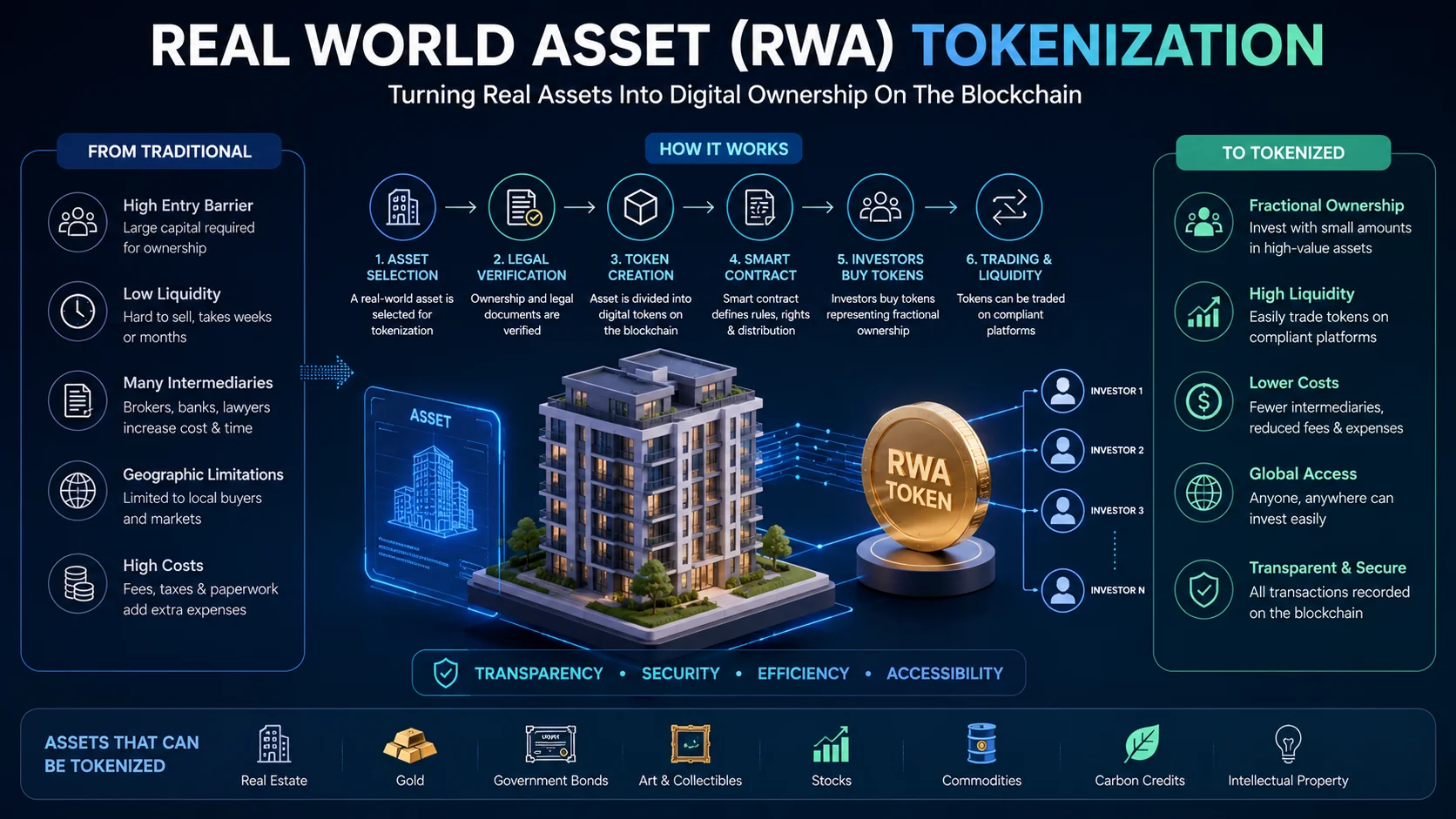
How Does RWA Tokenization Work?
Understanding the process is easier than most people think.
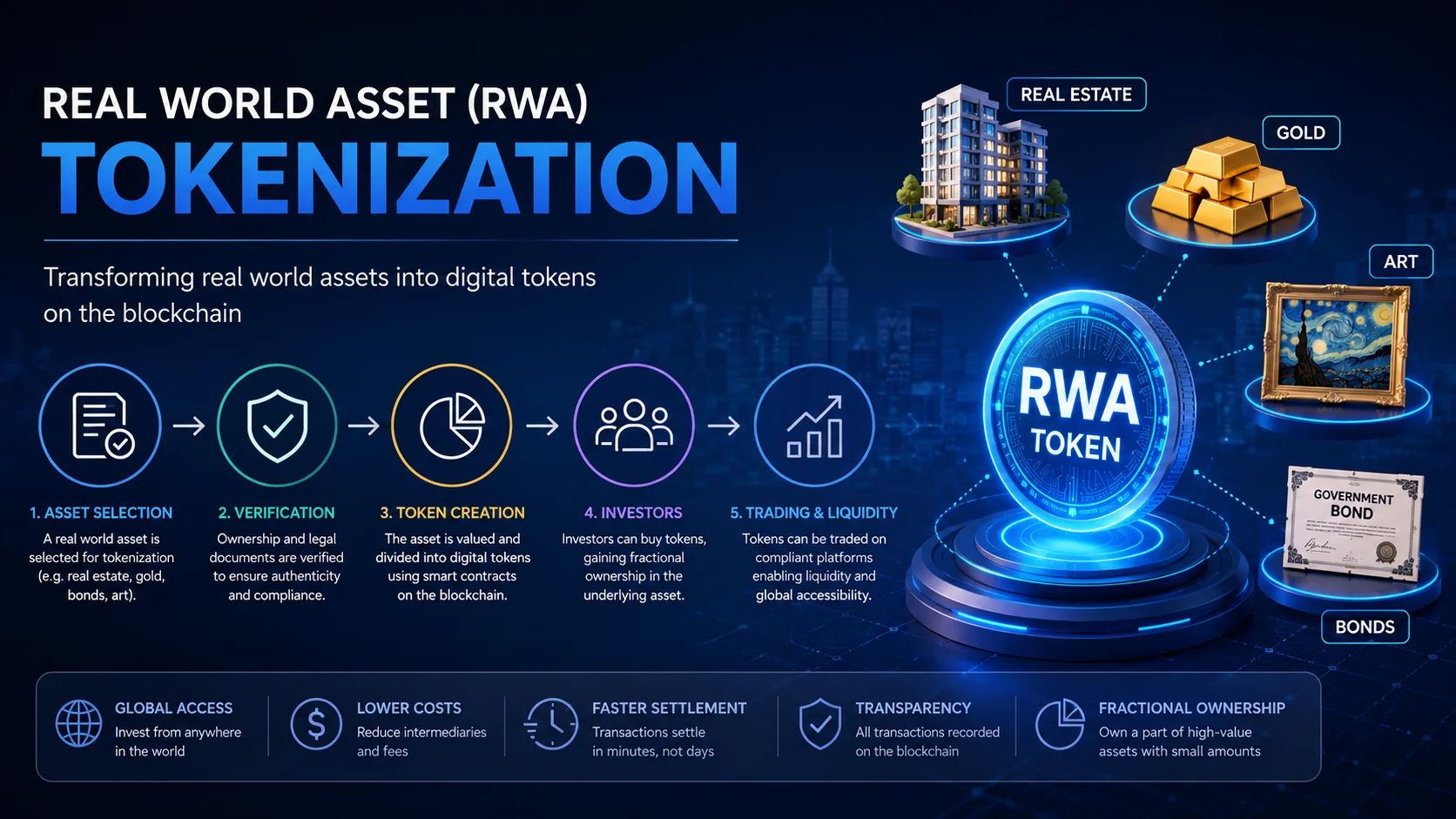
Step 1: Select the Asset
An owner decides to tokenize a valuable asset.
For example:
- An apartment
- Gold reserves
- Corporate bonds
- Art collection
Step 2: Verify Ownership
Before tokenization begins, legal ownership must be verified.
This ensures the asset genuinely exists and belongs to the issuer.
Legal documentation is essential because blockchain cannot verify physical assets on its own.
Step 3: Asset Valuation
Professional experts estimate the current market value of the asset.
For example:
Apartment Value = $500,000
Step 4: Create Digital Tokens
The issuer decides how many blockchain tokens to create.
Example:
500,000 Tokens
Each token now represents:
$1 worth of ownership.
Step 5: Deploy Smart Contracts
Smart contracts define:
- Ownership rules
- Transfer conditions
- Dividend distribution
- Compliance requirements
- Investor rights
Everything becomes automated.
Step 6: Investors Purchase Tokens
Investors can now buy tokens through supported blockchain platforms.
Instead of purchasing the entire apartment, someone might buy only 500 tokens.
This represents a small ownership percentage.
Step 7: Trading
These ownership tokens may later be traded on compliant marketplaces, depending on local regulations.
This provides liquidity that traditional assets often lack.
Simple Example
Imagine a luxury hotel worth:
$20 Million
Instead of selling it to one company:
The owner creates
20 Million Tokens
Each token equals:
$1 ownership.
Now:
- Investor A buys 10,000 tokens.
- Investor B buys 25,000 tokens.
- Investor C buys 500 tokens.
Every investor owns part of the hotel.
If the hotel earns rental income, token holders may receive their proportional share based on the platform's legal and contractual structure.
Benefits of RWA Tokenization
Fractional Ownership
One of the biggest advantages is fractional investing.
Instead of spending millions of dollars, investors can own a small portion of expensive assets.
This opens investment opportunities for many more people.
Better Liquidity
Real estate is traditionally difficult to sell quickly.
Finding buyers may take months.
Tokenized assets can potentially be traded much faster on approved marketplaces, making them more liquid than traditional ownership structures.
Global Investment
Anyone meeting the platform's legal requirements may be able to invest from different parts of the world.
This expands investment opportunities beyond local markets.
Lower Costs
Traditional transactions involve:
- Lawyers
- Brokers
- Banks
- Paperwork
- Registrars
Smart contracts automate many administrative processes, reducing operational costs in some cases.
Faster Settlement
Traditional asset transfers often require several days or weeks.
Blockchain transactions can settle much more quickly once all legal and compliance checks are satisfied.
Transparency
Every blockchain transaction is recorded permanently.
Investors can verify ownership history and transaction records without relying solely on centralized databases.
Improved Accessibility
Young investors who previously could not afford expensive assets can now invest with much smaller amounts.
Why Are Banks Interested?
Many people assume blockchain only benefits crypto users.
That is no longer true.
Major financial institutions are exploring RWA Tokenization because it can modernize existing financial infrastructure.
Potential benefits include:
- Faster settlements
- Lower operational costs
- Better transparency
- Increased market efficiency
- New investment products
Banks are not replacing traditional finance overnight. Instead, many are testing how blockchain can improve existing systems while remaining compliant with regulations.
Real-World Examples of Tokenized Assets
Several sectors are already experimenting with tokenization.
Real Estate
Property owners can tokenize apartments, office buildings, hotels, and commercial spaces.
Investors purchase fractional ownership instead of entire properties.
Gold
Instead of physically storing gold at home, investors can own blockchain tokens backed by allocated gold held in secure vaults by trusted custodians.
Government Bonds
Some financial institutions are exploring tokenized government securities to improve settlement efficiency and accessibility.
Art
High-value artwork can be divided into thousands of ownership shares.
Collectors gain exposure without purchasing the entire piece.
Carbon Credits
Blockchain enables more transparent tracking and transfer of carbon credit ownership.
How Smart Contracts Help
Smart contracts are the automation layer behind tokenized assets.
They can automatically handle:
- Ownership transfers
- Dividend distribution
- Interest payments
- Compliance rules
- Token issuance
- Investor permissions
Because these actions are encoded into software, many manual processes become faster and more consistent.
Is RWA the Same as Cryptocurrency?
No.
This is an important distinction.
Cryptocurrencies like Bitcoin are native digital assets.
They are not backed by physical objects.
RWA tokens represent ownership or rights connected to real-world assets.
For example:
Bitcoin exists only digitally.
A tokenized apartment represents ownership in an actual physical property.
Challenges of RWA Tokenization
Although the technology is promising, several challenges remain.
Legal Regulations
Every country has different securities laws.
Tokenized assets must comply with local regulations.
Legal compliance remains one of the biggest hurdles for large-scale adoption.
Asset Custody
Someone must securely hold and manage the underlying physical asset.
Blockchain cannot physically protect a building or a gold bar.
Trusted custodians are still necessary.
Valuation Issues
Real-world assets change in value over time.
Regular professional valuations are important to maintain fair pricing.
Security Risks
While blockchain itself is highly secure, poorly written smart contracts, platform vulnerabilities, or compromised user wallets can still create risks.
Security audits are essential.
Market Adoption
Many investors are still unfamiliar with blockchain technology.
Education and user-friendly platforms will play a major role in increasing adoption.
How Developers Are Involved
Developers are central to the growth of RWA ecosystems.
They build:
- Smart contracts
- Asset management platforms
- Investor dashboards
- Compliance systems
- Identity verification tools
- Wallet integrations
- Blockchain APIs
As more institutions adopt tokenization, demand for blockchain developers with expertise in security, compliance, and smart contract development is expected to grow.
Why Investors Are Paying Attention
RWA Tokenization combines aspects of traditional finance with blockchain technology.
Potential advantages include:
- Portfolio diversification
- Fractional access to premium assets
- Increased transparency
- Easier access to global opportunities
- Potentially improved liquidity
However, investors should remember that tokenization does not eliminate investment risk. The value of the underlying asset can still rise or fall, and regulatory or market changes may affect returns.
Industries That Could Benefit
Many industries may adopt tokenization over time.
Examples include:
- Banking
- Insurance
- Real estate
- Supply chain
- Agriculture
- Energy
- Entertainment
- Sports
- Healthcare
- Infrastructure
- Investment management
As digital asset infrastructure matures, tokenization could become a common way to represent ownership across many sectors.
The Future of RWA Tokenization
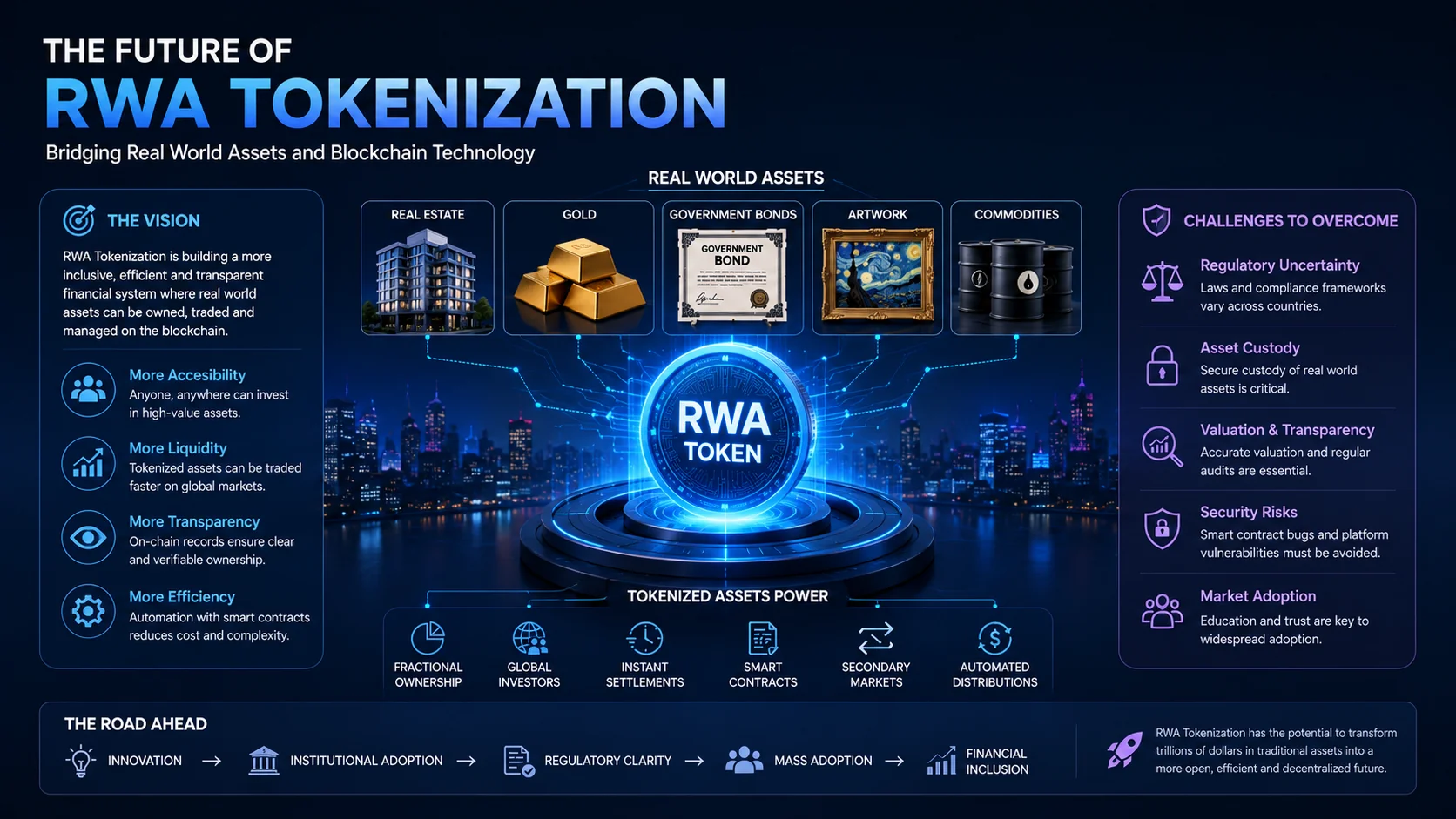
Industry analysts expect tokenized real-world assets to grow significantly over the coming years as technology, regulation, and institutional adoption continue to evolve.
We are already seeing:
- Banks experimenting with blockchain-based settlement.
- Asset managers launching tokenized investment products.
- Governments exploring digital financial infrastructure.
- Real estate firms testing fractional ownership models.
- Blockchain companies building platforms focused on compliant tokenization.
Although widespread adoption will take time, the direction of the industry suggests that tokenization may become an increasingly important part of modern finance.
Final Thoughts
Real World Asset (RWA) Tokenization is one of the most practical and exciting applications of blockchain technology. Instead of focusing only on digital currencies, it connects blockchain with assets people already understand, such as real estate, gold, bonds, artwork, and other valuable property.
By enabling fractional ownership, improving transparency, and making certain assets more accessible, tokenization has the potential to reshape how people invest and manage ownership. At the same time, challenges around regulation, custody, valuation, and security must continue to be addressed before the technology reaches its full potential.
Whether you are a developer exploring Web3, an investor looking for new opportunities, or simply someone interested in the future of finance, understanding RWA Tokenization is becoming increasingly valuable. As blockchain adoption expands, real-world asset tokenization is likely to remain one of the most closely watched trends in the digital economy.
Frequently Asked Questions (FAQs)
1. What is Real World Asset (RWA) Tokenization?
Real World Asset (RWA) Tokenization is the process of converting ownership rights of physical or traditional financial assets into digital tokens on a blockchain. These assets can include real estate, gold, bonds, artwork, and many others. Each token represents full or fractional ownership of the underlying asset, making investing more accessible and efficient.
2. What types of assets can be tokenized?
A wide variety of assets can be tokenized, including residential and commercial real estate, precious metals like gold and silver, government bonds, stocks, artwork, collectibles, intellectual property, carbon credits, luxury goods, and even agricultural land. In general, any asset with clear legal ownership has the potential to be tokenized.
3. What are the main benefits of RWA Tokenization?
RWA Tokenization offers several advantages, such as fractional ownership, improved liquidity, lower transaction costs, faster settlements, greater transparency, and access to global investment opportunities. It also allows smaller investors to participate in markets that were traditionally available only to high-net-worth individuals or institutions.
4. Is RWA Tokenization the same as cryptocurrency?
No. Cryptocurrencies like Bitcoin and Ethereum are native digital assets that exist only on a blockchain. RWA tokens, on the other hand, represent ownership or rights linked to real-world assets such as property, gold, or financial securities. Their value is connected to the underlying asset rather than existing independently.
5. Is investing in tokenized real-world assets safe?
RWA Tokenization can improve transparency and security through blockchain technology, but it is not risk-free. Investors should consider factors such as legal regulations, the credibility of the platform, smart contract security, asset custody, and market risks before investing. Conducting proper research and using regulated platforms can help reduce potential risks.