
Autonomous AI Agents in Web3 Explained: How They Work, Use Cases, Benefits and Risks
Learn how autonomous AI agents in Web3 use artificial intelligence, blockchain wallets, and smart contracts to automate DeFi, DAO governance, payments, gaming, and other on-chain activities.

Table of Content
Table of Content
Artificial intelligence and blockchain are two of the most influential technologies shaping the digital world. AI can analyze information, understand instructions, make decisions, and automate complex tasks. Blockchain provides transparent records, digital ownership, programmable money, and decentralized infrastructure.
When these technologies work together, they create something more powerful: autonomous AI agents in Web3.
An autonomous AI agent is not simply a chatbot that answers questions. It is a software-based entity that can observe its environment, process information, make decisions, and perform actions with limited human involvement. In Web3, these agents can also own wallets, interact with smart contracts, exchange digital assets, purchase services, and coordinate with other agents.
Imagine telling an AI agent to manage part of your cryptocurrency portfolio. Instead of only suggesting which token you could buy, the agent could monitor market conditions, compare opportunities across decentralized finance protocols, simulate a transaction, and execute an approved strategy through its blockchain wallet.
The same idea can be applied to gaming, decentralized autonomous organizations, supply chains, content creation, data marketplaces, security monitoring, and many other industries.
However, giving software the ability to control assets creates serious questions. How much authority should an agent receive? Who is responsible when it makes a mistake? How can users verify its decisions? What happens if someone manipulates the information it uses?
This guide explains autonomous AI agents in Web3, how they work, where they are being used, their benefits and risks, and what their development could mean for the future of the internet.
What Is an Autonomous AI Agent?
An autonomous AI agent is a software system designed to complete goals by making and executing decisions.
A traditional program normally follows fixed instructions. For example, a basic trading bot may buy a token whenever its price falls below a predefined level. It does not understand why the price changed or whether buying the token still supports the user’s broader objective.
An AI agent can work more dynamically. It may collect information from several sources, evaluate possible actions, adjust its plan, use external tools, and learn from the outcome.
Most AI agents contain several important components:
- A goal that defines what the agent should achieve
- An AI model that interprets information and supports reasoning
- Memory that stores useful context and previous results
- Tools that allow the agent to interact with external systems
- Rules that limit what the agent can do
- A feedback system that evaluates whether an action was successful
For example, the goal of a portfolio-management agent could be to earn conservative returns while maintaining a specific level of liquidity. To pursue that goal, it might monitor lending rates, assess protocol risks, estimate network fees, and recommend or execute transactions.
Autonomy does not necessarily mean complete independence. In practical systems, autonomy exists at different levels. One agent might only prepare transaction suggestions, while another may execute transactions automatically within strict spending limits.
What Makes a Web3 AI Agent Different?
A normal AI assistant can research information, write content, analyze data, or call an API. A Web3 AI agent adds blockchain-based capabilities to this foundation.
These capabilities can include:
- Owning or controlling a blockchain wallet
- Holding cryptocurrencies, stablecoins, tokens, or NFTs
- Reading transparent blockchain data
- Signing or requesting blockchain transactions
- Interacting with smart contracts
- Participating in decentralized protocols
- Receiving payments for completed work
- Paying other agents or digital services
- Building an on-chain identity and reputation
This means a Web3 agent can potentially operate as an economic participant.
Ethereum’s documentation highlights three important advantages blockchains offer AI agents: transparent data, digital asset ownership, and the ability to interact with smart contracts and decentralized protocols. These features can turn an agent from a passive assistant into a system capable of taking verifiable on-chain action. Ethereum.org
Consider a standard travel-planning AI assistant. It may find a hotel and produce a suggested itinerary. A Web3-enabled version could also hold a travel budget in stablecoins, purchase access to useful data, make approved payments, receive refunds, and maintain a verifiable record of its transactions.
The blockchain does not make the AI intelligent. Instead, it gives the agent access to programmable ownership, payments, and decentralized applications.
How Do Autonomous AI Agents in Web3 Work?
A Web3 AI agent usually operates through a combination of off-chain intelligence and on-chain execution.
Complex AI processing generally happens off-chain because running a large AI model directly on a blockchain would be slow and expensive. The blockchain is primarily used for transactions, ownership, settlement, coordination, and verifiable records.
A typical agent follows the process below.
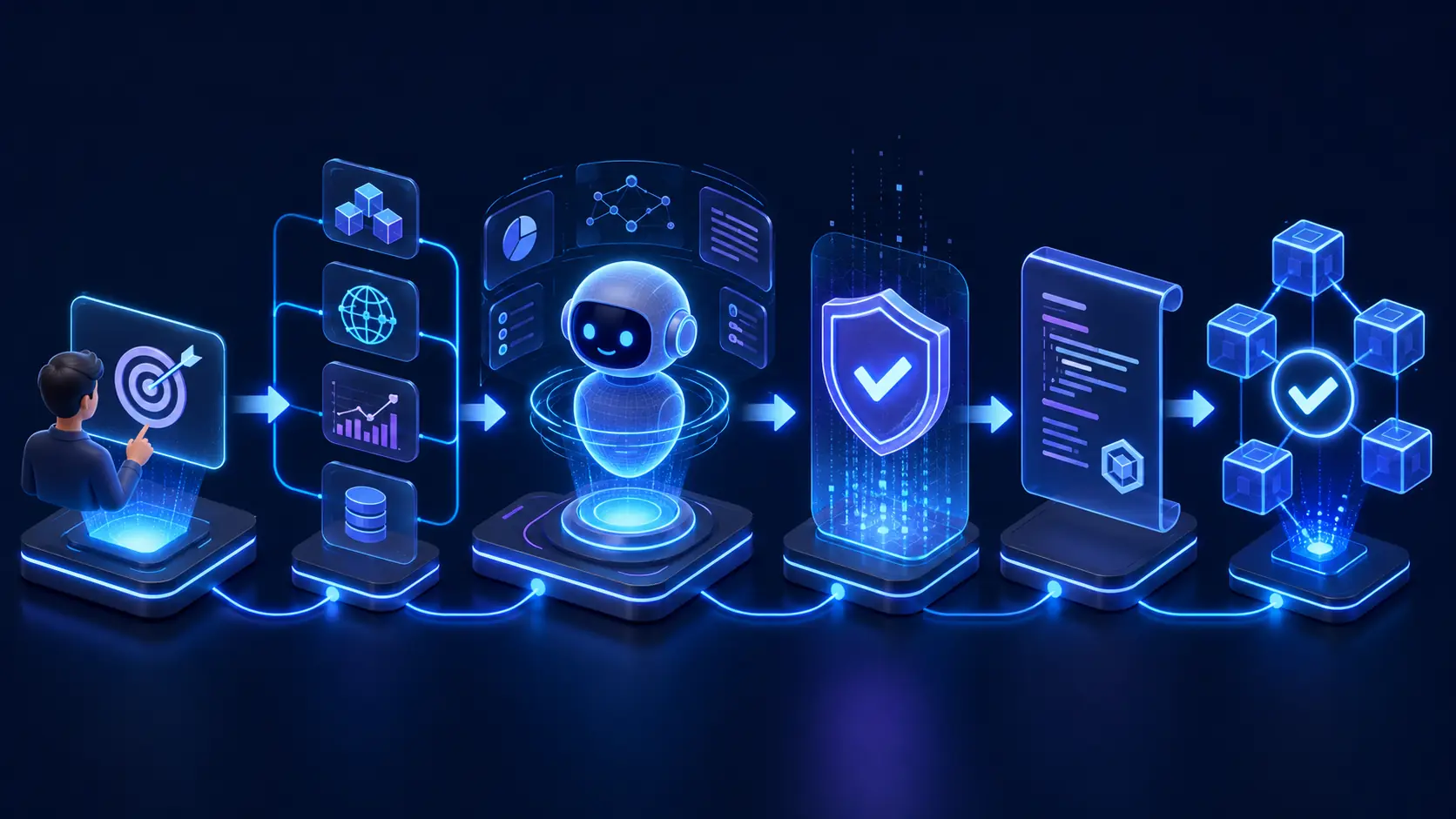
1. The User Defines a Goal
The process begins when a person, company, DAO, or another agent provides an objective.
The instruction could be:
“Maintain at least 40% of the treasury in stable assets and search for low-risk lending opportunities.”
A useful objective should include constraints. Without them, the agent may technically complete the task while taking risks the user did not intend.
Constraints can define:
- The maximum amount the agent can spend
- Approved blockchain networks
- Allowed smart contracts
- Acceptable risk levels
- Required human approvals
- Maximum transaction frequency
- The length of the agent’s authorization
2. The Agent Collects Information
The agent gathers information relevant to its objective. It may read:
- Blockchain transactions
- Wallet balances
- Smart contract states
- Token prices
- Governance proposals
- Protocol documentation
- Oracle data
- Social or community signals
- Information from external APIs
Blockchain data is valuable because it is openly auditable. However, transparency does not automatically guarantee that every interpretation is correct. Agents must distinguish between confirmed on-chain activity, potentially manipulated market signals, and unverified off-chain information.
3. The Agent Reasons and Creates a Plan
After collecting information, the AI model evaluates possible actions.
A DeFi agent might compare lending protocols using factors such as interest rates, liquidity, smart contract history, collateral requirements, withdrawal conditions, and estimated transaction fees.
The model can then divide its objective into smaller tasks:
- Check the available wallet balance.
- Compare approved protocols.
- Remove options that exceed the allowed risk level.
- Simulate the selected transaction.
- Request approval if required.
- Execute the transaction.
- Monitor the resulting position.
This planning ability separates a flexible AI agent from a simple automation script.
4. The Agent Uses Blockchain Tools
The AI model cannot move tokens merely by producing text. It needs tools that convert an intended action into a correctly formatted blockchain transaction.
Developer frameworks are emerging to connect agents with wallets and on-chain functions. For example, Coinbase AgentKit is designed to help agents create or use wallets and perform actions such as transfers, swaps, and smart contract interactions. Coinbase AgentKit documentation
These tools act as a bridge between the AI’s reasoning and the blockchain’s technical requirements.
5. Security Rules Check the Proposed Action
A properly designed system should validate the proposed action before signing or broadcasting it.
The security layer may check:
- Whether the destination contract is approved
- Whether the amount exceeds a spending limit
- Whether the expected output is reasonable
- Whether the transaction contains suspicious permissions
- Whether sufficient funds will remain in the wallet
- Whether the action requires human confirmation
- Whether the transaction succeeds in a simulation
This stage is essential because AI models can misunderstand instructions, generate inaccurate outputs, or be manipulated by malicious content.
6. The Transaction Is Executed
If the transaction passes every check, the wallet signs it and sends it to the blockchain.
Depending on the system, the signing process may use:
- A directly managed private key
- A smart contract wallet
- A multisignature wallet
- A session key with limited permissions
- A delegated authorization system
- A human signature request
Limited permissions are safer than giving an agent permanent and unrestricted control over a wallet.
7. The Result Becomes Feedback
After execution, the agent monitors the result. It records whether the transaction succeeded, how much it cost, and whether it improved progress toward the original goal.
This feedback helps the agent decide what to do next. It may continue monitoring, adjust its plan, notify the user, or reverse a position when that is technically possible and permitted.
Smart Contracts and AI Agents Are Not the Same
Smart contracts and autonomous agents are often discussed together, but they perform different roles.
A smart contract is a program deployed on a blockchain. Its rules are deterministic: when specified conditions are met, it produces a predictable result. This consistency makes smart contracts useful for holding assets and enforcing agreements.
An AI agent is more flexible. It can interpret natural-language goals, analyze uncertain information, compare alternatives, and choose actions based on context.
A smart contract cannot independently browse news, understand a governance discussion, or develop a new strategy. An AI agent can perform these tasks, but its output may be less predictable.
The strongest systems combine both technologies:
- The AI agent handles interpretation, planning, and adaptive decision-making.
- Smart contracts enforce permissions, ownership rules, payments, and settlement.
In simple terms, the agent decides what action may be useful, while the smart contract determines whether that action is permitted and records the result.
Projects such as Olas use off-chain autonomous agents alongside on-chain functionality. Its Open Autonomy framework describes agents operating as multi-agent systems that can perform complex off-chain computation while coordinating actions on-chain. Olas Open Autonomy documentation
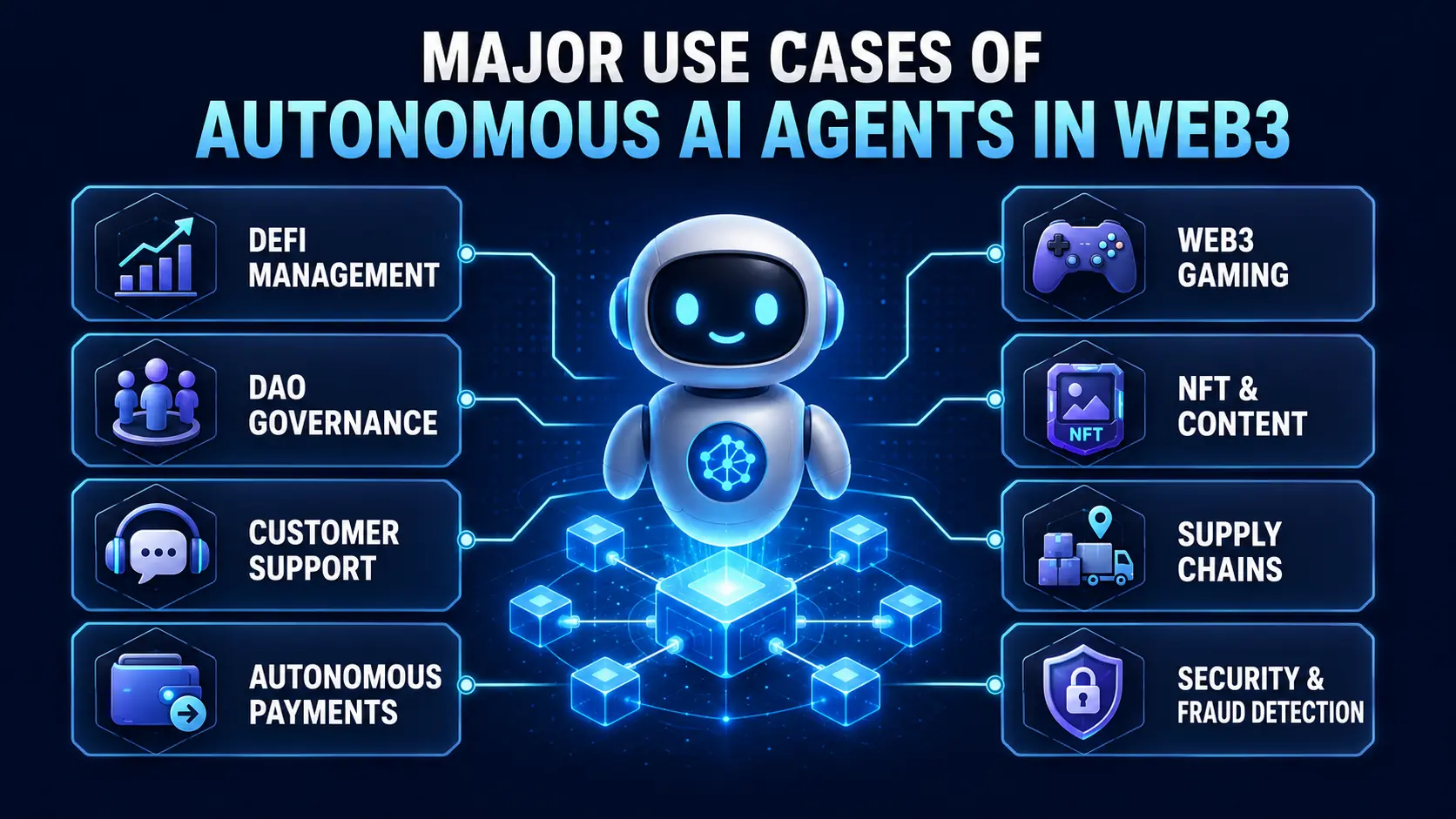
Major Use Cases of Autonomous AI Agents in Web3
Automated DeFi Management
Decentralized finance is one of the most natural environments for autonomous agents because most activity already occurs through programmable smart contracts.
A DeFi agent could:
- Compare lending and borrowing rates
- Rebalance a token portfolio
- Monitor collateral levels
- Claim staking rewards
- Move liquidity according to user-defined rules
- Find more efficient token-swap routes
- Warn users about unusual protocol activity
- Prepare transactions using natural-language instructions
An Ethereum tutorial demonstrates the basic structure of an AI trading agent that reads blockchain and price information, asks a model to evaluate it, and then trades according to the resulting recommendation. It also illustrates why execution safeguards matter when AI-generated decisions affect real assets. Ethereum.org AI trading agent tutorial
These agents can make DeFi easier to use, but they do not remove financial risk. Smart contract failures, market volatility, poor model decisions, and manipulated data remain possible.
DAO Operations and Governance
Decentralized autonomous organizations often struggle with information overload. Members may need to review long proposals, understand treasury effects, participate in discussions, and vote regularly.
AI agents could help DAOs by:
- Summarizing governance proposals
- Comparing proposals with previous decisions
- Detecting conflicting rules
- Estimating possible treasury impact
- Monitoring voting activity
- Preparing reports for members
- Executing approved operational tasks
- Representing delegated voting preferences within strict limits
An agent should not silently replace community judgment. Its role should be transparent, and users should be able to see which decisions were made by humans and which were automated.
On-Chain Customer Support
Web3 applications frequently have complicated user experiences. Users must understand wallets, transaction fees, token approvals, bridges, and smart contract interactions.
An AI support agent can examine public transaction information and explain:
- Why a transaction failed
- Whether a transaction is still pending
- Which network the user selected
- What a token approval allows
- Whether funds reached the correct contract
- What steps are needed to complete an action
Unlike a traditional support bot, an on-chain agent can use live blockchain information. However, it should never request a seed phrase or private key.
Autonomous Payments and Commerce
A Web3 agent can hold and transfer digital assets, allowing it to pay for services on demand.
For example, a research agent might purchase access to a specialized dataset, pay for an API request, hire another agent to perform an analysis, and then deliver the final result to its owner.
Payment standards designed for machine-to-machine transactions could make this process more practical. Coinbase describes x402 use cases including APIs charged per request and AI agents that autonomously pay for access to online services. Coinbase x402 documentation
This could create a digital economy in which agents purchase exactly the resources they need rather than requiring humans to manage every subscription and payment.
Web3 Gaming and Virtual Worlds
AI agents can make blockchain games more dynamic.
An autonomous game character could:
- Own in-game assets
- Trade items with players
- Complete tasks
- Join a guild
- Negotiate with other characters
- Develop behavior based on previous interactions
- Earn tokens through permitted activities
Traditional non-player characters usually repeat predetermined dialogue and actions. An AI-driven character can respond to changing conditions and maintain memory.
Blockchain ownership could also allow an agent or character to carry assets, achievements, or reputation across compatible environments. This vision is promising, although interoperability between different games remains technically and commercially difficult.
NFT and Digital Content Management
Creative agents can generate content, manage digital collectibles, communicate with communities, and distribute revenue through smart contracts.
An agent could assist an artist by:
- Tracking ownership and royalty payments
- Creating descriptions for a collection
- Managing community announcements
- Identifying unauthorized copies
- Personalizing digital experiences
- Distributing earnings among collaborators
The use of AI-generated content also raises questions about copyright, originality, licensing, and proper disclosure. Blockchain records can prove when an asset was created or transferred, but they do not automatically prove that its underlying content was legally produced.
Supply Chain Monitoring
Supply chains involve many separate organizations, documents, and events. An agent can monitor incoming records and react when specified conditions occur.
It might:
- Check whether a shipment reached a checkpoint
- Compare delivery records
- detect unusual delays
- Release a smart contract payment after verification
- Notify participants about missing documents
- Evaluate supplier performance
Blockchain can provide a shared record, while AI can interpret patterns and exceptions. The quality of the result still depends on the accuracy of the information submitted to the blockchain.
Security and Fraud Detection
AI agents can continuously monitor blockchain activity for suspicious behavior.
They may identify:
- Unexpected transfers
- Abnormal wallet behavior
- Risky token approvals
- Sudden liquidity removal
- Governance attacks
- Interaction with known malicious addresses
- Transactions that differ from a user’s normal pattern
An agent could immediately notify the user or pause a permitted operation. Automatic defensive actions should be carefully limited because incorrect detection could prevent legitimate activity.
Benefits of Combining AI Agents With Web3
Verifiable Activity
Blockchain transactions create a public and time-stamped record. Users can verify what an agent did, which wallet it used, and which smart contracts it interacted with.
This does not expose every part of the agent’s reasoning, but it improves the auditability of its financial actions.
Native Digital Ownership
A Web3 agent can control assets through a wallet. It can receive payment, maintain a budget, purchase services, and distribute revenue.
This gives agents an economic capability that ordinary chatbots do not possess.
Continuous Operation
Agents can monitor systems around the clock. They do not need to wait for a person to manually check every market change, governance proposal, or security alert.
Continuous operation is useful only when supported by reliable infrastructure and clearly defined emergency controls.
Cross-Platform Coordination
Public blockchains provide a shared settlement layer. Different agents and applications can coordinate through common smart contracts without relying entirely on one company’s internal database.
Reduced Complexity for Users
Web3 applications often require technical knowledge. AI agents can translate human goals into understandable steps.
A person may eventually be able to say, “Move a small part of my stablecoin balance into an approved low-risk lending option,” instead of manually navigating several protocols.
The agent must still show the proposed transaction, expected result, fees, and risks in clear language before execution.
Risks and Limitations
Private-Key Security
An agent with access to a wallet becomes an attractive target. If its credentials are exposed, an attacker may steal funds or misuse permissions.
Safer systems can use smart wallets, limited session keys, spending caps, approved contract lists, multisignature requirements, and emergency revocation.
AI Hallucinations and Reasoning Errors
AI models can produce convincing but incorrect conclusions. In a conversation, an inaccurate answer may be inconvenient. In an on-chain transaction, it may lead to irreversible financial loss.
Critical actions should therefore use deterministic validation rather than relying only on a model’s confidence.
Prompt Injection
An agent may read untrusted websites, token metadata, governance posts, or messages. Malicious text could attempt to instruct it to ignore its original rules or reveal sensitive information.
Developers must treat external content as data, not trusted instructions. Tool permissions should also be separated from the model’s general conversational context.
Irreversible Transactions
Most blockchain transactions cannot be cancelled after confirmation. If an agent transfers tokens to an incorrect address or interacts with a malicious contract, recovery may be impossible.
Simulations, allowlists, confirmation screens, and transaction limits are therefore essential.
Unreliable External Information
Smart contracts cannot directly access real-world information without oracles or other data providers. If an agent receives inaccurate prices or manipulated data, it may make a poor decision.
Using multiple sources and defining acceptable data freshness can reduce this risk.
Legal and Accountability Questions
When an agent causes a loss, responsibility may be difficult to determine. Possible parties include the user, developer, wallet provider, protocol, model provider, or data source.
Regulation around autonomous software and digital assets is still developing in many regions. Businesses should not assume that calling a system “decentralized” removes their legal obligations.
Cost and Scalability
AI inference, blockchain transactions, data services, and monitoring infrastructure all have costs. Frequent on-chain actions may become expensive during periods of high network demand.
Developers must determine which decisions genuinely need blockchain settlement and which can remain off-chain.
False Autonomy
Some products are marketed as autonomous even though their behavior is mostly controlled by human operators or fixed scripts.
A trustworthy project should clearly explain:
- What the agent decides independently
- Which actions require approval
- Who controls its wallet
- How its permissions can be revoked
- Where its AI processing occurs
- How users can audit its behavior
How to Build Safer Web3 AI Agents
Security should be part of an agent’s architecture from the beginning.
Developers should follow several practical principles:
- Start with read-only access before allowing transactions.
- Give the agent the minimum permissions required for its task.
- Use a separate wallet with a limited balance.
- Add daily and per-transaction spending limits.
- Restrict interactions to approved contracts and networks.
- Simulate transactions before signing them.
- Require human confirmation for unfamiliar or high-value actions.
- Store detailed logs of decisions and tool calls.
- Validate addresses, token amounts, slippage, and contract methods using deterministic code.
- Provide a clear emergency pause and permission-revocation process.
The model can recommend an action, but predictable security code should decide whether that action is allowed.
Emerging standards are also exploring portable identities, reputation, and validation for agents. ERC-8004, for example, proposes on-chain registries related to agent identity, reputation, and validation. It remains an Ethereum proposal, so its status and adoption should be checked before treating it as production infrastructure. ERC-8004 specification
The Future of Autonomous AI Agents in Web3
The long-term vision is an open economy populated by humans, applications, organizations, and specialized AI agents.
One agent might manage a business budget. Another could perform market research. A third could verify data, while a fourth handles payments. Smart contracts would coordinate the exchange of work and value between them.
This could lead to new types of services:
- Personal financial agents operating under strict limits
- DAO agents that carry out approved community decisions
- Autonomous software services paid per task
- AI-managed blockchain game characters
- Decentralized agent marketplaces
- Agents with portable identities and reputations
- Machine-to-machine stablecoin payments
- Security agents that monitor wallets continuously
The most successful systems are unlikely to be completely uncontrolled. Practical autonomy will probably mean limited authority within transparent boundaries.
Users will need tools to inspect what an agent plans to do, understand why it selected an action, approve sensitive operations, and immediately remove access.
Web3 provides useful infrastructure for payments and auditability, but blockchain alone does not make an AI agent trustworthy. Trust will depend on secure wallet design, accurate data, tested smart contracts, transparent policies, and thoughtful human oversight.
Conclusion
Autonomous AI agents in Web3 combine the decision-making ability of artificial intelligence with blockchain-based ownership, payments, and programmable coordination.
These agents can monitor information, create plans, interact with smart contracts, manage approved assets, and work with other digital services. Their potential use cases include DeFi automation, DAO governance, gaming, customer support, security monitoring, content management, and machine-to-machine commerce.
The opportunity is significant, but so are the risks. AI errors, prompt injection, stolen credentials, malicious contracts, manipulated data, and irreversible transactions can cause real financial damage.
For that reason, the future of Web3 agents should not be based on unlimited autonomy. It should be based on controlled autonomy: clear goals, minimum permissions, spending limits, transaction simulations, human approvals, transparent records, and emergency controls.
Autonomous agents may eventually become a normal interface for using blockchain technology. Instead of manually navigating complicated applications, people may describe their goals while trusted agents handle the technical steps.
The real breakthrough will not happen when an AI agent can simply send a transaction. It will happen when users can safely understand, verify, and control every important action that the agent performs.
Frequently Asked Questions
1. What is an autonomous AI agent in Web3?
An autonomous AI agent in Web3 is a software system that can analyze information, make decisions, and perform approved blockchain actions with limited human intervention. It may use a wallet, interact with smart contracts, hold digital assets, or pay for services.
2. Can an AI agent own cryptocurrency?
An AI agent can control a wallet that holds cryptocurrency, but the legal meaning of ownership depends on the system and jurisdiction. In most practical implementations, a person, company, or DAO ultimately controls the agent and defines its permissions.
3. Are Web3 AI agents safe?
Web3 AI agents can be useful, but they are not automatically safe. Their risks include private-key theft, inaccurate AI decisions, prompt injection, malicious smart contracts, and irreversible transactions. Spending limits, simulations, allowlists, and human approvals can reduce these risks.
4. What is the difference between a smart contract and an AI agent?
A smart contract follows predefined rules on a blockchain and normally produces deterministic results. An AI agent can interpret goals, analyze changing information, create plans, and select between different actions. They can work together, with the agent making recommendations and smart contracts enforcing permissions and settlement.
5. Will autonomous AI agents replace humans in Web3?
They are more likely to automate repetitive and technical tasks than completely replace humans. People will still be needed to define goals, manage risks, approve sensitive decisions, maintain systems, resolve disputes, and determine the rules under which agents operate.