
Decentralized Identity (DID): The Future of Digital Identity and Online Privacy
how Decentralized Identity (DID) is transforming online identity by giving users complete control over their personal information. Learn how DID works, its benefits, real-world use cases, challenges, and why it is considered the future of secure digital identity in Web3.

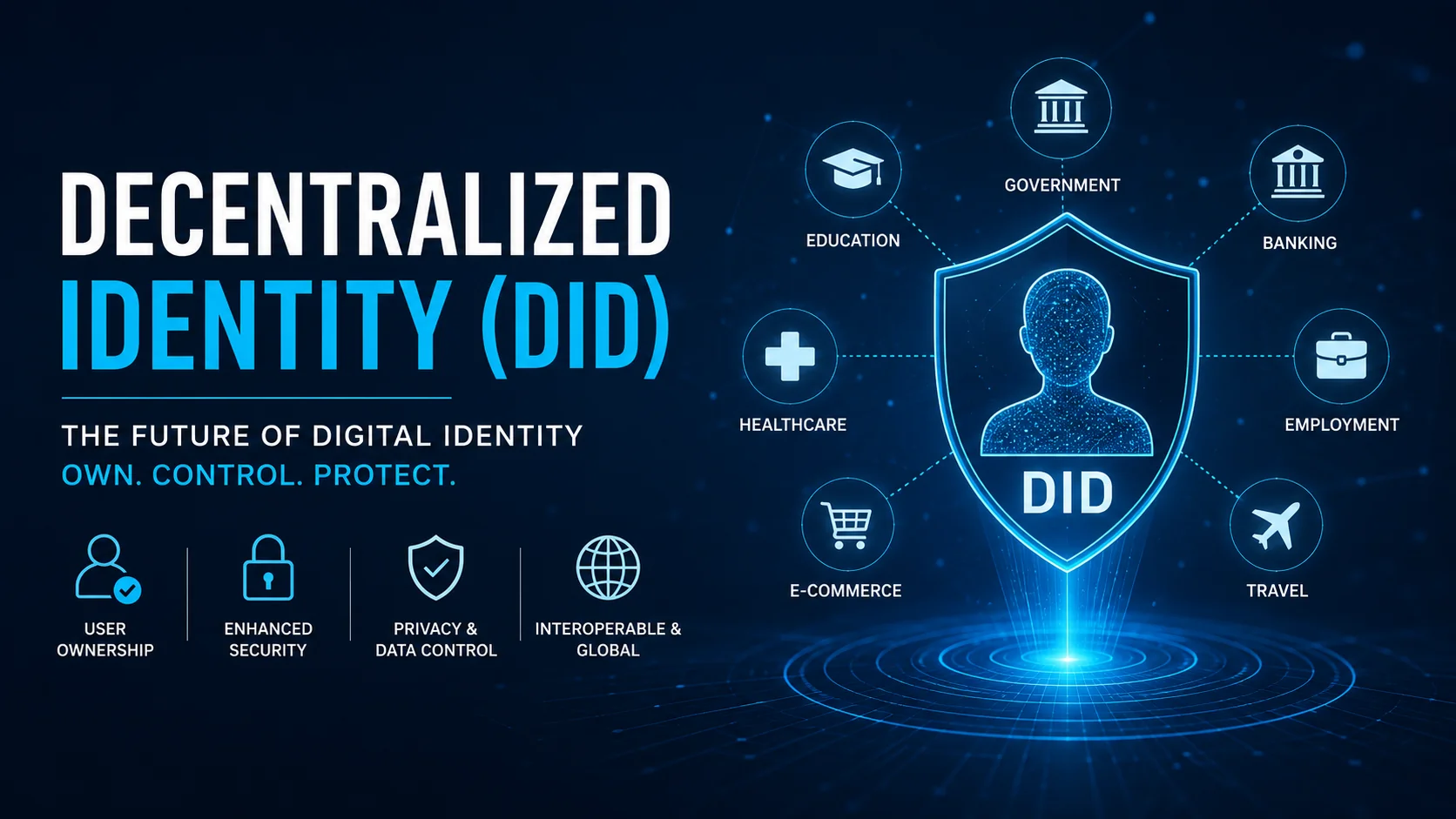
Table of Content
Table of Content
Introduction
Every day, people create new online accounts for shopping, banking, education, healthcare, gaming, and social media. Most of these services require users to hand over personal information such as their name, phone number, email address, date of birth, or even government-issued identification.
While this system has worked for years, it has also created one major problem. Users no longer control their own identity.
Instead, companies store personal information inside centralized databases. When these databases are hacked, millions of users become victims of identity theft, phishing attacks, and financial fraud.
According to various cybersecurity reports, billions of personal records have been exposed over the past decade due to data breaches. This growing problem has encouraged researchers and technology companies to rethink how digital identity should work.
This is where Decentralized Identity (DID) enters the picture.
Rather than allowing companies to own your identity, DID allows individuals to control their own digital identity using cryptography, blockchain technology, and verifiable credentials.
Instead of asking,
"Can I trust this company with my data?"
the future asks,
"Why should the company store my data at all?"
That simple shift could redefine how identity works across the internet.
In this guide, you'll learn how Decentralized Identity works, why it matters, where it is already being used, and why many experts believe it will become a core building block of Web3 and the future internet.
What Is Decentralized Identity (DID)?
A Decentralized Identity (DID) is a globally unique digital identifier that is created, owned, and controlled by an individual rather than a centralized organization.
Unlike traditional usernames issued by Google, Facebook, or banks, a DID belongs entirely to the user.
It is built using cryptographic keys instead of passwords.
This means users can prove who they are without exposing unnecessary personal information.
Think of it this way.
Traditional identity works like this:
Company → Stores Identity → Verifies Identity
Decentralized Identity changes the model:
User → Owns Identity → Shares Only Required Information
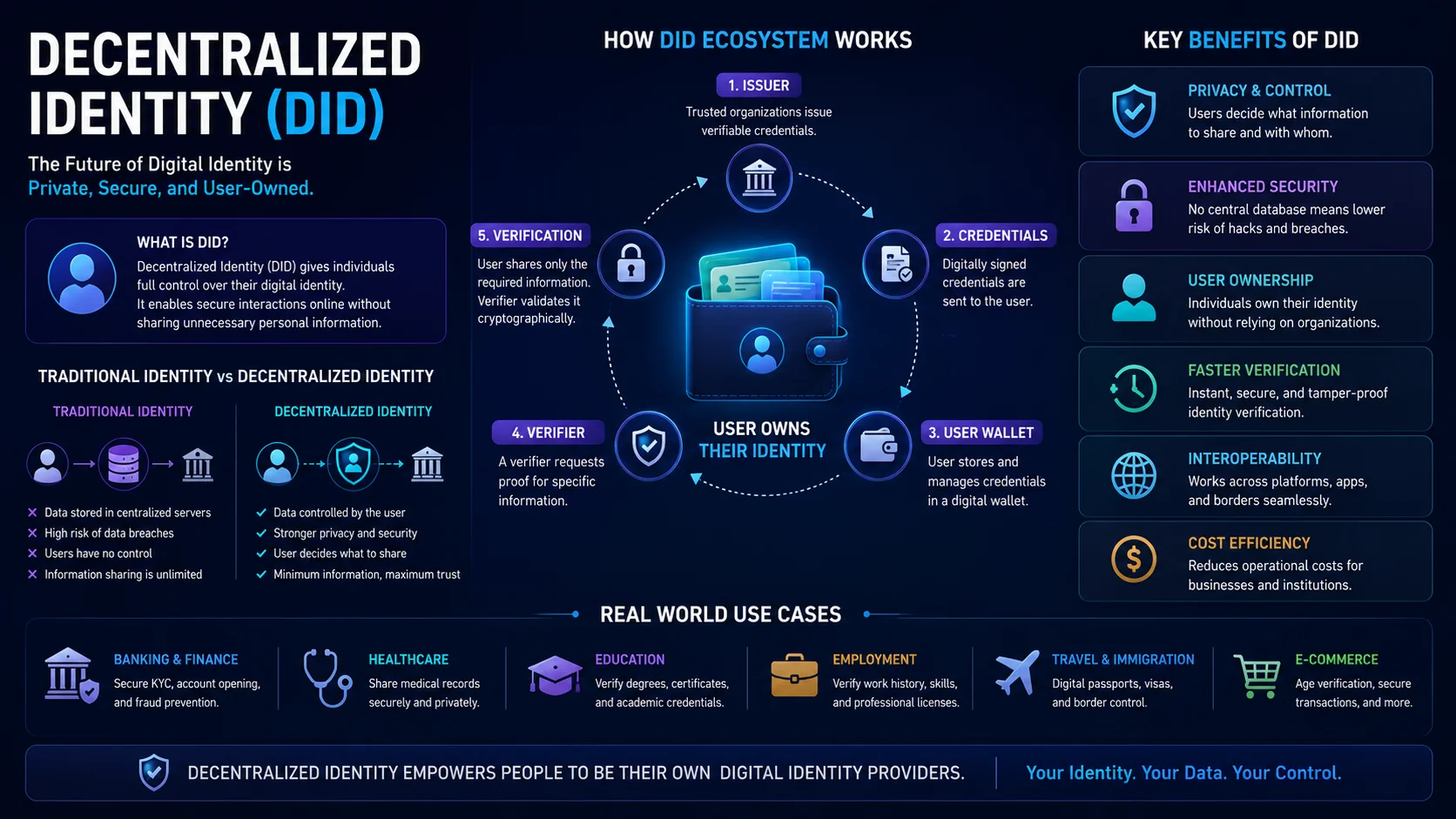
For example, if a website only needs to verify that you are over 18 years old, a DID system can confirm your age without revealing:
- Your full name
- Date of birth
- Address
- Government ID number
This concept is known as selective disclosure, and it represents one of the biggest improvements over traditional identity systems.
Why Traditional Digital Identity Is Broken
The internet was not originally designed with privacy in mind.
As a result, digital identities became scattered across hundreds of services.
Most people now have:
- Multiple email accounts
- Social media accounts
- Banking accounts
- Shopping accounts
- Healthcare portals
- Government portals
- Workplace logins
Every account stores duplicate personal information.
This creates several serious problems.
Massive Data Breaches
Organizations become attractive targets for hackers.
A single successful attack can expose millions of users.
Password Fatigue
People struggle to remember dozens of passwords.
Many reuse passwords, making cyberattacks easier.
Identity Theft
Once attackers steal personal information, they can impersonate victims for financial fraud.
Lack of Privacy
Many websites collect more information than necessary.
Sometimes a simple newsletter requests your full name, phone number, address, and birth date.
No User Ownership
Users cannot easily move their identity between platforms.
Each website creates another isolated identity.
This leads to fragmented online experiences.
How Decentralized Identity Works
Decentralized Identity combines cryptography, blockchain, and digital wallets.
Here is the simplified process.
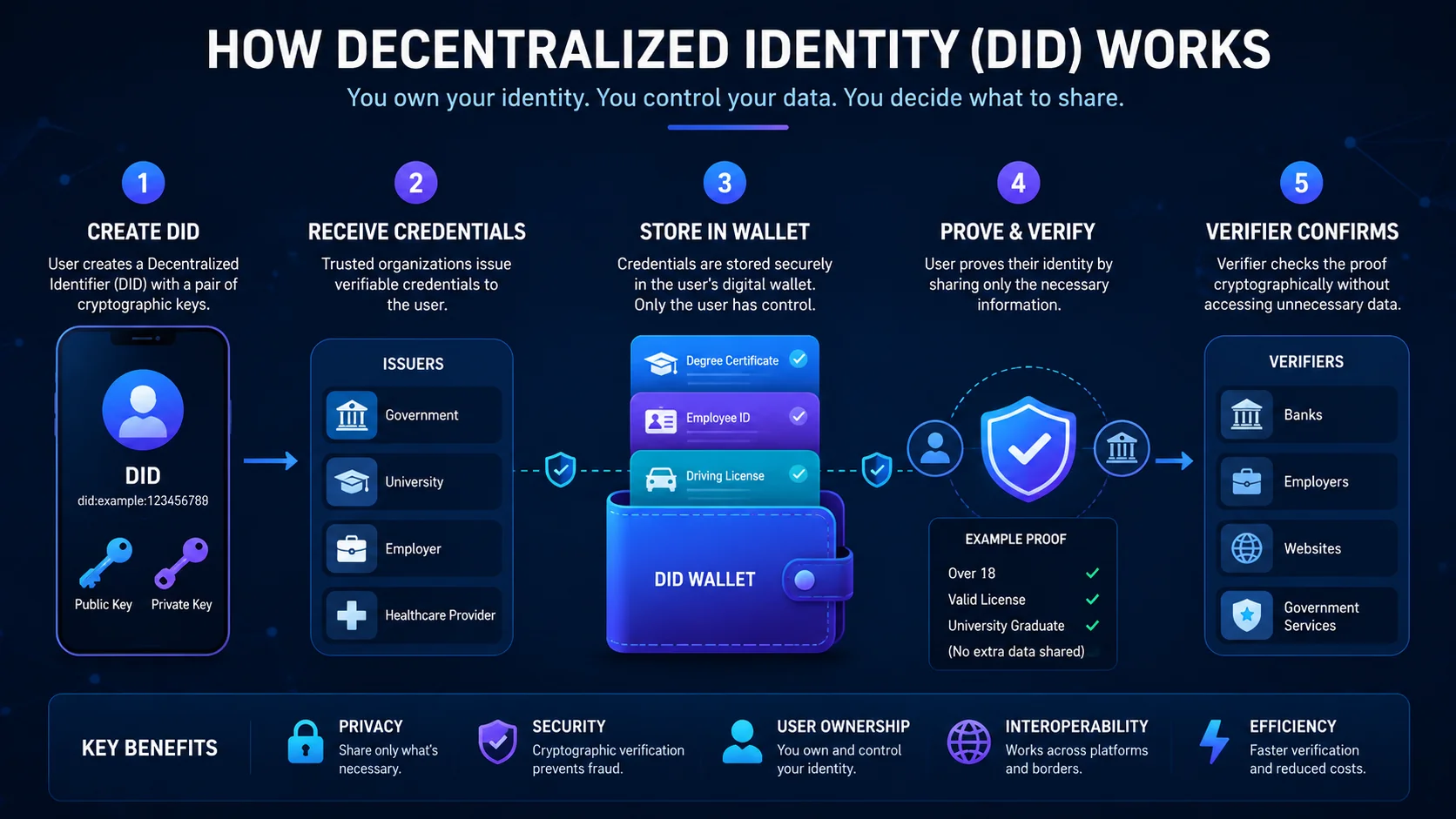
Step 1: Create a DID
The user generates a decentralized identifier.
No government or company issues it.
The identifier is mathematically linked to public and private cryptographic keys.
Step 2: Receive Credentials
Trusted organizations issue digital credentials.
Examples include:
- University degree
- Driver's license
- Passport
- Employee ID
- Medical certificate
- Professional certification
These credentials are digitally signed.
Step 3: Store Credentials
Instead of storing credentials on company servers, users keep them inside a secure identity wallet.
Only the owner controls access.
Step 4: Verify Information
When another organization needs verification, the wallet generates cryptographic proof.
The verifier checks:
- Authenticity
- Digital signature
- Expiration
- Issuer
without accessing unnecessary personal information.
This significantly improves privacy.
Core Components of Decentralized Identity
1. Decentralized Identifier (DID)
A DID is the permanent identifier representing a user.
It works similarly to a web address but identifies people rather than websites.
2. DID Document
Every DID points to a DID Document.
This document contains:
- Public keys
- Authentication methods
- Service endpoints
- Verification methods
No personal information is stored here.
3. Verifiable Credentials
These are tamper-proof digital credentials issued by trusted organizations.
Examples include:
- Digital diploma
- Vaccination certificate
- Employment verification
- Professional licenses
They are cryptographically signed.
4. Digital Identity Wallet
Identity wallets securely store credentials.
They function similarly to cryptocurrency wallets but hold identity documents instead of coins.
5. Verifiers
Organizations requesting identity verification are known as verifiers.
Examples:
- Banks
- Employers
- Universities
- Government agencies
- Online marketplaces
Benefits of Decentralized Identity
Greater Privacy
Users only reveal necessary information.
This minimizes unnecessary data sharing.
Better Security
Private information stays under user control rather than in centralized databases.
This greatly reduces large-scale data breaches.
Reduced Fraud
Cryptographic verification makes forged credentials extremely difficult.
Identity fraud becomes much harder.
Faster Verification
Traditional verification may take days.
Digital credential verification often takes seconds.
User Ownership
Individuals own their digital identity.
Changing jobs or switching platforms no longer requires rebuilding identity from scratch.
Global Accessibility
A decentralized identity can potentially work across countries and organizations.
This creates a more connected digital ecosystem.
Real-World Use Cases
Decentralized Identity is already being explored in multiple industries.
Banking
Banks can verify customer identity more securely while reducing Know Your Customer (KYC) costs.
Healthcare
Patients can securely share medical records with doctors without exposing unrelated health information.
This improves both privacy and efficiency.
Education
Universities can issue tamper-proof digital diplomas.
Employers can instantly verify educational qualifications.
Government Services
Digital passports and national IDs could become more secure while reducing paperwork.
Recruitment
Candidates could prove employment history and certifications instantly.
Recruiters spend less time verifying documents.
Travel
Travelers may use digital identity wallets for airport verification.
This could reduce waiting times while improving security.
Online Gaming
Players could verify age without revealing personal information.
Gaming companies gain compliance without storing sensitive data.
E-Commerce
Customers can prove identity during high-value purchases while protecting personal privacy.
DID and Blockchain
Blockchain is often associated with cryptocurrencies, but its role in DID is different.
Blockchain does not usually store personal identity information.
Instead, it stores:
- Public identifiers
- Public keys
- Verification references
- Revocation information
Sensitive data remains with the user.
This design offers both transparency and privacy.
If someone attempts to modify identity information, cryptographic verification immediately detects the change.
That makes tampering extremely difficult.
Challenges and Limitations
Although DID has enormous potential, adoption still faces several obstacles.
Standardization
Different organizations currently use different identity frameworks.
Universal standards are still evolving.
User Education
Managing cryptographic keys requires responsibility.
Users need simple interfaces that hide technical complexity.
Lost Wallet Recovery
If users lose access to their private keys, recovering identity can become difficult.
Recovery mechanisms are improving but remain an important challenge.
Regulatory Compliance
Governments must adapt existing identity regulations to decentralized systems.
Legal frameworks continue to evolve worldwide.
Adoption by Organizations
The technology only becomes powerful when many organizations participate.
Widespread adoption will require collaboration across industries.
The Future of Decentralized Identity
The internet is moving toward user ownership.
Just as digital payments transformed banking, decentralized identity may transform online trust.
Future applications may include:
- Passwordless authentication
- AI agent identity verification
- Cross-border digital identity
- Smart city services
- Digital voting
- Secure metaverse identities
- IoT device authentication
- Enterprise access management
- Cross-platform login systems
- Privacy-preserving social networks
Governments, universities, healthcare providers, banks, and technology companies are increasingly exploring decentralized identity frameworks.
As AI becomes more capable, verifying whether a person, organization, or software agent is authentic will become even more important. DID can provide a trusted foundation for those interactions.
While traditional identity systems are unlikely to disappear overnight, hybrid models that combine existing infrastructure with decentralized identity are expected to become more common over the next decade.
Emerging Trends That Will Shape the Future of Decentralized Identity
As decentralized identity technology continues to mature, several emerging trends are expected to accelerate its adoption across industries. These developments are not only improving the technology itself but also making it easier for businesses and everyday users to embrace user-owned digital identities.
AI and Decentralized Identity
Artificial Intelligence is becoming deeply integrated into online services, from virtual assistants to autonomous AI agents. However, AI also introduces new challenges, such as fake identities, deepfakes, and automated fraud.
Decentralized Identity can help solve these problems by providing trusted identity verification for both people and AI systems. Instead of relying on usernames or easily forged credentials, AI-powered platforms can verify cryptographically signed identities before allowing access to sensitive resources.
For example, an AI assistant handling financial transactions could prove its identity using verifiable credentials issued by its organization. Similarly, users interacting with AI services could confirm they are communicating with an authentic system rather than a malicious clone.
As AI adoption grows, trusted digital identity will become increasingly important for ensuring secure interactions between humans, organizations, and intelligent software.
Cross-Border Digital Identity
Today, proving your identity across different countries often involves multiple documents, lengthy verification processes, and repeated manual checks.
Decentralized Identity has the potential to simplify international identity verification.
Imagine applying to a foreign university, opening an overseas bank account, or starting a remote job for a company in another country. Instead of uploading scans of passports, certificates, and identity cards several times, you could securely share digitally signed credentials that are instantly verified.
This could reduce administrative costs, improve user experience, and speed up global business operations while maintaining strong privacy protections.
Passwordless Authentication
Passwords remain one of the weakest links in cybersecurity. Weak passwords, password reuse, and phishing attacks continue to be major causes of security breaches.
Decentralized Identity supports passwordless authentication by replacing passwords with cryptographic keys stored in secure identity wallets.
Instead of remembering dozens of complex passwords, users simply approve authentication requests using their digital wallet or biometric verification.
Benefits include:
- Faster login experiences
- Reduced phishing attacks
- Stronger account security
- Fewer password reset requests
- Better user experience across devices
Many cybersecurity experts believe passwordless authentication will become the default standard over the next decade, with DID playing a central role in this transition.
Enterprise Identity Management
Large organizations spend significant resources managing employee identities and access permissions.
Human resources departments issue employee IDs, IT teams create accounts, security teams manage permissions, and administrators revoke access when employees leave the company.
A decentralized identity system can simplify this process.
Employees receive verified digital credentials that prove their employment status, department, certifications, and security clearances. When changing roles or joining another organization, they can present verified credentials without repeating lengthy verification processes.
For businesses, this reduces administrative overhead while strengthening access control and improving compliance.
Building a More Privacy-First Internet
The internet has evolved rapidly over the past two decades, but privacy has often been treated as an afterthought. Users are frequently required to share far more personal information than necessary just to access everyday online services.
Decentralized Identity represents a shift toward a privacy-first model, where individuals decide what information to share, with whom, and for how long. Instead of organizations collecting large amounts of personal data by default, they can request only the specific proof they need, such as verifying that a user is over a certain age or holds a valid certification.
This approach benefits everyone. Users gain greater control over their personal information, while organizations reduce the amount of sensitive data they must store and protect. Over time, this could lead to a more secure, transparent, and trustworthy digital ecosystem where identity verification is based on cryptographic proof rather than excessive data collection.
As governments, technology companies, financial institutions, and standards organizations continue investing in decentralized identity solutions, DID is steadily moving from an emerging concept to a practical technology with real-world applications. Although widespread adoption will take time, its potential to improve privacy, security, and user ownership makes it one of the most promising innovations shaping the future of the internet.
Final Thoughts
Digital identity has become one of the most valuable assets in today's connected world. Yet the systems most people rely on were built around centralized control, forcing users to trust countless organizations with sensitive personal information.
Decentralized Identity offers a different approach. By giving individuals ownership of their credentials and allowing them to share only the information required for a specific interaction, DID improves privacy, strengthens security, and reduces the impact of large-scale data breaches.
Although challenges such as interoperability, regulation, and user-friendly key management still need to be addressed, the direction is clear. Governments, enterprises, educational institutions, and technology companies are investing in decentralized identity because it enables a safer and more trustworthy digital ecosystem.
As Web3, artificial intelligence, and digital services continue to evolve, decentralized identity is likely to become a foundational layer of the next generation of the internet, where users are no longer just participants but true owners of their digital identities.
Frequently Asked Questions (FAQs)
1. What is a Decentralized Identity (DID)?
A Decentralized Identity (DID) is a user-controlled digital identity that relies on cryptographic verification instead of centralized databases. It allows individuals to own and manage their identity without depending on a single organization.
2. Is blockchain required for Decentralized Identity?
Not always. Many DID implementations use blockchain to publish public identifiers and verification data, but personal information is generally stored off-chain in secure digital identity wallets.
3. How is DID more secure than traditional login systems?
DID reduces the need for centralized storage of personal information and enables cryptographic authentication. This lowers the risk of large-scale data breaches, password theft, and identity fraud.
4. Where can Decentralized Identity be used?
DID can be used in banking, healthcare, education, government services, recruitment, travel, online gaming, e-commerce, enterprise security, and Web3 applications.
5. Will Decentralized Identity replace passwords?
In many cases, yes. DID supports passwordless authentication using cryptographic keys and verifiable credentials, making online access both more secure and more convenient.