
What is RAG? - Retrieval-Augmented Generation AI Explained
what RAG is in AI, how Retrieval-Augmented Generation works, and how embeddings, vector databases, retrieval, and LLMs work together to generate more relevant and grounded AI responses.
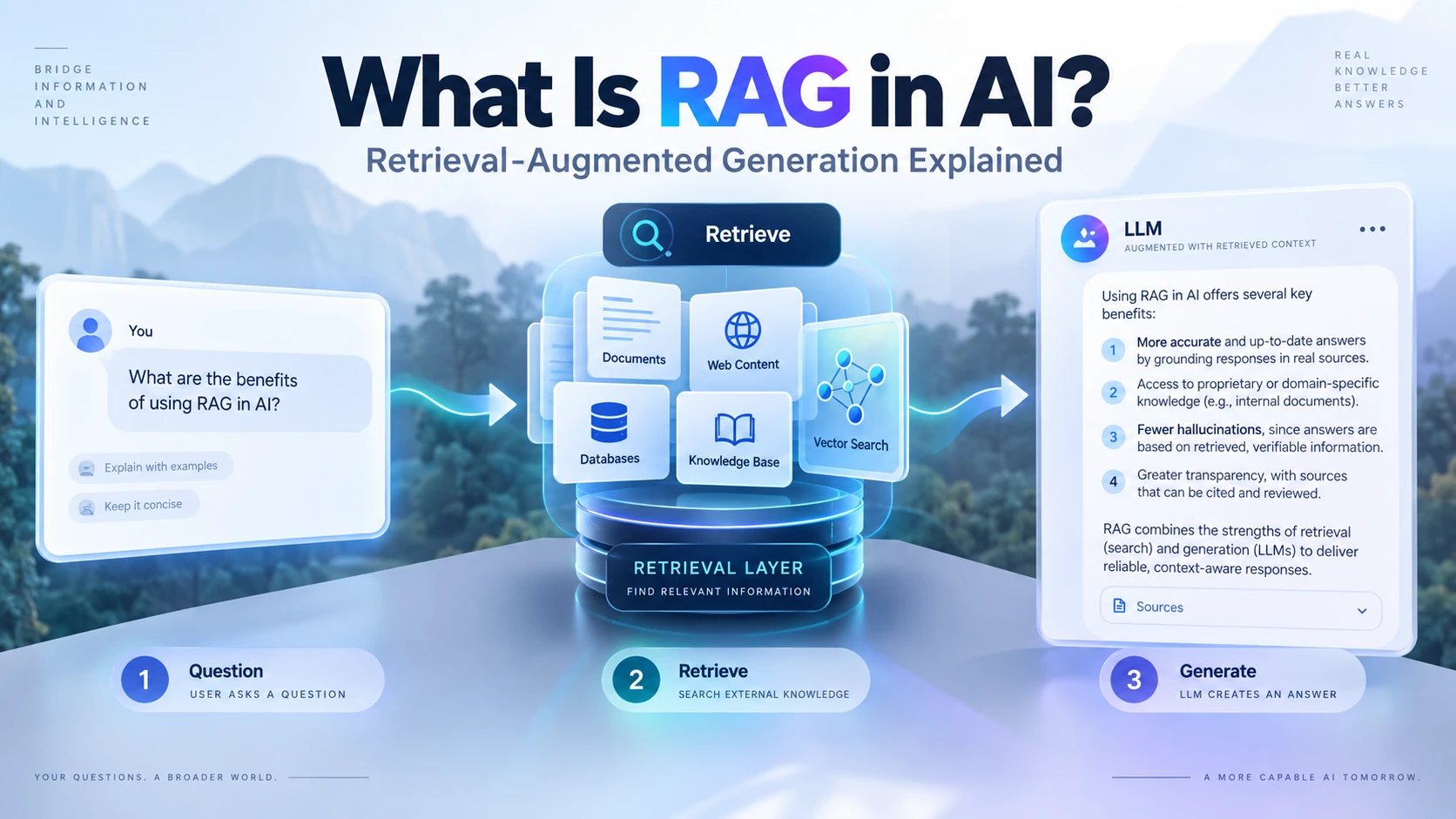
Table of Content
Table of Content
Artificial intelligence has become remarkably good at answering questions, generating content, writing code, summarizing information, and helping people complete complex tasks. However, even powerful large language models have an important limitation: they do not automatically know everything that exists in your private databases, company documents, recently updated websites, internal policies, product manuals, or knowledge bases.
This is where Retrieval-Augmented Generation, commonly known as RAG, becomes useful.
RAG is one of the most practical techniques used to make AI applications more knowledgeable, context-aware, and grounded in specific information. Instead of expecting an AI model to answer a question entirely from what it learned during training, a RAG system first retrieves relevant information from an external knowledge source and then gives that information to the language model before it generates its response.
In simple terms, RAG allows an AI system to look up useful information before answering.
This approach is now widely used in enterprise chatbots, document assistants, customer support systems, research tools, internal knowledge assistants, education platforms, legal applications, healthcare information systems, developer tools, and many other AI-powered products.
But how does RAG actually work? Why do developers use it instead of simply training a larger AI model? What are embeddings, vector databases, chunking, retrieval, and reranking?
This guide explains RAG from the ground up.
What Is RAG in AI?
RAG stands for Retrieval-Augmented Generation.
It is an AI architecture that combines two main processes:
- Retrieval: Finding information relevant to the user's question from an external data source.
- Generation: Giving the retrieved information to a generative AI model so it can create a useful response.
A normal large language model might receive a question such as:
"What is our company's refund policy for enterprise customers?"
The model may not know the answer because the policy is stored inside the company's internal documentation.
A RAG-powered application can search those documents, retrieve the section describing the enterprise refund policy, place that information into the model's context, and ask the model to answer based on it.
The process can be represented simply as:
User Question → Search Relevant Information → Retrieve Context → Send Context to LLM → Generate Answer
Instead of relying entirely on the model's internal knowledge, the AI receives external evidence that can help it produce a more relevant response.
Why Do We Need RAG?
Large language models are powerful, but they are not databases.
During training, an LLM learns patterns from enormous amounts of text. The information becomes encoded within billions of model parameters. However, the model normally cannot directly inspect its original training documents when generating an answer.
This creates several practical problems.
AI Knowledge Can Become Outdated
An AI model's training data represents information available during a particular period.
Imagine that a company changes its pricing plans today. A model trained earlier will not automatically know about those changes.
A RAG application can retrieve the company's latest pricing documentation at the time the user asks the question.
This means the underlying language model does not necessarily need to be retrained every time information changes.
AI Models Can Hallucinate
LLMs sometimes generate answers that sound convincing even when the information is incorrect.
This behavior is usually called AI hallucination.
RAG can reduce this problem by supplying relevant source material before generation. The model can use that evidence when answering instead of relying only on its learned statistical patterns.
However, it is important to understand that RAG does not completely eliminate hallucinations. Poor retrieval, irrelevant documents, confusing instructions, or weak model reasoning can still produce incorrect responses.
Companies Have Private Information
A general AI model will not automatically know information stored in your:
- Company knowledge base
- Product documentation
- Customer support manuals
- Internal PDFs
- Database records
- Research papers
- Employee policies
- Technical documentation
- Private reports
- Course materials
RAG provides a practical way to connect this information to an AI application.
Retraining Models Is Expensive
Suppose an organization has 50,000 internal documents.
Training or fine-tuning a model every time one document changes would be inefficient.
With RAG, documents can instead be added to or updated in the retrieval system. The AI can access the updated information without needing to retrain the entire language model.
How Does RAG Work?
A production RAG application typically has two major stages:
Indexing and retrieval-generation.
The indexing stage prepares documents so they can be searched efficiently.
The retrieval-generation stage happens when the user asks a question.
Let's understand the complete workflow.
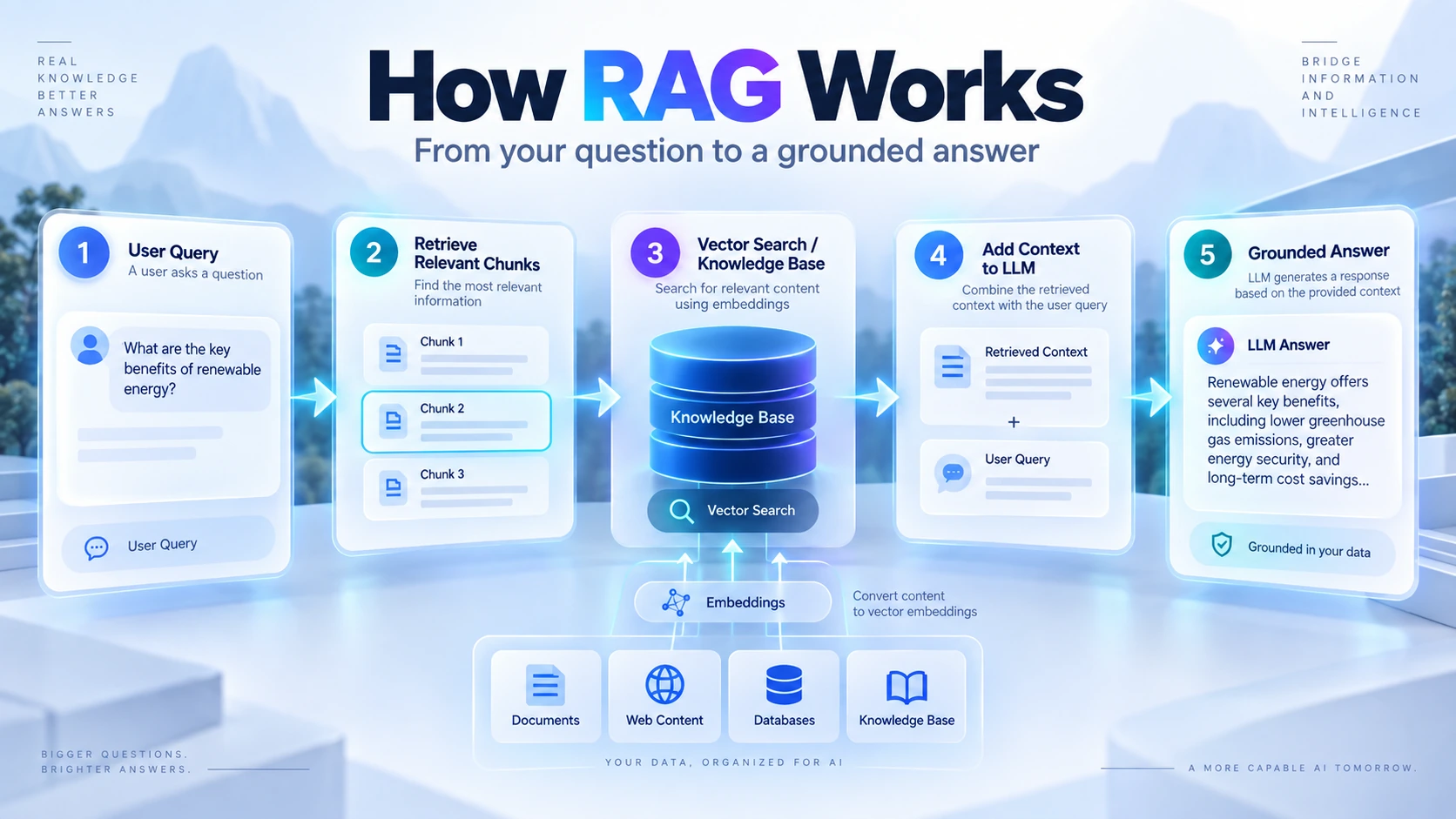
Step 1: Collect the Knowledge Sources
First, developers decide which information the AI application should be able to access.
The knowledge source could contain:
- PDFs
- Web pages
- Word documents
- Markdown files
- Product documentation
- Database records
- FAQs
- Research papers
- Support tickets
- Internal company documents
- API responses
- Learning materials
For example, imagine that you are building an AI assistant for a university.
You may provide:
- Admission guidelines
- Examination rules
- Course information
- Scholarship documentation
- Student policies
- Frequently asked questions
These documents become the knowledge base used by the RAG system.
Step 2: Clean and Process the Documents
Raw documents usually cannot be sent directly into a retrieval system without preparation.
They may contain unnecessary headers, navigation elements, broken formatting, advertisements, repeated text, or irrelevant metadata.
The system typically extracts the useful text and cleans it before indexing.
Document preprocessing can significantly affect RAG quality.
If low-quality or duplicated information enters the knowledge base, the retrieval system may return poor results later.
Step 3: Split Documents Into Chunks
Large documents are normally divided into smaller sections called chunks.
For example, a 30-page PDF might be split into dozens or hundreds of smaller passages.
Why?
Suppose a user asks:
"What documents are required for admission?"
If the entire 30-page admission handbook is treated as one searchable object, the system may struggle to identify the specific paragraph containing the answer.
Instead, the document might be divided into chunks such as:
- Eligibility requirements
- Required documents
- Admission fees
- Scholarship policy
- Application deadlines
The retrieval system can then identify the exact section that is most relevant.
Chunking is one of the most important parts of RAG architecture.
Chunks that are too large can contain too much unrelated information.
Chunks that are too small may lose important context.
Some advanced systems also use overlapping chunks so that important information located near chunk boundaries is not lost.
Step 4: Convert Text Into Embeddings
After chunking, each passage can be converted into a numerical representation called an embedding.
An embedding represents the semantic meaning of text as a vector containing numbers.
For example, sentences such as:
"How do I reset my password?"
and:
"I forgot my login password."
use different words but express a similar meaning.
Embedding models can represent them as vectors that are relatively close to each other in a mathematical space.
This allows RAG systems to perform semantic search instead of relying entirely on exact keyword matching.
Step 5: Store Embeddings in a Vector Database
The embeddings are commonly stored inside a vector database or another system capable of vector similarity search.
Popular technologies used in RAG architectures can include vector databases, search engines, PostgreSQL extensions, or databases with vector-search capabilities.
Each stored entry may contain:
- Embedding vector
- Original text
- Document title
- Source URL
- Section
- Category
- Creation date
- Access permissions
- Other metadata
The metadata becomes valuable when developers want to filter retrieval results.
For example, an organization might retrieve documents only from the "HR Policies" category or only documents published within the last year.
Step 6: The User Asks a Question
Once documents have been indexed, the system can process questions.
Suppose the user asks:
"Can enterprise customers cancel their subscription anytime?"
The system converts this question into an embedding using a compatible embedding model.
Step 7: Retrieve Relevant Information
The query embedding is compared with document embeddings stored in the retrieval system.
The system searches for chunks that are semantically similar to the user's question.
It might retrieve passages explaining:
- Enterprise cancellation rules
- Subscription agreements
- Refund conditions
- Contract renewal policies
Usually, only a limited number of highly relevant passages are selected.
This is commonly known as Top-K retrieval.
For example, if K = 5, the system might retrieve the five most relevant chunks.
Step 8: Rerank the Search Results
Similarity search does not always return results in the ideal order.
Because of this, advanced RAG systems often include a reranker.
A reranking model examines the query and retrieved passages more carefully and gives each result a new relevance score.
Imagine the original retrieval produces:
- General subscription policy
- Cancellation policy
- Pricing information
- Enterprise cancellation policy
- Account deletion instructions
A reranker may realize that result number 4 is actually the most relevant and move it to the top.
Good reranking can significantly improve answer quality.
Step 9: Build the Prompt
After retrieval, the selected text is inserted into a prompt sent to the LLM.
Conceptually, the prompt might say:
"You are a customer support assistant. Answer the user's question using the provided company documentation. If the documentation does not contain the answer, say that you do not have enough information."
Then the system includes the retrieved passages followed by the user's question.
The language model now has both:
- The user's request
- Relevant external context
Step 10: Generate the Final Answer
Finally, the LLM reads the retrieved context and generates a natural-language response.
Instead of inventing an answer, it can use the supplied evidence.
Well-designed systems may also display citations or source links so users can verify where the information came from.
The entire real-time process becomes:
Question → Query Processing → Retrieval → Reranking → Context Building → LLM → Answer
A Simple Real-World Example of RAG
Imagine you own an online electronics store.
Your support documentation contains hundreds of pages about:
- Product specifications
- Warranty rules
- Shipping policies
- Returns
- Installation instructions
- Troubleshooting
A customer asks:
"My SmartView X200 monitor has a flickering screen. What should I do?"
A generic AI model may provide general monitor troubleshooting advice.
A RAG system can instead search your official product documentation and retrieve the troubleshooting section specifically written for the SmartView X200.
The AI might then explain the correct troubleshooting process based on your documentation.
That difference is extremely important.
The first system provides general knowledge.
The second provides business-specific knowledge.
Semantic Search vs Keyword Search in RAG
Traditional search engines often depend heavily on keywords.
If a document contains "cancel membership" while the user searches "stop my subscription," basic keyword matching might not always recognize their relationship.
Semantic retrieval uses embeddings to search based on meaning.
However, keyword search is still useful.
Modern RAG systems sometimes combine both approaches using hybrid search.
Hybrid retrieval may combine:
- Vector similarity search
- Keyword search such as BM25
- Metadata filtering
- Reranking
This can provide stronger results than depending entirely on one retrieval technique.
What Is Hybrid RAG?
Hybrid RAG improves retrieval by combining multiple search strategies.
Consider a technical database containing a product named:
TXR-8492 Router
Vector search understands semantic meaning, but exact identifiers such as "TXR-8492" are often better handled using lexical or keyword search.
Hybrid search allows the system to benefit from both.
For example:
Vector search identifies conceptually related information.
Keyword search identifies exact words, names, codes, or identifiers.
Reranking determines which retrieved passages are most useful.
This combination is common in serious production RAG applications.
RAG vs Fine-Tuning
RAG and fine-tuning solve different problems, although they can sometimes be used together.
What RAG Changes
RAG changes the information available to the model when a request is processed.
The model itself may remain unchanged.
This makes RAG useful when your primary challenge is giving the AI access to external knowledge.
What Fine-Tuning Changes
Fine-tuning modifies a model using additional training examples.
It can help teach:
- Response styles
- Specialized formatting
- Domain-specific behavior
- Task patterns
- Classification behavior
Fine-tuning is generally not the ideal replacement for a frequently changing document database.
For example, if your company's product prices change every week, putting those prices into a retrieval system is usually more practical than repeatedly fine-tuning the model.
A sophisticated application can also combine the two approaches.
A fine-tuned model might learn how your support team should communicate, while RAG supplies the latest product and policy information.
Where Is RAG Used?
RAG has applications across many industries.
Customer Support
An AI chatbot can search support documentation and answer customer questions about products, troubleshooting, subscriptions, and policies.
Education
Students can ask questions about notes, textbooks, lectures, and course material.
A RAG-based education assistant can retrieve relevant sections before explaining a concept.
Enterprise Knowledge Assistants
Employees often spend significant time searching internal documents.
RAG systems can provide conversational access to company knowledge bases, policies, technical documentation, and internal resources.
Research
Researchers can search large collections of papers and generate summaries based on relevant sections.
Legal Applications
RAG can help search contracts, regulations, case documents, and internal legal resources.
Because legal work requires high accuracy, retrieved sources and citations should always be carefully verified.
Healthcare Information Systems
Healthcare organizations can use retrieval techniques to search approved clinical documentation, policies, research, or patient-related information within appropriately controlled systems.
Such applications require strong privacy safeguards and expert oversight.
Software Development
Developer assistants can retrieve:
- Internal API documentation
- Codebase documentation
- Architecture guidelines
- Error explanations
- Framework documentation
This can make coding assistants significantly more useful within private engineering environments.
Major Benefits of RAG
RAG has become popular because it solves several practical AI problems.
Access to Custom Knowledge
Organizations can connect AI applications to information that was never included in the model's original training data.
Easier Knowledge Updates
Documents can be added, replaced, or removed without retraining the underlying LLM.
Better Grounding
Providing relevant evidence can help the model produce answers based on known information rather than relying entirely on general knowledge.
Source Attribution
RAG systems can associate retrieved information with its source, allowing applications to display citations.
Cost Efficiency
For many knowledge-intensive applications, maintaining a searchable knowledge base can be more practical than frequently training new models.
Better Domain-Specific Responses
The same general-purpose LLM can behave like a specialized assistant when supplied with the correct domain knowledge.
Limitations of RAG
RAG is powerful, but it is not magic.
A badly designed RAG pipeline can perform worse than a normal LLM.
Retrieval Failure
If the correct information is not retrieved, the model cannot reliably use it.
This is sometimes described as:
Garbage in, garbage out.
Poor retrieval creates poor context.
Poor Chunking
Bad chunk boundaries can separate information that should have remained together.
For example, a section containing a question might be separated from the paragraph containing its answer.
Outdated Documents
RAG can only be as current as its knowledge base.
If outdated policies remain indexed, the AI might retrieve obsolete information.
Conflicting Information
Two documents may provide different answers.
The system needs rules for freshness, source authority, metadata, or conflict resolution.
Context Window Limits
Retrieved information must eventually be passed to the model.
Sending hundreds of irrelevant documents is inefficient and may reduce response quality.
Hallucinations Can Still Happen
The existence of RAG does not guarantee factual accuracy.
Models can misunderstand retrieved passages or add unsupported claims.
Production applications should therefore include appropriate validation, citations, fallback responses, and evaluation.
How to Improve RAG Quality
Developers often focus too much on the LLM while ignoring retrieval quality.
In reality, a strong RAG application depends heavily on the entire pipeline.
Use High-Quality Source Documents
Remove duplicated, outdated, incorrect, or irrelevant content.
Choose Appropriate Chunk Sizes
There is no perfect chunk size for every application.
Technical documentation, legal contracts, conversational transcripts, and product pages may require different strategies.
Preserve Metadata
Store useful attributes such as:
- Title
- URL
- Section
- Category
- Timestamp
- Author
- Version
- Permissions
Metadata filtering can dramatically improve retrieval.
Combine Retrieval Methods
Consider hybrid search instead of relying exclusively on vector similarity.
Use Reranking
A good reranker can improve the quality of the final context sent to the model.
Retrieve Enough, But Not Too Much
More context does not automatically mean better answers.
Retrieve the smallest amount of highly relevant information required to answer the question.
Tell the Model When Not to Answer
Prompts should allow the model to say:
"I couldn't find enough information in the provided sources."
This is often better than forcing it to invent an answer.
Evaluating a RAG System
A RAG application should not be evaluated only by looking at whether its final response sounds good.
Developers should evaluate multiple parts of the system.
Retrieval Quality
Did the system retrieve the document that actually contains the answer?
Context Relevance
Are retrieved passages directly related to the question?
Answer Faithfulness
Is the generated answer supported by the retrieved context?
Answer Relevance
Does the response actually answer the user's question?
Citation Accuracy
If citations are shown, do they genuinely support the statements being made?
A polished answer is not necessarily a correct answer.
Reliable RAG development requires testing the retrieval pipeline as carefully as the final language model response.
Security Considerations in RAG
Security becomes especially important when RAG systems access private information.
Imagine an employee asks an AI assistant:
"Show me the CEO's confidential compensation document."
Even if the document exists in the vector database, the application should not retrieve it unless that employee has permission.
Production RAG applications therefore need strong access controls.
Important security practices include:
- User authentication
- Role-based document permissions
- Data encryption
- Secure API communication
- Retrieval filters
- Logging and auditing
- Protection against prompt injection
- Sensitive-data handling
- Source validation
Developers must also consider indirect prompt injection.
A malicious instruction could be hidden inside a document that the RAG system retrieves. If the model blindly follows instructions from retrieved content, an attacker may influence its behavior.
Retrieved documents should therefore be treated as untrusted data, not as system-level instructions.
A Basic RAG Technology Stack
A typical RAG application might contain several components.
The frontend could be built using technologies such as React or Next.js.
A backend might use Python, Node.js, Java, or another server-side technology.
An embedding model converts text into vectors.
A vector-capable database stores embeddings.
A retrieval layer searches for relevant content.
A reranking model may improve the ranking.
Finally, an LLM generates the response.
The architecture might look like:
Frontend
↓
Backend/API
↓
Query Processing
↓
Vector + Keyword Search
↓
Reranker
↓
Relevant Context
↓
Large Language Model
↓
Final Answer + Sources
Developers do not necessarily need every component when building a simple prototype. However, these layers become increasingly important as the application grows.
Does RAG Give an AI Model Memory?
Not exactly.
RAG and AI memory are related concepts but should not automatically be treated as the same thing.
A RAG system retrieves information from stored knowledge.
Memory systems usually attempt to preserve information about previous interactions, user preferences, tasks, or conversational history.
However, retrieval can be used to implement certain forms of long-term AI memory.
For example, previous conversations could be summarized, embedded, stored, and retrieved when relevant.
In that architecture, retrieval technology becomes part of the memory system.
Is RAG Only for Text?
No.
The same basic idea can extend beyond text.
Modern retrieval systems may work with:
- Images
- Audio transcripts
- Video information
- Tables
- Code
- Structured database records
- Multimodal documents
For example, a multimodal RAG system might retrieve both a paragraph from a manual and a diagram showing the relevant machine component.
This creates opportunities for more advanced AI assistants that can reason over multiple forms of information.
RAG and AI Agents
RAG is also useful within AI agent systems.
An agent may need access to information before deciding what action to take.
For example, an IT support agent could:
- Receive a user's technical issue.
- Retrieve troubleshooting documentation.
- Search previous support incidents.
- Determine possible solutions.
- Ask for additional details if required.
- Execute an approved action through a tool.
- Generate a final explanation.
In this situation, RAG becomes one part of a larger agentic workflow.
The agent does not simply generate text. It retrieves knowledge, reasons about it, uses tools, and performs tasks.
The Future of RAG
RAG continues to evolve beyond simple "search a vector database and paste the results into a prompt" architectures.
Modern systems increasingly use more advanced techniques such as:
- Query rewriting
- Query expansion
- Hybrid retrieval
- Metadata filtering
- Reranking
- Multi-step retrieval
- Graph-based retrieval
- Agentic retrieval
- Context compression
- Multimodal retrieval
- Retrieval evaluation
- Dynamic source selection
Future AI systems may automatically decide which databases, APIs, documents, search engines, or tools should be consulted for a particular question.
In other words, retrieval is becoming less like a single search operation and more like an intelligent research process.
Should You Use RAG?
RAG is worth considering when your AI application needs information that is:
- Private
- Frequently updated
- Domain-specific
- Too large to place permanently inside prompts
- Stored across many documents
- Expected to include verifiable sources
For a simple creative writing assistant, RAG may not be necessary.
For an AI system that answers questions from thousands of company documents, it can be extremely valuable.
Before implementing RAG, ask one important question:
Does my AI need external knowledge to answer users reliably?
If the answer is yes, RAG is often one of the first architectures worth exploring.
Final Thoughts
Retrieval-Augmented Generation is one of the most useful techniques for building practical AI applications.
Instead of expecting a language model to know every piece of information, RAG gives the model a way to retrieve relevant knowledge before answering.
A typical RAG system collects documents, breaks them into chunks, generates embeddings, indexes them in a searchable database, retrieves relevant passages when a user asks a question, and sends those passages to a large language model to generate the final response.
The basic idea is simple.
Retrieve first. Generate second.
The difficult part is building the retrieval pipeline well.
Good source data, thoughtful chunking, high-quality embeddings, hybrid search, reranking, metadata, access control, evaluation, and carefully designed prompts can make the difference between a weak chatbot and a genuinely useful knowledge assistant.
RAG will not solve every problem with generative AI, and it cannot guarantee that an AI will never make mistakes. But when an application needs accurate, domain-specific, frequently updated, or private knowledge, Retrieval-Augmented Generation provides a practical bridge between large language models and the information they need to produce better answers.
Frequently Asked Questions About RAG
1. What does RAG stand for in AI?
RAG stands for Retrieval-Augmented Generation. It is an AI architecture in which relevant information is retrieved from an external knowledge source before a generative model creates its response. This helps an AI application use information that may not exist in the model's original training data.
2. Does RAG prevent AI hallucinations?
RAG can reduce hallucinations by providing the model with relevant supporting information, but it cannot completely prevent them. The model may still misunderstand a document, retrieve the wrong information, or generate unsupported details. Reliable RAG systems therefore combine good retrieval, clear prompts, citations, evaluation, and appropriate fallback behavior.
3. What is a vector database in RAG?
A vector database stores numerical representations called embeddings and allows applications to search for vectors that are mathematically similar. In RAG, document chunks can be converted into embeddings and stored so the system can retrieve passages that are semantically related to a user's question.
4. What is the difference between RAG and fine-tuning?
RAG gives an existing model external information at request time, while fine-tuning modifies a model through additional training. RAG is especially useful for frequently changing or private knowledge. Fine-tuning is often better suited to teaching particular behaviors, formats, or task patterns. Some applications use both techniques together.
5. Can I build a RAG application using my own documents?
Yes. You can build a RAG application using PDFs, web pages, database records, documentation, notes, FAQs, and many other information sources. A typical process involves extracting the content, splitting it into useful chunks, creating embeddings, indexing them in a searchable system, retrieving relevant passages for each question, and passing those passages to a language model for response generation.