
Zero-Knowledge Virtual Machines (zkVMs) Explained: A Complete Guide to Secure and Verifiable Computing
what Zero-Knowledge Virtual Machines (zkVMs) are, how they work, their architecture, benefits, challenges, real-world applications, and why they are becoming the backbone of scalable and privacy-focused blockchain systems
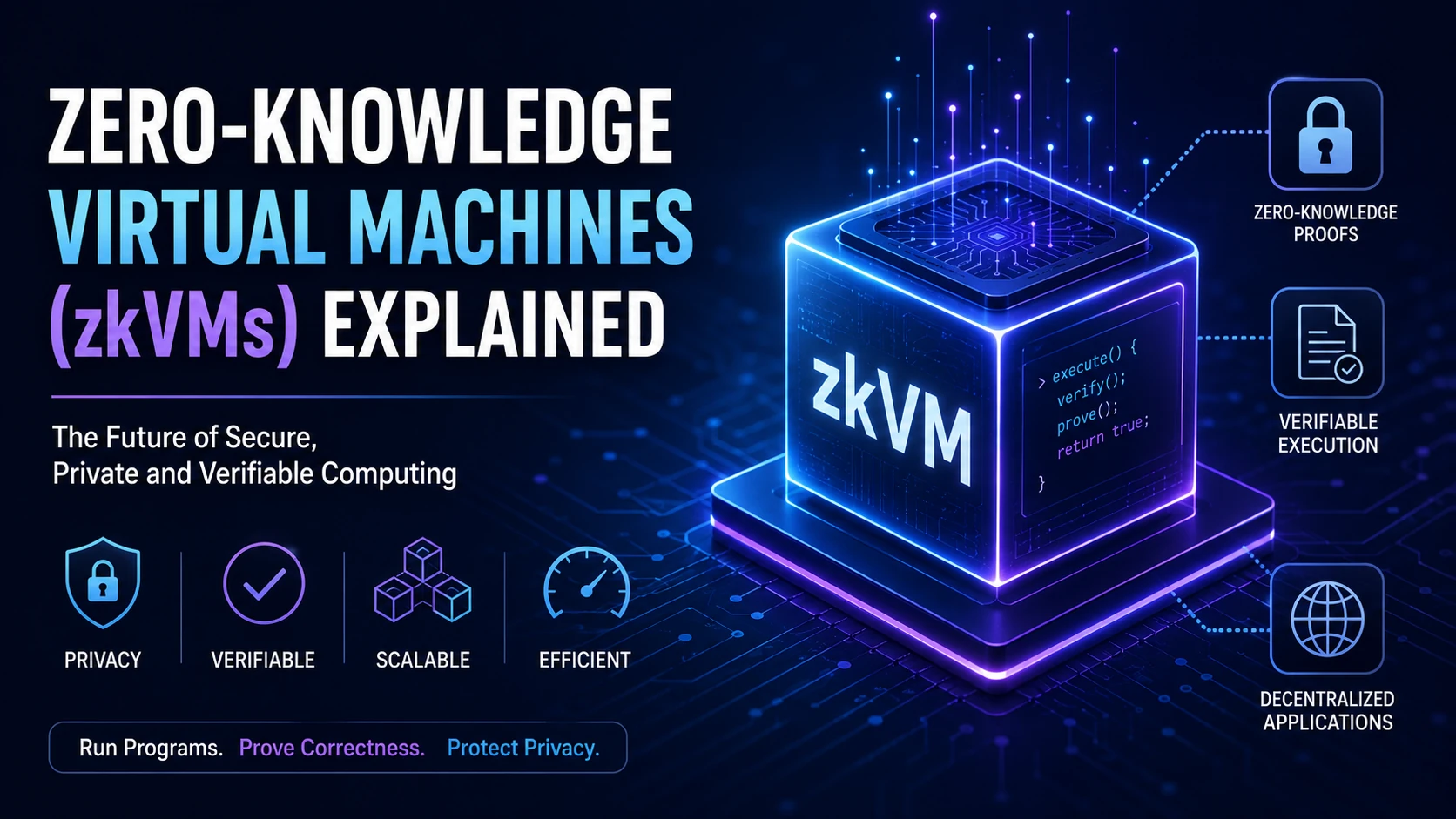
Table of Content
Table of Content
Blockchain technology has transformed how people think about trust, ownership, and decentralized applications. However, traditional blockchains still face significant challenges. Every transaction must usually be verified by every validator, making systems slower as usage grows. At the same time, sensitive information often becomes publicly visible, creating privacy concerns.
This is where Zero-Knowledge Virtual Machines (zkVMs) are changing the game.
zkVMs combine the power of virtual machines with zero-knowledge cryptography, allowing developers to execute programs and prove they were executed correctly without revealing private inputs or repeating expensive computations on every network participant.
Instead of asking everyone to trust a centralized server or execute identical computations repeatedly, a zkVM generates a mathematical proof that confirms the correctness of the execution. Anyone can verify this proof quickly, making decentralized applications more scalable, secure, and privacy-friendly.
As blockchain ecosystems continue to evolve, zkVMs are becoming one of the most exciting innovations behind Layer 2 scaling, decentralized identity, confidential finance, AI verification, gaming, and enterprise applications.
This guide explains everything you need to know about Zero-Knowledge Virtual Machines in simple language.
Understanding Zero-Knowledge Proofs
Before learning about zkVMs, it's important to understand Zero-Knowledge Proofs (ZKPs).
A Zero-Knowledge Proof is a cryptographic technique that allows one party to prove that a statement is true without revealing the underlying information.
Imagine proving that you know a password without actually showing the password itself.
Instead of revealing the secret, you generate mathematical evidence proving that you possess the correct information.
This idea has enormous value in blockchain because users often need to prove ownership, balances, identities, or computations while keeping private data confidential.
Zero-Knowledge Proofs provide three important guarantees:
- Completeness
- Soundness
- Zero Knowledge
Together, these properties ensure secure and trustworthy verification.
What Is a Zero-Knowledge Virtual Machine (zkVM)?
A Zero-Knowledge Virtual Machine is a virtual computing environment capable of executing programs while simultaneously generating cryptographic proofs that verify the execution was correct.
Instead of trusting the computer running the program, anyone can verify the generated proof.
In simple words:
Program → Execution → Mathematical Proof → Fast Verification
Unlike traditional blockchains where every validator executes every instruction, zkVMs allow only one executor to perform the computation while everyone else simply verifies the proof.
This dramatically reduces computation costs and improves scalability.
Think of a zkVM as a highly trustworthy computer that always provides mathematical evidence for every task it performs.
Why Traditional Blockchains Need zkVMs
Traditional blockchains suffer from several limitations.
Every Node Repeats Computation
If thousands of validators execute the same smart contract, enormous computational resources are wasted.
zkVMs eliminate this duplication.
Limited Scalability
As transaction volume increases, blockchain performance decreases.
zkVMs move heavy computation off-chain while keeping verification on-chain.
Poor Privacy
Many public blockchains expose transaction details.
zkVMs allow users to keep sensitive information private while still proving correctness.
High Transaction Costs
More computation means higher gas fees.
zkVMs reduce computational requirements for validators, lowering network costs.
Slow Finality
Complex smart contracts require more execution time.
Proof verification is much faster than re-running the entire computation.
How Does a zkVM Work?
Although zkVM technology relies on advanced cryptography, its workflow is surprisingly straightforward.
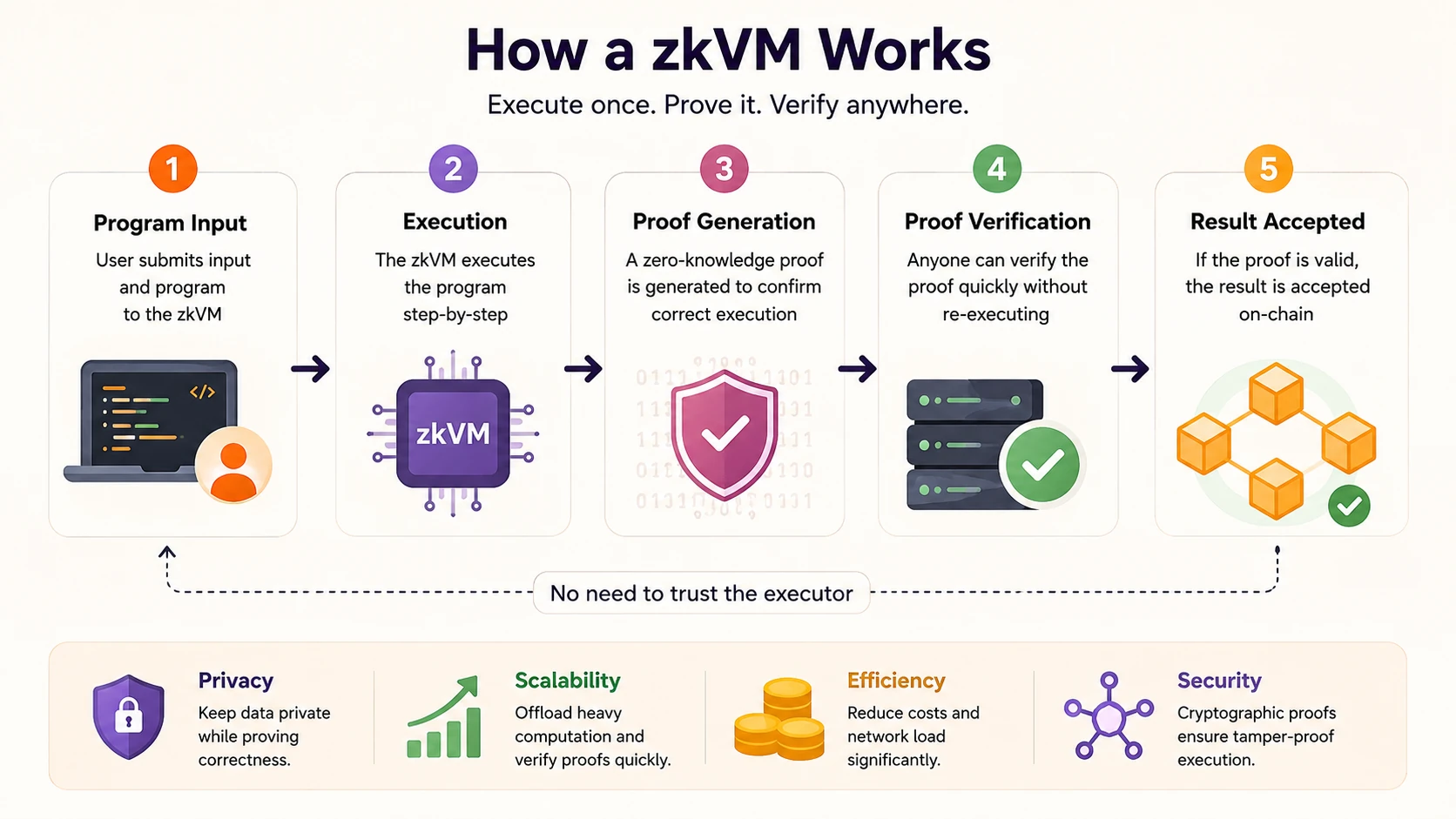
Step 1: Program Execution
A developer writes a program.
The zkVM executes every instruction exactly like a normal virtual machine.
Step 2: Record Every Computation
Instead of simply producing an output, the zkVM records every computational step.
These execution traces become the foundation for proof generation.
Step 3: Generate a Zero-Knowledge Proof
The zkVM creates a compact cryptographic proof showing that:
- Every instruction executed correctly
- Inputs followed program rules
- Outputs are valid
- No unauthorized changes occurred
Step 4: Verify the Proof
Validators verify the proof instead of executing the program.
Verification usually requires only milliseconds.
Step 5: Accept the Result
If the proof is valid, the network accepts the computation.
No additional execution is necessary.
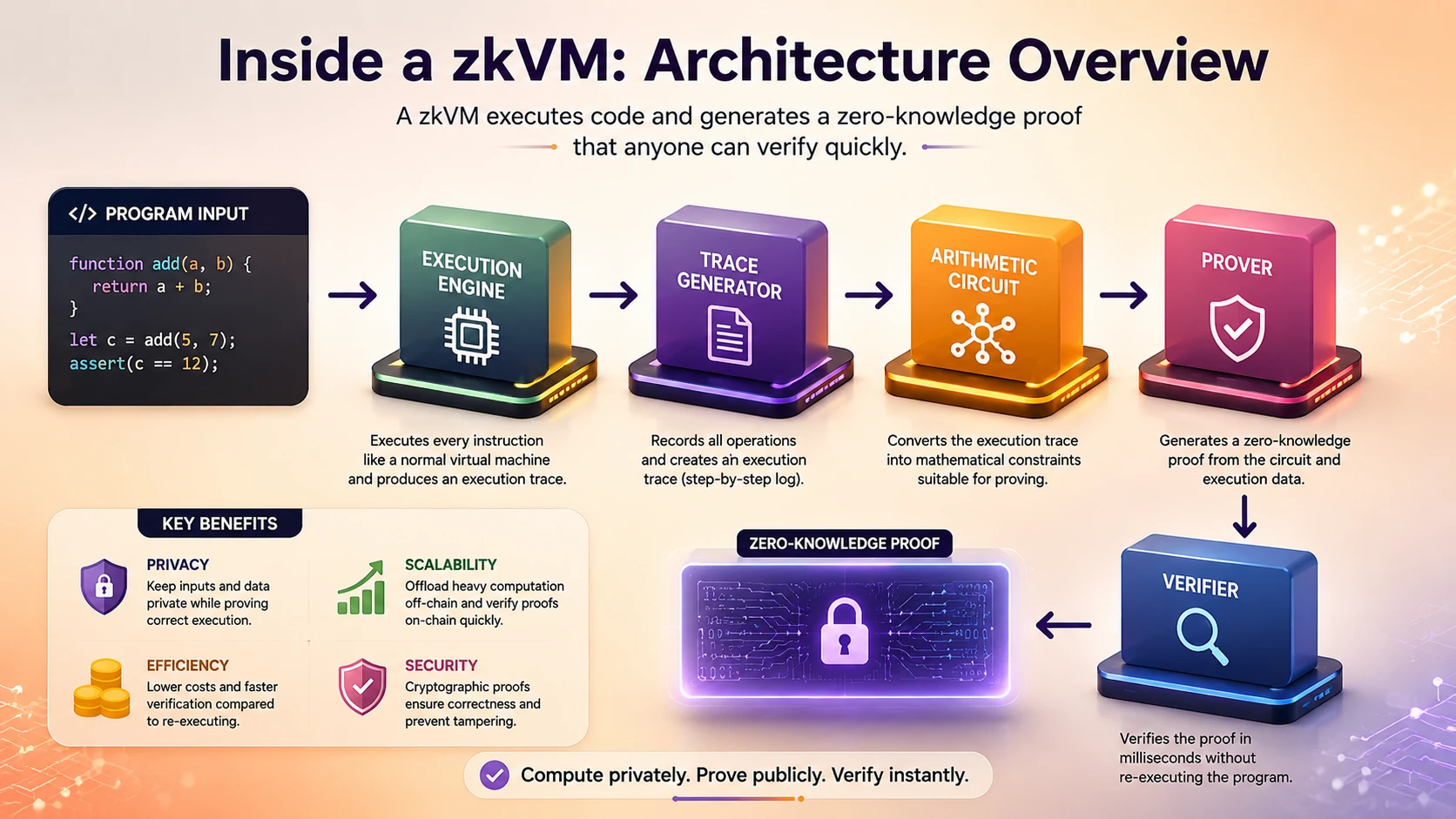
Core Components of a zkVM
Several technologies work together inside a Zero-Knowledge Virtual Machine.
Execution Engine
Runs the application exactly like a standard CPU or blockchain virtual machine.
Trace Generator
Records every operation performed during execution.
Arithmetic Circuit
Transforms program execution into mathematical equations suitable for cryptographic proving.
Prover
Generates the zero-knowledge proof.
This is typically the most computationally intensive stage.
Verifier
Checks the proof quickly.
Verification requires far less computational power than proof generation.
Cryptographic Backend
Implements technologies such as:
- zk-SNARKs
- zk-STARKs
- Polynomial commitments
- Hash functions
- Finite field arithmetic
These algorithms guarantee proof security.
Different Types of zkVM Architectures
Not all zkVMs work the same way.
EVM-Compatible zkVMs
Designed to execute Ethereum smart contracts with minimal modification.
Developers can migrate existing Solidity applications more easily.
WASM-Based zkVMs
Execute WebAssembly programs.
These support multiple programming languages and broader developer ecosystems.
RISC-Based zkVMs
Some zkVMs emulate simple processor architectures such as RISC-V.
These systems prioritize efficiency and easier proof generation.
Custom Virtual Machines
Some blockchain projects design specialized virtual machines optimized for their own ecosystems.
These often deliver better performance for specific applications.
Key Benefits of zkVMs
Massive Scalability
Instead of every validator repeating computation, only proofs are verified.
This dramatically increases throughput.
Enhanced Privacy
Sensitive inputs remain confidential.
Only proof validity becomes public.
Lower Blockchain Costs
Smaller verification workloads reduce transaction expenses.
Strong Security
Mathematical proofs are far more reliable than trusting centralized execution.
Faster Verification
Proof verification is extremely efficient compared to executing complex programs.
Better User Experience
Users enjoy lower fees, faster transactions, and improved privacy.
Cross-Chain Verification
Proofs can often be verified across different blockchain networks.
This improves interoperability.
The biggest advantage is that zkVMs eliminate the need for everyone to repeat the same computation.
Real-World Applications of zkVMs
Layer 2 Scaling
Many Ethereum scaling solutions rely on zkVMs to process thousands of off-chain transactions while submitting only compact proofs to the blockchain.
This greatly improves transaction speed.
Private Payments
Users can prove payments are valid without revealing balances or transaction history.
Decentralized Identity
Identity verification can occur without exposing personal information.
For example:
- Age verification
- Citizenship
- Educational qualifications
- Membership status
AI Verification
Artificial intelligence models require enormous computational resources.
zkVMs can prove an AI model executed correctly without requiring every participant to rerun the model.
This is becoming increasingly valuable for decentralized AI.
Blockchain Gaming
Game logic can execute privately while players prove fairness.
Sensitive gameplay mechanics remain hidden.
Supply Chain
Manufacturers can prove products followed required processes without revealing confidential business data.
Financial Services
Banks and institutions can verify compliance while protecting customer privacy.
Healthcare
Medical organizations can prove patient eligibility without exposing health records.
Popular zkVM Projects
Several blockchain ecosystems are actively developing zkVM technology.
RISC Zero
Builds a zkVM based on the RISC-V instruction set.
Developers can prove arbitrary program execution.
Succinct
Focuses on scalable proof systems and developer-friendly infrastructure.
zkSync
Uses zk technology to improve Ethereum scalability while maintaining compatibility.
Polygon zkEVM
Provides Ethereum-compatible smart contract execution using zero-knowledge proofs.
Scroll
Another Ethereum Layer 2 focused on zkEVM compatibility and scalability.
SP1
A modern zkVM designed for efficient proof generation and general-purpose applications.
These projects continue pushing the boundaries of decentralized computing.
Challenges of zkVMs
Despite their impressive capabilities, zkVMs are still evolving.
Expensive Proof Generation
Creating proofs can require significant computational resources.
Although verification is fast, proving remains resource-intensive.
Complex Development
Developers must understand cryptography, proving systems, and optimization techniques.
Larger Infrastructure Requirements
Proof generation often demands high-performance hardware.
Rapidly Evolving Standards
The ecosystem changes quickly.
New proving systems appear frequently.
Limited Developer Experience
Compared to traditional programming environments, tooling is still maturing.
zkVMs and Artificial Intelligence
One of the most exciting future applications involves AI.
Modern AI systems generate billions of computations.
Verifying AI outputs independently is nearly impossible.
zkVMs allow AI providers to produce cryptographic proofs confirming that:
- The correct model was used.
- Inputs were processed accurately.
- Outputs followed the intended computation.
- No unauthorized modifications occurred.
This creates trust in decentralized AI systems while preserving proprietary models and private user data.
zkVMs and the Future of Web3
Many blockchain experts believe zkVMs will become foundational infrastructure for the next generation of decentralized applications.
Future Web3 systems may rely on zkVMs for:
- High-speed decentralized finance
- Confidential business transactions
- Secure decentralized identity
- Blockchain gaming
- Cross-chain interoperability
- Decentralized AI
- Private voting systems
- Enterprise blockchain adoption
- Government digital services
- Secure cloud computing
As hardware improves and proving algorithms become more efficient, zkVMs are expected to become faster, cheaper, and easier for developers to adopt.
Best Practices for Developers
If you plan to build applications using zkVMs, consider these recommendations:
- Design programs with proof efficiency in mind.
- Minimize unnecessary computations.
- Choose the right proving system for your use case.
- Keep cryptographic libraries updated.
- Benchmark proving and verification performance regularly.
- Optimize memory usage and execution traces.
- Stay informed about evolving zk standards and tooling.
- Test proofs thoroughly before deploying production applications.
Following these practices can significantly improve performance and reliability.
Conclusion
Zero-Knowledge Virtual Machines represent one of the biggest breakthroughs in blockchain infrastructure and verifiable computing. Instead of requiring every participant to trust an executor or repeat expensive computations, zkVMs generate cryptographic proofs that mathematically guarantee correctness while protecting sensitive information.
This combination of scalability, privacy, and security makes zkVMs a powerful foundation for the future of decentralized applications. From Layer 2 blockchain scaling and confidential finance to decentralized identity, AI verification, gaming, and enterprise systems, the technology is opening possibilities that were difficult or impossible with traditional virtual machines.
Although proof generation remains computationally intensive and developer tooling is still evolving, ongoing research is rapidly improving performance and accessibility. As adoption grows, zkVMs are likely to become a core building block of Web3, helping create applications that are not only faster and more scalable but also more trustworthy and privacy-preserving. Developers who begin exploring zkVMs today will be well positioned to build the next generation of secure decentralized software.
Frequently Asked Questions (FAQs)
1. What is a Zero-Knowledge Virtual Machine (zkVM)?
A zkVM is a virtual machine that executes programs and generates cryptographic proofs showing the computation was performed correctly without revealing private data. This enables secure, verifiable, and privacy-preserving computation.
2. How is a zkVM different from a traditional virtual machine?
Traditional virtual machines execute code but do not provide mathematical proof of correctness. A zkVM produces a zero-knowledge proof that anyone can verify quickly, eliminating the need to trust the executor or repeat the computation.
3. Where are zkVMs commonly used?
zkVMs are used in Ethereum Layer 2 networks, decentralized finance (DeFi), blockchain gaming, digital identity, private payments, AI verification, supply chain systems, and enterprise blockchain applications.
4. What are the biggest advantages of zkVMs?
The major benefits include enhanced privacy, lower blockchain costs, improved scalability, faster verification, stronger security through cryptographic proofs, and support for confidential computations.
5. Are zkVMs the future of blockchain?
Many researchers and blockchain developers believe zkVMs will play a major role in the future of Web3 because they solve important challenges related to scalability, privacy, and verifiable computation. As proving technology becomes faster and more efficient, zkVM adoption is expected to increase significantly.