
SOC Analyst Notes PDF – Complete Beginner to Advanced Guide
Download SOC Analyst Notes PDF covering SIEM, EDR, log analysis, incident response, MITRE ATT&CK, threat hunting, Splunk, KQL and practical labs.
 Aditya Chavhan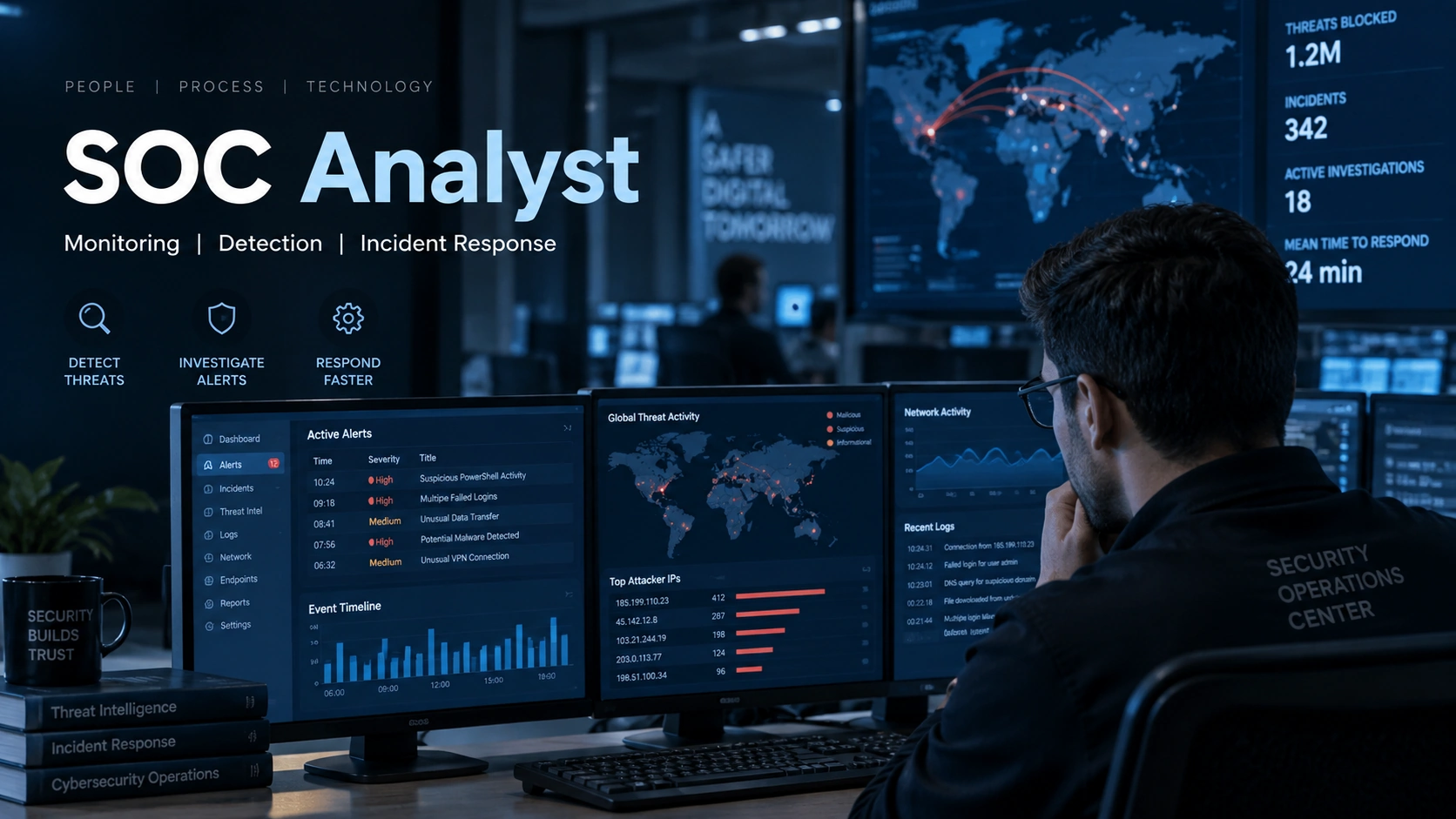
Cybersecurity is often shown as a world of hackers, malware, red-team operations, and complex exploits. In reality, a large part of modern cybersecurity is defensive work. Organizations need people who can continuously watch their systems, identify suspicious behavior, investigate alerts, respond to incidents, and determine whether unusual activity represents a genuine attack or simply normal business activity.
This is where a SOC Analyst becomes important.
SOC stands for Security Operations Center. A SOC is the team or operational function responsible for monitoring an organization's technology environment and responding to security threats. Depending on the company, analysts may monitor employee laptops, Windows and Linux servers, cloud infrastructure, firewalls, email systems, applications, identity platforms, and other security tools from one centralized environment.
For beginners trying to enter cybersecurity, SOC Analyst is also one of the most practical roles to understand because it brings together networking, operating systems, log analysis, malware investigation, phishing, incident response, threat intelligence, SIEM platforms, endpoint security, and cloud security. You do not need to become an expert in every area before starting, but you do need to understand how these pieces connect.
This guide explains what a SOC Analyst actually does, the skills and tools involved, how investigations work, what beginners should learn, and how to build practical experience before applying for jobs.
What Is a SOC Analyst?
A SOC Analyst is a cybersecurity professional who monitors systems and investigates potential security incidents. The analyst receives information from security tools, evaluates whether activity is suspicious, collects evidence, and decides what should happen next.
Imagine that an employee's account suddenly logs in from an unusual location and then downloads hundreds of files. A security tool may generate an alert, but the alert alone does not prove an attack occurred. The employee may be travelling, a legitimate automated application may be running, or an attacker may have stolen the employee's credentials.
The SOC Analyst investigates the surrounding evidence. They may review authentication logs, device activity, IP reputation, file downloads, endpoint telemetry, email events, and the user's previous behavior. Their job is to turn an alert into a meaningful security conclusion.
This distinction is important because security tools generate large amounts of information. The value of a SOC Analyst is not simply opening alerts. It is understanding context.
What Happens Inside a Security Operations Center?
A SOC continuously receives telemetry from different parts of the organization's infrastructure. Logs may come from firewalls, VPN systems, endpoints, servers, Active Directory, cloud services, applications, intrusion detection systems, email security platforms, and identity providers.
These events are often sent into a SIEM, or Security Information and Event Management platform. SIEM systems help organizations centralize logs, search through them, correlate events, and generate security alerts.
For example, a SIEM rule might notice that a user had ten failed login attempts followed by a successful login from a previously unseen country. Another rule might detect that PowerShell executed an unusual encoded command on an employee laptop.
The SOC Analyst reviews these alerts and determines what they mean.
The job therefore combines technology with investigation. Analysts need to understand how normal systems behave before they can reliably recognize abnormal behavior.
SOC Analyst Levels and Responsibilities
Many organizations divide SOC responsibilities into different levels, commonly called Tier 1, Tier 2, and Tier 3, although the exact structure varies.
A Tier 1 analyst generally focuses on alert monitoring and initial triage. They collect basic information, confirm whether an alert is meaningful, document their findings, and escalate suspicious incidents when necessary.
A Tier 2 analyst usually performs deeper investigations. They may analyze endpoint activity, network traffic, malware behavior, authentication records, and attack timelines. They may also coordinate containment actions.
Senior analysts or Tier 3 teams may handle advanced threat hunting, detection engineering, malware analysis, digital forensics, and complex incident response.
This does not mean beginners only perform easy work. Even a junior SOC analyst needs strong fundamentals because a seemingly simple alert can represent the beginning of a serious compromise.
Networking Knowledge Every SOC Analyst Needs
Networking is one of the most important foundations for SOC work. You do not need to become a network engineer, but you should understand how devices communicate.
Start with concepts such as IP addresses, private and public networks, TCP and UDP, ports, DNS, HTTP, HTTPS, routing, firewalls, VPNs, NAT, and basic network protocols.
Suppose a SIEM alert shows that an internal workstation connected to an unusual external IP address on port 443. Knowing that port 443 normally carries HTTPS traffic is useful, but you should not immediately assume the connection is safe. Malware can also communicate over HTTPS.
The analyst may need to investigate the domain name, destination IP, process responsible for the connection, amount of transferred data, and whether other devices contacted the same destination.
Understanding networking allows you to ask better questions during investigations.
Why Windows Knowledge Matters
Windows is extremely important in enterprise SOC environments because many organizations depend heavily on Windows endpoints, Windows Server, and Active Directory.
SOC analysts commonly work with Windows Event Logs. These logs record authentication activity, process creation, account changes, security events, and many other actions.
For example, analysts frequently examine login events to determine whether an account was used successfully or unsuccessfully. Process creation logs can help identify suspicious executables, PowerShell activity, command-line tools, or malware.
Tools such as Sysmon can provide even richer endpoint telemetry, including detailed process, network, and file-related events.
The goal is not simply memorizing hundreds of Windows Event IDs. More important is understanding what security question each event can help answer.
If an administrator account appears compromised, you might ask: When did the account log in? From which machine? Which processes ran afterward? Were new accounts created? Were permissions changed?
Those questions guide the investigation.
Linux Knowledge for SOC Analysts
Linux is also widely used across servers, cloud infrastructure, containers, and security systems.
A SOC Analyst should be comfortable navigating the Linux command line and understanding basic files, permissions, processes, services, users, networking, and logs.
Useful areas include SSH authentication, sudo activity, shell history, process listings, system logs, cron jobs, and permission changes.
Imagine a Linux server suddenly begins making connections to an unfamiliar external server. An analyst may investigate running processes, recently modified files, user logins, scheduled tasks, network connections, and authentication records.
Basic Linux skills can make these investigations dramatically easier.
SIEM: The Central Tool of Many SOC Teams
The SIEM is often the primary workspace of a SOC analyst. Popular platforms include Splunk, Microsoft Sentinel, IBM QRadar, Elastic Security, and others.
A SIEM collects security data and allows analysts to search it.
For example, an analyst might search for all authentication attempts associated with a particular username, all devices communicating with a suspicious IP, or every execution of a specific process across the environment.
Learning query languages is therefore extremely valuable.
Splunk commonly uses SPL, while Microsoft Sentinel relies heavily on Kusto Query Language, or KQL.
A beginner does not need to memorize every query command. Start by learning how to filter events, select fields, group results, count occurrences, sort data, and search across a specific time range.
Once you can investigate logs confidently, many SOC alerts become much easier to understand.
Endpoint Detection and Response
Traditional antivirus software primarily focuses on identifying known malicious files. Modern SOC teams often use Endpoint Detection and Response, or EDR, platforms.
EDR tools provide visibility into what happens on endpoints. They can record process creation, command-line activity, network connections, file changes, registry modifications, and other endpoint behavior.
Suppose Microsoft Word launches PowerShell, which then downloads a file from an external server. That process chain can be extremely suspicious.
An analyst may examine the process tree and ask whether the behavior makes sense.
Why did Word start PowerShell? What command executed? Which server was contacted? Which file was downloaded? Did the downloaded file create another process?
This type of behavioral investigation is central to modern SOC work.
Phishing Investigation
Phishing remains one of the most common areas investigated by SOC teams.
When an employee reports a suspicious email, the analyst needs to determine whether it is harmless spam, credential phishing, malware delivery, business email compromise, or another form of attack.
The analyst may examine the sender address, reply-to address, email headers, links, attachments, domain registration, message content, and authentication mechanisms such as SPF, DKIM, and DMARC.
Suppose the email claims to come from Microsoft but links to a completely unrelated domain. The analyst may investigate that domain, check its reputation, determine whether other employees received the same message, and see whether anyone clicked the link.
If users interacted with the phishing site, the investigation may expand into identity logs and endpoint telemetry.
A phishing investigation can therefore become a broader incident-response case very quickly.
Malware Triage
SOC analysts do not necessarily perform advanced reverse engineering, but they should understand malware triage.
When a suspicious file appears, the analyst may collect information such as its cryptographic hash, file type, digital signature, source, execution behavior, network connections, and reputation.
Static analysis looks at the file without executing it, while dynamic analysis observes behavior in a controlled environment.
SOC teams may also use YARA rules to identify files based on specific patterns or characteristics.
The objective of initial malware triage is often not to understand every instruction inside the malware. It is to determine whether the file is dangerous, what systems may be affected, and what indicators defenders should search for elsewhere.
MITRE ATT&CK and Understanding Attacker Behavior
The MITRE ATT&CK framework provides a structured way to describe attacker techniques.
Instead of simply saying, “The attacker used PowerShell,” defenders can associate activity with specific behaviors and understand where it fits within an attack lifecycle.
ATT&CK includes areas such as initial access, execution, persistence, privilege escalation, credential access, discovery, lateral movement, collection, command and control, and exfiltration.
SOC analysts use ATT&CK to understand alerts, map detections, communicate incidents, and identify gaps in security monitoring.
It also helps beginners stop thinking of attacks as isolated events. Real compromises are often chains of connected actions.
A phishing email may lead to script execution, credential theft, privilege escalation, lateral movement, and eventually data exfiltration.
Incident Response
When an alert becomes a confirmed security incident, structured incident response becomes important.
An investigation generally moves through identification, containment, eradication, recovery, and lessons learned, although organizations may use slightly different frameworks.
Imagine that an employee device is infected with malware. The SOC may isolate the endpoint from the network, disable compromised credentials, block malicious domains, collect evidence, remove persistence mechanisms, and restore the system.
The analyst also needs to understand the scope.
Was only one machine affected? Did the attacker steal credentials? Were other endpoints contacted? Did the attacker access sensitive data?
Strong incident response focuses not only on removing the immediate threat but also on understanding what actually happened.
Threat Intelligence
Threat intelligence provides information about attackers, malicious infrastructure, techniques, malware, domains, and indicators of compromise.
Indicators can include IP addresses, domains, URLs, file hashes, and email addresses.
However, an indicator alone is not proof of malicious activity. IP addresses change, shared cloud infrastructure may host both legitimate and malicious services, and old indicators can become irrelevant.
Good analysts combine threat intelligence with local context.
If a system communicates with an IP previously associated with malware, the analyst still needs to understand which process created the connection, when it happened, how much data moved, and whether other suspicious behavior occurred.
Threat Hunting and Detection Engineering
Traditional alert monitoring waits for a detection to fire. Threat hunting takes a more proactive approach.
A threat hunter develops a hypothesis and searches the environment for signs of suspicious activity that existing alerts may have missed.
For example, a hunter might investigate unusual PowerShell execution across workstations or search for rare administrative tools being launched by unexpected users.
Detection engineering focuses on creating better rules and analytics that identify malicious behavior.
Sigma is commonly used as a vendor-neutral detection-rule format that can describe suspicious log behavior and later be converted for different SIEM platforms.
These skills usually become more important as analysts gain experience.
Cloud Security in Modern SOC Teams
SOC environments increasingly include AWS, Azure, Google Cloud, Microsoft 365, and other SaaS platforms.
Cloud investigations may involve unusual console logins, new access keys, unexpected administrator roles, public storage changes, suspicious API activity, or unusual data downloads.
Identity becomes especially important because cloud attackers often abuse legitimate credentials instead of exploiting traditional network services.
A modern SOC Analyst should therefore understand at least the basics of cloud IAM, audit logging, storage permissions, and cloud security monitoring.
How Beginners Should Learn SOC Analysis
The best learning strategy combines fundamentals with investigations. Start with networking, Windows, Linux, and basic security concepts. Then learn how logs represent activity.
After that, explore a SIEM and practice searching data. Learn endpoint telemetry, basic phishing analysis, network traffic analysis, MITRE ATT&CK, and incident-response concepts.
Tools are important, but avoid becoming dependent on one product. Splunk may be replaced by Sentinel at another company, but investigation skills transfer.
Instead of asking, “Which button should I click in this SIEM?” learn to ask, “Which evidence would prove or disprove my hypothesis?”
That mindset is far more valuable.
Building a SOC Analyst Portfolio
Practical projects can make a beginner's profile much stronger.
You can create a small home SOC lab using Windows and Linux virtual machines, generate authentication activity, collect logs, and investigate them using a SIEM.
Other useful projects include analyzing a sample phishing email, creating Sigma detections, investigating network traffic in Wireshark, mapping an attack scenario to MITRE ATT&CK, writing an incident report, or creating a dashboard for suspicious authentication activity.
Document what you investigated, what evidence you used, and how you reached your conclusion.
Employers often value evidence of practical thinking more than a large list of tools with no demonstrated understanding.
What Makes a Good SOC Analyst?
Technical knowledge is important, but investigation requires discipline.
A good analyst does not immediately assume an alert is malicious. They collect evidence.
They do not close an alert simply because one indicator looks harmless. They examine context.
They document what they found so another analyst can understand the investigation.
They also remain curious. Cybersecurity changes constantly, so analysts need to keep learning.
Communication matters too. During a serious incident, technical findings may need to be explained to managers, IT administrators, developers, and executives. Clear writing and accurate incident notes are therefore valuable professional skills.
Final Thoughts
Becoming a SOC Analyst is not about memorizing every tool, attack technique, Windows Event ID, or SIEM command. The real skill is learning how to investigate.
You receive an alert, develop questions, gather evidence, compare normal and abnormal behavior, build a timeline, determine risk, and decide what needs to happen next.
Networking helps you understand communication. Windows and Linux knowledge help you understand endpoints. SIEM platforms help you search evidence. EDR provides process visibility. Threat intelligence adds external context. MITRE ATT&CK helps organize attacker behavior, while incident-response processes help teams contain and recover from real attacks.
Beginners should focus on these fundamentals before worrying about every advanced security product.
If you consistently practice investigating logs, analyzing endpoints, understanding network traffic, studying real attack techniques, and writing clear investigation reports, you gradually develop the most important SOC skill of all: the ability to look at scattered technical evidence and understand the story behind it.
Frequently Asked Questions
1. What does a SOC Analyst do every day?
A SOC Analyst monitors security alerts, investigates suspicious activity, analyzes logs and endpoint events, reviews phishing reports, gathers evidence, documents findings, and escalates or responds to genuine security incidents. The exact responsibilities depend on the organization's SOC structure and the analyst's experience level.
2. What skills should a beginner learn to become a SOC Analyst?
Beginners should focus on networking, Windows and Linux fundamentals, cybersecurity basics, log analysis, SIEM platforms, endpoint security, phishing investigation, incident response, MITRE ATT&CK, and basic network traffic analysis. Strong investigation and documentation skills are equally important.
3. Which tools should a SOC Analyst learn?
Useful tools include SIEM platforms such as Splunk or Microsoft Sentinel, EDR platforms, Wireshark, Sysmon, VirusTotal-style threat intelligence tools, Sigma, YARA, and basic Linux and Windows utilities. Beginners should understand the security concepts behind the tools rather than trying to memorize every product.
4. Can a fresher become a SOC Analyst?
Yes. SOC Analyst is a common cybersecurity entry path, but employers generally expect solid fundamentals and evidence of practical learning. Building home labs, investigating logs, writing incident reports, practicing SIEM searches, analyzing phishing samples, and documenting cybersecurity projects can significantly strengthen a fresher profile.
5. Is SOC Analyst a good cybersecurity career?
SOC analysis can provide a strong foundation because analysts gain exposure to networking, operating systems, malware, phishing, identity attacks, cloud security, threat intelligence, detection engineering, and incident response. With experience, SOC analysts can progress toward threat hunting, incident response, detection engineering, DFIR, security engineering, cloud security, or other specialized cybersecurity roles.