
Digital Public Infrastructure Meets Web3: The Future of Digital Identity, Payments, and Governance
Digital Public Infrastructure and Web3 are transforming how governments, businesses, and citizens interact online. Learn how blockchain, decentralized identity, smart contracts, and digital payments are shaping the future of secure, transparent, and efficient digital public services.
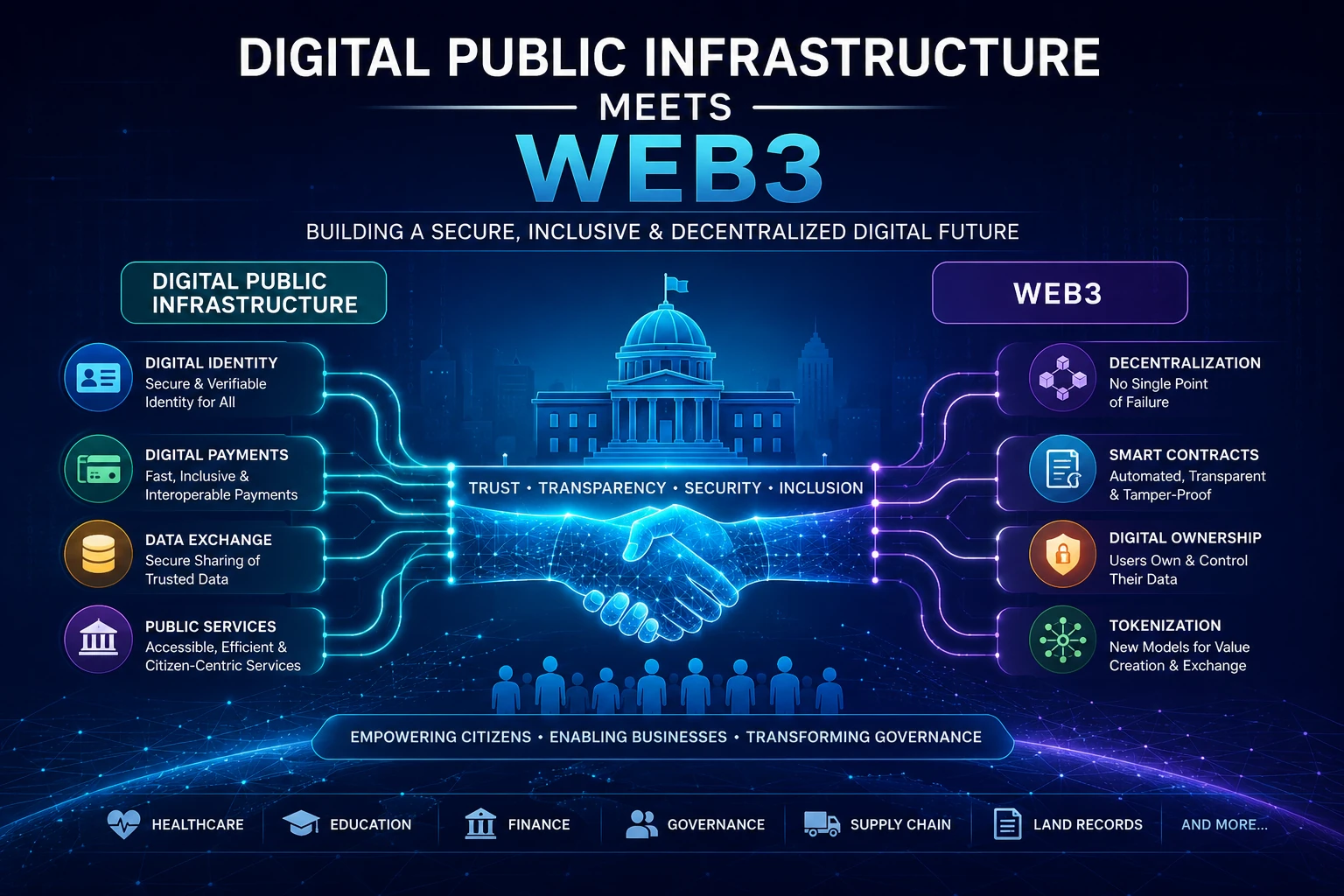
Table of Content
Table of Content
Introduction
Every few decades, technology reaches a point where it fundamentally changes how societies operate. The internet connected people. Smartphones connected daily life. Cloud computing transformed businesses. Today, another transformation is taking shape through the combination of Digital Public Infrastructure (DPI) and Web3.
Governments around the world are investing heavily in digital services that make identification, payments, healthcare, education, and public administration more efficient. At the same time, blockchain technology and decentralized applications are introducing new ways to establish trust without relying on a single central authority.
When these two worlds come together, they create opportunities that extend far beyond cryptocurrency. They open the possibility of secure digital identities, transparent government services, faster financial systems, privacy preserving citizen data, and digital ecosystems where users maintain greater control over their information.
This combination has attracted attention from governments, technology companies, financial institutions, startups, and international organizations because it represents a practical path toward building more accessible and trustworthy digital societies.
In this guide, we will explore what Digital Public Infrastructure is, how Web3 complements it, the technologies behind this transformation, real world applications, benefits, challenges, and why this convergence may become one of the most significant technology trends of the coming decade.
What Is Digital Public Infrastructure?
Digital Public Infrastructure refers to foundational digital systems that enable governments, businesses, and citizens to interact securely through digital services.
Rather than representing a single application, DPI is an ecosystem of interconnected platforms that support everyday activities such as identity verification, payments, document sharing, and public service delivery.
Most successful Digital Public Infrastructure initiatives are built around three foundational pillars.
Digital Identity
A trusted digital identity allows individuals to verify who they are online without repeatedly submitting physical documents.
Examples include:
- National digital identity systems
- Secure citizen authentication
- Online verification for banking
- Government service access
- Educational credential verification
A reliable digital identity reduces paperwork while improving convenience and security.
Digital Payments
Modern payment infrastructure enables instant financial transactions between citizens, businesses, and government agencies.
Examples include:
- Real time bank transfers
- Government benefit distribution
- Digital wallets
- Merchant payments
- Cross platform financial services
Efficient payment systems reduce costs while increasing financial inclusion.
Data Exchange
Governments often maintain separate databases for healthcare, taxation, education, transportation, and public welfare.
Digital Public Infrastructure enables these systems to communicate securely while protecting citizen privacy.
Instead of repeatedly collecting identical information from users, authorized systems can securely exchange verified data whenever necessary.
Why Digital Public Infrastructure Matters
Digital services have become essential for modern societies.
People expect to:
- Open bank accounts online
- Pay taxes digitally
- Apply for passports
- Receive healthcare services
- Access educational records
- Register businesses
- Receive government benefits
Without a strong digital foundation, these services become fragmented, slow, and vulnerable to fraud.
Digital Public Infrastructure provides a common framework that improves efficiency across both public and private sectors.
Understanding the Core Principles of Web3
To understand why DPI and Web3 complement each other, it is important to understand what Web3 actually represents.
Many people associate Web3 only with cryptocurrencies. While digital assets are part of the ecosystem, Web3 is much broader.
Web3 refers to the next generation of internet technologies where ownership, trust, and data management rely on decentralized networks rather than centralized platforms.
Instead of placing complete control in the hands of a single organization, Web3 distributes responsibility across blockchain networks.
Its core technologies include:
- Blockchain
- Smart contracts
- Decentralized applications
- Cryptographic security
- Digital wallets
- Tokenization
- Decentralized identity
The objective is to create digital systems that are transparent, secure, resilient, and resistant to single points of failure.
Traditional Internet vs Web3
The internet has evolved through multiple stages.
Web1
Web1 primarily allowed users to read information.
Examples included:
- Static websites
- Online directories
- Basic information portals
Interaction was very limited.
Web2
Web2 introduced user generated content.
Examples include:
- Social media
- Video platforms
- Cloud applications
- Online marketplaces
Although Web2 improved convenience, most user data became concentrated within a small number of large technology companies.
Web3
Web3 introduces decentralized ownership.
Instead of trusting a central platform to store information, users interact with blockchain networks where records are cryptographically verified and shared across distributed systems.
This creates greater transparency while reducing dependence on centralized databases.
Why Digital Public Infrastructure and Web3 Are Converging
Governments need reliable digital systems.
Citizens need privacy.
Businesses need trusted digital transactions.
Traditional centralized systems solve many problems but also introduce challenges.
Some common concerns include:
- Single points of failure
- Large scale cyber attacks
- Data breaches
- Limited transparency
- Identity fraud
- Vendor lock in
Web3 technologies address many of these issues.
Blockchain creates tamper resistant records.
Cryptography protects sensitive information.
Smart contracts automate verification.
Decentralized identity gives users greater control over personal information.
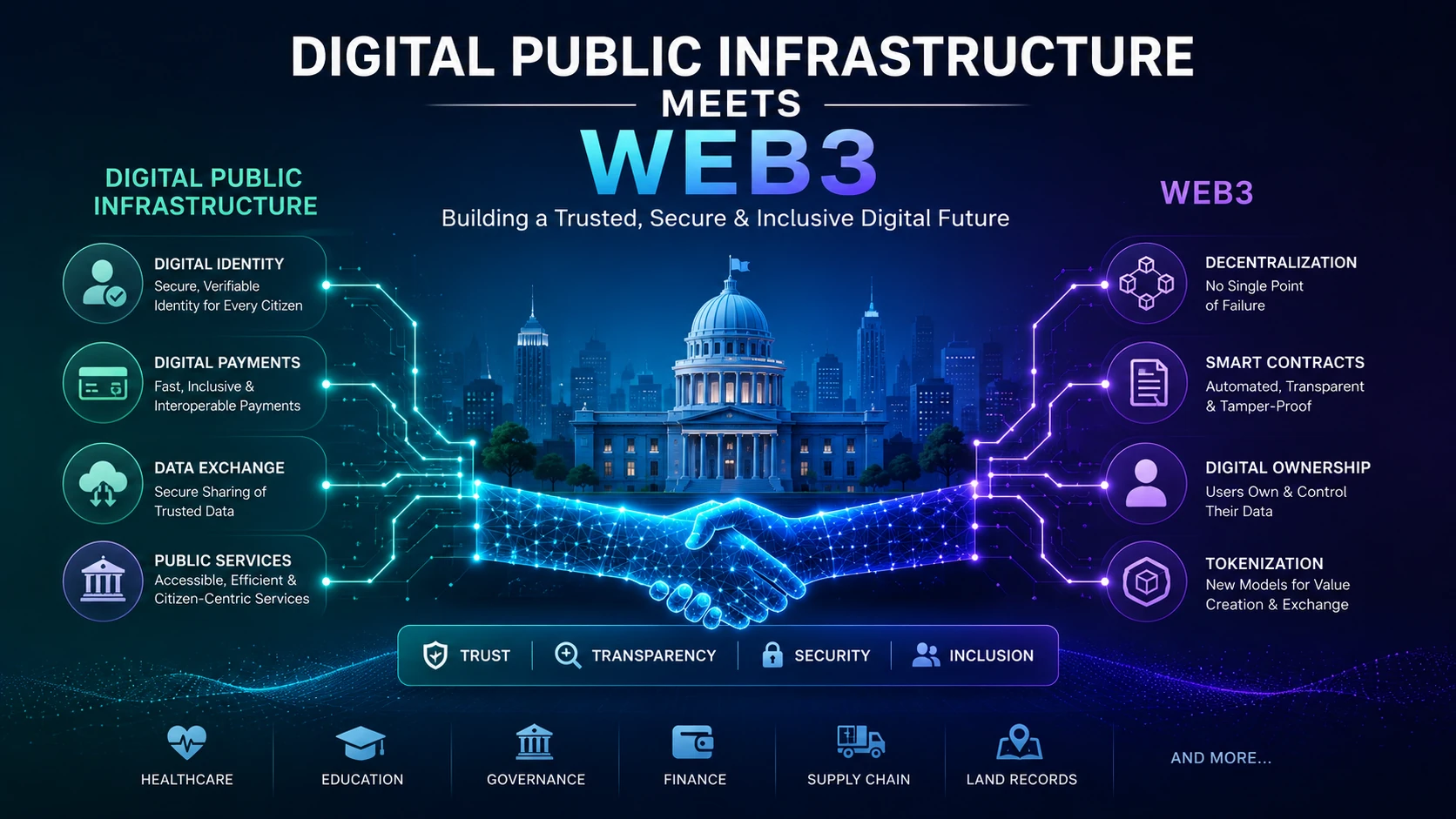
Together, Digital Public Infrastructure and Web3 create stronger digital ecosystems that improve trust between governments, businesses, and citizens.
The Evolution from Centralized Infrastructure to Distributed Trust
For decades, governments have relied on centralized databases.
While these systems perform well under normal conditions, they also create risks.
If one database is compromised, millions of citizen records may be exposed.
Similarly, system outages can interrupt essential public services.
Distributed infrastructure changes this model.
Instead of storing every critical record within a single environment, blockchain networks replicate information across multiple participating nodes.
Every authorized participant verifies transactions using consensus mechanisms.
This dramatically increases integrity while reducing opportunities for unauthorized modifications.
Imagine a national land registry.
In traditional systems, a malicious insider might alter ownership records.
In a blockchain based registry, every modification becomes permanently recorded and independently verified.
Unauthorized changes become significantly more difficult.
This creates stronger trust without increasing administrative complexity.
Key Components of Digital Public Infrastructure
Digital Public Infrastructure consists of several interconnected technologies rather than a single platform.
Digital Identity Systems
These authenticate citizens securely.
Payment Infrastructure
Supports real time digital transactions.
Data Exchange Frameworks
Enable secure communication between authorized organizations.
Digital Certificates
Provide verified educational, medical, and professional credentials.
Public Service Platforms
Offer online access to government programs.
Security Frameworks
Protect digital assets through encryption, authentication, monitoring, and compliance.
When Web3 technologies are integrated into these components, each layer becomes more transparent, secure, and resilient.
How Blockchain Strengthens Public Digital Infrastructure
Blockchain acts as a trust layer.
Instead of replacing existing systems entirely, blockchain can verify important events while allowing governments to maintain operational flexibility.
Several characteristics make blockchain valuable for public infrastructure.
Transparency
Every authorized transaction becomes traceable.
Audit processes become significantly easier.
Immutability
Historical records cannot be secretly modified after verification.
This improves accountability across public institutions.
Security
Cryptographic algorithms protect information against unauthorized changes.
Automation
Smart contracts reduce manual approvals for predefined processes.
Reduced Fraud
Identity verification and transaction validation become far more reliable than traditional paper based systems.
These advantages explain why governments worldwide are actively exploring blockchain based public infrastructure projects.
Digital Identity in the Web3 Era
Identity is one of the most valuable assets in the digital world. Whether someone wants to open a bank account, enroll in a university, apply for a government benefit, or access healthcare services, identity verification is the first step. Traditional identity systems often require users to submit the same documents repeatedly, increasing both inconvenience and the risk of data exposure.
Web3 introduces a new approach known as Decentralized Identity (DID). Instead of storing all personal information in a central database, users hold verified digital credentials in a secure digital wallet. They decide when, where, and how to share specific pieces of information.
For example, if a person wants to prove they are over 18, they can share only their age verification rather than revealing their full date of birth, address, or identification number. This concept is called selective disclosure, and it significantly improves privacy.
When integrated with Digital Public Infrastructure, decentralized identity can make online services faster, safer, and more user friendly. Citizens gain greater control over their personal data, while governments and businesses can still verify information with confidence.
The Role of Smart Contracts in Public Services
One of the most promising aspects of Web3 is the use of smart contracts. These are self-executing digital agreements that automatically perform predefined actions once specific conditions are met.
Unlike traditional software that often requires manual approval, smart contracts reduce delays and minimize human error.
Imagine a scholarship program where students receive financial support after meeting academic requirements. Instead of processing thousands of manual applications, a smart contract could automatically verify eligibility using trusted educational records and release the payment without unnecessary paperwork.
Similar applications include:
Government Subsidies
Eligible citizens receive payments automatically after identity and qualification checks.
Business Registration
Company registration can be completed once all legal requirements are digitally verified.
Tax Refunds
Refunds can be processed more quickly through automated validation.
Public Procurement
Government contracts become more transparent because bidding, evaluation, and payment processes are recorded on immutable digital ledgers.
Automation does not replace government oversight. Instead, it reduces repetitive administrative work while improving transparency and accountability.
Real World Applications Across Different Industries
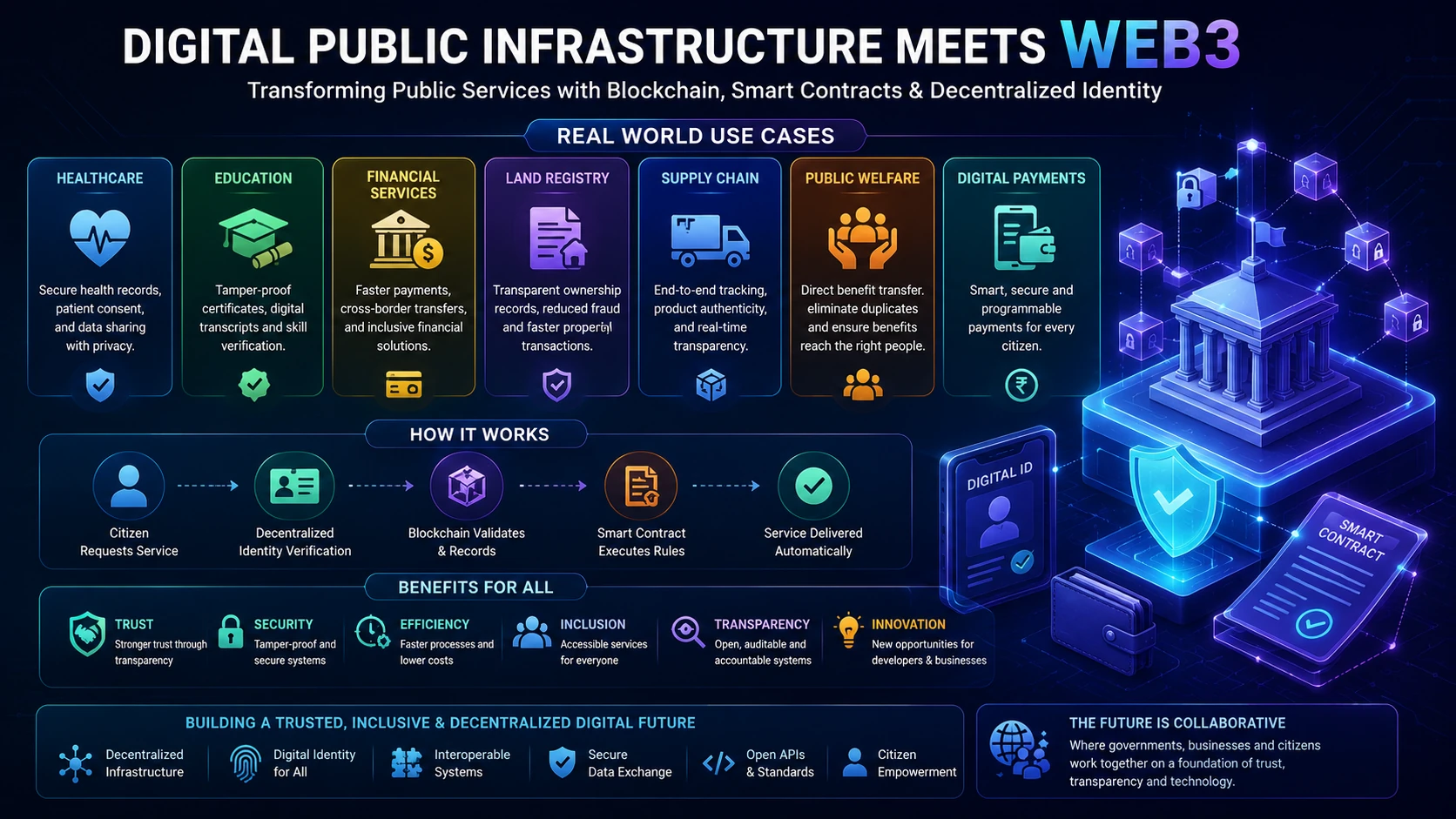
The combination of Digital Public Infrastructure and Web3 is already influencing multiple sectors. While adoption varies across countries, the underlying concepts have broad potential.
Healthcare
Healthcare systems generate enormous amounts of sensitive data. Patients often visit multiple hospitals, clinics, laboratories, and specialists throughout their lives.
Without interoperability, medical records remain fragmented across different institutions.
Web3 can enable secure medical data sharing while allowing patients to control who can access their records.
Possible benefits include:
- Faster emergency treatment
- Reduced duplicate medical tests
- Secure prescription verification
- Improved insurance claim processing
- Better patient privacy
Medical professionals gain access to verified information while patients retain greater ownership of their health data.
Education
Educational credentials are frequently verified during university admissions and job applications.
Traditional verification can take days or even weeks.
Blockchain-based credentials allow institutions to issue tamper-resistant digital certificates that employers can verify within seconds.
Potential applications include:
- Digital diplomas
- Online certifications
- Skill verification
- Academic transcripts
- Professional licenses
Students benefit from lifelong ownership of their educational achievements without depending on paper documents.
Financial Services
Digital payments already form a major part of Digital Public Infrastructure.
Web3 expands these capabilities through programmable financial services.
Examples include:
- Cross-border payments
- Digital asset settlement
- Automated compliance
- Tokenized financial products
- Peer-to-peer lending
Financial institutions can reduce transaction costs while improving transparency.
Land Registry
Land ownership disputes remain a significant challenge in many regions.
Paper records may be lost, damaged, or manipulated.
Blockchain-based land registries create permanent ownership histories that are difficult to alter without authorization.
Benefits include:
- Reduced fraud
- Faster property transfers
- Transparent ownership history
- Simplified legal verification
This improves confidence among citizens, investors, and government agencies.
Supply Chain Management
Governments and businesses rely on complex supply chains for food, medicine, infrastructure, and manufacturing.
Blockchain enables every stage of production and transportation to be recorded securely.
Consumers can verify where products originated, how they were transported, and whether quality standards were maintained.
Applications include:
- Pharmaceutical tracking
- Agricultural supply chains
- Food safety
- Manufacturing quality control
- Public procurement transparency
Public Welfare Programs
Governments distribute financial assistance through various welfare schemes.
Fraud, duplicate beneficiaries, and administrative delays reduce efficiency.
Combining Digital Public Infrastructure with blockchain enables verified identity checks before benefits are distributed.
This helps ensure:
- Genuine beneficiaries receive support
- Duplicate claims are minimized
- Public spending becomes more transparent
- Administrative costs decrease
Digital Payments Become Smarter
Digital payment infrastructure has already transformed modern economies.
Web3 introduces programmable payments through smart contracts.
Imagine a government infrastructure project where contractors receive payment only after independent inspectors verify completed work.
Instead of relying on lengthy approval chains, payments can be released automatically when predefined conditions are satisfied.
This approach improves accountability while reducing delays.
Cross Border Digital Cooperation
International trade often involves multiple identity checks, financial intermediaries, and documentation processes.
Shared digital infrastructure combined with blockchain verification can simplify many of these activities.
Potential improvements include:
- Faster customs verification
- Digital trade documentation
- International educational credential recognition
- Cross-border healthcare records
- Secure financial settlements
As more countries invest in digital infrastructure, interoperability becomes increasingly important.
Benefits of Combining Digital Public Infrastructure with Web3
The convergence of these technologies offers several long-term advantages.
Improved Trust
Citizens gain confidence because important records become transparent and verifiable.
Trust no longer depends entirely on a single database or institution.
Stronger Security
Blockchain uses advanced cryptographic techniques that make unauthorized modifications significantly more difficult.
Although no technology is completely immune to attacks, decentralized systems reduce several traditional security risks.
Better Privacy
Users share only the information required for a particular service.
This minimizes unnecessary exposure of sensitive personal data.
Faster Public Services
Automation reduces waiting times for:
- Identity verification
- Financial assistance
- License approvals
- Certificate issuance
- Record validation
Citizens receive services more quickly while governments reduce operational costs.
Reduced Fraud
Tamper-resistant records improve accountability.
Duplicate identities, forged documents, and unauthorized modifications become much harder to execute successfully.
Financial Inclusion
Millions of people worldwide remain underserved by traditional banking systems.
Digital identity combined with accessible payment infrastructure allows more individuals to participate in the digital economy.
Increased Transparency
Government spending, procurement processes, and public records become easier to audit.
Greater transparency strengthens public confidence in institutions.
Encouraging Innovation
Open digital infrastructure allows startups and developers to build new applications without recreating foundational systems.
Innovation becomes faster because reliable infrastructure already exists.
Challenges That Still Need Solutions
Despite its enormous potential, combining Digital Public Infrastructure with Web3 is not without challenges.
Technology alone cannot solve every problem.
Successful implementation requires thoughtful planning, regulation, and collaboration.
Challenges and Risks of Combining Digital Public Infrastructure with Web3
While the integration of Digital Public Infrastructure and Web3 offers exciting possibilities, it is important to recognize that every technological advancement brings new challenges. Governments, businesses, and technology providers must address these issues carefully to ensure that digital transformation benefits everyone.
Privacy and Data Protection
Privacy remains one of the biggest concerns in any digital ecosystem. Citizens trust governments with highly sensitive information, including identity records, healthcare data, financial details, and educational credentials.
Blockchain provides transparency, but not every piece of public information should be permanently visible. This is why many Digital Public Infrastructure projects use permissioned blockchain networks or privacy-preserving technologies rather than fully public blockchains.
Techniques such as encryption, zero-knowledge proofs, and selective disclosure allow systems to verify information without exposing unnecessary personal data.
Finding the right balance between transparency and privacy will remain one of the most important priorities.
Scalability Challenges
National digital infrastructure serves millions or even billions of users.
A blockchain network that works well for a small community may struggle when processing millions of transactions every day.
Developers continue working on solutions such as:
- Layer 2 scaling technologies
- Parallel transaction processing
- Improved consensus mechanisms
- Hybrid blockchain architectures
- Cloud-assisted blockchain infrastructure
These innovations aim to improve performance while maintaining security and decentralization.
Regulatory and Legal Considerations
Technology evolves much faster than laws.
Many countries are still developing regulations around:
- Digital identity
- Blockchain governance
- Smart contracts
- Digital assets
- Cross-border data sharing
- Privacy compliance
Governments must create clear legal frameworks that encourage innovation while protecting citizens and businesses.
International cooperation will also become increasingly important because digital services often operate across national borders.
Digital Inclusion
Technology should simplify access to services rather than create new barriers.
Not everyone has:
- Reliable internet access
- Modern smartphones
- Digital literacy
- Access to online financial services
Digital Public Infrastructure should always include accessible alternatives for elderly citizens, rural communities, and individuals with disabilities.
Inclusive design is just as important as technological innovation.
Cybersecurity Risks
Although blockchain improves data integrity, the overall ecosystem still requires strong cybersecurity practices.
Potential risks include:
- Phishing attacks
- Wallet theft
- Weak authentication
- Social engineering
- Software vulnerabilities
- Insider threats
Governments and organizations must continue investing in cybersecurity awareness, secure software development, and continuous monitoring.
Interoperability Challenges
Different countries often develop digital systems using different technologies and standards.
Without interoperability, cross-border collaboration becomes difficult.
Future Digital Public Infrastructure initiatives will require common standards for:
- Identity verification
- Data exchange
- Payment systems
- Digital credentials
- Authentication
International standards organizations and technology communities are already working toward this goal.
The Future of Digital Public Infrastructure and Web3
The next decade is likely to bring significant changes in how governments, businesses, and citizens interact online.
Instead of isolated digital platforms, future ecosystems may operate through interconnected networks where trusted information moves securely between authorized participants.
Several emerging trends support this vision.
Self-Sovereign Identity
Individuals will have greater control over their personal information.
Rather than creating separate accounts for every service, citizens may use verified digital credentials stored in secure wallets.
AI-Powered Public Services
Artificial intelligence will help governments process applications, answer citizen questions, detect fraud, and improve decision-making.
When combined with verified digital identity and blockchain records, AI systems can become both more efficient and more trustworthy.
Cross-Border Digital Cooperation
Countries may increasingly recognize each other's verified digital credentials.
Students could use digital academic certificates internationally.
Businesses could complete international trade documentation digitally.
Citizens may access certain services while traveling without repeatedly verifying their identity.
Tokenization of Public Assets
Governments may eventually tokenize certain public assets or financial instruments to improve transparency and efficiency.
Examples could include:
- Infrastructure investment
- Carbon credits
- Renewable energy certificates
- Government bonds
- Public grant distribution
Tokenization has the potential to simplify ownership records and improve liquidity in selected sectors.
Smart Cities
Future smart cities will combine:
- IoT devices
- AI
- Digital identity
- Secure payment systems
- Blockchain verification
Citizens may seamlessly access transportation, utilities, healthcare, education, and municipal services through integrated digital platforms.
Digital Trust as National Infrastructure
Just as roads, electricity, and telecommunications became essential public infrastructure, trusted digital systems are becoming equally important.
Countries investing in secure digital infrastructure today may gain long-term advantages in innovation, economic growth, and public service delivery.
Why This Matters for Businesses
The convergence of Digital Public Infrastructure and Web3 is not only a government initiative.
Businesses also benefit from trusted digital ecosystems.
Companies can:
- Verify customer identities more efficiently.
- Reduce fraud.
- Automate compliance processes.
- Improve cross-border transactions.
- Issue secure digital credentials.
- Build new Web3-enabled services.
- Reduce paperwork and administrative costs.
Organizations that understand these technologies early will be better positioned as digital economies continue evolving.
Skills Professionals Should Learn
As adoption grows, demand for professionals with relevant expertise is expected to increase.
Useful skills include:
- Blockchain fundamentals
- Smart contract development
- Cryptography basics
- Cloud computing
- Cybersecurity
- API integration
- Digital identity standards
- Distributed systems
- Data privacy regulations
- AI integration
Learning these technologies today can prepare developers, architects, security professionals, and policy experts for future opportunities.
Conclusion
Digital Public Infrastructure and Web3 represent two powerful movements that are reshaping how digital societies function.
Digital Public Infrastructure provides the essential foundation for delivering secure and accessible public services. Web3 contributes decentralized trust, stronger security, programmable automation, and improved user ownership of digital information.
Together, they have the potential to transform identity verification, payments, healthcare, education, governance, financial services, and countless other sectors.
However, successful implementation requires more than technology. Governments must establish clear regulations, organizations must prioritize cybersecurity, developers must build secure applications, and citizens must understand how to use these systems responsibly.
The future of digital transformation will not be defined by blockchain alone or government platforms alone. It will be shaped by how effectively these technologies work together to create systems that are secure, transparent, inclusive, and trusted.
As more countries invest in digital innovation, the convergence of Digital Public Infrastructure and Web3 is likely to become one of the defining technology trends of the coming decade.
Frequently Asked Questions (FAQs)
1. What is Digital Public Infrastructure?
Digital Public Infrastructure is a set of foundational digital systems that enable secure services such as digital identity, digital payments, and trusted data exchange for governments, businesses, and citizens.
2. How does Web3 improve Digital Public Infrastructure?
Web3 introduces blockchain, smart contracts, decentralized identity, and cryptographic security. These technologies improve transparency, reduce fraud, strengthen security, and give users greater control over their personal data.
3. Is blockchain required for every Digital Public Infrastructure project?
No. Blockchain is one possible technology that can enhance trust and transparency, but many Digital Public Infrastructure systems also use traditional databases and cloud infrastructure. The best solution depends on the specific use case.
4. Which industries will benefit the most from this technology?
Healthcare, education, finance, government services, supply chain management, digital identity, public welfare, taxation, land registry, and smart cities are among the sectors expected to benefit significantly.
5. Why is Digital Public Infrastructure combined with Web3 considered the future?
The combination creates digital systems that are more secure, transparent, interoperable, and user-centric. It enables trusted online interactions, reduces administrative overhead, improves service delivery, and supports innovation across both the public and private sectors.