
DePIN Explained: The Future of Decentralized Infrastructure
Learn what DePIN (Decentralized Physical Infrastructure Networks) is, how it works, its benefits, use cases, challenges, and why it is becoming one of the fastest-growing sectors in Web3 and blockchain technology.

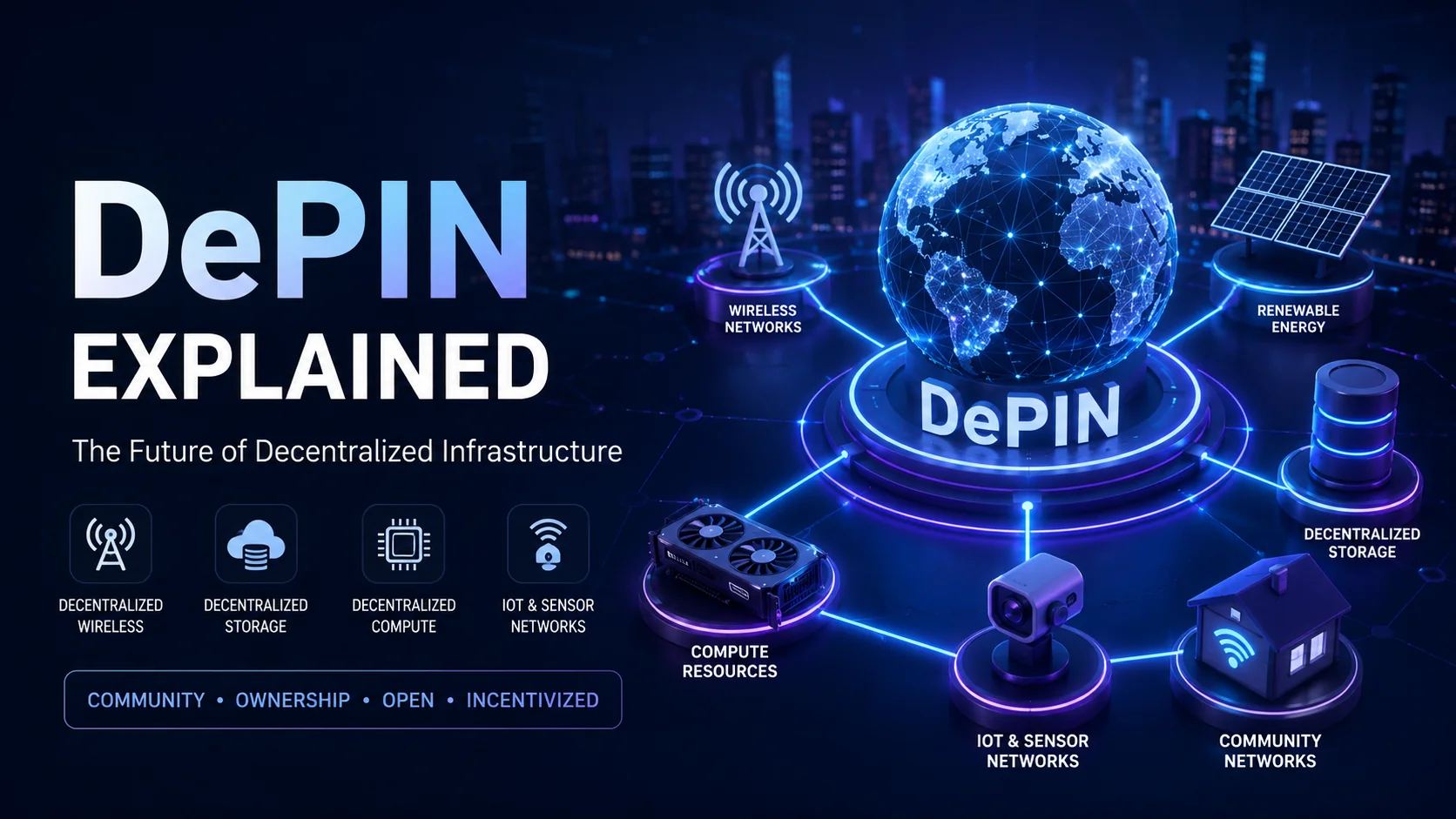
Table of Content
Table of Content
Introduction
The internet has changed the way people communicate, work, shop, and build businesses. However, most of the infrastructure behind the internet is still controlled by a small number of companies. Cloud servers, wireless networks, data storage, and computing resources are often owned and managed by centralized organizations. While this model has worked for many years, it also creates problems such as high costs, single points of failure, limited transparency, and dependence on a few providers.
Blockchain technology introduced the idea of decentralization by allowing people to transfer value without relying on a central authority. Now, this concept is expanding beyond digital payments and cryptocurrencies. A new movement called Decentralized Physical Infrastructure Networks (DePIN) aims to decentralize real-world infrastructure by allowing anyone to contribute physical resources and earn rewards for doing so.
Instead of relying on one company to build and maintain infrastructure, DePIN encourages communities to create networks together. People can share internet connectivity, storage space, computing power, sensors, energy resources, or other physical assets. Contributors receive blockchain-based rewards, while users benefit from more resilient, transparent, and distributed infrastructure.
As Web3 continues to grow, many experts believe DePIN could become one of the most important sectors in blockchain because it connects digital technology with the physical world.
What is DePIN?
DePIN stands for Decentralized Physical Infrastructure Networks.
It is a blockchain-powered system where individuals and businesses contribute physical infrastructure to create decentralized networks. These contributors are rewarded with cryptocurrency or network tokens based on the value they provide.
Unlike traditional infrastructure companies that invest billions of dollars before launching services, DePIN networks grow organically as more participants join the ecosystem.
Imagine thousands of people installing small wireless devices, sharing unused hard drive storage, providing GPU power, or operating environmental sensors. Together, these independent contributors build a global infrastructure network without a single company owning everything.
The blockchain keeps track of contributions, verifies activity, distributes rewards, and ensures transparency across the network.
Simply put, DePIN allows ordinary people to become infrastructure providers instead of only infrastructure users.
Why Was DePIN Created?
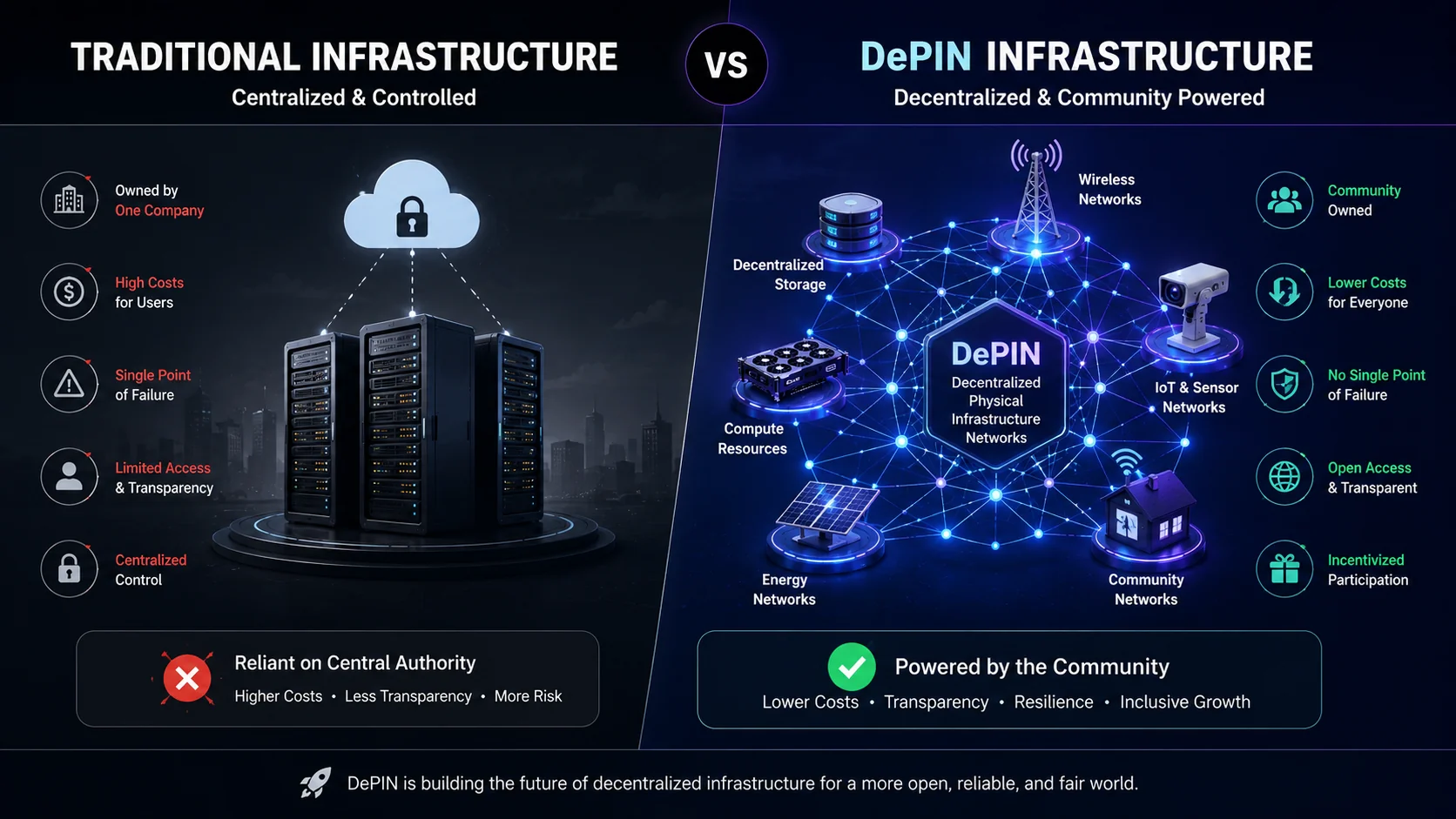
Traditional infrastructure comes with several challenges.
Large companies usually own expensive hardware and control access to their services. This creates high barriers for new competitors and gives users limited choices.
Some common problems include:
- Expensive deployment costs
- Centralized ownership
- Limited transparency
- Single points of failure
- Vendor lock-in
- Slow expansion into underserved regions
- Dependence on large cloud providers
DePIN was introduced to solve these problems by encouraging community participation.
Instead of waiting for a company to expand its services, local communities can build infrastructure themselves and receive financial incentives for doing so.
This creates a win-win situation where contributors earn rewards while the network becomes stronger over time.
How Does DePIN Work?
Although every project is different, most DePIN networks follow a similar process.
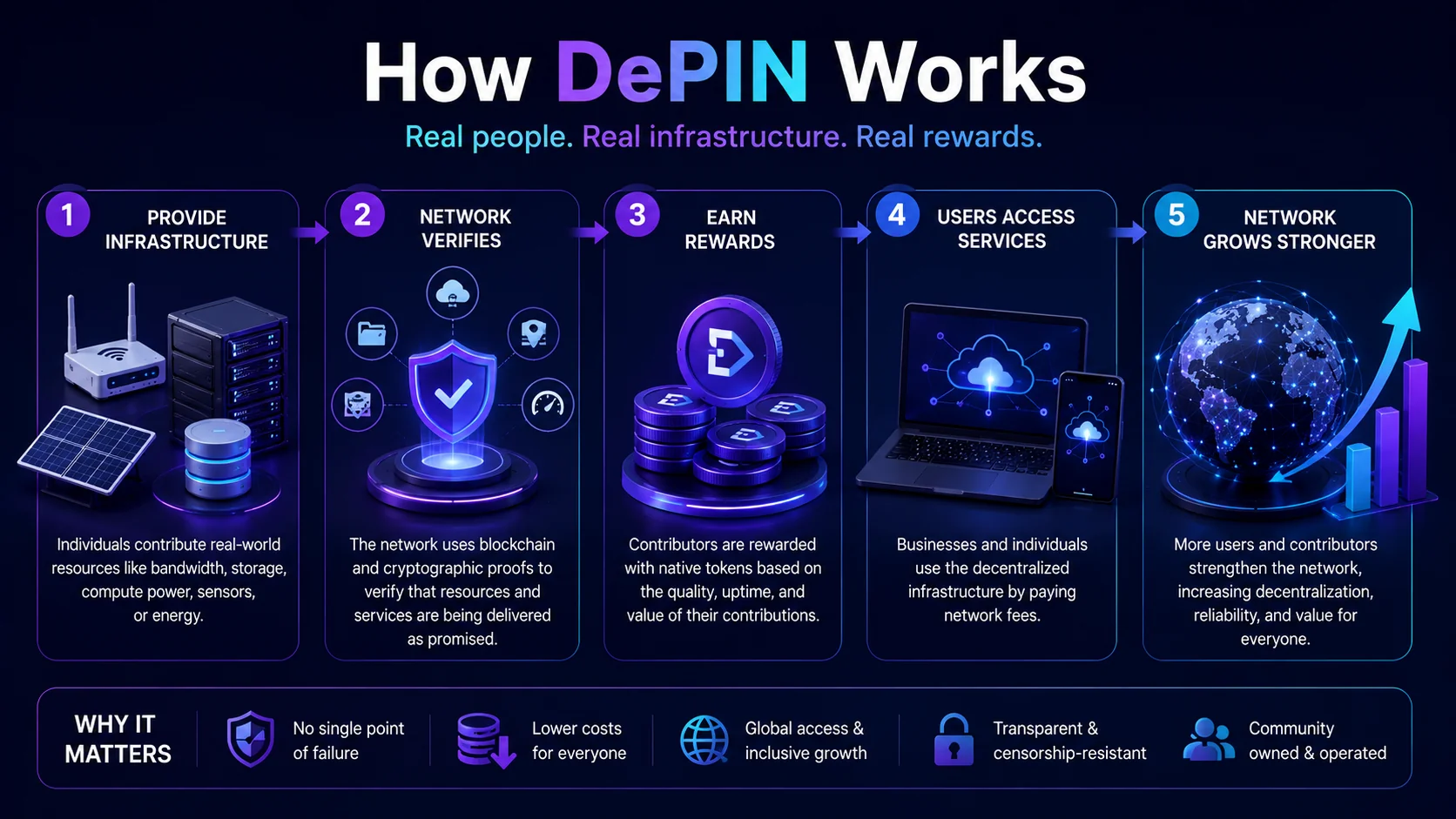
Step 1: Users Provide Infrastructure
Participants contribute physical resources such as:
- Internet hotspots
- Hard drive storage
- Computing power
- GPU resources
- Sensors
- Energy systems
- Cameras
- Wireless devices
These resources become part of the decentralized network.
Step 2: Network Verifies Contributions
The blockchain verifies whether the infrastructure is actually providing useful services.
Verification may include:
- Proof of coverage
- Proof of storage
- Proof of bandwidth
- Proof of uptime
- Proof of computation
This prevents fake participation and ensures contributors are genuinely helping the network.
Step 3: Contributors Receive Rewards
Once contributions are verified, participants earn tokens.
Rewards depend on factors like:
- Amount of resources shared
- Quality of service
- Network demand
- Uptime
- Geographic importance
More valuable contributions generally receive higher rewards.
Step 4: Users Access the Services
Businesses or individuals use the decentralized infrastructure by paying network fees.
These payments support the ecosystem and help maintain sustainable incentives for contributors.
Types of DePIN Networks
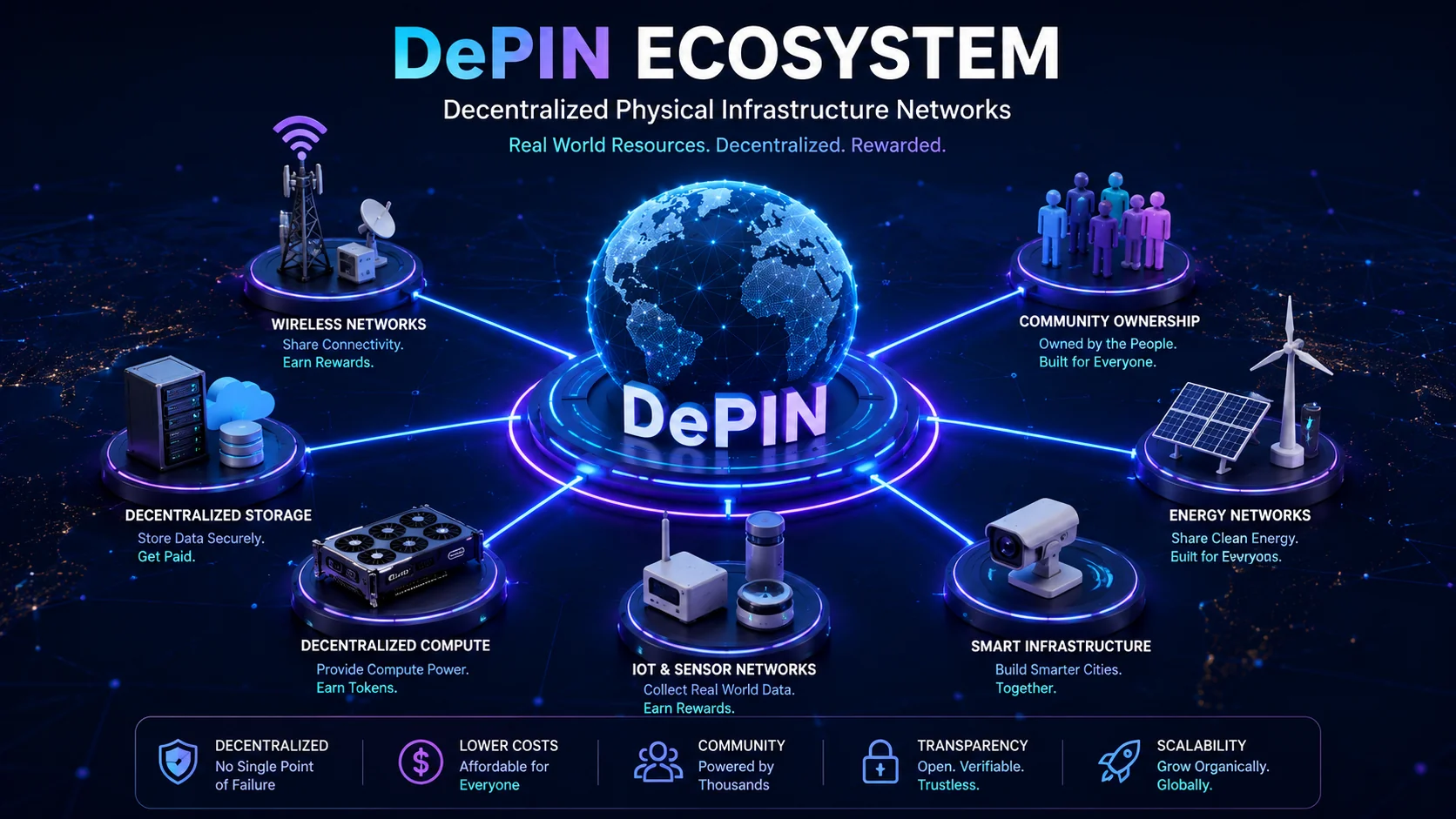
DePIN is not limited to one industry. It covers many different types of infrastructure.
Wireless Networks
Instead of telecom companies building every wireless tower, communities install small hotspot devices that provide internet coverage.
Participants earn rewards while helping expand wireless connectivity.
This approach reduces deployment costs and improves coverage in underserved areas.
Decentralized Storage
Cloud storage is usually controlled by major providers.
DePIN storage networks allow users to rent unused hard drive space to others.
Files are encrypted, distributed across multiple nodes, and stored securely.
Benefits include:
- Better redundancy
- Lower storage costs
- Improved privacy
- Reduced dependence on centralized servers
Decentralized Computing
Artificial Intelligence, rendering, scientific simulations, and machine learning require massive computing resources.
Instead of buying expensive hardware, companies can access decentralized computing networks where contributors rent unused CPU or GPU power.
This makes computing more affordable while allowing hardware owners to generate passive income.
Sensor Networks
Environmental monitoring, smart cities, agriculture, weather forecasting, and logistics rely heavily on sensors.
DePIN enables communities to install sensors that collect useful data.
Participants receive rewards while governments, researchers, and businesses purchase verified datasets.
Energy Infrastructure
Some projects are exploring decentralized energy systems where homes with solar panels or battery storage share excess electricity.
Blockchain records energy production and consumption while distributing rewards fairly among participants.
Key Components of a DePIN Ecosystem
A successful DePIN project usually consists of several important elements.
Blockchain
The blockchain records every transaction, contribution, reward, and network activity.
It provides transparency and removes the need for centralized management.
Physical Hardware
Real-world devices form the backbone of DePIN.
Examples include:
- Routers
- Storage servers
- GPUs
- IoT sensors
- Cameras
- Solar panels
- Wireless hotspots
Without physical hardware, DePIN cannot function.
Incentive System
Participants need motivation to contribute.
Most projects reward users with native cryptocurrency tokens.
These incentives encourage long-term participation and network growth.
Verification Mechanism
The network must verify that contributors are actually providing useful services.
Different projects use different validation methods depending on their infrastructure.
End Users
Businesses and consumers ultimately use the infrastructure.
Their payments create real economic value that supports the ecosystem.
Benefits of DePIN
DePIN offers several advantages over traditional infrastructure systems.
Community Ownership
Instead of one corporation owning everything, infrastructure is built and maintained by thousands of independent contributors.
This reduces monopolies and encourages broader participation.
Better Scalability
Traditional infrastructure requires massive upfront investments.
DePIN grows gradually as new contributors join the network.
Expansion becomes faster and more cost-effective.
Lower Costs
Since infrastructure is crowdsourced, operational expenses are often lower than centralized alternatives.
Users benefit from competitive pricing while contributors earn rewards.
Increased Transparency
Blockchain records all important activities publicly.
Contributors can verify rewards, network activity, and transactions without relying on a central authority.
Higher Resilience
Centralized systems can experience outages if one major provider fails.
DePIN distributes infrastructure across thousands of independent operators.
This improves reliability and reduces single points of failure.
Global Participation
Anyone meeting the project requirements can join from almost anywhere in the world.
This creates opportunities for people in regions where traditional infrastructure investment is limited.
Challenges Facing DePIN
Despite its potential, DePIN still faces several obstacles.
High Hardware Costs
Many projects require participants to purchase specialized devices before earning rewards.
This initial investment may discourage some users.
Regulatory Uncertainty
Governments are still developing regulations for blockchain-based infrastructure.
Future legal changes could affect how some networks operate.
Reward Sustainability
If token prices decline significantly, contributor incentives may decrease.
Projects must build real demand for their services instead of relying only on token speculation.
Technical Complexity
Running infrastructure devices, managing wallets, and understanding blockchain technology can be challenging for beginners.
Improved user experience will be important for wider adoption.
Security Risks
Physical devices connected to decentralized networks must remain secure.
Poor security practices could expose contributors to attacks or hardware failures.
Real-World Use Cases of DePIN
DePIN is already finding practical applications across multiple industries.
Smart Cities
Cities can deploy decentralized sensor networks to monitor traffic, pollution, weather, and public infrastructure.
Agriculture
Farmers can collect environmental data using decentralized sensors to improve irrigation, crop management, and productivity.
Artificial Intelligence
AI companies require enormous computing power.
Decentralized GPU networks can reduce infrastructure costs while making AI development more accessible.
Telecommunications
Community-owned wireless networks can expand internet access into rural and underserved areas where traditional providers have limited coverage.
Cloud Storage
Businesses can securely store data across decentralized storage providers instead of relying on one cloud company.
Scientific Research
Researchers can rent decentralized computing resources for simulations, genome analysis, and complex calculations.
Why Investors Are Paying Attention to DePIN
Over the past few years, DePIN has attracted increasing interest from investors because it combines blockchain incentives with real-world utility.
Unlike many blockchain projects that focus only on digital assets, DePIN networks solve practical problems by creating infrastructure that people and businesses actually use.
Several factors make DePIN attractive:
- Real-world applications
- Growing demand for decentralized infrastructure
- AI-driven need for computing resources
- Increasing adoption of IoT devices
- Expansion of Web3 ecosystems
- Community-driven network growth
- Multiple revenue opportunities
As blockchain technology matures, many analysts believe infrastructure-focused projects could become one of the strongest long-term sectors.
The Future of DePIN
The future of DePIN looks promising as industries increasingly seek alternatives to centralized infrastructure.
Artificial Intelligence, autonomous vehicles, smart cities, edge computing, decentralized cloud services, and renewable energy systems all require massive amounts of physical infrastructure.
Building these systems through centralized companies alone may become expensive and slow.
DePIN offers a different approach by allowing millions of individuals to contribute resources while earning rewards.
As hardware becomes more affordable and blockchain technology continues improving, participation barriers are expected to decrease. Better user interfaces, clearer regulations, and sustainable token economies could also encourage broader adoption.
Although the industry is still in its early stages, DePIN represents an important step toward a future where infrastructure is owned, operated, and maintained by global communities rather than a handful of corporations.
Final Thoughts
DePIN is transforming the idea of infrastructure ownership by combining blockchain technology with physical resources. Instead of depending entirely on centralized companies, individuals can actively participate in building wireless networks, cloud storage systems, computing platforms, sensor networks, and energy infrastructure.
While challenges such as regulation, hardware costs, and long-term sustainability still exist, the underlying concept offers significant advantages in terms of transparency, resilience, scalability, and community participation.
As Web3 continues to evolve and the demand for decentralized services increases, DePIN has the potential to become one of the most impactful innovations in blockchain technology. Whether you are a developer, investor, entrepreneur, or simply someone interested in emerging technologies, understanding DePIN today can help you better prepare for the decentralized infrastructure ecosystem of tomorrow.
Frequently Asked Questions (FAQs)
1. What is DePIN in simple words?
DePIN (Decentralized Physical Infrastructure Networks) is a blockchain-based model where people contribute real-world resources such as internet hotspots, storage space, computing power, or sensors to build decentralized infrastructure. In return, contributors earn rewards, usually in the form of cryptocurrency tokens. Instead of relying on a single company, the network is owned and maintained by its community.
2. How do people earn money with DePIN?
Participants earn rewards by providing useful infrastructure to the network. Depending on the project, this could involve sharing storage space, running a wireless hotspot, offering GPU computing power, or operating IoT devices. The amount earned depends on factors like network demand, service quality, uptime, and the project's reward system.
3. What are some real-world uses of DePIN?
DePIN has applications across many industries, including decentralized cloud storage, wireless internet networks, AI computing, smart cities, environmental monitoring, logistics, agriculture, and renewable energy. These networks help reduce infrastructure costs while improving accessibility and reliability.
4. Is DePIN different from traditional blockchain projects?
Yes. Most blockchain projects focus on digital assets, decentralized finance, or smart contracts. DePIN goes a step further by connecting blockchain technology with physical infrastructure. It uses real-world hardware such as storage servers, wireless devices, GPUs, and sensors, making it one of the few blockchain sectors with direct real-world utility.
5. Is DePIN a good long-term technology to watch?
Many industry experts consider DePIN one of the most promising areas in Web3 because it solves real infrastructure challenges rather than focusing only on digital transactions. As demand for AI, cloud computing, IoT, and decentralized services continues to grow, DePIN has strong potential for long-term adoption. However, like any emerging technology, its success will depend on factors such as user adoption, regulatory developments, and sustainable economic models.