
Web4 Explained: What Comes After Web3?
what Web4 is, how it builds on Web3, and the technologies shaping the next generation of the internet. Learn about AI, blockchain, IoT, edge computing, real-world applications, benefits, challenges, and the future of an intelligent, interconnected web.

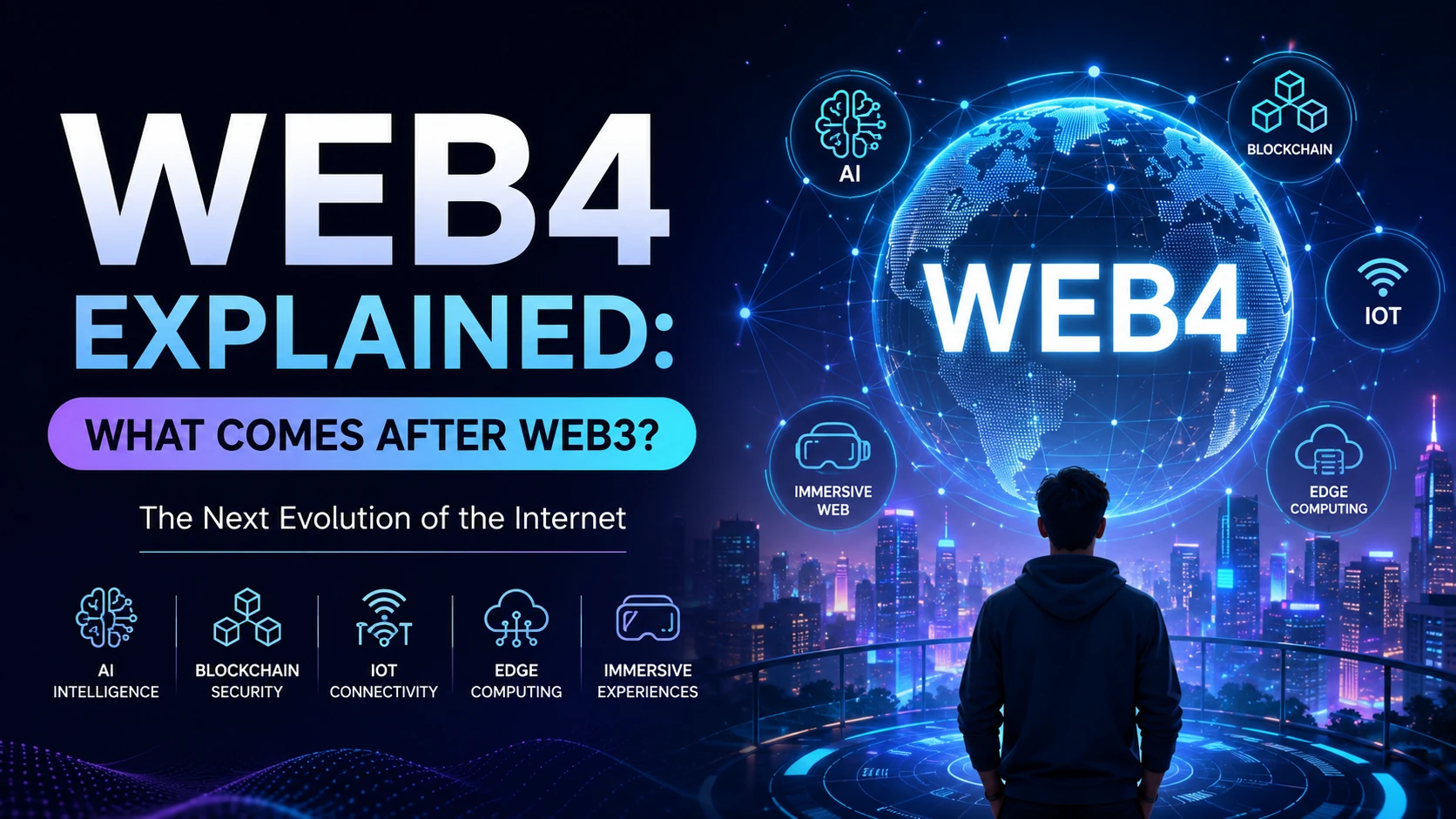
Table of Content
Table of Content
Introduction
The internet has never stopped evolving. Every generation of the web has changed the way people communicate, work, learn, and do business. From simple static websites in the early days of the internet to today's decentralized applications powered by blockchain, every phase has introduced new opportunities and challenges. Now, as technologies like artificial intelligence, edge computing, blockchain, quantum computing, and spatial computing continue to mature, discussions about Web4 are becoming increasingly common.
While Web3 focuses on decentralization and giving users ownership of their digital assets and identities, Web4 aims to make the internet more intelligent, personalized, connected, and autonomous. Instead of simply interacting with websites or decentralized applications, users may soon interact with AI-powered digital assistants that understand context, anticipate needs, and complete complex tasks across multiple platforms without constant human intervention.
Although Web4 is still an emerging concept rather than a finalized standard, many of its foundational technologies are already being developed. AI agents, decentralized identity systems, Internet of Things (IoT) devices, augmented reality, virtual reality, edge computing, and machine-to-machine communication are gradually moving the internet toward a smarter ecosystem.
This article explores what Web4 is, how it differs from previous generations of the web, the technologies driving it, and why it could fundamentally reshape the digital world over the coming decade.
Understanding the Evolution of the Internet
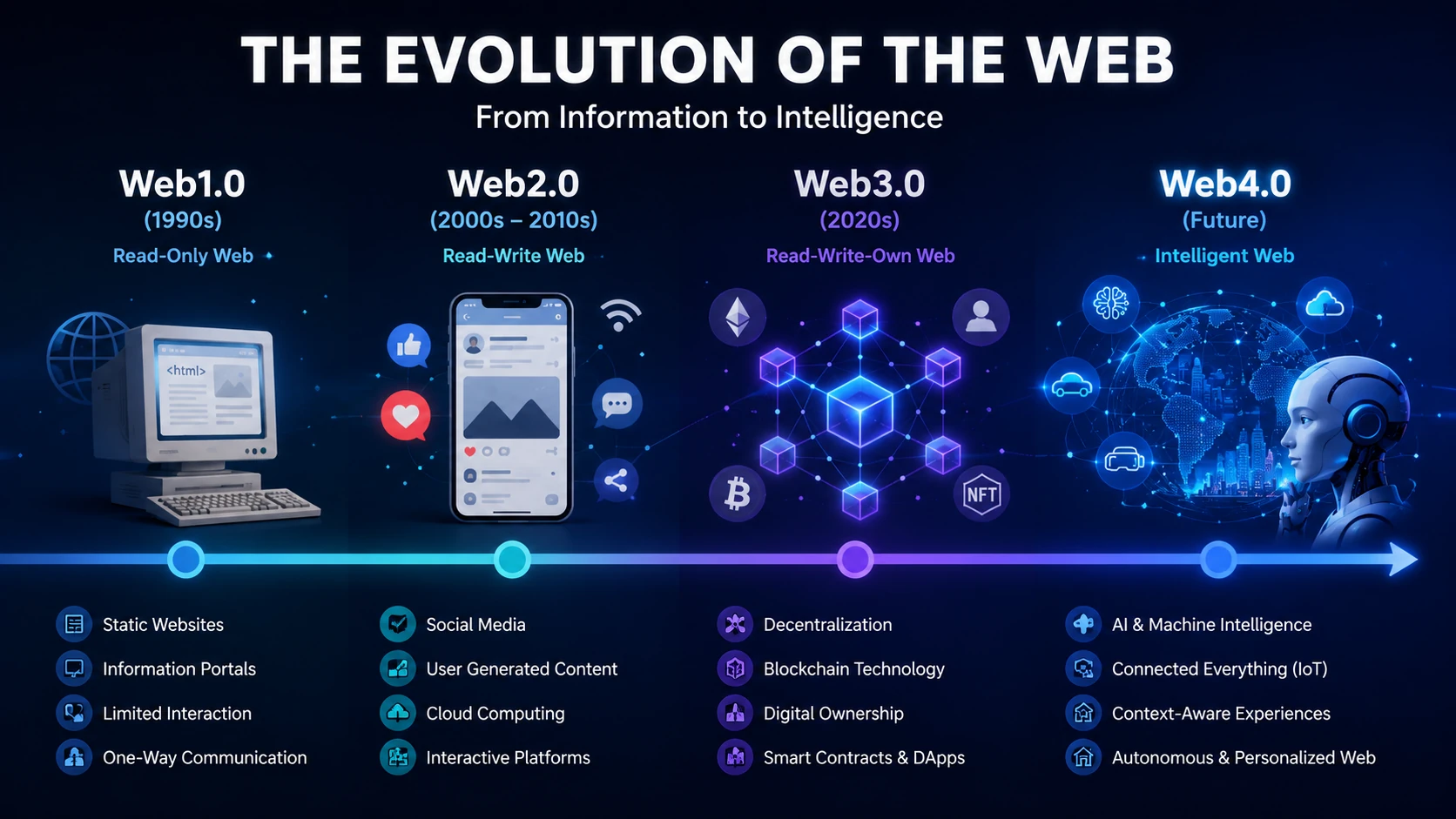
Before exploring Web4, it's important to understand how the internet has evolved over the years.
Web1: The Read-Only Internet
The first generation of the internet, commonly called Web1, emerged during the 1990s. Websites primarily contained static pages where visitors could read information but had very limited opportunities to interact with content.
Characteristics of Web1 included:
- Static HTML websites
- Limited user interaction
- One-way information publishing
- Basic search engines
- Personal websites and directories
Businesses mainly used websites as digital brochures, while users consumed information without contributing much content themselves.
Web2: The Social Internet
Web2 introduced interactive websites and transformed internet users into content creators.
Instead of simply reading information, users could:
- Share photos
- Publish blogs
- Upload videos
- Join online communities
- Communicate through social media
Platforms such as Facebook, YouTube, Instagram, and X (formerly Twitter) became central to everyday internet usage.
Major characteristics included:
- User-generated content
- Cloud computing
- Social networking
- Mobile applications
- Real-time communication
However, Web2 also created significant concerns around data privacy, centralized control, targeted advertising, and ownership of personal information.
Web3: The Decentralized Internet
Web3 emerged as a response to many limitations of Web2.
Instead of relying on centralized companies to control user data, Web3 leverages blockchain technology to create decentralized systems where users have greater ownership over digital assets and identities.
Popular Web3 innovations include:
- Cryptocurrencies
- Smart contracts
- NFTs
- DAOs
- Decentralized Finance (DeFi)
- Decentralized applications (dApps)
Although Web3 has introduced revolutionary ideas, it still faces challenges including scalability, user experience, transaction costs, and mainstream adoption.
This is where discussions about Web4 begin.
What Is Web4?
Web4 represents the next conceptual stage of internet evolution where artificial intelligence, decentralized technologies, connected devices, and immersive digital experiences work together to create an intelligent, autonomous web.
Unlike previous versions of the internet, Web4 is expected to understand users rather than simply respond to commands.
Imagine asking your AI assistant:
"Plan my business trip next month while keeping costs under budget, schedule meetings with clients, reserve transportation, book hotels near the meeting locations, adjust my calendar, and notify my team."
Instead of manually visiting multiple websites, comparing prices, filling forms, and managing bookings yourself, an intelligent Web4 ecosystem could complete these tasks automatically while respecting your preferences and digital identity.
This represents a shift from searching for information to having intelligent systems perform meaningful work on your behalf.
Why Do We Need Web4?
Despite the innovations introduced by Web3, today's internet still has limitations.
Many online activities require users to:
- Switch between multiple applications
- Repeat authentication
- Enter identical information repeatedly
- Compare data manually
- Perform repetitive digital tasks
Modern users increasingly expect technology to understand context instead of requiring constant instructions.
Businesses also face challenges involving:
- Massive amounts of data
- Complex cybersecurity threats
- Real-time analytics
- Global digital collaboration
- Connected devices
Web4 aims to solve these issues through automation, intelligent decision-making, secure identity management, and seamless communication between systems.
Core Principles of Web4
Although there is no official definition accepted by every organization, most experts describe Web4 using several common principles.
1. Artificial Intelligence Everywhere
Artificial intelligence becomes deeply integrated into nearly every digital interaction.
Instead of acting as a separate tool, AI becomes an invisible assistant that continuously learns from user preferences while respecting privacy.
Possible capabilities include:
- Personalized recommendations
- Intelligent search
- Automatic scheduling
- Content generation
- Fraud detection
- Healthcare assistance
- Customer support
- Business automation
Rather than replacing people, AI in Web4 focuses on improving productivity and decision-making.
2. Human and Machine Collaboration
In Web4, humans and intelligent software agents collaborate naturally.
For example:
A freelancer could simply explain project requirements to an AI assistant.
The assistant could then:
- Find clients
- Draft proposals
- Estimate pricing
- Schedule meetings
- Prepare invoices
- Track payments
The user remains in control while intelligent systems handle repetitive work.
3. Context-Aware Computing
Today's websites typically respond only to direct user input.
Web4 systems may understand:
- Location
- Time
- User behavior
- Personal preferences
- Device type
- Environmental conditions
- Calendar events
- Previous interactions
This enables much smarter and more relevant digital experiences.
For instance, a travel application could recommend transportation based not only on traffic but also on weather conditions, flight delays, budget preferences, and calendar availability.
4. Interconnected Digital Ecosystems
Instead of isolated applications, Web4 encourages seamless communication between services.
Your smart home, wearable devices, healthcare provider, banking application, vehicle, and workplace software may securely exchange information with your permission to deliver better experiences.
This interconnected ecosystem reduces friction and saves time.
Technologies Powering Web4
Web4 is not built upon a single innovation. It combines multiple advanced technologies that are already evolving today.
Artificial Intelligence
AI serves as the intelligence layer of Web4.
Advanced machine learning models help computers:
- Understand language
- Analyze images
- Recognize patterns
- Predict outcomes
- Automate workflows
- Support decision-making
Future AI systems may operate continuously as trusted digital assistants rather than isolated chatbots.
Blockchain
Blockchain continues to play an important role by providing:
- Decentralized identity
- Secure transactions
- Transparent record keeping
- Smart contracts
- Digital ownership
Rather than replacing blockchain, Web4 builds upon its strengths while combining it with AI and other technologies.
Internet of Things (IoT)
Billions of connected devices already collect valuable information.
Examples include:
- Smart watches
- Connected vehicles
- Home automation systems
- Medical sensors
- Industrial equipment
- Agricultural monitoring devices
Web4 enables these devices to communicate intelligently while AI analyzes their data in real time.
For example, a smart home could automatically reduce electricity consumption based on weather forecasts, energy prices, and household routines without requiring manual adjustments.
Edge Computing
Processing all data in centralized cloud servers introduces delays.
Edge computing solves this by processing information closer to users and connected devices.
Benefits include:
- Lower latency
- Faster response times
- Better privacy
- Reduced bandwidth usage
- Improved reliability
This is especially important for autonomous vehicles, healthcare monitoring, industrial automation, and augmented reality applications.
Spatial Computing
Web4 is expected to blend physical and digital environments.
Spatial computing combines technologies such as:
- Augmented Reality (AR)
- Virtual Reality (VR)
- Mixed Reality (MR)
- 3D digital environments
Instead of browsing flat web pages, users may interact with immersive digital spaces where information appears naturally within their surroundings.
For example, architects could collaborate on a full-scale 3D building model from different countries, while medical students practice surgeries in highly realistic virtual environments.
Benefits of Web4
Web4 is expected to redefine how individuals, businesses, and governments interact with technology. Rather than simply offering faster websites or more decentralized services, Web4 focuses on making digital experiences intelligent, proactive, and deeply personalized.
Here are some of the biggest advantages of Web4.
1. Highly Personalized User Experiences
Modern websites often personalize content based on browsing history or cookies. Web4 goes much further by understanding user preferences, habits, goals, and context.
For example, instead of searching for learning resources manually, a Web4-powered educational platform could recommend personalized courses, generate custom study plans, schedule revision sessions, and even adapt teaching methods based on a student's learning style.
This level of personalization makes digital experiences more meaningful and efficient.
2. Intelligent Automation
One of Web4's most promising features is autonomous task execution.
Instead of opening multiple apps to complete a process, users may simply describe their objective, and AI agents will coordinate the entire workflow.
Imagine planning a vacation. A Web4 assistant could:
- Compare flights
- Find hotels
- Check visa requirements
- Book transportation
- Recommend restaurants
- Create a travel itinerary
- Sync everything with your calendar
This dramatically reduces repetitive work and saves valuable time.
3. Improved Digital Security
Cybersecurity continues to be one of the biggest concerns on today's internet.
Web4 aims to strengthen security by combining:
- Decentralized identity
- AI-powered threat detection
- Blockchain verification
- Zero-trust architecture
- Behavioral authentication
Instead of relying solely on passwords, future systems may continuously verify identity based on user behavior and secure cryptographic credentials.
This can significantly reduce phishing attacks, identity theft, and unauthorized access.
4. Better Collaboration Between Devices
Today, many devices work independently.
In Web4, smartphones, smartwatches, vehicles, computers, healthcare devices, and home automation systems can securely exchange information to create seamless experiences.
For instance, if your smartwatch detects abnormal health metrics, it could securely notify your healthcare provider, suggest nearby medical facilities, update your emergency contacts, and prepare relevant health records for doctors with your permission.
5. Smarter Business Operations
Businesses generate enormous amounts of data every day.
Web4 helps organizations analyze this information automatically to improve:
- Customer service
- Supply chain management
- Inventory forecasting
- Marketing campaigns
- Product recommendations
- Financial planning
Instead of reacting to problems after they occur, companies can predict trends and make proactive decisions.
Real-World Applications of Web4
Although Web4 is still developing, many of its technologies are already being used in practical ways.
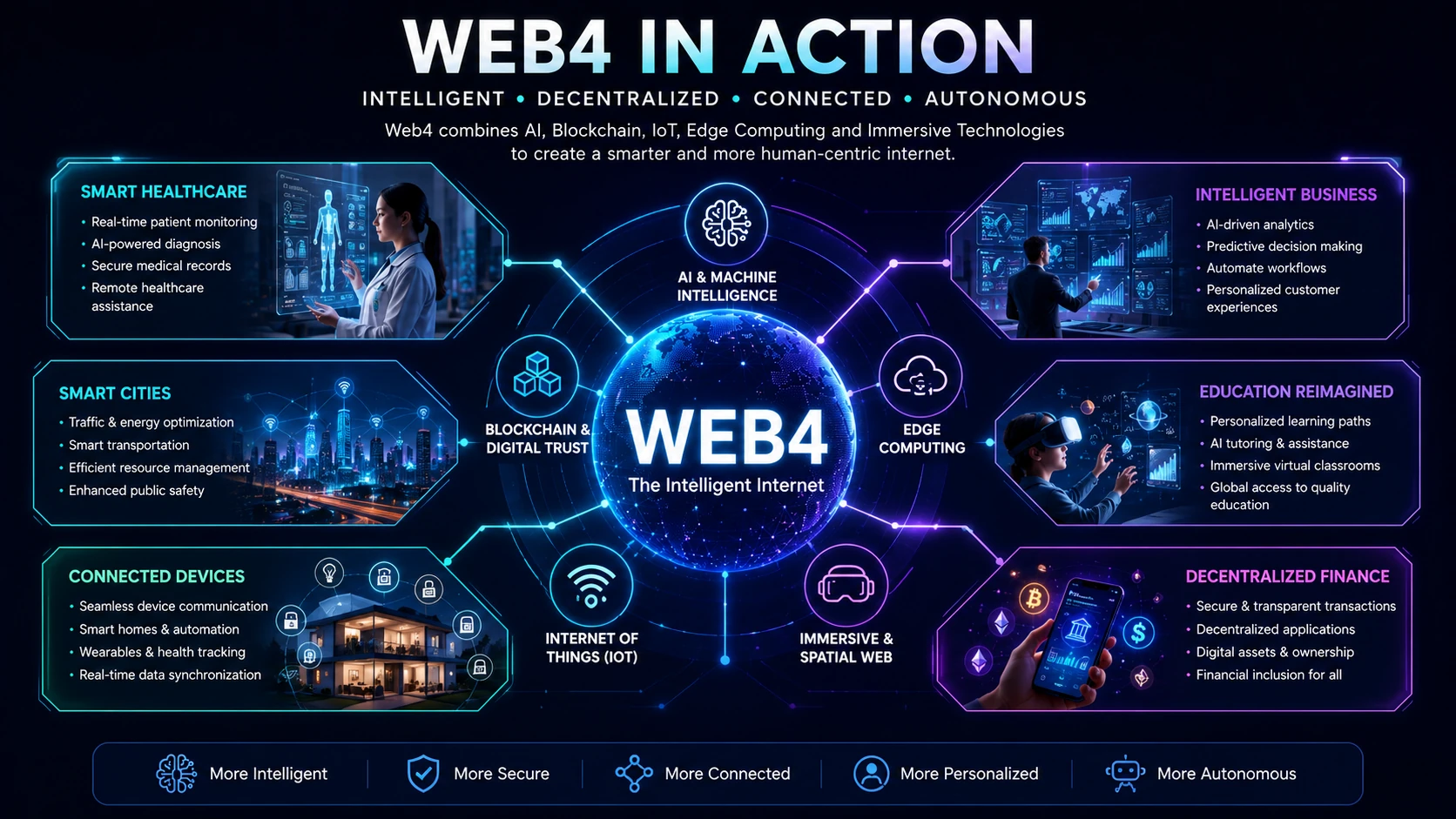
Healthcare
Healthcare may become one of the biggest beneficiaries of Web4.
Future healthcare systems could:
- Monitor patients continuously through wearable devices
- Detect diseases earlier using AI
- Share medical records securely
- Support remote diagnosis
- Personalize treatment recommendations
- Reduce administrative work for hospitals
Doctors spend less time managing paperwork and more time treating patients.
Education
Education can become significantly more adaptive.
Instead of every student following the same curriculum, AI-powered learning platforms could:
- Identify knowledge gaps
- Recommend personalized lessons
- Generate practice questions
- Track learning progress
- Provide instant feedback
Students receive a learning experience tailored to their individual needs rather than a one-size-fits-all approach.
Finance
Financial services are already evolving rapidly.
Web4 may introduce:
- AI financial advisors
- Automated investment management
- Fraud detection
- Secure digital identities
- Intelligent budgeting
- Cross-border decentralized payments
Users gain more control over their finances while reducing risks.
Smart Cities
Cities generate massive amounts of operational data.
Web4 technologies can optimize:
- Traffic management
- Public transportation
- Waste collection
- Energy consumption
- Water distribution
- Emergency response systems
This leads to safer, cleaner, and more efficient urban environments.
Manufacturing
Factories are increasingly adopting automation.
Web4 expands these capabilities through:
- Predictive maintenance
- AI-powered robotics
- Supply chain optimization
- Real-time equipment monitoring
- Autonomous production planning
Manufacturers reduce downtime while improving efficiency and product quality.
E-Commerce
Shopping experiences become far more intelligent.
Instead of browsing hundreds of products, AI assistants may:
- Understand customer preferences
- Compare prices automatically
- Verify product authenticity
- Predict future purchases
- Handle returns
- Complete secure payments
The result is a faster and more personalized shopping experience.
Challenges of Web4
Despite its enormous potential, Web4 also faces several important challenges.
Privacy Concerns
Highly personalized services require access to significant amounts of data.
Organizations must ensure:
- User consent
- Transparent data usage
- Secure storage
- Regulatory compliance
Privacy should remain a core principle rather than an afterthought.
Ethical AI
Artificial intelligence must be:
- Fair
- Transparent
- Explainable
- Free from harmful bias
- Accountable
Developers and policymakers will need strong governance frameworks to prevent misuse.
Security Risks
As more devices become interconnected, the number of potential attack surfaces also increases.
Future cybersecurity strategies must protect:
- AI systems
- Connected devices
- Blockchain networks
- Personal identities
- Critical infrastructure
Strong encryption and continuous monitoring will become even more important.
Infrastructure Requirements
Supporting billions of connected devices and intelligent AI systems requires significant investment in:
- High-speed internet
- Cloud infrastructure
- Edge computing
- Data centers
- Energy-efficient hardware
Many regions still lack the digital infrastructure needed for widespread Web4 adoption.
Regulatory Challenges
Governments around the world will need updated regulations covering:
- AI governance
- Digital identity
- Data ownership
- Cross-border information sharing
- Autonomous decision-making
Creating global standards will be essential for interoperability and public trust.
Is Web4 Already Here?
The short answer is not completely.
Web4 is still an evolving vision rather than a fully established internet standard. However, many of its building blocks already exist.
Today we can already see:
- AI assistants capable of natural conversations
- Smart homes connected through IoT
- Blockchain-based digital identities
- Edge computing for low-latency services
- Autonomous vehicles under development
- Immersive AR and VR experiences
- AI-powered business automation
As these technologies become more integrated, the transition toward Web4 will happen gradually rather than through a single technological breakthrough.
Businesses that begin experimenting with AI, automation, decentralized identity, and connected systems today will likely be better positioned for the future digital economy.
The Role of AI Agents in Web4
One of the most exciting ideas behind Web4 is the rise of AI agents. Unlike today's chatbots, which typically answer questions or generate content only when prompted, AI agents are expected to perform complete workflows on behalf of users. These agents can understand goals, make decisions within defined limits, coordinate with other digital services, and continuously improve based on feedback.
For example, imagine you run an online business. Instead of manually checking website analytics, inventory levels, customer emails, marketing campaigns, and sales reports every day, you could assign an AI agent to handle these tasks. The agent could identify declining website traffic, suggest SEO improvements, pause underperforming advertisements, reorder inventory before products run out, and prepare a daily business summary. You would still approve important decisions, but the repetitive work would happen automatically.
In personal life, AI agents could become digital assistants that understand your habits and preferences. They might remind you about upcoming deadlines, recommend healthier daily routines, manage subscriptions, organize travel plans, and even negotiate appointments with other AI systems. This represents a shift from software that simply responds to commands toward software that actively helps users achieve their objectives.
As these intelligent agents become more capable, they are expected to transform productivity across industries while allowing people to focus on creative thinking, problem-solving, and strategic decision-making instead of repetitive administrative tasks.
How Businesses Should Prepare for Web4
Although Web4 is still developing, businesses do not need to wait for its official arrival. Organizations that begin adopting modern technologies today will have a significant advantage as the next generation of the internet becomes mainstream.
The first step is embracing artificial intelligence across business operations. AI-powered customer support, predictive analytics, content generation, and workflow automation can improve efficiency while reducing operational costs.
Companies should also invest in strong cybersecurity practices. As digital systems become more interconnected, protecting customer data, digital identities, and critical infrastructure becomes even more important. Implementing multi-factor authentication, zero-trust security models, encryption, and continuous monitoring will help businesses remain resilient against evolving cyber threats.
Another important area is cloud and edge computing. Modern applications increasingly require low latency and real-time processing. Businesses that modernize their infrastructure will be better prepared to deliver intelligent services that meet future customer expectations.
Organizations should also pay close attention to ethical AI. Customers are becoming more aware of how their data is collected and used. Transparent AI systems, responsible data handling, and compliance with privacy regulations will play a major role in building long-term trust.
Finally, companies should continue experimenting with blockchain, decentralized identity, IoT, and automation where these technologies provide real business value. Web4 is not about adopting every emerging technology it is about combining the right technologies to create smarter, more secure, and more personalized digital experiences.
Businesses that start learning and adapting today are likely to become the leaders of tomorrow's intelligent internet.
Will Web4 Replace Web3?
A common misconception is that Web4 will completely replace Web3. In reality, the relationship between the two is more complementary than competitive.
Web3 introduced the concept of decentralization, allowing users to own digital assets, control their identities, and interact with applications without relying entirely on centralized platforms. These principles remain valuable and are expected to continue playing an important role in the future internet.
Web4 builds on these foundations by adding intelligence, automation, and context awareness. Rather than replacing blockchain, Web4 uses blockchain as one of several technologies that support secure identity, trusted data sharing, and transparent transactions. Artificial intelligence becomes the decision-making layer, while edge computing, IoT, and spatial computing create richer digital experiences.
In other words, Web3 focuses on who owns the internet, while Web4 focuses on how intelligently the internet works. Together, these technologies have the potential to create a digital ecosystem that is secure, decentralized, efficient, and capable of understanding user needs in ways that were previously impossible.
Frequently Asked Questions (FAQs)
1. What is Web4 in simple terms?
Web4 is the next expected evolution of the internet that combines Artificial Intelligence (AI), blockchain, the Internet of Things (IoT), edge computing, and immersive technologies to create a smarter and more autonomous web. Unlike Web3, which focuses on decentralization, Web4 aims to understand user needs, automate tasks, and provide highly personalized digital experiences.
2. How is Web4 different from Web3?
Web3 primarily focuses on decentralization, blockchain technology, and digital ownership, giving users more control over their data and assets. Web4 builds on these ideas by adding AI-powered intelligence, automation, context-aware computing, and seamless communication between connected devices. In simple terms, Web3 is about ownership, while Web4 is about intelligent interaction and automation.
3. Which technologies will power Web4?
Web4 is expected to be powered by a combination of advanced technologies, including:
- Artificial Intelligence (AI)
- Blockchain
- Internet of Things (IoT)
- Edge Computing
- Cloud Computing
- Augmented Reality (AR)
- Virtual Reality (VR)
- Mixed Reality (MR)
- Digital Identity Systems
- Machine Learning
- 5G and Future Communication Networks
These technologies will work together to create intelligent, secure, and interconnected digital ecosystems.
4. Is Web4 already available today?
Not entirely. Web4 is still an emerging concept rather than a fully developed internet standard. However, many of its core technologies are already in use. AI assistants, smart home devices, blockchain applications, wearable technology, edge computing, and advanced automation are all early building blocks of what will eventually become the Web4 ecosystem.
5. How will Web4 impact businesses and everyday users?
Web4 has the potential to transform both personal and professional digital experiences. Businesses can benefit from AI-driven automation, predictive analytics, improved cybersecurity, personalized customer experiences, and smarter decision-making. For everyday users, Web4 could simplify daily tasks through intelligent virtual assistants, connected devices, secure digital identities, personalized online services, and seamless interactions across multiple platforms, making the internet faster, safer, and more intuitive.