
Blockchain for AI Data Provenance: Ensuring Trust, Transparency, and Data Integrity
how blockchain improves AI data provenance by ensuring transparency, integrity, and traceability of AI training datasets. Learn the benefits, real-world use cases, challenges, and future of combining blockchain with artificial intelligence
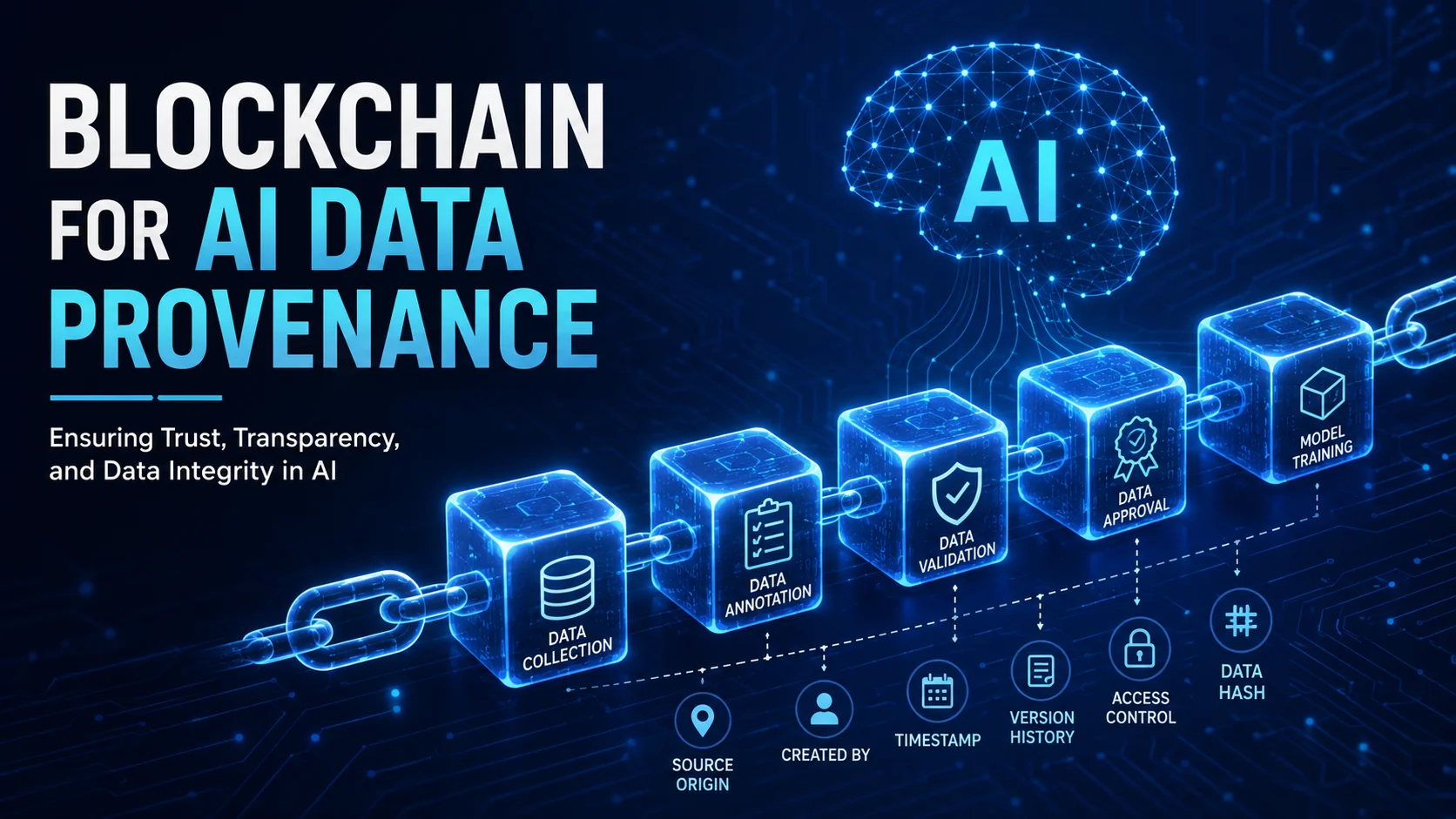
Table of Content
Table of Content
Artificial Intelligence is changing the way people work, learn, create, and make decisions. From healthcare and finance to autonomous vehicles and content generation, AI systems are becoming more powerful every year. However, there is one challenge that continues to grow alongside AI: Can we trust the data used to train and operate AI models?
AI is only as reliable as the data behind it. If training data is manipulated, mislabeled, stolen, or lacks transparency, the resulting AI system can produce biased, inaccurate, or even dangerous outcomes. This is where AI data provenance becomes essential.
Data provenance refers to the complete history of a dataset where it originated, who modified it, when changes occurred, and whether it has remained authentic over time. Unfortunately, traditional databases often struggle to provide tamper-proof records of this information.
This is where blockchain technology offers a promising solution. By providing an immutable and transparent ledger, blockchain can create trustworthy records for AI datasets without relying on a single centralized authority. Instead of simply storing data, blockchain records the history and integrity of that data, making AI systems more transparent, accountable, and reliable.
In this guide, you'll learn how blockchain improves AI data provenance, why it matters for businesses and researchers, the challenges involved, real-world applications, and what the future may look like as these two transformative technologies continue to evolve together.
Understanding AI Data Provenance
Before exploring blockchain, it is important to understand what data provenance actually means.
Imagine an AI model trained to detect diseases from medical images. Thousands or even millions of images may have been collected from different hospitals across different countries. Some images might be updated, corrected, or removed over time.
Without proper provenance, nobody can confidently answer questions such as:
- Where did this image originate?
- Who uploaded it?
- Has it been edited?
- Was patient consent obtained?
- Was it verified by experts?
- Which version of the image trained the model?
These questions become even more critical when AI systems make decisions affecting healthcare, finance, law enforcement, or public safety.
Data provenance creates a detailed timeline showing every important event associated with a dataset throughout its lifecycle.
Why AI Needs Trustworthy Data
Modern AI models consume enormous amounts of information.
This data may include:
- Images
- Videos
- Medical records
- Financial transactions
- Satellite imagery
- Scientific research
- Sensor readings
- User-generated content
- Industrial machine logs
If any of these datasets become corrupted or manipulated, the AI model may learn incorrect patterns.
Poor-quality data often leads to:
- Biased predictions
- Reduced accuracy
- Ethical concerns
- Regulatory violations
- Financial losses
- Reduced public trust
As AI becomes responsible for increasingly important decisions, organizations need stronger mechanisms to verify every stage of the data lifecycle.
Blockchain provides exactly that.
What Is Blockchain?
Blockchain is a distributed digital ledger where records are grouped into blocks and linked together using cryptographic techniques.
Unlike traditional databases:
- Records cannot easily be changed.
- Every transaction is timestamped.
- Every participant can verify data integrity.
- Changes become permanently auditable.
Instead of trusting one organization, trust is distributed across the network.
This makes blockchain especially valuable whenever transparency and accountability are required.
How Blockchain Supports AI Data Provenance
Blockchain is not designed to replace AI databases.
Instead, it acts as a trusted verification layer.
The actual AI datasets usually remain stored in cloud storage, data lakes, or distributed storage systems.
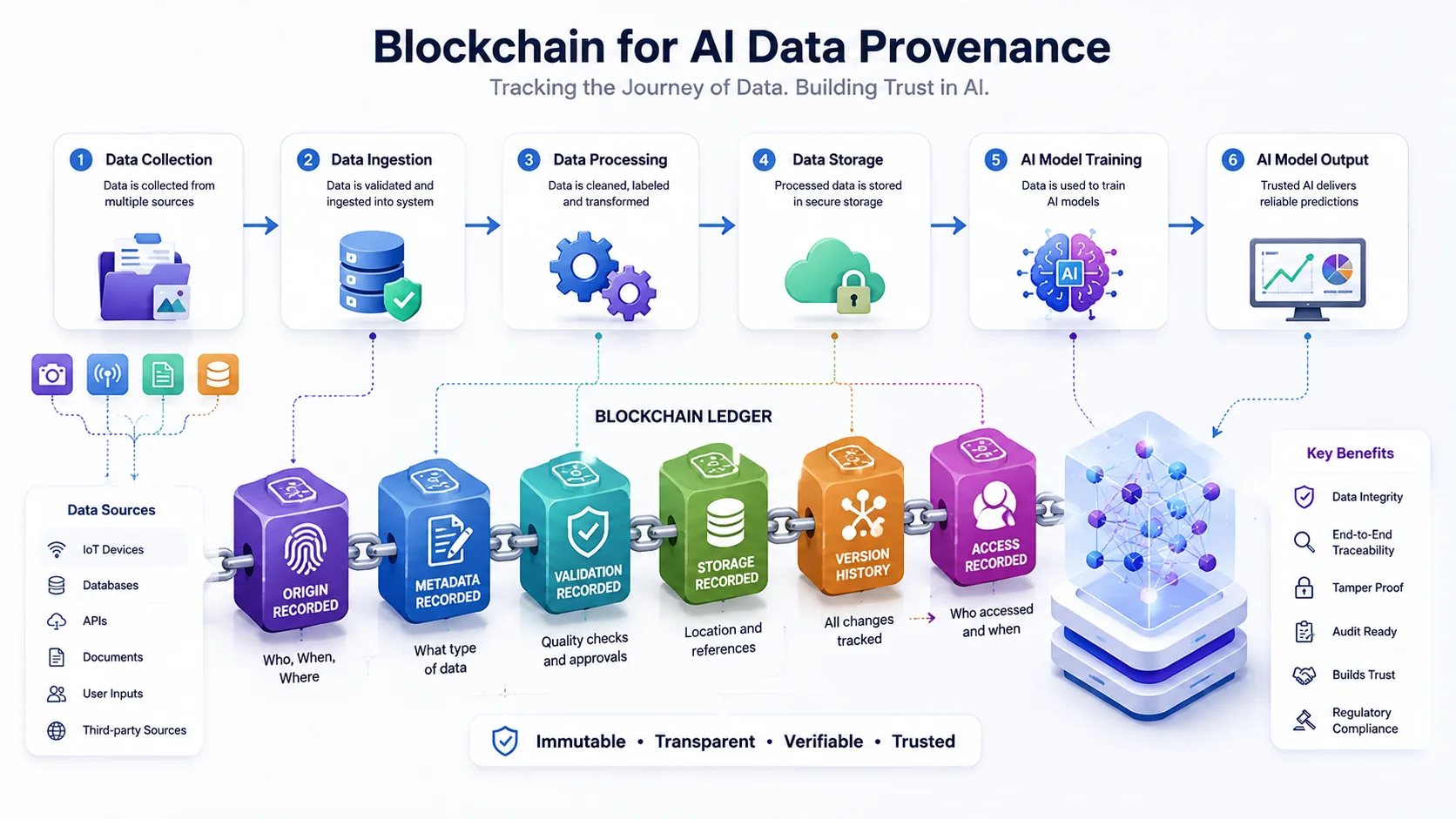
Blockchain stores important metadata such as:
- Dataset identifier
- Timestamp
- Data owner
- Source
- Hash values
- Version history
- Permission records
- Access logs
- Verification status
Whenever the dataset changes, a new blockchain record documents the modification.
This creates a permanent audit trail that cannot easily be altered.
The Role of Cryptographic Hashing
One of blockchain's greatest strengths is cryptographic hashing.
A hash is a unique digital fingerprint generated from data.
Even changing one pixel in an image produces a completely different hash.
For example:
Original Dataset
Hash:
A82C91F34D...
Modified Dataset
Hash:
91AB77EF22...
Since blockchain stores hashes instead of massive files, organizations can quickly verify whether data has been modified.
If the calculated hash no longer matches the blockchain record, the dataset has been altered.
This makes tampering immediately detectable.
Version Tracking for AI Datasets
AI datasets constantly evolve.
Examples include:
- Correcting labels
- Removing duplicates
- Adding new samples
- Cleaning noisy data
- Updating annotations
Without version control, researchers may struggle to reproduce earlier experiments.
Blockchain records every dataset version.
Instead of overwriting previous information, each update creates another immutable record.
Researchers can always identify:
- Dataset version used
- Modification date
- Person responsible
- Reason for update
- Approval history
This greatly improves reproducibility in AI research.
Preventing Data Manipulation
One major concern in AI development is unauthorized modification.
For example:
An insider changes financial transaction records before AI fraud detection training.
The AI now learns incorrect behavior.
Because blockchain creates immutable records, unauthorized modifications become easy to detect.
Attackers cannot secretly replace data without leaving evidence.
This dramatically increases confidence in AI training pipelines.
Improving Transparency in AI Development
AI systems are increasingly criticized for being "black boxes."
While explainable AI focuses on understanding model decisions, blockchain helps explain the data behind those decisions.
Organizations can demonstrate:
- Data source
- Collection process
- Quality checks
- Validation history
- Ownership records
- Regulatory compliance
This level of transparency builds trust among customers, regulators, and business partners.
Blockchain and AI Supply Chains
Modern AI datasets often come from multiple organizations.
For example:
An autonomous driving company may collect:
- Vehicle cameras
- Traffic sensors
- GPS devices
- Mapping providers
- Government road databases
- Weather services
Each contributor may update data independently.
Blockchain records contributions from every participant while preserving accountability.
Every stakeholder can verify where each dataset originated.
Smart Contracts for Automated Verification
Smart contracts allow blockchain networks to automate specific rules.
Examples include:
- Accept new datasets only after expert approval.
- Reject duplicate submissions.
- Verify licensing agreements.
- Confirm regulatory compliance.
- Automatically reward data contributors.
This reduces manual administration while maintaining transparent governance.
Smart contracts also eliminate many opportunities for human error.
AI Model Auditing
Organizations increasingly need to prove how AI models were developed.
Auditors may ask:
- Which dataset trained the model?
- Was personal information removed?
- Were data licenses respected?
- Were updates documented?
- Did data change after deployment?
Blockchain maintains permanent evidence for answering these questions.
This simplifies compliance with emerging AI regulations worldwide.
Healthcare Applications
Healthcare produces enormous amounts of sensitive information.
Examples include:
- MRI scans
- CT images
- Blood reports
- Clinical notes
- Laboratory results
- Genomic data
Hospitals may collaborate across countries to train medical AI systems.
Blockchain enables secure provenance tracking while ensuring every record has a verifiable history.
Doctors gain greater confidence that AI recommendations rely on authentic medical data.
Financial Services
Banks increasingly use AI for:
- Fraud detection
- Credit scoring
- Risk assessment
- Anti-money laundering
- Customer verification
Blockchain ensures transaction histories remain verifiable before entering AI training systems.
This helps reduce fraud while improving regulatory compliance.
Manufacturing and Industrial AI
Factories deploy AI for predictive maintenance.
Machines continuously generate sensor information.
Blockchain records:
- Sensor identity
- Timestamp
- Equipment history
- Maintenance records
- Software updates
Engineers can verify that AI predictions rely on genuine machine data rather than manipulated logs.
Government and Public Sector
Governments increasingly use AI for:
- Traffic management
- Public services
- Disaster prediction
- Resource planning
- Environmental monitoring
Blockchain strengthens trust by documenting where public datasets originated and how they evolved.
Citizens gain greater confidence in AI-assisted government decisions.
Protecting Intellectual Property
AI training datasets often require significant investment.
Companies need proof of ownership.
Blockchain timestamps every dataset creation event.
Creators can demonstrate:
- Original ownership
- Publication date
- Licensing terms
- Usage permissions
- Modification history
This supports intellectual property protection without exposing the underlying data publicly.
Supporting Responsible AI
Responsible AI requires more than accurate predictions.
It also requires:
- Fairness
- Accountability
- Transparency
- Privacy
- Security
- Human oversight
Blockchain contributes to responsible AI by making data history visible and verifiable.
Organizations can show regulators exactly how datasets were managed throughout the AI lifecycle.
Challenges of Using Blockchain for AI Data Provenance
Although blockchain provides many benefits, it is not a perfect solution.
Some challenges include:
Scalability
AI datasets often reach terabytes or petabytes in size.
Blockchain cannot efficiently store such large files.
Instead, organizations usually store only hashes and metadata.
Privacy Concerns
Some AI datasets contain confidential information.
Even metadata may reveal sensitive details.
Privacy-preserving techniques such as zero-knowledge proofs and permissioned blockchains are becoming increasingly important.
Integration Complexity
Existing AI pipelines may rely on numerous cloud services.
Integrating blockchain requires additional architecture, governance, and security planning.
Performance
Public blockchains may introduce delays when recording transactions.
Private or consortium blockchains often provide faster performance for enterprise AI applications.
Regulatory Compliance
Different countries have different rules regarding:
- Personal data
- Data deletion
- Cross-border transfers
- Consent management
Organizations must carefully design blockchain systems that comply with regional privacy regulations.
Future Trends
The combination of AI and blockchain continues to evolve rapidly.
Future innovations may include:
- Decentralized AI marketplaces
- Verifiable synthetic datasets
- Tokenized data ownership
- Federated AI with blockchain governance
- Autonomous AI agents managing trusted datasets
- Cross-border AI collaboration
- Privacy-preserving machine learning
- Cryptographic proof of AI training history
As governments introduce stronger AI regulations, verifiable data provenance will become increasingly valuable.
Best Practices for Organizations
Organizations adopting blockchain for AI data provenance should:
- Record metadata instead of entire datasets.
- Use cryptographic hashing for integrity verification.
- Automate validation with smart contracts.
- Maintain clear version histories.
- Implement role-based access controls.
- Combine blockchain with secure cloud storage.
- Regularly audit data pipelines.
- Train employees on responsible data governance.
- Monitor regulatory changes.
- Design systems with scalability in mind.
Following these practices helps organizations build AI systems that are both trustworthy and compliant.
Conclusion
Artificial Intelligence is transforming industries, but its success depends on trustworthy data. Without reliable information, even the most advanced AI models can produce inaccurate or biased results.
Blockchain offers a practical way to establish trustworthy AI data provenance by creating immutable records of dataset origins, modifications, ownership, and verification history. Rather than replacing traditional storage systems, blockchain complements them by providing a secure layer of transparency and accountability.
As AI adoption continues to accelerate, organizations will face increasing pressure from customers, regulators, and partners to demonstrate how their AI systems are trained and maintained. Blockchain-based provenance systems can help meet these expectations by making every stage of the data lifecycle verifiable and auditable.
While challenges such as scalability, privacy, and implementation complexity still exist, ongoing innovation in blockchain infrastructure and cryptographic technologies is steadily addressing these limitations. Businesses that invest in trustworthy data management today will be better positioned to build ethical, reliable, and regulation-ready AI systems in the future.
Ultimately, blockchain for AI data provenance is not just about securing information it is about creating confidence in every AI decision built upon that information.
Frequently Asked Questions (FAQs)
1. What is AI data provenance?
AI data provenance is the complete history of a dataset, including where it originated, who modified it, when changes occurred, and how it was used throughout the AI lifecycle.
2. Why is blockchain useful for AI data provenance?
Blockchain creates an immutable and transparent record of dataset history, making it easier to verify authenticity, detect tampering, and improve trust in AI systems.
3. Does blockchain store entire AI datasets?
Usually, no. Most implementations store cryptographic hashes and metadata on the blockchain while keeping the actual datasets in secure cloud or distributed storage systems.
4. Which industries benefit most from blockchain-based AI provenance?
Healthcare, finance, manufacturing, government, supply chain management, scientific research, and autonomous vehicle development are among the industries that benefit the most.
5. Can blockchain completely solve AI trust issues?
No. Blockchain significantly improves data transparency and integrity, but trustworthy AI also requires high-quality datasets, ethical governance, privacy protection, explainable AI techniques, and ongoing human oversight.