
Token Engineering Explained: The Complete Guide to Optimizing AI Context and Prompts
what Token Engineering is, how it differs from Prompt Engineering, and why it is becoming an essential skill for building modern AI applications. This comprehensive guide explains token optimization, context management, Retrieval-Augmented Generation (RAG), best practices, real-world use cases, and future trends to help developers build smarter, faster, and more cost-effective AI systems.
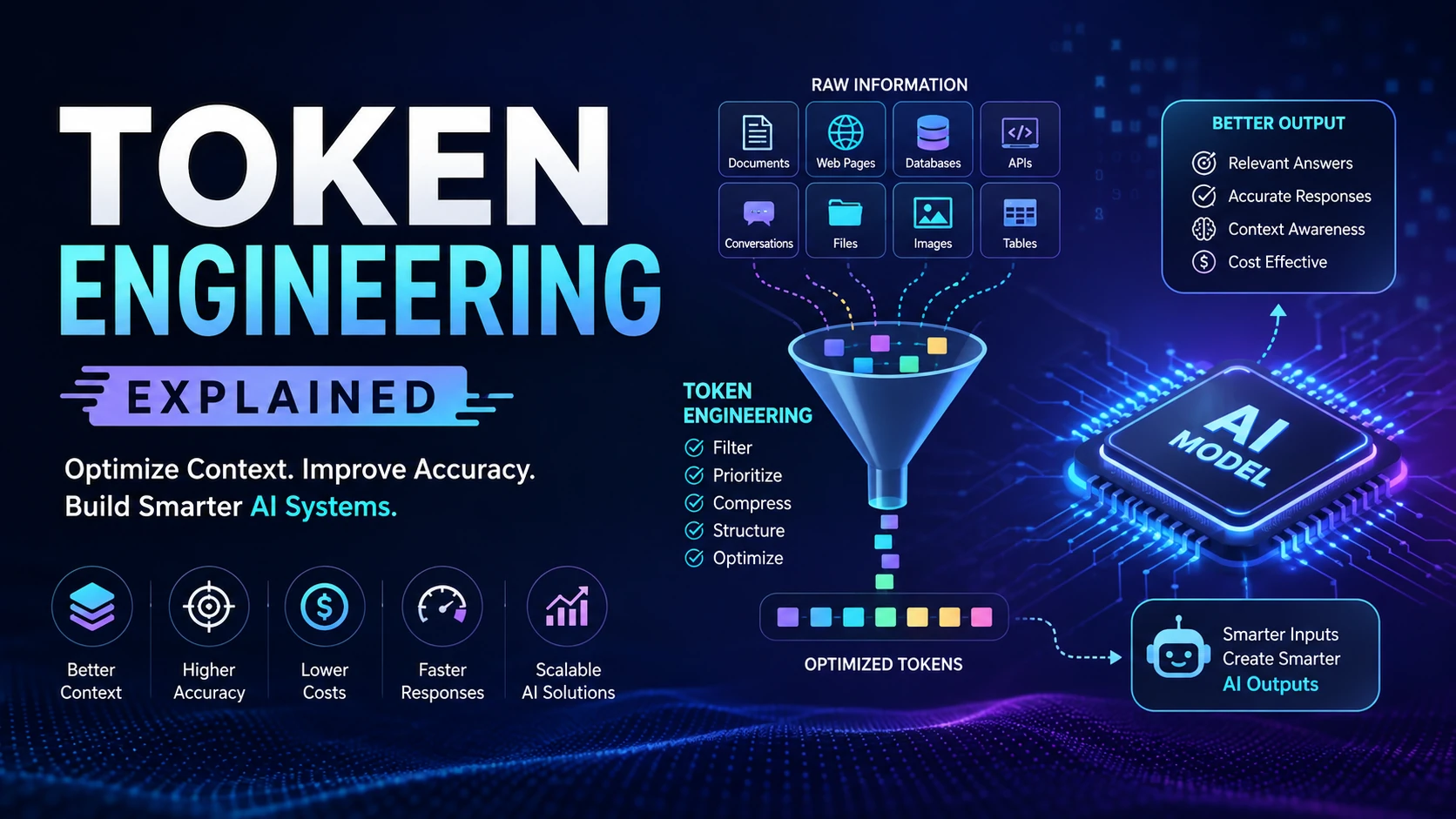
Table of Content
Table of Content
Artificial Intelligence has evolved rapidly over the last few years. Large Language Models (LLMs) such as GPT, Claude, Gemini, and other modern AI systems can generate human-like responses, write code, summarize research papers, analyze data, and even assist in decision-making. However, one important fact often gets overlooked: the quality of an AI's response depends heavily on the quality of the input it receives.
Many people think prompt engineering is enough to build reliable AI applications. While prompts are important, modern AI applications require something much more advanced. This is where Token Engineering enters the picture.
Token Engineering is an emerging discipline that focuses on managing, organizing, and optimizing the information sent to AI models. Instead of simply writing better prompts, developers engineer the entire context that reaches the model, ensuring every token contributes meaningful information.
As AI applications become increasingly sophisticated, Token Engineering is becoming one of the most valuable skills for AI developers, machine learning engineers, SaaS founders, and software architects.
In this guide, you'll learn what Token Engineering is, why it matters, how it differs from Prompt Engineering, practical implementation strategies, real-world examples, common challenges, and why it is likely to become a core part of future AI development.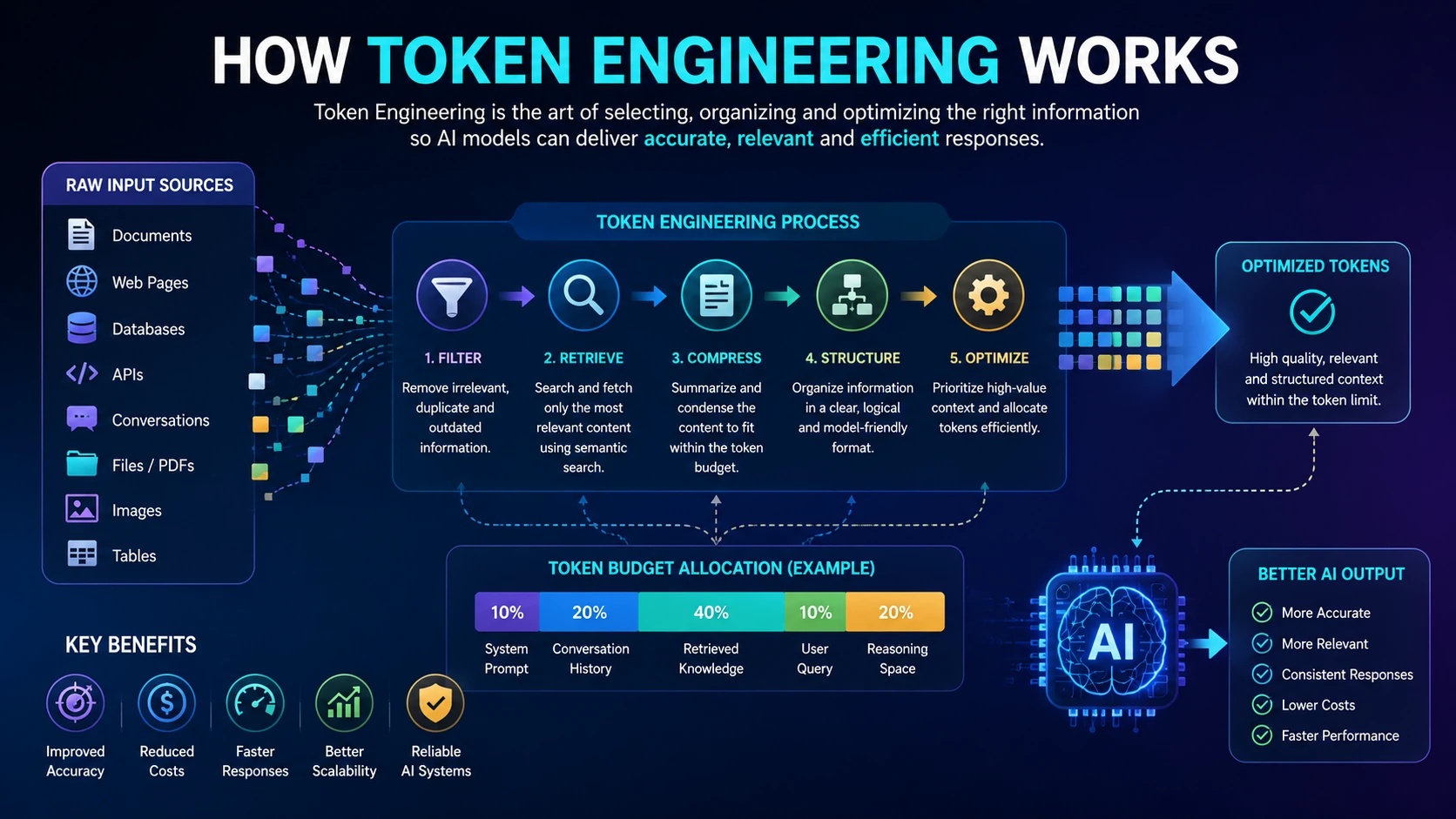
What is Token Engineering?
Token Engineering is the process of designing, organizing, filtering, compressing, and optimizing the information (tokens) provided to AI models so they can produce more accurate, relevant, and efficient outputs.
Unlike Prompt Engineering, which focuses mainly on writing instructions, Token Engineering manages the complete context sent to an AI model.
This includes:
- User instructions
- Previous conversations
- Retrieved documents
- Database records
- Memory
- External APIs
- Tool outputs
- System prompts
- Structured data
- Images (for multimodal models)
Every piece of information consumes tokens. Token Engineering ensures that every token is useful.
Think of it like packing a suitcase for an international trip. You cannot carry everything, so you carefully select only what is necessary. AI models work similarly because every model has a context window with a maximum number of tokens it can process at once.
Understanding AI Tokens
Before learning Token Engineering, it's important to understand what tokens actually are.
Tokens are the smallest units of text that an AI model processes.
They are not always complete words.
For example:
Artificial Intelligence

↓

Artificial
Intelligence
Sometimes a single long word becomes multiple tokens.
Numbers, punctuation, spaces, and emojis also consume tokens.
For example:
Hello World!

↓

Hello
World
!
Even simple formatting contributes to token usage.
Different AI models use different tokenization algorithms, but the basic concept remains the same.
Why Token Engineering Matters
Modern AI systems rarely rely on a single prompt.
Instead, they combine information from multiple sources.
For example, a customer support chatbot might include:
- Customer profile
- Purchase history
- Support tickets
- Company policies
- Product documentation
- Current conversation
- System instructions
Without Token Engineering, all this information could exceed the model's context limit or overwhelm the AI with unnecessary details.
Good Token Engineering helps by:
- Reducing token waste
- Improving response quality
- Lowering API costs
- Increasing reasoning accuracy
- Improving response consistency
- Enabling scalable AI systems
- Managing long conversations efficiently
Prompt Engineering vs Token Engineering
Many people confuse these two concepts.
Prompt Engineering focuses on writing effective instructions.
Example:
"Summarize this article in five bullet points."
Token Engineering focuses on everything the AI receives.
Example:
Instead of sending an entire 100-page document, Token Engineering retrieves only the relevant sections, removes duplicates, summarizes background information, and structures the context before sending it to the model.
Prompt Engineering is one part of Token Engineering.
Token Engineering is the broader system-level discipline.
How Large Language Models Process Tokens
Every AI model has a limited context window.
For example:
- 32K tokens
- 128K tokens
- 200K tokens
- 1M+ tokens (depending on the model)
Everything sent to the AI consumes this context.
This includes:
- Instructions
- User questions
- AI responses
- Tool outputs
- Retrieved documents
- Conversation history
If the context exceeds the maximum limit, older information may be removed or the request may fail.
Token Engineering helps determine:
- What information should stay
- What should be summarized
- What should be removed
- What should be compressed
- What should be retrieved dynamically
Core Principles of Token Engineering
1. Relevance First
Only provide information that directly relates to the current task.
Instead of sending an entire database record, include only the fields needed for the question.
2. Context Compression
Long documents can often be summarized without losing important meaning.
Instead of sending:
20 pages
Send:
A concise summary plus the specific relevant sections.
3. Dynamic Retrieval
Modern AI systems use Retrieval-Augmented Generation (RAG).
Instead of storing everything in the prompt, relevant information is retrieved only when needed.
This greatly reduces token usage.
4. Structured Information
Well-organized data is easier for AI models to understand.
Instead of:
John bought three products last month and contacted support twice...
Use:
Customer
Name: John

Orders:
- Laptop
- Mouse
- Keyboard

Support Tickets:
2
Structured data improves reasoning.
5. Remove Noise
Duplicate paragraphs
Repeated instructions
Unnecessary metadata
Irrelevant conversation history
These all waste valuable tokens.
Token Optimization Techniques
Context Filtering
Filter irrelevant information before sending it to the model.
For example, if the user asks about billing, product documentation may not be necessary.
Semantic Search
Instead of searching by keywords, semantic search retrieves information based on meaning.
Vector databases make this possible.
Popular options include:
- Pinecone
- Weaviate
- Milvus
- Chroma
- Qdrant
Chunking
Large documents are divided into smaller sections called chunks.
Instead of sending an entire book, only the relevant chunks are retrieved.
Chunk size significantly affects AI performance.
Context Ranking
When multiple documents are available, rank them by relevance.
Only send the highest-quality results.
Token Budgeting
Developers often allocate token limits for different components.
Example:
System Prompt
10%
Conversation History
20%
Retrieved Knowledge
40%
User Query
10%
Reasoning Space
20%
This prevents one section from consuming the entire context window.
Summarization Pipelines
Older conversations can be summarized into compact memory.
Instead of keeping hundreds of messages, maintain an evolving summary.
This allows long-term conversations without exceeding token limits.
Real-World Applications
AI Customer Support
Support bots retrieve only the relevant product documentation.
Benefits:
- Faster responses
- Lower costs
- Better accuracy
AI Coding Assistants
Instead of loading an entire repository, the assistant retrieves:
- Current file
- Imported modules
- Related functions
- Documentation
This produces better code suggestions.
Healthcare AI
Medical AI retrieves:
- Patient history
- Current medications
- Lab reports
- Relevant medical guidelines
without loading unnecessary records.
Legal AI
Legal assistants retrieve:
- Specific contracts
- Relevant clauses
- Case laws
- Regulations
instead of sending thousands of legal pages.
Financial Analysis
AI systems retrieve:
- Company reports
- Market data
- Recent earnings
- Historical trends
while ignoring unrelated financial documents.
Enterprise Knowledge Assistants
Large organizations store millions of documents.
Token Engineering ensures employees receive only the relevant company knowledge instead of overwhelming the AI with entire databases.
Best Practices
Keep System Prompts Clear
Avoid unnecessary instructions.
Simple prompts are often more reliable.
Retrieve Before Generating
Instead of embedding all knowledge inside prompts, retrieve relevant information dynamically.
Use Memory Carefully
Store long-term facts separately.
Do not repeatedly send identical information.
Compress Long Conversations
Summaries often preserve important context while saving thousands of tokens.
Measure Token Usage
Monitor:
- Input tokens
- Output tokens
- Cost
- Latency
Optimization should be data-driven rather than based on assumptions.
Test Different Context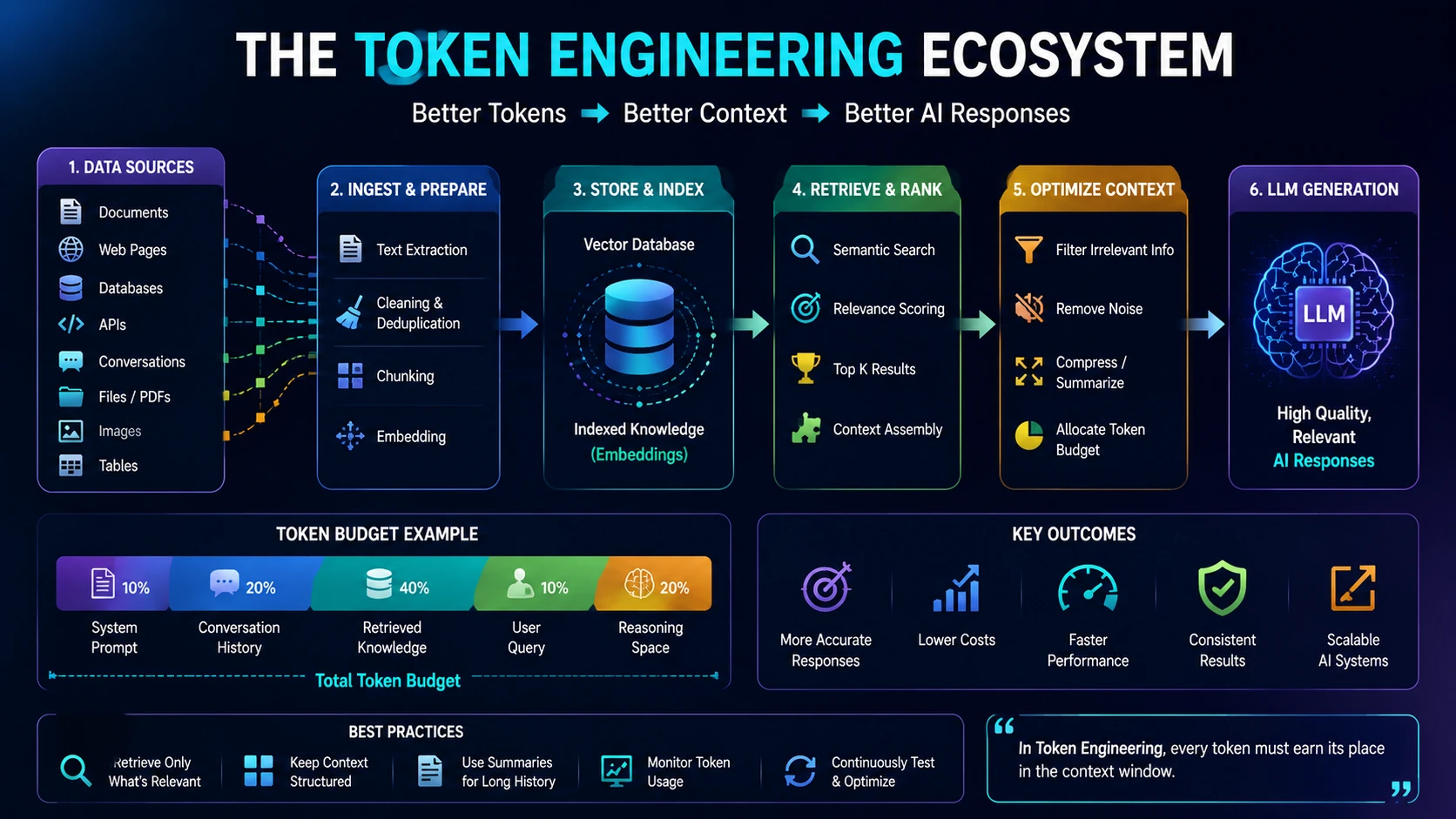 Strategies
Experiment with:
- Different chunk sizes
- Retrieval depth
- Ranking methods
- Summarization approaches
Small improvements can significantly increase response quality.
Common Mistakes
Sending Entire Documents
Large documents often contain irrelevant information.
Retrieve only what is needed.
Ignoring Token Costs
More tokens mean:
- Higher API costs
- Slower responses
- Increased latency
Repeating Instructions
Developers sometimes include identical system instructions multiple times.
This wastes valuable context.
Poor Document Chunking
Chunks that are too large reduce retrieval precision.
Chunks that are too small lose important context.
Finding the right balance is essential.
No Context Ranking
Sending ten average documents is often less effective than sending two highly relevant ones.
Quality matters more than quantity.
Forgetting Conversation Memory
Without memory management, long conversations become inefficient and expensive.
The Future of Token Engineering
As AI systems become more capable, Token Engineering will continue to grow in importance.
Future AI platforms are expected to include:
- Intelligent context management
- Automatic memory optimization
- Adaptive token budgeting
- Personalized long-term memory
- Multi-agent context sharing
- Context-aware retrieval systems
- Autonomous token optimization
- Hybrid memory architectures
- AI-native knowledge graphs
Developers who understand Token Engineering today will be better prepared to build scalable AI products tomorrow.
The future of AI is not just about larger models. It is about delivering the right information at the right time using the fewest possible tokens.
Step-by-Step Process of Token Engineering
Token Engineering is not a single technique but a complete workflow for managing the information that an AI model receives. Every production-grade AI application follows a structured process to ensure that the model gets only the most useful context. By following a step-by-step approach, developers can improve response quality, reduce token costs, and build AI systems that scale efficiently.
Step 1: Identify the User's Intent
The first step in Token Engineering is understanding what the user actually wants. Before retrieving documents or sending data to the language model, the application should analyze the user's query and determine its intent.
For example, if a user asks, "How do I reset my account password?", there is no need to load billing documents or product marketing content. The AI only needs password recovery instructions.
Accurately identifying intent helps reduce unnecessary token usage while improving response relevance.
Step 2: Retrieve Only Relevant Information
Once the user's intent is understood, the next step is retrieving only the information that directly supports the answer. Modern AI applications often use Retrieval-Augmented Generation (RAG) combined with vector databases to perform semantic search.
Instead of searching for exact keywords, semantic search finds documents based on meaning. This allows the AI to retrieve the most relevant sections of documentation without sending entire files.
This selective retrieval saves thousands of tokens while making responses more precise.
Step 3: Filter Unnecessary Context
Not every retrieved document should be passed to the AI model. Some documents may contain duplicate information, outdated content, or sections that are unrelated to the current question.
Token Engineering removes unnecessary context before the request reaches the model. Filtering irrelevant information reduces confusion and ensures that the AI focuses on answering the user's actual question instead of processing excessive background data.
This step is especially important for enterprise applications where thousands of documents may exist.
Step 4: Organize the Context Logically
After filtering the information, developers should organize it in a logical structure. AI models generally perform better when information is presented in a clean and predictable format.
A typical context structure might include:
- System instructions
- User request
- Retrieved documents
- Previous conversation summary
- Tool or API results
Presenting information in a consistent order helps the model understand relationships between different pieces of context and generate more coherent responses.
Step 5: Optimize the Token Budget
Every language model has a limited context window, making token budgeting an essential part of Token Engineering.
Developers should decide how many tokens are allocated to different sections such as system prompts, conversation history, retrieved documents, and user queries.
For example, instead of allowing one long document to consume most of the available context, developers can reserve space for reasoning and recent conversation history. A balanced token budget helps maintain response quality while preventing important information from being excluded.
Step 6: Continuously Improve Through Monitoring
Token Engineering is an ongoing optimization process rather than a one-time implementation.
Production AI applications should monitor important metrics such as:
- Input token usage
- Output token usage
- Response accuracy
- API cost
- Response latency
- Retrieval quality
By analyzing these metrics, developers can identify opportunities to improve chunk sizes, retrieval strategies, context ranking, and summarization techniques.
Continuous monitoring ensures that AI systems remain efficient even as datasets and user interactions grow over time.
Why This Workflow Matters
Following a structured Token Engineering workflow allows AI applications to deliver faster, more accurate, and more cost-effective responses. Instead of overwhelming the language model with unnecessary information, developers provide only the context that truly matters.
As modern AI applications continue to become more complex, this systematic approach helps organizations reduce operational costs, improve user satisfaction, and build scalable AI products that perform consistently across millions of interactions. Token Engineering is no longer just an optimization technique it is becoming a fundamental design principle for building reliable AI systems.
Final Thoughts
Token Engineering represents the next evolution of AI application development. While Prompt Engineering teaches AI what to do, Token Engineering determines what information the model receives before it starts reasoning. That distinction has a major impact on accuracy, efficiency, cost, and scalability.
As organizations increasingly adopt Retrieval-Augmented Generation (RAG), AI agents, enterprise search, long-term memory systems, and multimodal applications, managing context effectively will become just as important as selecting the right AI model. Developers who can filter irrelevant data, compress conversations, retrieve precise knowledge, and structure context intelligently will build AI systems that are faster, more reliable, and significantly more cost-effective.
Whether you're building chatbots, AI coding assistants, research tools, healthcare applications, financial platforms, or enterprise automation, investing time in learning Token Engineering today will help you create smarter AI products that perform consistently at scale. In the coming years, it is likely to become a foundational skill for anyone working with modern artificial intelligence.
Frequently Asked Questions (FAQs)
1. What is Token Engineering in AI?
Token Engineering is the practice of optimizing, organizing, filtering, and managing the information sent to AI models so they can generate more accurate responses while reducing token usage and API costs.
2. How is Token Engineering different from Prompt Engineering?
Prompt Engineering focuses on writing effective instructions for AI, whereas Token Engineering manages the entire context including prompts, retrieved documents, conversation history, memory, and structured data to maximize AI performance.
3. Why is Token Engineering important for AI applications?
It improves response accuracy, reduces latency, lowers API costs, optimizes context windows, enhances retrieval quality, and enables AI systems to scale efficiently.
4. Which technologies are commonly used in Token Engineering?
Common technologies include Retrieval-Augmented Generation (RAG), vector databases, semantic search, document chunking, context compression, embeddings, long-term memory systems, and context-ranking algorithms.
5. Is Token Engineering only useful for developers?
No. While developers use it extensively, AI product managers, solution architects, researchers, and businesses building AI-powered applications also benefit from understanding Token Engineering because it directly impacts performance, user experience, and operational costs.