
Introduction to Prompt Engineering for Beginners: A Complete Guide for 2026
Learn prompt engineering from scratch with this beginner-friendly guide. Discover what prompt engineering is, how AI understands prompts, why it matters in 2026, and how to write better prompts for ChatGPT, Gemini, Claude, and other AI tools.

Table of Content
Table of Content
Introduction to Prompt Engineering for Beginners
Artificial Intelligence has transformed the way people learn, work, create content, write code, analyze data, and solve everyday problems. Tools like ChatGPT, Google Gemini, Claude, Microsoft Copilot, and other AI assistants are becoming part of daily workflows for students, developers, marketers, designers, writers, and business professionals.
However, many people quickly realize that asking AI random questions does not always produce the results they expect. Sometimes the answers are too short, too generic, incomplete, or simply different from what they actually wanted.
The difference often comes down to one important skill known as prompt engineering.
Prompt engineering is the practice of writing clear, structured, and detailed instructions that help AI models understand exactly what you want. A well-written prompt can turn an average AI response into something highly accurate, detailed, and useful.
The good news is that prompt engineering is not limited to AI researchers or software engineers. Anyone can learn it. Whether you are a student preparing assignments, a developer building AI-powered applications, a content creator writing articles, or a business owner automating repetitive tasks, prompt engineering can significantly improve the quality of your AI interactions.
As AI continues to become a standard workplace tool in 2026, understanding how to communicate effectively with AI is becoming just as valuable as learning a programming language or mastering office software.
This beginner-friendly guide explains everything you need to know about prompt engineering. You will learn what prompt engineering is, why it matters, how AI understands prompts, who should learn this skill, and the foundational concepts that will help you create better prompts with confidence.
By the end of this guide, you will have a clear understanding of prompt engineering and be ready to start writing prompts that produce more accurate, relevant, and high-quality AI responses.
What is Prompt Engineering?
Prompt engineering is the process of designing and writing effective instructions that guide an Artificial Intelligence model toward producing the desired response.
The word prompt refers to the input or instruction you provide to an AI system. This input can be a simple question, a detailed task description, a coding request, or even a long document with multiple instructions.
Prompt engineering focuses on improving the quality of those instructions so the AI clearly understands your intent.
For example, instead of asking:
"Write a blog."
A better prompt would be:
"Write a 1500-word beginner-friendly blog about cloud computing using simple English. Include an introduction, headings, practical examples, FAQs, and an SEO-friendly conclusion."
The second prompt gives the AI much more context, resulting in a response that is organized, detailed, and closer to your expectations.
Prompt engineering is not about using complicated language. It is about communicating your requirements clearly, logically, and with enough context for the AI to understand your goals.
Why Prompt Engineering Matters in 2026
Artificial Intelligence is now being used across almost every industry.
Companies use AI to write documentation, generate reports, create marketing campaigns, summarize meetings, assist customer support, develop software, analyze business data, and automate repetitive tasks.
Because of this rapid adoption, knowing how to interact effectively with AI has become a valuable professional skill.
Here are some reasons why prompt engineering is more important than ever.
Better AI Responses
Clear prompts produce more accurate, relevant, and detailed answers.
Instead of spending time correcting AI responses repeatedly, a well-written prompt helps you receive useful results from the beginning.
Increased Productivity
Good prompts reduce the number of follow-up questions needed to complete a task.
Whether you are writing code, generating content, or creating presentations, prompt engineering helps you finish work faster.
Improved Learning
Students can use prompt engineering to receive personalized explanations, practice questions, coding exercises, summaries, and study plans.
Instead of receiving generic information, they can ask AI to explain concepts according to their learning style.
Higher Quality Content
Content creators use prompt engineering to generate blogs, social media posts, scripts, newsletters, product descriptions, and marketing content more efficiently.
Providing detailed instructions helps maintain quality and consistency.
Career Growth
Many companies now expect employees to understand AI tools.
Developers, marketers, analysts, designers, teachers, researchers, and entrepreneurs all benefit from knowing how to communicate effectively with AI systems.
Prompt engineering has quickly become a practical workplace skill rather than just a technical concept.
How AI Models Understand Prompts
One of the biggest misconceptions is that AI "thinks" like a human.
In reality, AI models analyze patterns learned from enormous amounts of training data.
When you enter a prompt, the AI examines your words, identifies relationships between them, predicts the most appropriate response, and generates text based on probabilities rather than human reasoning.
This is why the wording of your prompt has such a significant impact on the final output.
For example, these prompts may seem similar but produce very different responses.
Prompt 1:
Explain Java.
Prompt 2:
Explain Java programming for complete beginners using simple English. Include real-world examples, advantages, disadvantages, career opportunities, and a comparison with Python.
The second prompt provides context, audience, structure, and expectations, allowing the AI to generate a much more useful answer.
The more context you provide, the easier it becomes for AI to understand exactly what you need.
Prompt Engineering vs Traditional Programming
Many beginners assume prompt engineering is another programming language.
In reality, prompt engineering is quite different from traditional software development.
Programming languages such as Java, Python, C++, and JavaScript require developers to write precise instructions that computers execute exactly as written.
Prompt engineering focuses on communicating effectively with AI using natural language.
Instead of writing algorithms and functions, you describe the task, define the expected output, provide context, and specify any constraints.
Although they are different skills, they complement each other.
Developers often combine programming with prompt engineering when building AI-powered applications using APIs from platforms like ChatGPT, Gemini, or Claude.
As AI becomes integrated into more software products, understanding both programming and prompt engineering provides a significant advantage.
Who Should Learn Prompt Engineering?
One of the best things about prompt engineering is that it is useful for almost everyone.
You do not need a computer science degree or years of programming experience to start learning.
Here are some people who can benefit from prompt engineering.
Students
Students can use AI to understand complex topics, prepare for exams, generate summaries, create practice questions, and improve writing skills.
Software Developers
Developers use prompt engineering for:
- Writing code
- Debugging applications
- Explaining algorithms
- Creating documentation
- Generating test cases
- Learning new frameworks
Content Creators
Bloggers, YouTubers, copywriters, and marketers can create content ideas, outlines, scripts, captions, newsletters, and promotional material more efficiently.
Designers
UI and UX designers can generate design ideas, color palettes, user flows, wireframe suggestions, accessibility improvements, and design documentation.
Digital Marketers
Marketing professionals can create advertising campaigns, SEO strategies, email sequences, keyword research, and social media content using AI-powered tools.
Business Owners
Entrepreneurs can automate customer support, draft proposals, prepare business plans, analyze competitors, generate reports, and improve productivity using effective prompts.
Researchers
Researchers can summarize research papers, organize information, generate literature reviews, compare studies, and simplify complex concepts for presentations.
Common Myths About Prompt Engineering
As prompt engineering becomes more popular, several misconceptions have also emerged.
Understanding these myths can help beginners approach the subject with realistic expectations.
Myth 1: Only Developers Can Learn Prompt Engineering
This is false.
Prompt engineering is valuable for writers, students, teachers, marketers, designers, researchers, entrepreneurs, and many other professionals.
Myth 2: Longer Prompts Are Always Better
A longer prompt is not automatically a better prompt.
The goal is clarity, relevance, and sufficient context rather than unnecessary length.
Myth 3: AI Always Gives Correct Answers
AI can occasionally generate inaccurate or outdated information.
Prompt engineering improves response quality, but users should still verify important facts before relying on them.
Myth 4: Prompt Engineering Will Replace Programming
Prompt engineering is a valuable skill, but it does not replace software engineering.
Instead, it complements programming by helping developers build smarter AI-powered applications and work more efficiently.
Types of Prompts Every Beginner Should Know
One of the biggest advantages of prompt engineering is that there is no single way to communicate with AI. Different tasks require different prompt styles, and understanding these types can significantly improve the quality of AI-generated responses.
Let's explore the most common prompt types that every beginner should know.
Zero-Shot Prompting
Zero-shot prompting means asking the AI to perform a task without providing any examples.
The AI relies entirely on its existing knowledge to generate a response.
Example
Prompt:
Explain blockchain technology in simple English.
This approach works well for general questions and simple tasks.
Best Use Cases
- Definitions
- General explanations
- Summaries
- Basic coding questions
- Brainstorming ideas
One-Shot Prompting
In one-shot prompting, you provide a single example before asking the AI to perform a similar task.
The example helps the AI better understand the expected output.
Example
Example:
Input: Apple
Output: A popular technology company.
Now explain:
Microsoft
The AI follows the same format used in the example.
Best Use Cases
- Product descriptions
- Text formatting
- Classification tasks
- Writing style consistency
Few-Shot Prompting
Few-shot prompting involves providing multiple examples before asking AI to generate the final answer.
This usually produces more consistent and accurate results.
Example
Input: Dog
Category: Animal
Input: Rose
Category: Flower
Input: Car
Category:
The AI understands the pattern and completes the response correctly.
Best Use Cases
- Data classification
- Content formatting
- Email templates
- Customer support replies
Instruction-Based Prompting
This is the most commonly used prompt style.
You directly tell the AI what you want it to do.
Example
Write a 1200-word beginner-friendly article about cloud computing using simple English. Include headings, practical examples, FAQs, and a conclusion.
The clearer your instructions, the better the output.
Role-Based Prompting
Role prompting tells the AI to behave like a specific professional or expert.
This often improves response quality because the AI adjusts its tone and perspective.
Examples
- Act as a senior software engineer.
- Act as an experienced HR recruiter.
- Act as a cybersecurity consultant.
- Act as an IELTS examiner.
- Act as a mathematics teacher.
Role prompting is one of the easiest ways to receive more specialized responses.
Chain-of-Thought Prompting
Sometimes a problem requires reasoning instead of a direct answer.
Chain-of-thought prompting encourages the AI to solve problems step by step.
Example
Explain how binary search works step by step using a real-world example.
This approach is particularly useful for:
- Mathematics
- Algorithms
- Programming
- Logical reasoning
- Problem solving
Components of a Good Prompt
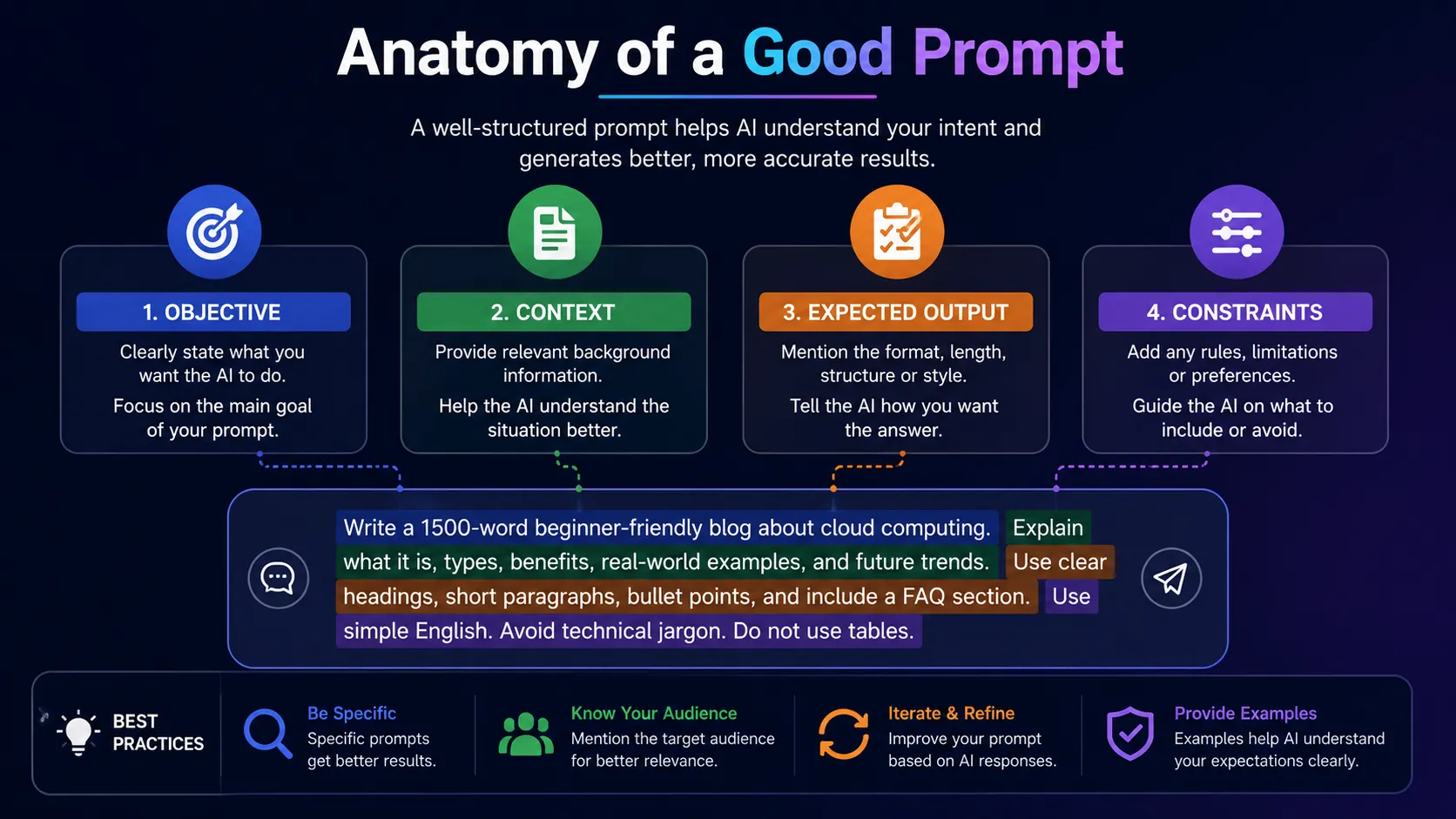
Most high-quality prompts follow a simple structure.
Understanding these components helps you write prompts that consistently produce better responses.
Objective
Clearly explain what you want the AI to accomplish.
Instead of saying:
Tell me about React.
Write:
Explain React for complete beginners.
The objective should be specific.
Context
Context gives the AI additional information.
Examples include:
- Target audience
- Industry
- Experience level
- Background information
Example:
Explain React to a first-year computer science student.
The additional context helps AI generate a more appropriate response.
Expected Output
Tell AI exactly how you want the answer.
Examples include:
- Bullet points
- Table
- Blog
- Tutorial
- Checklist
- Step-by-step guide
- FAQ
- Interview questions
The more specific your output format, the better.
Constraints
Constraints tell AI what to avoid.
Examples:
- Use simple English.
- Do not use technical jargon.
- Maximum 1000 words.
- No tables.
- Include practical examples.
- Use short paragraphs.
Constraints improve consistency.
Prompt Engineering Frameworks
Professional prompt engineers often use structured frameworks instead of writing random instructions.
Here are some beginner-friendly frameworks.
RTF Framework
RTF stands for:
Role
Task
Format
Example:
Role:
Act as a senior frontend developer.
Task:
Explain React Hooks.
Format:
Use simple English with examples.
This simple framework works well for educational content.
CARE Framework
CARE stands for:
Context
Action
Result
Expectation
Example:
Context:
I am preparing for a frontend interview.
Action:
Explain JavaScript closures.
Result:
Help me understand the concept.
Expectation:
Use simple English and practical examples.
CREATE Framework
Many content creators use this framework.
CREATE stands for:
Character
Request
Examples
Audience
Tone
Expected Output
Example:
Character:
Act as an experienced technical writer.
Request:
Write a blog about Docker.
Audience:
College students.
Tone:
Friendly and professional.
Expected Output:
1500 words with headings and FAQs.
Best Practices for Writing Better Prompts
Good prompt engineering is more about communication than complicated techniques.
Here are some proven best practices.
Be Specific
Avoid vague prompts.
Instead of writing:
Explain AI.
Write:
Explain Artificial Intelligence for beginners using simple English with real-world examples.
Specific prompts reduce ambiguity.
Define Your Audience
Different audiences require different explanations.
For example:
- Beginner
- Intermediate
- Professional
- School student
- College student
- Business owner
This improves relevance.
Mention the Desired Tone
Examples include:
- Professional
- Friendly
- Conversational
- Formal
- Technical
- Educational
Tone significantly changes how AI responds.
Request Structured Content
Instead of asking for plain text, specify the structure.
For example:
Include:
- Introduction
- Main headings
- Examples
- Summary
- FAQs
Structured prompts generate organized responses.
Ask for Practical Examples
Examples make AI-generated content much easier to understand.
Example:
Explain recursion with two real-world examples.
Iterate and Improve
Rarely does the first prompt produce the perfect answer.
Modify your prompt based on previous responses.
Professional prompt engineers often improve prompts multiple times before achieving the desired result.
Common Beginner Mistakes
Many beginners unknowingly reduce AI response quality by making simple mistakes.
Here are some common ones.
Asking Very Short Questions
Short prompts provide little context.
Instead of:
Python?
Write:
Explain Python programming for beginners with examples and career opportunities.
Giving Multiple Unrelated Tasks
Avoid combining unrelated requests into one prompt.
Instead of asking for coding, image generation, SEO, and marketing advice together, separate them into focused prompts.
Not Mentioning the Target Audience
Audience matters.
A response for software engineers will differ from one written for school students.
Ignoring Output Format
Always tell AI how you want the answer.
For example:
- Markdown
- JSON
- HTML
- Table
- Bullet points
- Blog format
Expecting Perfect Results Instantly
Prompt engineering is an iterative process.
Better prompts usually come after refining previous ones.
Real Prompt Examples
Here are some practical examples beginners can start using immediately.
Blog Writing
Write a 2000-word beginner-friendly blog about cloud computing. Use simple English, include practical examples, FAQs, and an SEO-friendly conclusion.
Coding
Act as a senior Java developer. Explain multithreading with practical examples and interview questions.
Resume Improvement
Improve my resume for a Full Stack Developer role. Highlight technical achievements and use ATS-friendly formatting.
Learning
Teach me Python from scratch. Create a 30-day learning roadmap with daily exercises.
Content Creation
Write a LinkedIn post announcing a new AI project. Keep the tone professional, engaging, and under 200 words.
Popular AI Tools That Support Prompt Engineering
Prompt engineering skills can be applied across many AI platforms.
Some of the most popular tools include:
- ChatGPT
- Google Gemini
- Claude
- Microsoft Copilot
- Perplexity AI
- GitHub Copilot
- Cursor AI
- Jasper AI
- Notion AI
- Canva Magic Write
Although each platform has unique strengths, the core principles of writing effective prompts remain largely the same.
Final Thoughts
Prompt engineering is quickly becoming one of the most valuable digital skills of the AI era. As artificial intelligence becomes a part of everyday work, the ability to communicate effectively with AI systems is no longer limited to developers or researchers. Students, software engineers, marketers, designers, writers, business owners, and professionals from almost every industry can benefit from learning how to write better prompts.
The key to becoming good at prompt engineering is practice. You do not need to memorize complicated frameworks or use advanced technical language. Instead, focus on writing clear instructions, providing enough context, defining your expected output, and refining your prompts based on the responses you receive. Small improvements in the way you ask questions can often lead to significantly better AI-generated results.
As AI technology continues to evolve in 2026 and beyond, prompt engineering will remain an essential skill for improving productivity, solving problems, generating ideas, and building AI-powered applications. Whether your goal is to create high-quality content, write better code, automate repetitive tasks, or simply learn more efficiently, mastering prompt engineering will give you a strong advantage in both your career and personal projects.
Remember that AI is a powerful assistant, but the quality of its output depends largely on the quality of your input. The better your prompts become, the more valuable and accurate your AI experience will be.
Frequently Asked Questions (FAQs)
1. What is prompt engineering in simple words?
Prompt engineering is the process of writing clear and detailed instructions that help AI tools like ChatGPT, Gemini, and Claude generate accurate, relevant, and useful responses. Better prompts usually lead to better AI-generated results.
2. Do I need programming knowledge to learn prompt engineering?
No. Prompt engineering does not require programming knowledge. Anyone, including students, writers, marketers, teachers, designers, and business professionals, can learn how to write effective prompts and use AI tools more efficiently.
3. Which AI tools support prompt engineering?
Many popular AI platforms support prompt engineering, including ChatGPT, Google Gemini, Claude, Microsoft Copilot, GitHub Copilot, Perplexity AI, Cursor AI, Jasper AI, and Notion AI. The basic principles of writing effective prompts are similar across these tools.
4. Why is prompt engineering an important skill in 2026?
As AI becomes widely used across industries, prompt engineering helps users generate higher-quality content, write better code, automate repetitive tasks, analyze information faster, and improve productivity. It has become a valuable workplace skill for both technical and non-technical professionals.
5. How can beginners improve their prompt engineering skills?
The best way to improve is through regular practice. Start by writing clear prompts with specific goals, provide enough context, define the desired output format, and experiment with different prompt styles. Reviewing AI responses and refining your prompts over time will help you develop stronger prompt engineering skills and achieve more accurate results.