
Decentralized GPU Networks Explained: The Future of AI Computing
how decentralized GPU networks are transforming AI computing by connecting unused GPU resources worldwide. Discover how they work, their advantages, challenges, real-world applications, and why they are becoming a cost-effective alternative to traditional cloud GPU providers

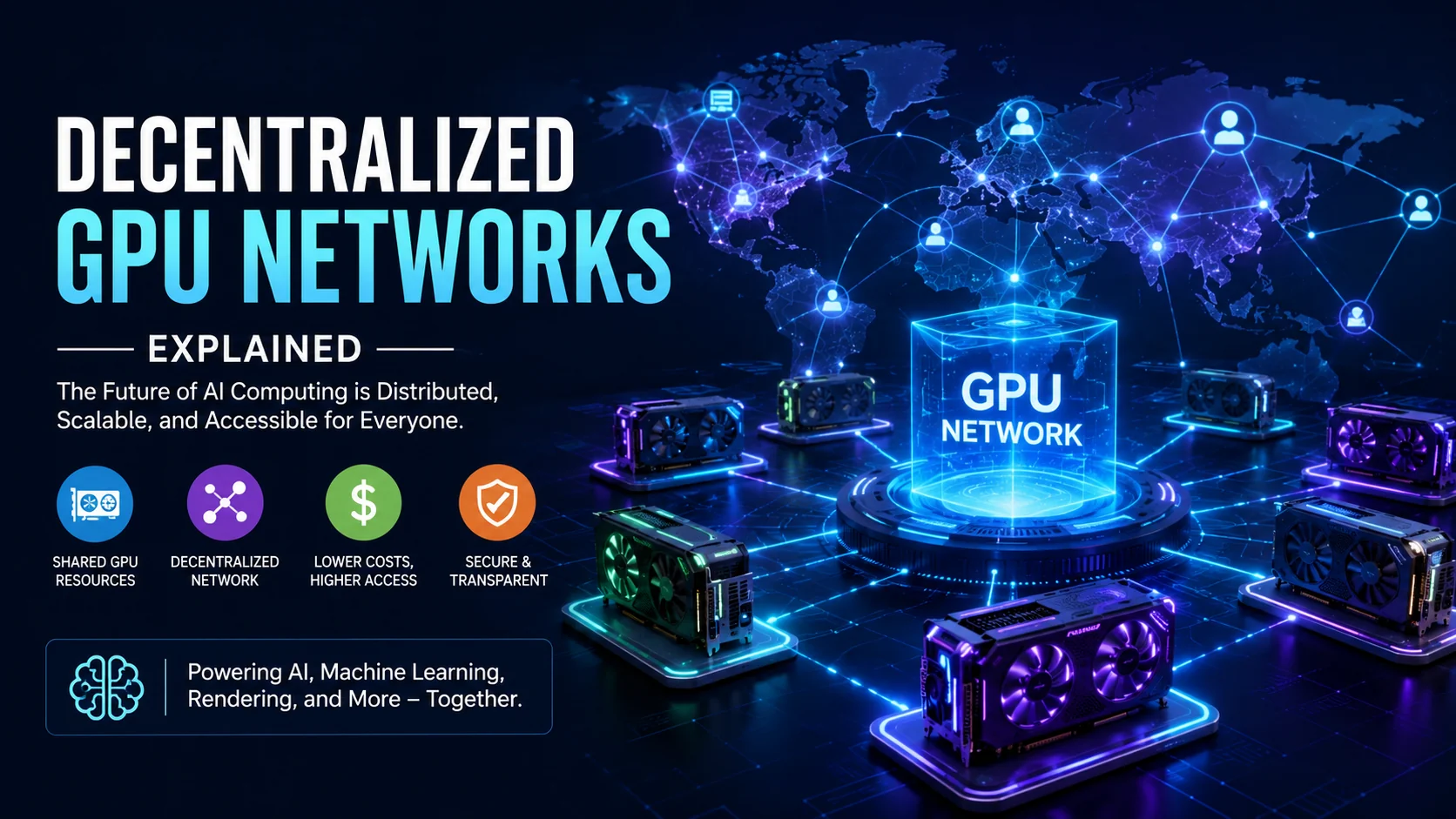
Table of Content
Table of Content
Artificial intelligence is evolving faster than ever before. Every day, new AI models are being trained to generate images, write code, create videos, and solve complex business problems. However, behind every AI breakthrough lies one essential resource: GPU computing power.
The demand for Graphics Processing Units (GPUs) has exploded because modern AI applications require enormous computational resources. Traditional cloud providers like AWS, Google Cloud, and Microsoft Azure offer GPU services, but they are often expensive, limited in availability, and controlled by a handful of companies.
This challenge has given rise to a completely new concept known as Decentralized GPU Networks.
Instead of relying on one centralized cloud provider, decentralized GPU networks combine thousands of GPUs contributed by individuals, businesses, and data centers worldwide into one shared marketplace. Anyone with unused GPU hardware can rent it out, while developers can access affordable computing power whenever they need it.
This innovative model is changing how AI infrastructure is built. It reduces costs, improves accessibility, and creates a more open ecosystem where computing resources are distributed instead of concentrated.
In this guide, you'll learn how decentralized GPU networks work, why they're becoming important for AI, their advantages, challenges, real-world applications, and what the future holds.
What Are Decentralized GPU Networks?
A decentralized GPU network is a distributed computing platform where GPU owners share their idle graphics processing power with users who need computational resources.
Unlike traditional cloud platforms that own and manage their own hardware, decentralized networks connect thousands of independent GPU providers into a single marketplace.
Imagine thousands of computers around the world with powerful GPUs sitting idle for several hours every day. Instead of wasting that hardware, decentralized networks allow owners to rent those GPUs to AI researchers, developers, gaming companies, animation studios, and scientific organizations.
The entire process is usually coordinated using blockchain technology, smart contracts, distributed scheduling systems, and secure workload management.
Rather than depending on one company, workloads are spread across multiple providers, making the network more resilient and scalable.
Why GPU Demand Is Growing So Fast
Artificial intelligence has dramatically increased GPU demand over the past few years.
Modern AI models require billions or even trillions of mathematical calculations during training.
Some of the biggest reasons include:
- Large Language Models (LLMs)
- Image generation
- Video generation
- AI coding assistants
- Scientific simulations
- Medical research
- Autonomous vehicles
- Robotics
- Climate modeling
- Financial forecasting
Training these systems often requires hundreds or even thousands of GPUs working together for weeks or months.
As AI adoption grows, centralized providers struggle to supply enough GPU capacity.
This shortage has made decentralized GPU networks increasingly attractive.
Why Centralized GPU Clouds Have Limitations
Traditional cloud providers have transformed computing, but they also introduce several challenges.
High Costs
GPU instances are expensive, especially high-performance GPUs designed for AI workloads.
Many startups simply cannot afford long-term GPU rentals.
Limited Availability
During periods of high demand, even large cloud providers experience GPU shortages.
Developers often wait weeks before obtaining sufficient GPU resources.
Vendor Lock-In
Applications become dependent on a single cloud provider.
Migrating workloads later can be complicated and expensive.
Geographic Restrictions
Some regions have fewer data centers, increasing latency and reducing performance.
Single Points of Failure
Outages at one cloud provider can interrupt thousands of applications simultaneously.
Distributed infrastructure minimizes this risk.
How Decentralized GPU Networks Work
Although every platform has its own architecture, most decentralized GPU networks follow a similar workflow.
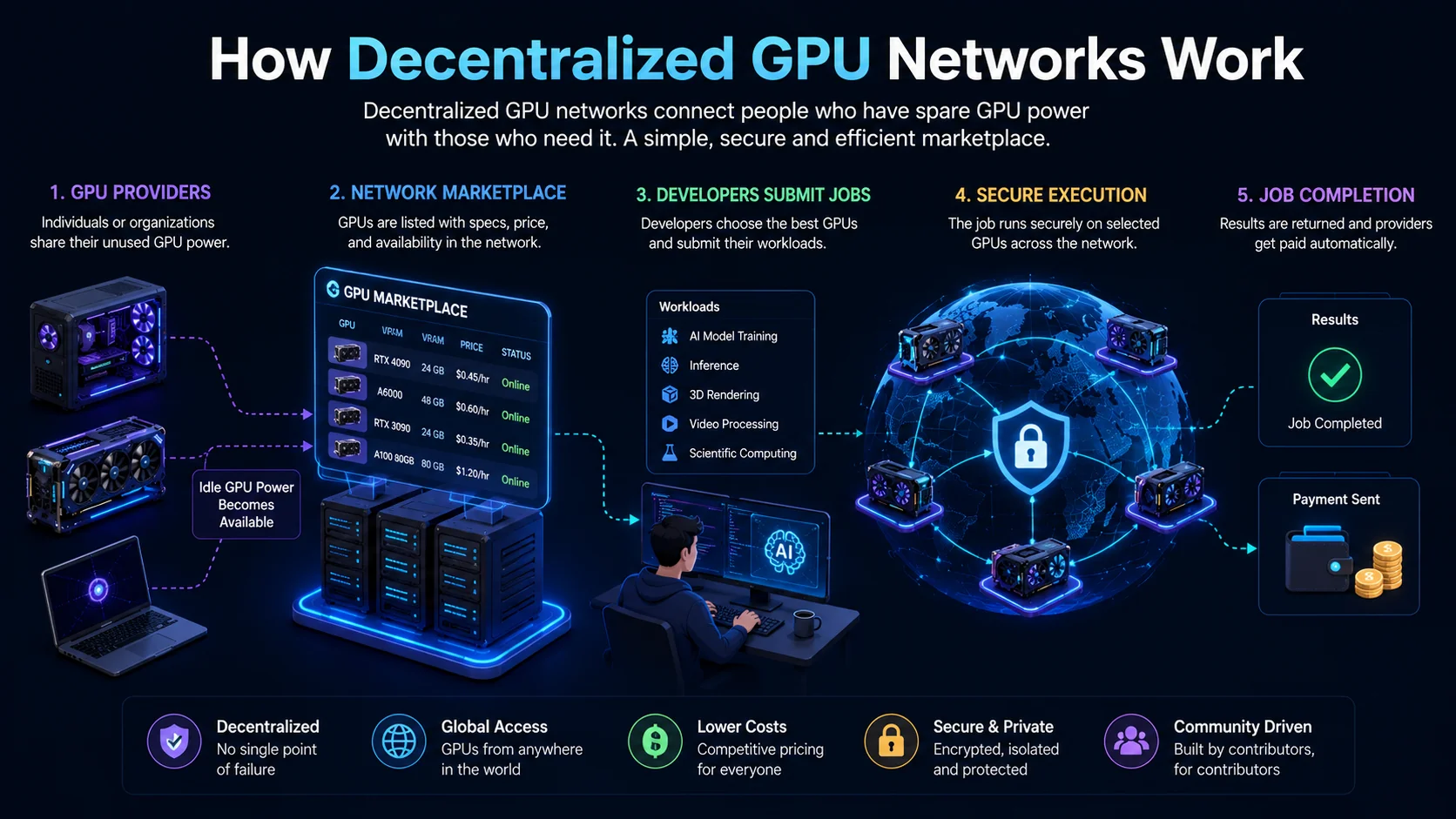
Step 1: GPU Owners Join the Network
Individuals or organizations install software that connects their GPU hardware to the decentralized platform.
The software verifies hardware specifications such as:
- GPU model
- VRAM
- Driver version
- Available memory
- Compute capability
- Internet bandwidth
Step 2: Resources Become Available
The GPUs are registered in the network marketplace.
Users searching for GPU resources can browse available hardware based on:
- Performance
- Price
- Region
- GPU model
- Availability
Step 3: Developers Submit Jobs
AI developers upload workloads such as:
- Machine learning training
- AI inference
- Rendering
- Scientific simulations
- Video processing
The network scheduler identifies suitable GPU providers.
Step 4: Secure Execution
The workload is securely transferred to selected nodes.
Many platforms use:
- Containerization
- Encryption
- Sandboxing
- Trusted execution environments
- Secure communication protocols
These technologies reduce security risks while protecting both users and providers.
Step 5: Job Completion
After computation finishes:
- Results are returned.
- GPU providers receive payment.
- Smart contracts automatically process transactions.
Everything happens with minimal manual intervention.
The Role of Blockchain
Not every decentralized GPU platform uses blockchain, but many integrate it because blockchain helps manage trust in open networks.
Blockchain can handle:
- Payment processing
- Identity verification
- Smart contracts
- Resource tracking
- Reputation systems
- Audit trails
- Incentive mechanisms
Instead of trusting a central authority, participants rely on transparent rules executed automatically.
Token-Based Incentives
Many decentralized GPU platforms reward contributors using digital tokens.
These tokens may be earned for:
- Sharing GPU power
- Completing computation
- Maintaining uptime
- Providing reliable performance
Users spend tokens to purchase GPU resources.
This creates a self-sustaining ecosystem where supply and demand determine pricing.
However, not every decentralized GPU network depends on cryptocurrency. Some platforms also support traditional payment methods.
Types of GPU Providers
A decentralized GPU marketplace can include many different participants.
Individual Users
Gamers often own powerful GPUs that remain idle for long periods.
These systems can generate passive income.
Data Centers
Professional hosting companies contribute enterprise-grade hardware.
These providers improve network reliability.
AI Companies
Organizations with excess GPU capacity may monetize unused infrastructure.
Universities
Academic institutions frequently possess GPU clusters used only during research periods.
Unused capacity can support external workloads.
Cloud Providers
Some hybrid platforms even integrate traditional cloud infrastructure alongside decentralized resources.
This improves availability during peak demand.
Types of Workloads Supported
Decentralized GPU networks support numerous computational tasks.
Popular examples include:
AI Model Training
Training deep learning models requires significant GPU power.
Distributed networks make large-scale training more affordable.
AI Inference
Once a model is trained, GPUs generate predictions.
Inference workloads often require lower latency and consistent availability.
Image Generation
Modern AI image generators process millions of calculations per request.
GPU acceleration dramatically reduces rendering time.
Video Generation
AI video models consume enormous computational resources.
Decentralized GPU networks provide scalable processing power.
3D Rendering
Animation studios can render movies and visual effects faster using distributed GPU clusters.
Scientific Computing
Researchers perform simulations involving:
- Physics
- Chemistry
- Astronomy
- Biology
- Climate science
GPU acceleration significantly shortens computation time.
Cryptocurrency Research
Certain blockchain-related computational workloads also benefit from distributed GPU infrastructure.
However, responsible resource allocation remains important to ensure AI workloads receive sufficient capacity.
Advantages of Decentralized GPU Networks
Lower Costs
Competition between thousands of providers often reduces pricing.
Developers pay only for resources they use.
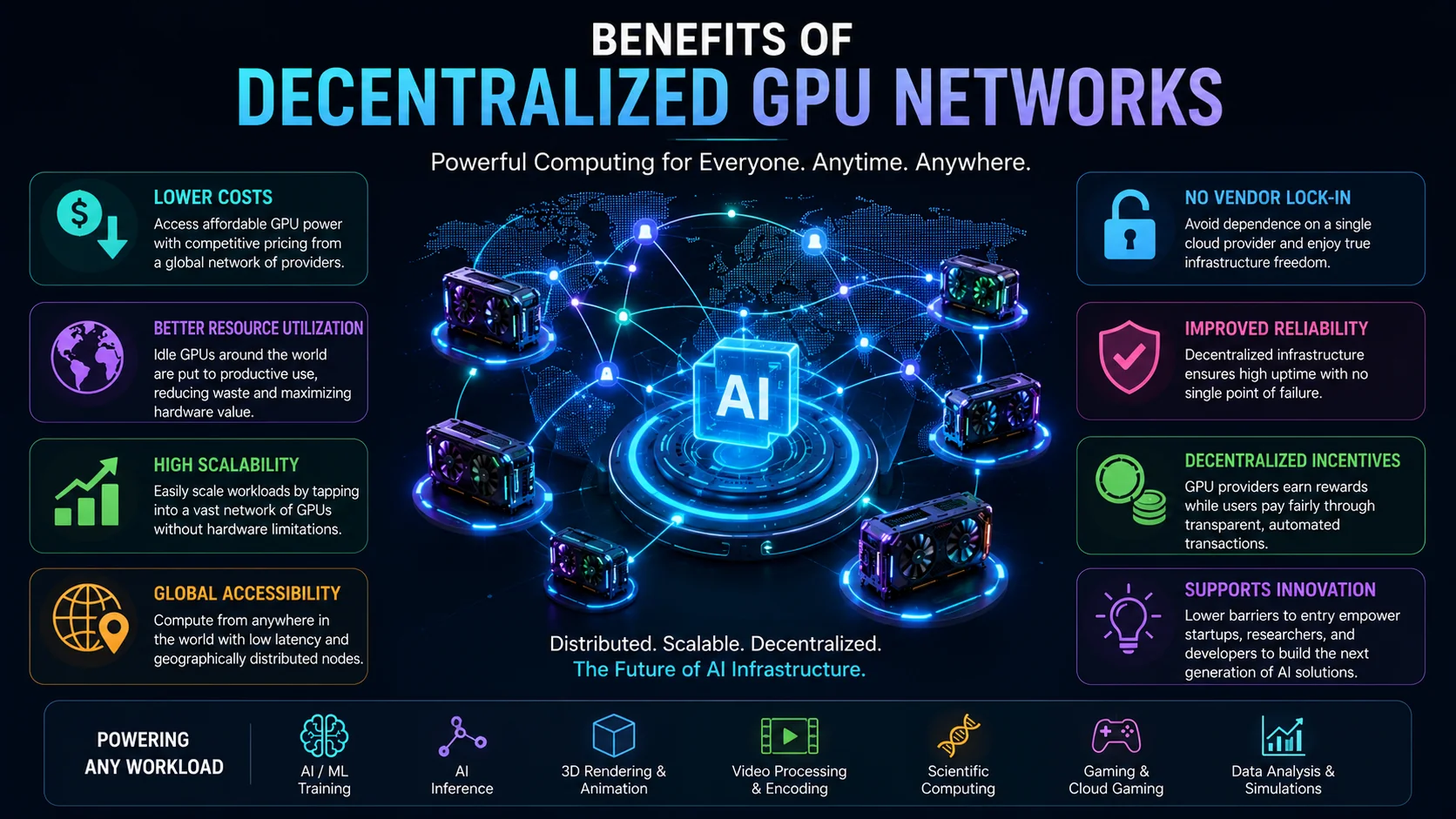
Better Resource Utilization
Millions of GPUs worldwide remain idle every day.
Decentralized networks unlock this unused capacity.
Global Scalability
New providers can join the network at any time.
This enables continuous expansion without massive infrastructure investments.
Increased Accessibility
Small startups gain access to enterprise-grade computing without building expensive GPU clusters.
Reduced Vendor Dependence
Users avoid becoming locked into a single cloud ecosystem.
Improved Fault Tolerance
If one provider goes offline, workloads can move elsewhere.
Distributed architecture increases resilience.
Community Participation
Anyone with compatible hardware can contribute resources.
This democratizes AI infrastructure.
Security Considerations
Security remains one of the biggest challenges.
Key concerns include:
- Data privacy
- Malicious nodes
- Hardware tampering
- Malware
- Network attacks
- Data leakage
Modern decentralized GPU platforms address these concerns through:
- Encrypted workloads
- Secure containers
- Reputation systems
- Node verification
- Performance monitoring
- Continuous auditing
Security continues improving as the ecosystem matures.
Challenges Facing Decentralized GPU Networks
Although promising, decentralized GPU infrastructure still faces several obstacles.
Performance Variability
Hardware differs across providers.
Some GPUs are significantly faster than others.
Network Latency
Distributed systems rely on internet connectivity.
Poor connections can affect workload performance.
Data Privacy
Sensitive enterprise workloads require strict confidentiality.
Additional encryption and secure execution technologies are often necessary.
Software Compatibility
Different drivers, operating systems, and hardware configurations increase complexity.
Scheduling Complexity
Efficiently assigning workloads across thousands of distributed GPUs is difficult.
Sophisticated scheduling algorithms are essential.
Regulatory Compliance
Organizations operating internationally must comply with data protection regulations.
Cross-border data processing requires careful governance.
Real-World Applications
Several industries are already benefiting from decentralized GPU computing.
Artificial Intelligence
AI startups reduce infrastructure costs while training advanced machine learning models.
Healthcare
Researchers analyze medical images and accelerate drug discovery.
Media Production
Studios render films and visual effects using distributed GPU resources.
Academic Research
Universities perform complex scientific simulations without purchasing additional hardware.
Gaming
Cloud gaming and real-time graphics rendering benefit from geographically distributed GPUs.
Engineering
Engineers perform CAD rendering, structural simulations, and computational analysis more efficiently.
Popular Decentralized GPU Projects
Several platforms are helping shape this emerging ecosystem, including:
- Akash Network
- Render Network
- io.net
- Gensyn
- Aethir
- Nosana
Each project focuses on different workloads such as AI training, rendering, inference, or cloud computing, but they all aim to make GPU resources more accessible through decentralized infrastructure.
The Future of Decentralized GPU Networks
The rapid growth of generative AI is expected to increase demand for GPU resources for years to come.
Future developments may include:
- Smarter workload scheduling using AI
- Faster distributed model training
- Improved security through confidential computing
- Better interoperability between networks
- Integration with edge computing
- Energy-efficient resource allocation
- Support for next-generation AI accelerators
- Enterprise-grade compliance and governance
As decentralized infrastructure matures, businesses may increasingly adopt hybrid models that combine traditional cloud services with decentralized GPU marketplaces.
This approach offers greater flexibility, resilience, and cost optimization.
How Businesses Can Evaluate a Decentralized GPU Network Before Adoption
As decentralized GPU networks mature, businesses should avoid choosing a platform based solely on the lowest price. Instead, evaluating several technical and operational factors ensures that the platform can reliably support production workloads.
Performance and Hardware Quality
Not all GPUs deliver the same level of performance. A network may include consumer-grade graphics cards alongside enterprise accelerators. Before deploying AI workloads, organizations should verify:
- Available GPU models
- VRAM capacity
- CUDA or ROCm support
- Tensor Core availability
- Average benchmark performance
- Network bandwidth between nodes
Understanding the underlying hardware helps estimate training time, inference speed, and overall project costs.
Reliability and Uptime
A decentralized network is only valuable if it remains consistently available. Businesses should examine historical uptime statistics, node reliability, and job success rates. Networks with strong monitoring systems and automatic workload migration can continue operating even if individual providers disconnect unexpectedly.
Security Standards
AI projects often involve confidential datasets, proprietary algorithms, or customer information. Organizations should verify whether the platform offers features such as encrypted storage, secure data transmission, isolated execution environments, and identity verification for GPU providers. These safeguards reduce the risk of data exposure while maintaining compliance with internal security policies.
Pricing Transparency
One of the biggest advantages of decentralized infrastructure is cost efficiency, but pricing models can vary. Some networks charge based on GPU hours, while others use token-based marketplaces where prices fluctuate according to demand. Businesses should understand all associated costs, including storage, bandwidth, transaction fees, and long-running workloads, before committing to a provider.
Developer Experience
A technically powerful network should also be easy to use. High-quality documentation, software development kits (SDKs), APIs, and container support simplify deployment and reduce engineering effort. Platforms that integrate with popular machine learning frameworks such as PyTorch, TensorFlow, and JAX allow teams to migrate existing workflows with minimal changes.
Environmental Benefits of Decentralized GPU Networks
Another important advantage that is often overlooked is sustainability. Traditional cloud providers build massive data centers that consume significant amounts of electricity and require continuous cooling. Although these facilities are highly optimized, expanding them demands substantial financial and environmental resources.
Decentralized GPU networks improve resource efficiency by utilizing hardware that already exists. Millions of gaming PCs, workstations, and enterprise servers remain idle for large portions of the day. Instead of manufacturing new infrastructure, decentralized platforms make productive use of these underutilized GPUs.
This approach offers several environmental benefits:
- Better utilization of existing hardware
- Reduced electronic waste through extended GPU lifespan
- Lower demand for constructing additional data centers
- More efficient distribution of computing workloads
- Improved overall resource efficiency
While decentralized computing is not entirely carbon neutral, maximizing the use of existing infrastructure can reduce unnecessary hardware production and contribute to a more sustainable AI ecosystem.
Why Decentralized GPU Networks Matter for the Future of AI
Artificial intelligence is expected to become a core technology across healthcare, education, manufacturing, finance, transportation, entertainment, and scientific research. As AI models grow larger and more complex, the demand for GPU computing will continue to rise.
Decentralized GPU networks offer a practical solution by transforming unused computing resources into a globally accessible infrastructure. Rather than concentrating computational power in a few massive cloud providers, they create a collaborative ecosystem where individuals, businesses, and institutions can both contribute resources and benefit from them.
In the coming years, decentralized GPU marketplaces are likely to work alongside traditional cloud platforms instead of replacing them entirely. Hybrid computing strategies will allow organizations to combine centralized infrastructure for mission-critical workloads with decentralized resources for scalable AI training, rendering, and experimentation. This balanced approach can improve cost efficiency, increase resilience, and make advanced computing power available to a much broader community, ultimately accelerating innovation across industries.
Conclusion
Decentralized GPU networks represent a major shift in how computing resources are shared across the world. Instead of relying on a handful of centralized cloud providers, these networks connect thousands of independent GPU owners into a distributed marketplace where computing power becomes more accessible, affordable, and scalable.
For AI developers, startups, researchers, and enterprises, this model provides an opportunity to reduce infrastructure costs while accessing powerful hardware on demand. At the same time, GPU owners can monetize idle resources, improving overall hardware utilization and creating a more efficient computing ecosystem.
While challenges such as security, latency, workload scheduling, and regulatory compliance still exist, ongoing innovations in distributed systems, blockchain, confidential computing, and AI orchestration are steadily addressing these issues. As AI adoption continues to accelerate, decentralized GPU networks are well-positioned to become a critical component of the future digital infrastructure, enabling innovation at a global scale without depending solely on centralized cloud providers.
Frequently Asked Questions (FAQs)
1. What is a decentralized GPU network?
A decentralized GPU network is a distributed computing platform where individuals and organizations share unused GPU resources with users who need computational power for AI, rendering, scientific research, and other GPU-intensive tasks.
2. How do decentralized GPU networks differ from traditional cloud providers?
Traditional cloud providers own and manage their own hardware, while decentralized GPU networks aggregate computing resources from many independent contributors. This often results in greater flexibility, broader availability, and competitive pricing.
3. Are decentralized GPU networks secure?
Most modern platforms use encryption, containerization, workload isolation, reputation systems, and secure execution techniques to protect user data and computational tasks. However, organizations handling highly sensitive workloads should carefully evaluate each platform's security features.
4. Who can benefit from decentralized GPU networks?
AI startups, machine learning engineers, researchers, animation studios, healthcare organizations, gaming companies, universities, and businesses requiring high-performance computing can all benefit from decentralized GPU infrastructure.
5. What is the future of decentralized GPU computing?
As AI demand continues to grow, decentralized GPU networks are expected to become an important part of global computing infrastructure by improving resource utilization, reducing costs, supporting hybrid cloud environments, and making advanced GPU access more widely available.