
DeCloud Explained: The Future of Cloud Computing (Complete Beginner's Guide 2026)
what DeCloud is, how decentralized cloud computing works, its benefits, challenges, real-world applications, and why it is considered the future of Web3 infrastructure and secure cloud storage
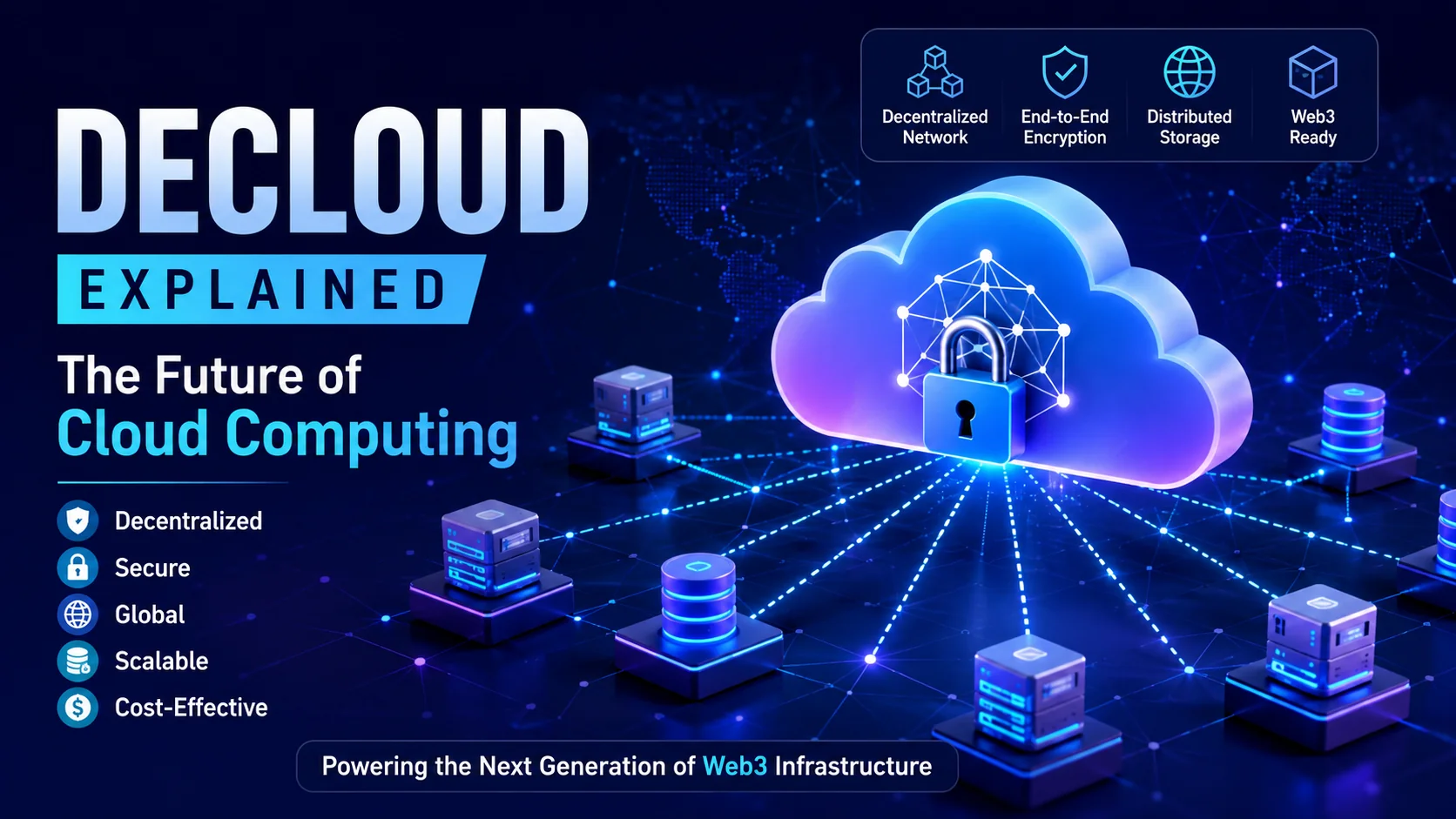
Table of Content
Table of Content
Cloud computing has transformed how businesses and individuals store, manage, and access data. Instead of relying on expensive physical servers, organizations now use cloud platforms to host applications, back up important files, and run complex workloads from virtually anywhere in the world. Services like centralized cloud storage have become an essential part of modern digital infrastructure.
However, as cloud adoption has grown, so have concerns about privacy, security, downtime, censorship, and the concentration of power among a small number of providers. Many organizations have started questioning whether the future of cloud computing should depend on only a handful of centralized companies.
This is where DeCloud, or Decentralized Cloud Computing, enters the picture.
Rather than storing data on a single provider's infrastructure, DeCloud distributes data and computing resources across thousands of independent nodes worldwide. This decentralized model improves resilience, enhances privacy, reduces single points of failure, and creates a more transparent internet infrastructure.
As blockchain technology, distributed storage, and Web3 continue to evolve, DeCloud is emerging as one of the most promising innovations in cloud computing. It represents a shift from trusting one organization with your data to trusting a decentralized network secured through cryptography and consensus mechanisms.
In this guide, you'll learn everything you need to know about DeCloud, including how it works, why it matters, its advantages, key technologies, and the industries that are already beginning to adopt decentralized cloud infrastructure.
What is DeCloud?
DeCloud, short for Decentralized Cloud Computing, is a cloud infrastructure model where storage, networking, and computing resources are distributed across numerous independent computers instead of being controlled by a single company.
Traditional cloud services rely on centralized data centers operated by providers such as AWS, Microsoft Azure, or Google Cloud. These providers own and manage the hardware, security, networking, and storage systems.
DeCloud follows a different philosophy.
Instead of one company controlling everything, participants contribute unused storage space, computing power, or bandwidth to a decentralized network. These contributors are often rewarded with cryptocurrency or network-specific tokens for sharing their resources.
When a user uploads data, it is typically:
- Encrypted before leaving the device
- Split into multiple pieces
- Distributed across different nodes
- Replicated for reliability
- Verified using cryptographic proofs
No single node usually possesses the complete file, making unauthorized access significantly more difficult.
This decentralized approach creates a cloud infrastructure that is more resilient, transparent, and resistant to outages or censorship.
Why Traditional Cloud Computing Needs Improvement
Centralized cloud platforms have enabled incredible innovation, but they also introduce several challenges that become more significant as businesses depend increasingly on digital infrastructure.
1. Single Point of Failure
One of the biggest concerns with centralized cloud computing is that services rely heavily on specific data centers.
If a major cloud provider experiences:
- Hardware failures
- Network outages
- Configuration mistakes
- Cyber attacks
- Power interruptions
Millions of websites and applications can become unavailable simultaneously.
Although providers use multiple availability zones and redundancy, outages still occur from time to time.
DeCloud distributes workloads across many independent locations, making complete network failures much less likely.
2. Data Privacy Concerns
When data is stored with one cloud provider, users must trust that company to:
- Protect sensitive information
- Prevent insider misuse
- Secure infrastructure
- Follow privacy regulations
Although major providers invest heavily in security, users often have limited visibility into how their data is handled internally.
DeCloud minimizes this trust requirement through encryption and distributed storage.
3. Vendor Lock-In
Migrating from one cloud provider to another can be expensive and technically difficult.
Organizations often become dependent on:
- Proprietary APIs
- Custom services
- Specialized databases
- Platform-specific tools
This creates vendor lock-in, limiting flexibility and increasing long-term costs.
Decentralized cloud platforms generally emphasize open protocols and interoperability, allowing greater freedom for developers.
4. Rising Infrastructure Costs
Cloud pricing has become increasingly complex.
Businesses often pay separately for:
- Storage
- Data transfer
- Compute instances
- Backup services
- API requests
- Network traffic
- Monitoring
Unexpected bills are common for rapidly growing applications.
DeCloud marketplaces introduce competition among resource providers, which may help reduce infrastructure costs in certain scenarios.
5. Centralized Control
A centralized provider ultimately controls:
- User accounts
- Access permissions
- Infrastructure policies
- Content availability
- Service availability
This level of control can create concerns regarding censorship, platform restrictions, or service suspensions.
DeCloud reduces dependency on any single organization.
How DeCloud Works
Understanding DeCloud becomes much easier when you examine the journey of a single uploaded file.
Imagine a company wants to upload a confidential business document.
Instead of sending the entire file to one data center, the decentralized system performs several operations.
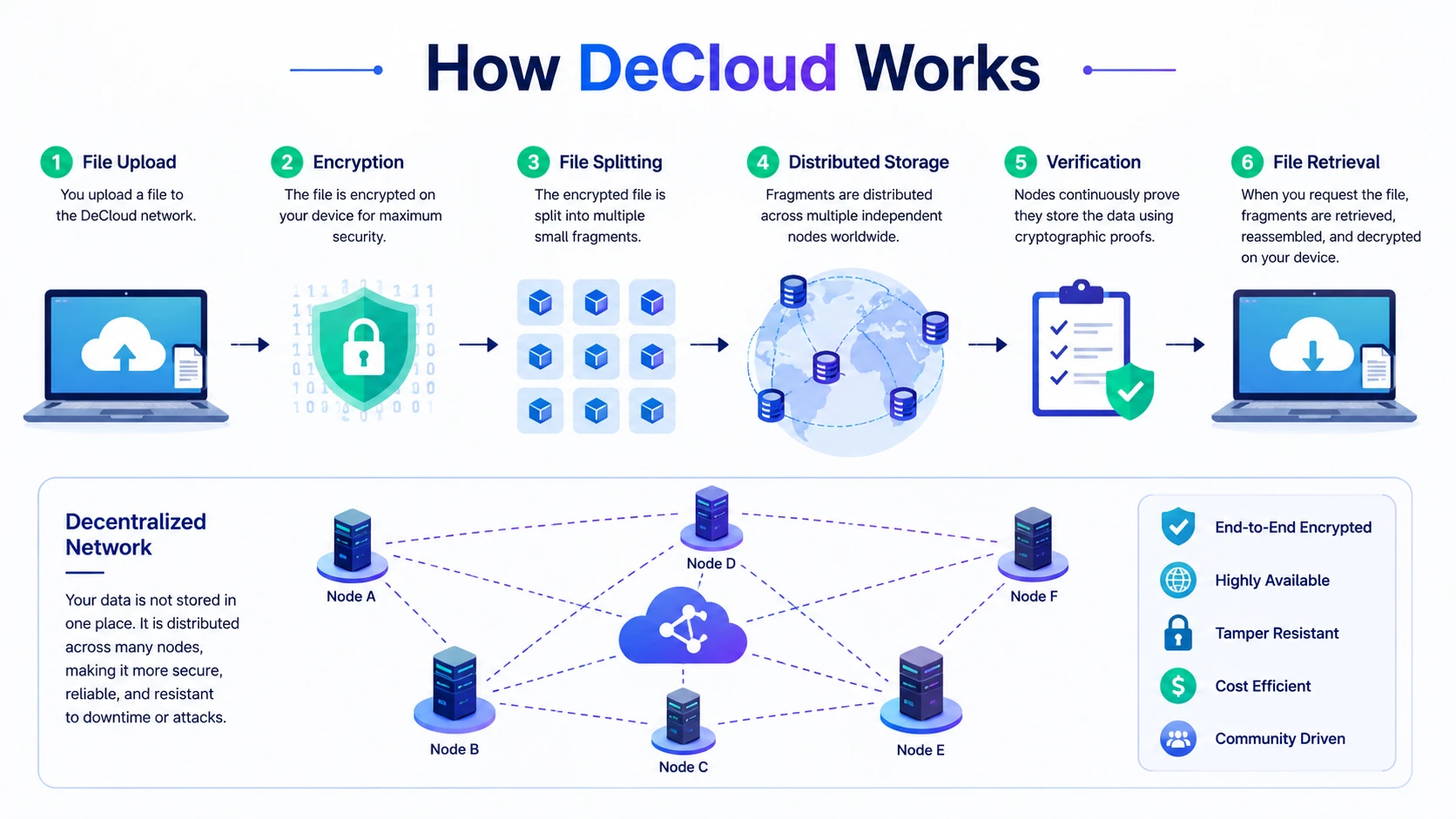
Step 1: File Encryption
Before leaving the user's device, the document is encrypted using advanced cryptographic algorithms.
Only the owner possesses the private key needed to decrypt the information.
Even storage providers cannot read the original file.
Step 2: File Fragmentation
The encrypted file is divided into many smaller fragments.
Rather than storing one large file in a single location, dozens or hundreds of encrypted pieces are created.
Each fragment is meaningless on its own.
Step 3: Distribution Across Multiple Nodes
The fragments are distributed across independent storage nodes located around the world.
Some nodes may be located in:
- North America
- Europe
- Asia
- South America
- Africa
This geographical distribution improves redundancy and resilience.
Step 4: Redundant Replication
To protect against hardware failures, several copies of each fragment are stored on different nodes.
If one node disconnects, another replica can immediately replace it.
This significantly improves data availability.
Step 5: Cryptographic Verification
Many decentralized storage systems periodically verify that nodes still possess the data they agreed to store.
Special cryptographic proofs allow verification without exposing file contents.
This prevents dishonest participants from claiming rewards without actually storing user data.
Step 6: Data Retrieval
When the user requests the file:
- The network identifies required fragments.
- Multiple nodes send encrypted pieces simultaneously.
- The fragments are reassembled.
- The encrypted file is reconstructed.
- The user's device decrypts the file locally.
The process happens automatically and often within seconds.
Core Technologies Behind DeCloud
DeCloud combines several modern technologies that work together to create secure and distributed cloud infrastructure.
Blockchain
Blockchain acts as the trust layer.
It records:
- Storage agreements
- Payments
- Resource allocation
- Network transactions
- Smart contract execution
Because blockchain records are immutable, participants can verify activities transparently.
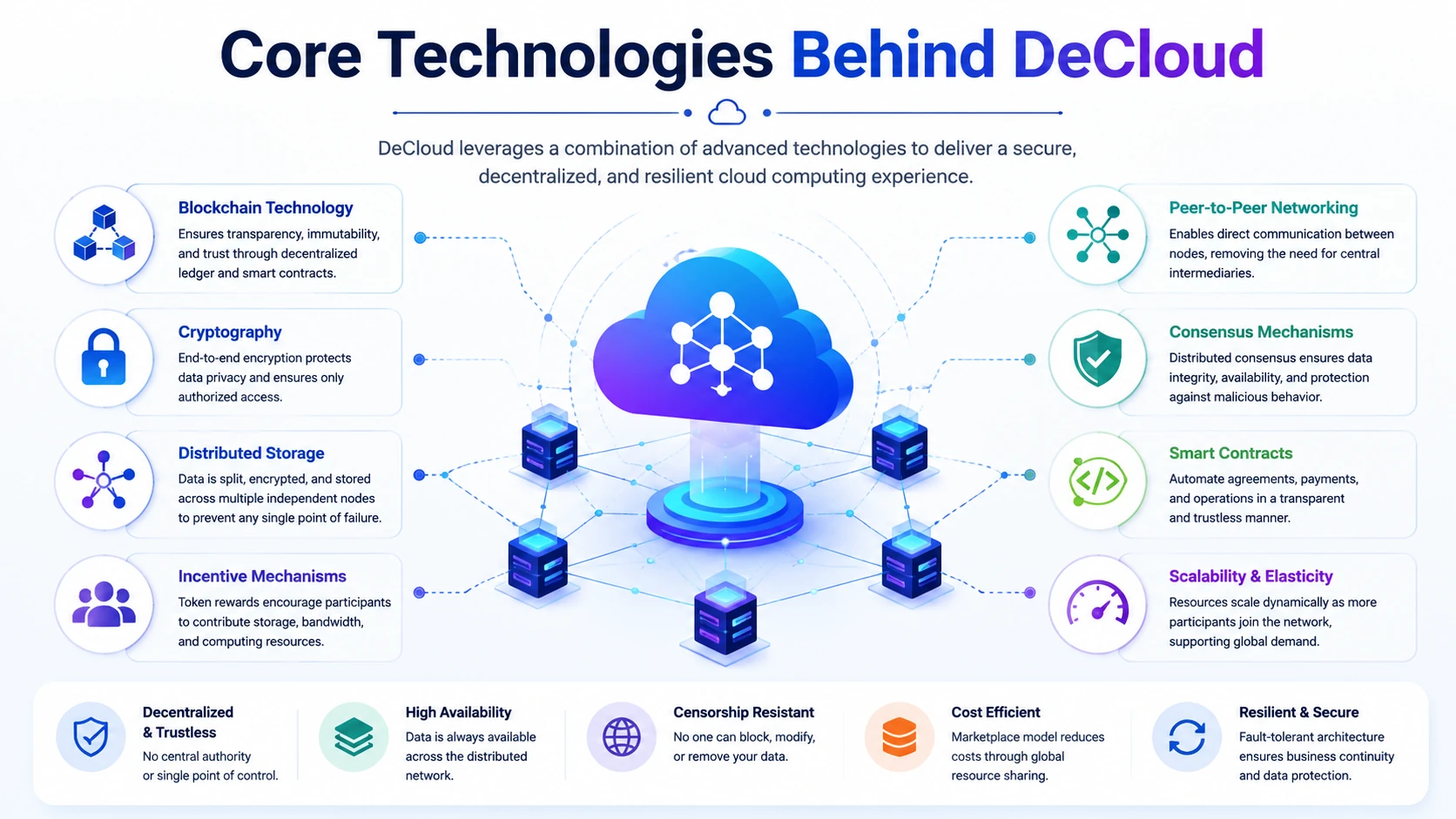
Distributed Storage
Instead of storing files in one location, distributed storage spreads encrypted data across thousands of independent computers.
This improves:
- Reliability
- Fault tolerance
- Availability
- Disaster recovery
Smart Contracts
Smart contracts automate network operations.
Examples include:
- Paying storage providers
- Allocating resources
- Managing storage contracts
- Validating service agreements
- Reward distribution
Automation removes the need for centralized intermediaries.
Cryptography
Security is built into the architecture through encryption techniques.
Cryptography ensures:
- Confidentiality
- Authentication
- Data integrity
- Secure access
- Digital signatures
Without encryption, decentralized storage would not provide meaningful privacy.
Peer-to-Peer Networking
Nodes communicate directly with one another using peer-to-peer protocols.
This removes dependence on central servers while improving scalability and resilience.
Key Features of DeCloud
Several characteristics distinguish decentralized cloud infrastructure from traditional cloud services.
Decentralized Architecture
Resources come from independent participants rather than one organization.
This reduces reliance on centralized infrastructure.
High Availability
Because data exists in multiple locations, hardware failures rarely affect overall accessibility.
Applications remain operational even if several nodes go offline.
Enhanced Security
Encryption, redundancy, and cryptographic verification work together to improve security.
Attackers would need to compromise multiple independent nodes instead of targeting one centralized server.
Better Privacy
Storage providers generally cannot view user data because files remain encrypted.
Users maintain greater control over sensitive information.
Global Resource Sharing
Unused storage and computing resources worldwide become part of one distributed marketplace.
This improves overall efficiency.
Transparent Operations
Many decentralized networks publish storage proofs, transactions, and resource allocations on blockchain ledgers.
Users can independently verify network activity.
Major Benefits of DeCloud
Improved Reliability
Distributed infrastructure continues operating even if some nodes fail.
This reduces downtime and improves service continuity.
Lower Infrastructure Costs
Open marketplaces encourage competition among storage providers.
Organizations may find more cost-effective options depending on workload requirements.
Stronger Security
Decentralization eliminates many traditional attack vectors associated with centralized databases.
Encryption adds another layer of protection.
Greater User Control
Instead of handing complete ownership of data to one provider, users retain greater authority over encryption keys and access permissions.
Scalability
As more participants join the network, storage capacity and computing resources naturally expand.
This enables decentralized systems to grow alongside user demand.
Resistance to Censorship
Since no single organization controls the entire infrastructure, content becomes significantly harder to censor or remove globally.
Real-World Use Cases of DeCloud
Although DeCloud is still evolving, several industries are already exploring decentralized cloud infrastructure.
Secure File Storage
Individuals and businesses can securely store documents, backups, media files, and archives without depending on a single provider.
Enterprise Backup Solutions
Companies use decentralized storage to create geographically distributed backups that remain available even during regional outages.
Healthcare
Hospitals and healthcare providers can improve data resilience while protecting sensitive patient records through encryption and distributed storage architectures.
Financial Services
Banks and fintech companies are exploring decentralized infrastructure for secure document storage, transaction records, compliance archives, and disaster recovery.
Artificial Intelligence
AI models require massive datasets and computational resources.
Decentralized computing networks can allow organizations to share unused GPU power, making AI training more accessible and potentially reducing infrastructure costs.
Media and Content Distribution
Video platforms, streaming services, and content creators can distribute files through decentralized networks, reducing dependence on centralized content delivery infrastructure and improving global accessibility.
Challenges and Limitations of DeCloud
While DeCloud offers exciting possibilities, it is not without challenges. Like any emerging technology, decentralized cloud computing is still evolving, and organizations should understand both its strengths and limitations before adopting it.
1. Slower Adoption Compared to Traditional Cloud
Major cloud providers have spent more than a decade building global infrastructure, enterprise support, and developer tools. Businesses already rely on these ecosystems, making migration difficult.
Many organizations prefer proven platforms with mature documentation, certifications, and large support teams.
As a result, DeCloud adoption is growing steadily but remains at an earlier stage than traditional cloud services.
2. Performance Variability
In centralized cloud platforms, servers are owned and managed by one provider using standardized hardware.
In decentralized networks, resources come from thousands of independent participants.
This means performance may vary depending on:
- Node location
- Internet connection quality
- Hardware specifications
- Network congestion
- Resource availability
Modern decentralized networks reduce these issues through intelligent node selection and replication, but consistency is still improving.
3. Complex User Experience
Traditional cloud platforms provide polished dashboards and familiar workflows.
Some decentralized platforms require users to understand concepts such as:
- Wallets
- Private keys
- Blockchain transactions
- Token payments
- Smart contracts
For non-technical users, this learning curve can slow adoption.
Fortunately, many DeCloud platforms are simplifying their interfaces to provide experiences similar to mainstream cloud services.
4. Regulatory and Compliance Challenges
Many industries must follow strict regulations regarding where data is stored and processed.
Examples include:
- GDPR in Europe
- HIPAA in healthcare
- Financial compliance standards
- Government security requirements
Since decentralized storage distributes data globally, organizations must carefully evaluate compliance requirements before migrating sensitive workloads.
5. Network Incentive Models
Most decentralized networks reward storage providers using cryptocurrency.
While this creates economic incentives, token price fluctuations can affect participation and long-term sustainability.
Stable and well-designed incentive systems remain an important area of ongoing development.
DeCloud vs Traditional Cloud Computing
Instead of thinking of DeCloud as a replacement for traditional cloud services, it is better to view it as a different architectural approach.
Traditional cloud platforms excel in enterprise support, managed services, and predictable performance.
DeCloud focuses on decentralization, transparency, resilience, and user ownership.
Infrastructure Ownership
Traditional cloud providers own and operate all infrastructure.
In DeCloud, thousands of independent participants contribute storage and computing resources.
Data Control
Traditional cloud customers trust one provider with their information.
DeCloud gives users greater control through encryption and distributed storage.
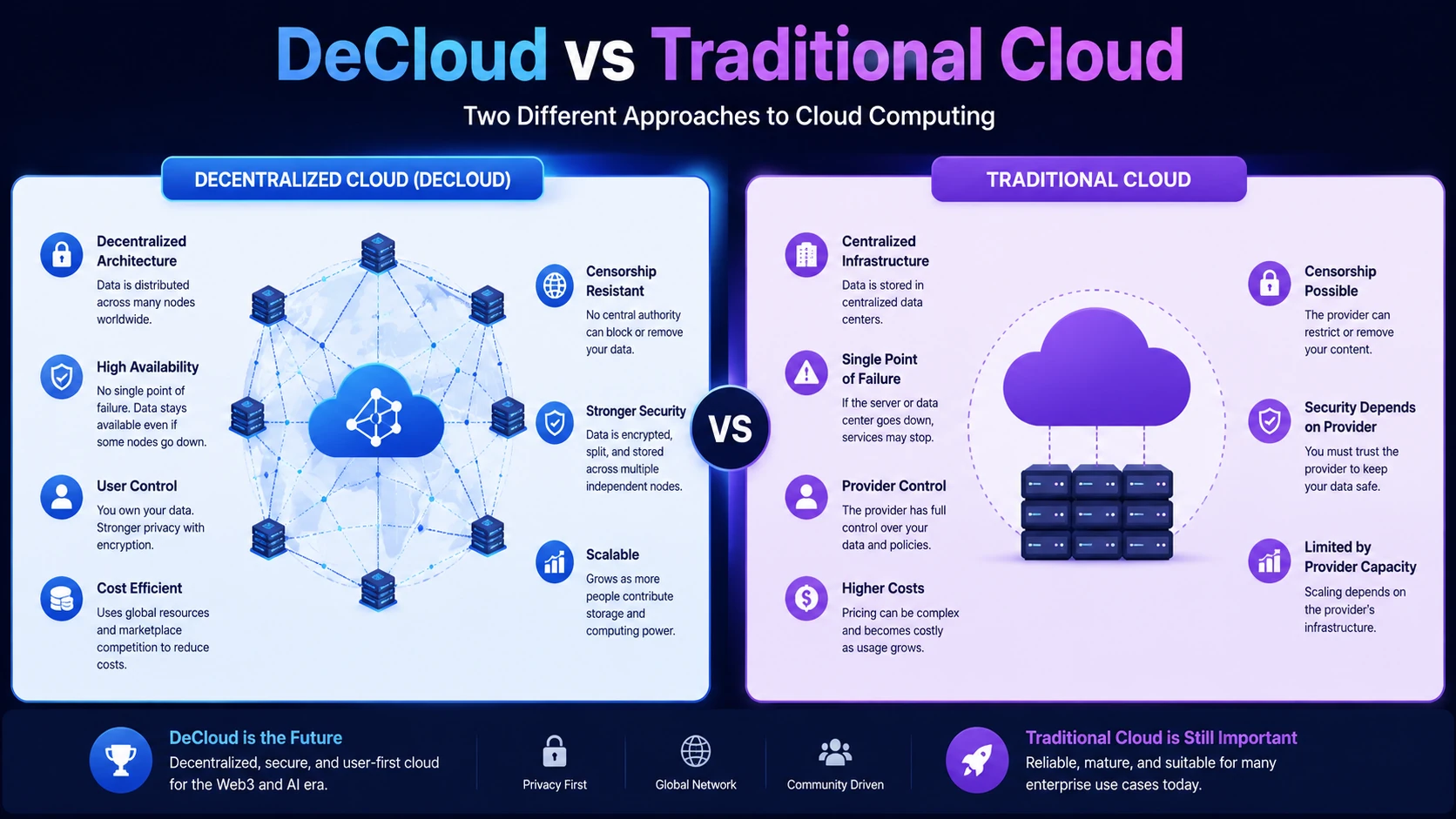
Availability
Traditional cloud services rely on multiple data centers operated by one company.
DeCloud spreads data across independent nodes worldwide, reducing dependence on a single infrastructure provider.
Security Model
Centralized cloud providers protect large data centers.
DeCloud combines encryption, fragmentation, redundancy, and decentralized architecture to minimize single points of attack.
Scalability
Traditional cloud providers scale by building larger infrastructure.
DeCloud grows as more participants contribute resources to the network.
Cost Structure
Traditional cloud pricing includes storage, bandwidth, API requests, and managed services.
Many decentralized platforms use marketplace-based pricing where providers compete to offer storage and compute resources.
Popular DeCloud Projects
Several innovative projects are helping shape the future of decentralized cloud computing.
Filecoin
Filecoin is one of the world's largest decentralized storage networks.
It allows storage providers to rent unused disk space while users securely store encrypted files across the network.
Its proof mechanisms verify that providers continue storing customer data correctly.
Storj
Storj focuses on secure cloud storage using end-to-end encryption.
Files are encrypted, divided into multiple pieces, and distributed across independent storage nodes.
Storj emphasizes enterprise-grade security while maintaining competitive pricing.
Akash Network
Akash Network is a decentralized cloud computing marketplace.
Instead of renting virtual servers from one cloud provider, developers can lease unused computing power from providers around the world.
It is especially popular among developers deploying:
- AI workloads
- Kubernetes applications
- Containers
- Blockchain nodes
- Web applications
Arweave
Arweave specializes in permanent decentralized data storage.
Instead of paying monthly storage fees, users pay once for long-term archival storage.
This model is useful for preserving:
- Research papers
- Historical records
- NFTs
- Public archives
- Government documents
Sia
Sia provides decentralized cloud storage with strong encryption and competitive pricing.
Users retain ownership of encryption keys while storage hosts earn rewards for contributing disk space.
Fluence
Fluence is building decentralized computing infrastructure that enables developers to create peer-to-peer applications without depending on centralized servers.
Its goal is to make Web3 applications more reliable and scalable.
Industries That Could Benefit Most from DeCloud
Artificial Intelligence
AI models require enormous computing resources and datasets.
Decentralized GPU marketplaces could allow businesses and researchers to rent unused computing power globally, lowering infrastructure costs.
Healthcare
Medical organizations generate massive amounts of sensitive data.
DeCloud can improve resilience while maintaining privacy through encryption and distributed storage.
Education
Universities can preserve research papers, learning materials, and digital archives across decentralized storage networks.
This reduces the risk of data loss while improving accessibility.
Government Services
Governments require secure and resilient infrastructure for public records and digital services.
Distributed storage can improve disaster recovery and reduce reliance on a single infrastructure provider.
Media and Entertainment
Streaming platforms, gaming companies, and digital publishers can use decentralized storage to distribute content efficiently across multiple geographic regions.
Finance
Financial institutions can benefit from secure archival storage, resilient infrastructure, and tamper-resistant record management.
Why DeCloud Matters for Web3
Web3 aims to build an internet where users own their digital assets and identities rather than relying entirely on centralized platforms.
However, true decentralization cannot exist if applications still depend on centralized cloud providers.
Imagine a decentralized application that stores all of its data on a single centralized server. If that server fails or becomes unavailable, the application can no longer function effectively.
DeCloud solves this problem by providing decentralized infrastructure for:
- File storage
- Computing
- Networking
- Data availability
- Application hosting
Combined with blockchain, smart contracts, and decentralized identity, DeCloud forms one of the core infrastructure layers of the Web3 ecosystem.
The Future of DeCloud
The future of decentralized cloud computing looks promising as organizations seek alternatives that provide greater transparency, resilience, and user control.
Several trends are expected to accelerate adoption over the coming years.
AI Infrastructure
The rapid growth of artificial intelligence is increasing demand for affordable computing power.
Decentralized GPU marketplaces may help distribute AI workloads across global networks.
Enterprise Adoption
Businesses are gradually exploring hybrid architectures that combine centralized cloud services with decentralized storage for backups, compliance, and disaster recovery.
Better Developer Tools
Modern SDKs, APIs, and simplified dashboards are making decentralized infrastructure easier to integrate into existing applications.
Improved tooling will reduce barriers for developers.
Increased Privacy Awareness
Consumers are becoming more aware of how their personal information is stored and shared.
Solutions that prioritize encryption and user ownership are likely to attract greater interest.
Hybrid Cloud Models
Rather than replacing traditional cloud providers entirely, many experts expect hybrid models to emerge.
Organizations may use centralized cloud platforms for high-performance applications while storing backups or sensitive archives on decentralized networks.
This balanced approach combines the strengths of both technologies.
Is DeCloud the Future of Cloud Computing?
DeCloud is unlikely to replace traditional cloud infrastructure overnight.
Large enterprises will continue using centralized cloud services because of their mature ecosystems, managed services, and global support.
However, DeCloud addresses several long-standing challenges that centralized systems struggle to solve, including data ownership, resilience, censorship resistance, and transparency.
As blockchain technology matures and decentralized infrastructure becomes more user-friendly, DeCloud will likely become an important component of future cloud architectures rather than a direct replacement.
For many organizations, the future is not centralized or decentralized—it is a combination of both.
Conclusion
Cloud computing has transformed the digital world, but growing concerns around privacy, centralized control, and infrastructure resilience have created demand for new approaches. DeCloud introduces a decentralized model where storage, computing, and networking resources are distributed across independent participants instead of relying on a single provider.
By combining blockchain, cryptography, peer-to-peer networking, and distributed storage, DeCloud enables secure, transparent, and fault-tolerant infrastructure that aligns with the principles of Web3. While the technology still faces challenges related to scalability, regulation, and user experience, its potential is significant.
From AI and healthcare to finance and digital media, decentralized cloud computing is opening new opportunities for organizations seeking greater control over their data and systems. As tools improve and adoption increases, DeCloud is expected to become an essential part of the next generation of internet infrastructure.
Businesses that understand and experiment with DeCloud today will be better positioned to take advantage of tomorrow’s decentralized digital economy.
Frequently Asked Questions (FAQs)
1. What is DeCloud in simple words?
DeCloud, or Decentralized Cloud Computing, is a cloud infrastructure model where data and computing resources are distributed across many independent computers instead of being stored in a single company's data center. This approach improves security, reliability, and user control.
2. How is DeCloud different from traditional cloud computing?
Traditional cloud computing relies on centralized providers that own and manage data centers. DeCloud distributes storage and computing across multiple independent nodes, reducing single points of failure and giving users greater ownership of their data.
3. Is DeCloud secure?
Yes. Most DeCloud platforms use strong encryption, data fragmentation, redundancy, and cryptographic verification. Since files are encrypted and distributed across multiple nodes, it is much harder for attackers to access complete data compared to a centralized storage system.
4. What are some popular DeCloud platforms?
Some of the leading decentralized cloud projects include Filecoin, Storj, Akash Network, Arweave, Sia, and Fluence. Each platform focuses on different services such as decentralized storage, computing, permanent data archiving, or Web3 infrastructure.
5. Will DeCloud replace traditional cloud providers?
Not entirely. Most experts believe the future will involve hybrid cloud models where organizations use both centralized cloud services and decentralized cloud infrastructure together. Traditional providers will continue to offer managed enterprise services, while DeCloud will strengthen privacy, resilience, and decentralized applications.