
Top 10 JavaScript Tips Every Developer Should Know
Discover the top 10 JavaScript tips every developer should know to write cleaner, faster, and more maintainable code.


Table of Content
Table of Content
JavaScript has become one of the most important programming languages in modern software development. Whether you are building a simple website, a large-scale web application, a mobile app, or even a backend server, JavaScript is likely to be part of your development journey. Its flexibility and extensive ecosystem make it an excellent choice for developers of every experience level.
However, writing JavaScript that simply works is very different from writing JavaScript that is clean, maintainable, and efficient. Many beginners focus only on making their code produce the expected output, while experienced developers pay attention to readability, performance, scalability, and long-term maintenance.
The good news is that improving your JavaScript skills does not always require learning advanced concepts. Sometimes, following a few proven coding practices can dramatically improve the quality of your projects. These small improvements also make debugging easier, reduce unexpected errors, and help teams collaborate more effectively.
In this guide, you'll learn ten practical JavaScript tips that every developer should know. These are not complicated tricks—they are habits that professional developers use every day to build reliable applications.
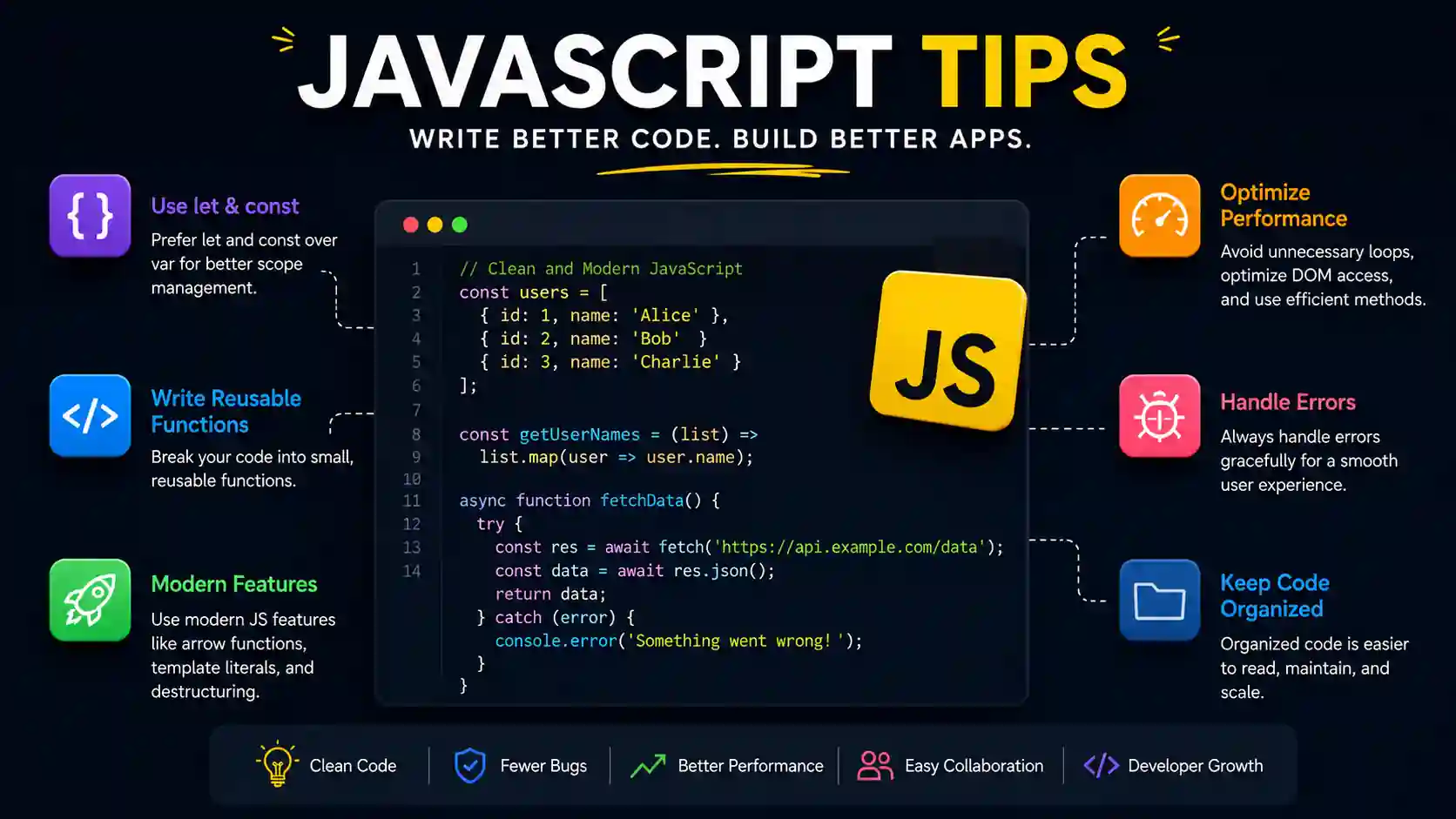
1. Always Use let and const Instead of var
One of the biggest improvements introduced in modern JavaScript was the addition of let and const. Although var still works, it has function scope and can create confusing behavior, especially in larger applications.
Using let and const makes your code easier to understand because they are block-scoped. Variables exist only where they are needed, reducing accidental changes and unexpected bugs.
As a general rule:
- Use const whenever the value should not change.
- Use let only when reassignment is necessary.
- Avoid using var in modern projects.
This simple habit improves code quality immediately and helps prevent many common programming mistakes.
2. Write Small and Reusable Functions
Many developers make the mistake of creating one large function that performs multiple tasks. While this may seem convenient initially, such functions become difficult to debug and maintain as the project grows.
Instead, divide your logic into smaller functions that each perform one clear responsibility.
Benefits include:
- Easier testing
- Better readability
- Improved code reuse
- Faster debugging
- Cleaner project structure
For example, instead of creating one function that validates a form, formats data, sends an API request, and updates the interface, split these responsibilities into individual functions. This approach follows the principle of writing code that is easier for humans to understand.
Remember, readable code is often more valuable than clever code.
3. Learn Modern JavaScript Features
JavaScript has evolved significantly over the past few years. Modern features make code shorter, cleaner, and easier to maintain.
Some examples include:
- Arrow functions
- Template literals
- Destructuring
- Spread operator
- Rest parameters
- Optional chaining
- Nullish coalescing
- Modules
- Async and Await
You don't need to master every feature at once, but gradually adopting modern syntax can improve both productivity and code quality.
For example, template literals make string formatting easier, while destructuring helps extract values from objects and arrays with much less code.
Modern JavaScript also improves compatibility with popular frameworks like React, Next.js, Vue, and Node.js.
4. Keep Your Code Readable
Many developers believe shorter code automatically means better code. In reality, readability is far more important than reducing the number of lines.
Imagine returning to a project six months later. If you cannot understand your own code within a few minutes, maintaining it becomes much harder.
To improve readability:
- Choose meaningful variable names.
- Keep functions short.
- Use proper indentation.
- Add whitespace where appropriate.
- Group related logic together.
- Remove unused code regularly.
- Write comments only when necessary to explain complex logic.
Readable code saves countless hours during debugging and future development.
Professional developers often spend more time reading code than writing it, which is why clarity should always be a priority.
5. Handle Errors Properly
One of the most overlooked aspects of JavaScript development is error handling.
Applications interact with APIs, databases, user input, and external services. Any of these can fail unexpectedly. Without proper error handling, users may experience broken pages or confusing behavior.
Instead of assuming everything will work perfectly, prepare your code to handle failures gracefully.
Good error handling includes:
- Validating user input before processing.
- Displaying helpful error messages.
- Logging errors for debugging.
- Preventing application crashes.
- Providing fallback behavior whenever possible.
When working with asynchronous operations, always ensure that potential failures are handled appropriately. A well-designed application continues working smoothly even when something goes wrong.
This not only improves user experience but also makes troubleshooting significantly easier during development and production.
6. Understand Asynchronous JavaScript
Modern web applications rarely work with static data. They communicate with servers, load images, fetch APIs, authenticate users, process payments, and perform many background operations. Because of this, understanding asynchronous JavaScript is one of the most valuable skills you can develop.
Instead of blocking the entire application while waiting for a response, JavaScript continues executing other tasks. This creates a faster and smoother user experience.
Every JavaScript developer should become comfortable with concepts such as:
- Promises
- Async and Await
- Fetch API
- Error handling in asynchronous code
- Parallel requests when appropriate
Among these, async/await has become the preferred approach because it makes asynchronous code easier to read and maintain.
Avoid writing deeply nested asynchronous logic whenever possible. Keeping asynchronous operations organized makes debugging much simpler and reduces unexpected behavior in production.
7. Learn Basic Performance Optimization
Fast applications create a better experience for users. Even small performance improvements can make your website feel more responsive.
Performance optimization doesn't always require advanced techniques. Often, following a few good habits is enough.
Some practical ways to improve JavaScript performance include:
- Avoid unnecessary loops.
- Reuse variables when appropriate.
- Cache frequently used values.
- Minimize repeated DOM access.
- Remove unused JavaScript.
- Load only the scripts that are actually needed.
- Break large tasks into smaller operations when possible.
It is also important to remember that optimization should be based on actual performance issues rather than assumptions. Write clean code first, then optimize areas that become bottlenecks as your application grows.
Readable and maintainable code should never be sacrificed for tiny performance gains that users will never notice.
8. Master Debugging Techniques
Every developer writes bugs. What separates experienced developers from beginners is how efficiently they identify and fix them.
Learning to debug properly will save hours of frustration.
Useful debugging practices include:
- Read error messages carefully.
- Verify variable values while tracing program flow.
- Test small parts of the application instead of everything at once.
- Reproduce bugs consistently before fixing them.
- Remove temporary debugging statements after solving the issue.
Rather than guessing where a problem exists, approach debugging systematically. Start by identifying where the application behaves differently from what you expected, then narrow the problem step by step.
Good debugging skills become increasingly valuable as projects become larger and involve multiple developers.
9. Organize Your Code Properly
As projects grow, code organization becomes just as important as writing the code itself.
A well-organized project is easier to maintain, easier to test, and easier for new developers to understand.
Some useful organizational practices include:
- Separate business logic from user interface logic.
- Keep reusable utilities in dedicated files.
- Use consistent folder structures.
- Follow a clear naming convention.
- Remove duplicate code whenever possible.
- Group related functionality together.
Consistency matters more than following a particular structure. A predictable project layout helps everyone understand where different pieces of functionality belong.
Whether you are working with vanilla JavaScript or frameworks like React, Vue, Angular, or Next.js, maintaining an organized codebase pays off throughout the life of the project.
10. Never Stop Learning JavaScript
JavaScript continues to evolve every year. New language features, browser improvements, development tools, and frameworks regularly introduce better ways to solve problems.
The best developers understand that learning never truly stops.
You can continue improving by:
- Building personal projects.
- Reading official documentation.
- Practicing coding challenges.
- Exploring open-source projects.
- Reviewing your own old code.
- Learning from experienced developers.
- Following modern development practices.
Each project teaches something new. Even experienced developers regularly discover better approaches to writing clean, efficient, and maintainable JavaScript.
Consistent practice over time is far more valuable than trying to learn everything at once.
Common JavaScript Mistakes to Avoid
Even experienced developers occasionally make mistakes. Being aware of these common issues can help you avoid unnecessary debugging and improve the overall quality of your applications.
Some of the most common mistakes include:
- Using global variables unnecessarily.
- Forgetting to validate user input.
- Writing functions that are too large.
- Ignoring error handling.
- Repeating the same logic in multiple places.
- Choosing unclear variable names.
- Leaving unused code in production.
- Mixing unrelated responsibilities inside a single function.
- Skipping code reviews.
- Avoiding documentation for complex logic.
Recognizing these patterns early will help you build applications that are easier to maintain and scale.
Bonus Tips for Becoming a Better JavaScript Developer
If you want to move beyond the basics, consider adopting these professional habits:
- Write code for humans first and computers second.
- Focus on solving problems instead of memorizing syntax.
- Learn browser developer tools thoroughly.
- Understand how JavaScript works behind the scenes.
- Practice reading other developers' code.
- Keep your projects clean and well-structured.
- Learn version control using Git.
- Improve your problem-solving skills alongside programming knowledge.
- Build complete projects instead of only following tutorials.
- Review and refactor old code regularly.
Small improvements made consistently will have a much greater impact than trying to master every advanced concept immediately.
Frequently Asked Questions
1)Is JavaScript difficult to learn?
JavaScript is considered beginner-friendly because it has a relatively simple syntax. However, mastering advanced concepts takes consistent practice and real-world experience.
2)Should beginners learn modern JavaScript?
Yes. Learning modern JavaScript from the beginning helps you develop good coding habits and prepares you for frameworks like React, Next.js, Vue, and Node.js.
3)How long does it take to become comfortable with JavaScript?
The timeline depends on your learning schedule and practical experience. Regular practice through projects generally leads to much faster improvement than studying theory alone.
4)Why is code readability important?
Readable code is easier to debug, maintain, and share with other developers. Clear code also reduces mistakes and simplifies future updates.
5)Is JavaScript only used for websites?
No. JavaScript is widely used for frontend development, backend development with Node.js, mobile applications, desktop applications, browser extensions, automation tools, and even game development.
Conclusion
JavaScript remains one of the most versatile programming languages in the software industry, and improving your skills doesn't always require learning complicated concepts. Often, the biggest improvements come from following simple, consistent best practices.
Using modern syntax, writing reusable functions, organizing your code, handling errors correctly, understanding asynchronous programming, and focusing on readability will make you a stronger developer regardless of the type of projects you build.
Remember that great developers are not defined by how much syntax they remember but by how effectively they solve problems and write code that others can understand. Continue practicing, build real projects, review your work regularly, and stay curious about new developments in the JavaScript ecosystem.
The habits you develop today will shape the quality of every application you build in the future. Start applying these JavaScript tips in your next project, and you'll gradually notice improvements in your coding confidence, productivity, and overall development skills.