How to Build a Strong Developer Portfolio in 2026: A Complete Guide for Students and Professionals
Learn how to build a strong developer portfolio in 2026 with practical tips, project ideas, GitHub best practices, portfolio design tips, and SEO strategies to impress recruiters and land more interviews.
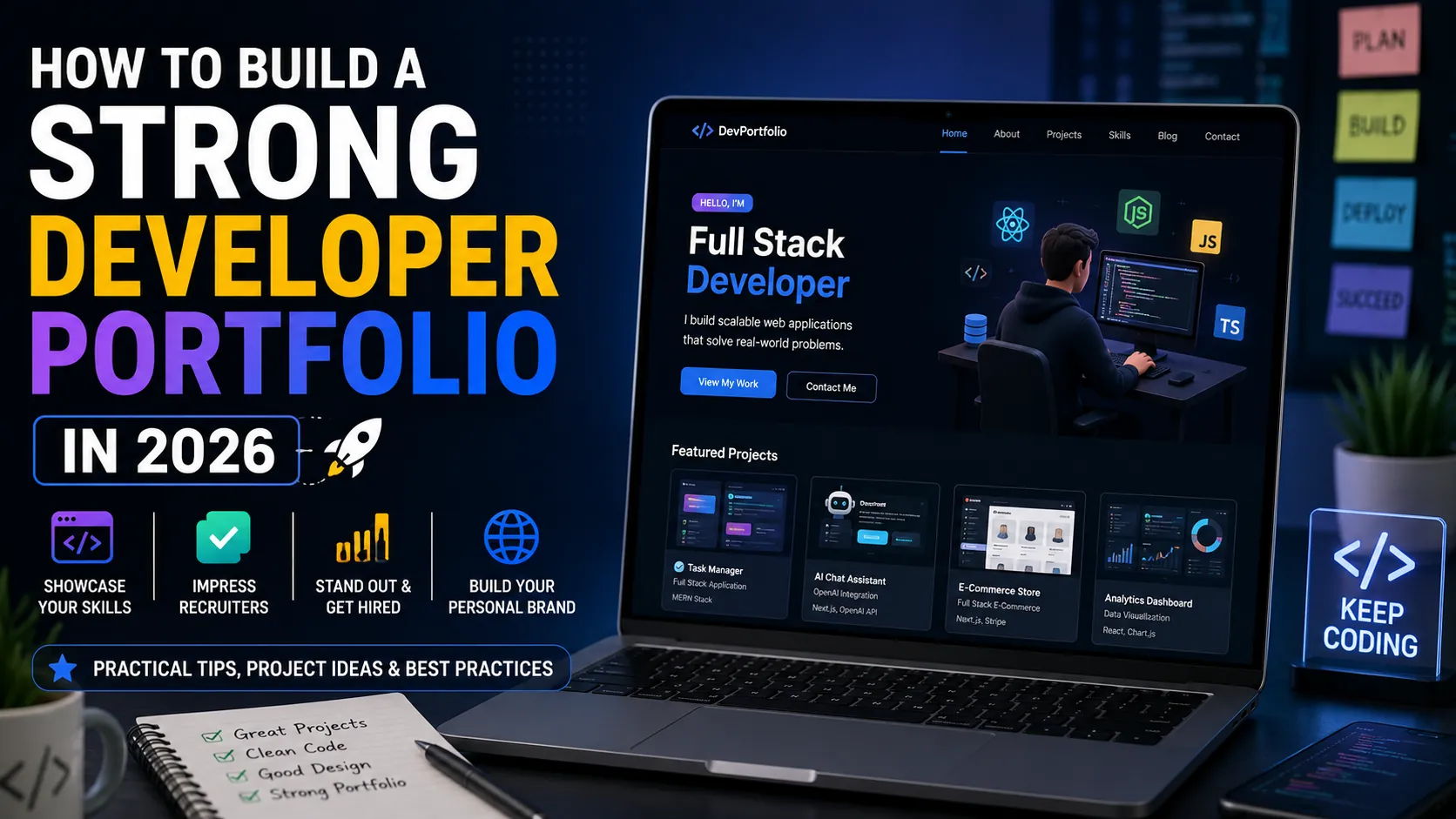
Table of Content
Table of Content
How to Build a Strong Developer Portfolio in 2026
Finding a developer job in 2026 is more competitive than ever. Companies receive hundreds or even thousands of applications for a single position, making it difficult for recruiters to evaluate every candidate based only on a resume. A degree, certifications, and a list of technical skills are still valuable, but they are no longer enough to stand out from the crowd.
A well-designed developer portfolio has become one of the most powerful tools for showcasing your skills. Instead of simply telling employers what you know, your portfolio demonstrates what you have actually built. It provides real evidence of your abilities, problem-solving approach, coding style, and technical knowledge.
Whether you are a college student, self-taught programmer, freelancer, or experienced software engineer, your portfolio can become your personal brand on the internet. It allows recruiters, hiring managers, and potential clients to understand your capabilities before scheduling an interview.
The good news is that creating an impressive portfolio does not require dozens of projects or years of experience. A few well-planned, high-quality projects presented professionally are often far more effective than a long list of unfinished applications.
This guide will walk you through every important aspect of building a developer portfolio in 2026. You will learn what recruiters actually look for, which sections every portfolio should include, common mistakes to avoid, and practical strategies that can significantly improve your chances of getting interviews.
By the end of this guide, you will know exactly how to build a portfolio that looks professional, demonstrates your technical expertise, and leaves a lasting impression on employers.
Why Every Developer Needs a Portfolio in 2026
Technology continues to evolve at a rapid pace. Companies now prefer candidates who can demonstrate practical skills rather than simply listing technologies on a resume.
A portfolio acts as your online proof of work. It allows employers to explore your projects, review your code, understand your design decisions, and evaluate how you solve real-world problems.
In many cases, a strong portfolio can help compensate for limited professional experience, making it especially valuable for students and fresh graduates.
A professional portfolio also helps you:
- Build credibility as a developer.
- Showcase real projects instead of just technical skills.
- Increase your chances of getting interview calls.
- Create a strong personal brand.
- Stand out from other applicants.
- Demonstrate your learning journey and growth.
- Attract freelance clients and networking opportunities.
In today's hiring market, many recruiters visit a candidate's GitHub profile or portfolio website before even reading the resume in detail. This makes your portfolio one of the most important assets in your career.
Portfolio vs Resume: Understanding the Difference
Many beginners think a resume and a portfolio serve the same purpose, but they actually complement each other.
A resume provides a concise summary of your education, work experience, technical skills, certifications, and achievements. It is designed to be short and easy for recruiters to scan quickly.
A portfolio, on the other hand, provides evidence to support everything mentioned in your resume. It gives employers the opportunity to explore your work in greater depth.
For example:
If your resume says you know React, your portfolio should include one or more React projects.
If you claim to be a backend developer, your portfolio should demonstrate APIs, authentication systems, databases, or cloud deployments.
If you specialize in UI/UX design, your portfolio should include polished interfaces, prototypes, and user experience case studies.
Think of your resume as an introduction and your portfolio as the complete story behind your skills.
What Recruiters Actually Look For
One of the biggest misconceptions among developers is that recruiters care only about the number of programming languages they know.
In reality, hiring managers evaluate much more than technical knowledge.
Here are some of the qualities recruiters often notice while reviewing a portfolio.
Project Quality
A few polished, production-ready projects create a much stronger impression than twenty incomplete applications.
Recruiters appreciate projects that solve real problems and demonstrate thoughtful planning.
Clean User Interface
Your portfolio represents your attention to detail.
A clean layout, readable typography, consistent spacing, responsive design, and smooth navigation immediately create a positive first impression.
Even backend developers benefit from having a professional-looking portfolio.
Code Quality
Many companies review GitHub repositories before scheduling interviews.
They often look for:
- Meaningful folder structure
- Clean naming conventions
- Reusable components
- Proper documentation
- Consistent formatting
- Meaningful commit history
Writing clean code is often more important than writing complex code.
Problem Solving Ability
Employers want developers who can solve practical problems.
Projects that include authentication, payment systems, dashboards, APIs, AI integrations, file uploads, analytics, or automation demonstrate practical engineering skills far better than simple clone projects.
Communication Skills
Your project descriptions matter.
Instead of simply writing:
"Built using React."
Explain:
- Why you built the project.
- What problem it solves.
- Which technologies were used.
- Challenges you faced.
- How you solved those challenges.
- What you learned during development.
Clear communication helps recruiters understand your thought process and technical decision-making.
Essential Sections Every Developer Portfolio Should Include
An effective portfolio is more than a collection of projects. It should guide visitors through your professional journey and make it easy for recruiters to learn about you.
Here are the essential sections every developer portfolio should include.
Hero Section
The hero section is the first thing visitors see.
It should immediately communicate:
- Your name
- Your professional role
- A short headline describing your expertise
- A brief introduction
- A clear call-to-action such as "View Projects" or "Contact Me"
A strong first impression encourages visitors to continue exploring your portfolio.
About Me
This section should briefly explain who you are, your background, your interests, and the technologies you enjoy working with.
Instead of listing every programming language you've ever learned, focus on your strengths and career goals.
Keep the tone professional, authentic, and easy to read.
Skills Section
Organize your technical skills into categories such as:
- Programming Languages
- Frontend Development
- Backend Development
- Databases
- Cloud Platforms
- Development Tools
- Version Control
- Testing Frameworks
This organization makes your expertise much easier to understand.
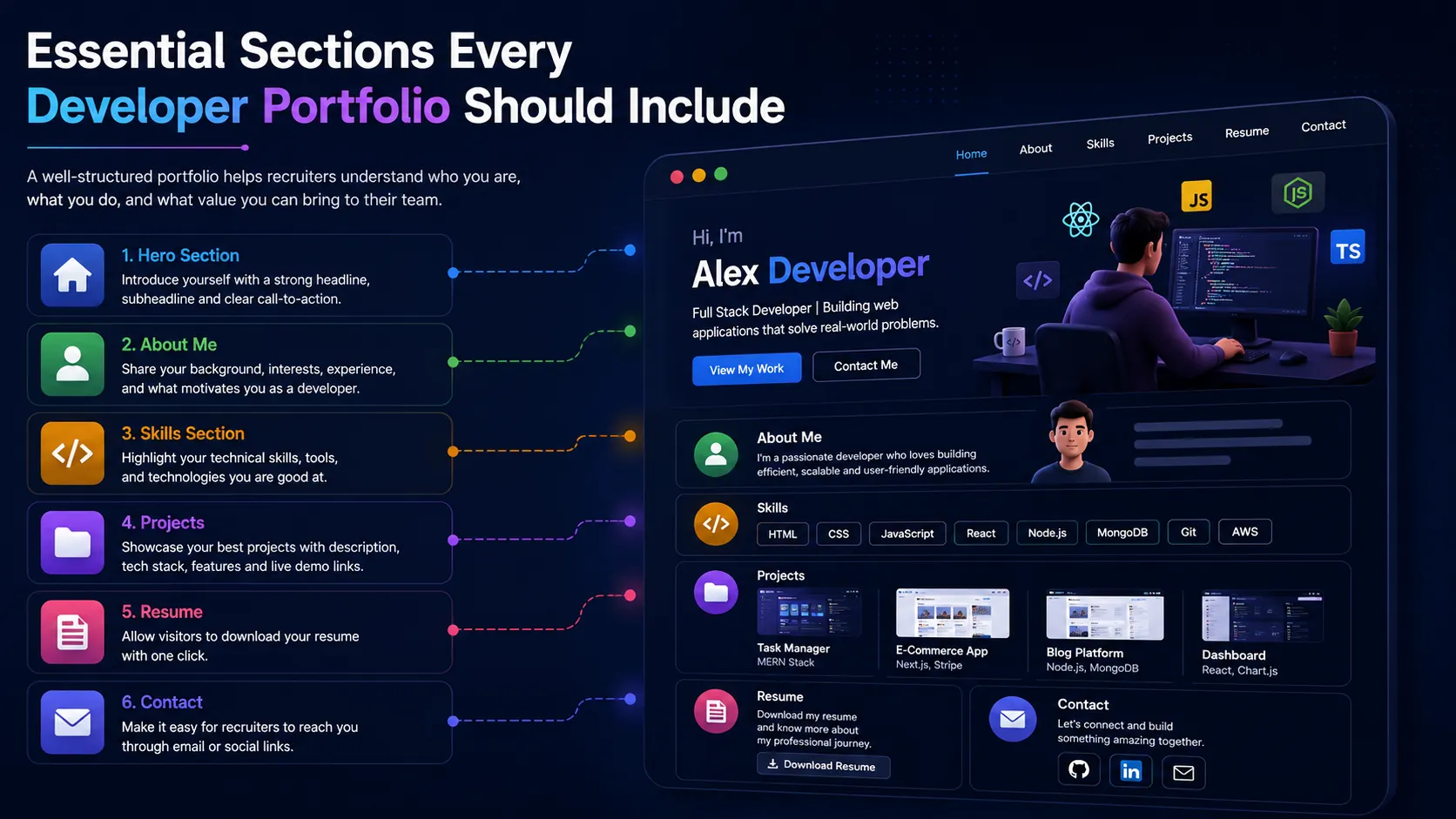
Featured Projects
Your projects are the heart of your portfolio.
Each project should include:
- Project title
- Short description
- Technologies used
- Live demo link
- GitHub repository
- Screenshots
- Key features
- Challenges solved
- Lessons learned
High-quality project presentation often has a greater impact than the number of projects you include.
Contact Section
Make it easy for recruiters to reach you.
Include professional contact options such as:
- Email address
- LinkedIn profile
- GitHub profile
- Personal website
- Resume download
Avoid forcing visitors to search for your contact information.
Responsive Design
Recruiters frequently browse portfolios on mobile devices, tablets, and laptops.
Your portfolio should look polished across all screen sizes.
Responsive layouts demonstrate your understanding of modern web development practices and improve the overall user experience.
Best Projects to Include in Your Developer Portfolio
One of the biggest mistakes developers make is filling their portfolio with random tutorial projects. While these projects help you learn, they rarely impress recruiters because thousands of other candidates have built the exact same applications.
Instead, focus on projects that solve real problems and demonstrate your technical abilities. Every project should have a clear purpose, clean user interface, responsive design, proper documentation, and meaningful functionality.
Here are some project ideas that can significantly strengthen your portfolio.
Full Stack Web Application
A complete web application demonstrates your ability to work across the entire development stack.
Examples include:
- Task Management System
- Student Management System
- Inventory Management System
- Expense Tracker
- CRM Dashboard
These projects should include authentication, database integration, APIs, responsive design, and deployment.
AI Powered Application
Artificial Intelligence skills are becoming increasingly valuable in 2026.
Some great portfolio ideas include:
- AI Resume Analyzer
- AI Chatbot
- AI Content Generator
- AI Image Generator
- AI Code Assistant
- AI Note Summarizer
These projects demonstrate that you can integrate third-party APIs and build modern applications.
E-commerce Website
An e-commerce application allows you to showcase multiple development skills in a single project.
Important features include:
- Product catalog
- Shopping cart
- User authentication
- Payment integration
- Order history
- Admin dashboard
- Product management
Recruiters appreciate projects that simulate real business applications.
REST API Project
Backend developers should always include at least one well-designed API project.
Examples include:
- Authentication API
- Blogging API
- Hospital Management API
- Employee Management API
Document your API using Swagger or Postman collections whenever possible.
Open Source Contributions
Contributing to open-source projects demonstrates teamwork, collaboration, and professional development practices.
Even fixing documentation, resolving bugs, or adding small features shows recruiters that you can work with existing codebases.
How to Showcase Your GitHub Profile Professionally
Your GitHub profile is often the second place recruiters visit after your portfolio website.
An empty or poorly organized GitHub account can reduce the impact of even the best portfolio.
Here are some ways to improve your GitHub profile.
Pin Your Best Repositories
GitHub allows you to pin important repositories.
Select your strongest projects instead of every project you've ever built.
Choose repositories that demonstrate different skills and technologies.
Write a Professional README
Every important repository should include a detailed README.
A good README should explain:
- Project overview
- Features
- Technologies used
- Installation steps
- Screenshots
- Live demo
- Future improvements
Good documentation shows professionalism.
Maintain a Clean Commit History
Instead of making dozens of commits like:
- Update
- Test
- Fix
Use meaningful commit messages such as:
- Added JWT authentication
- Implemented responsive dashboard
- Optimized database queries
- Fixed login validation bug
Meaningful commits help recruiters understand your development process.
Keep Repositories Organized
Avoid uploading unnecessary files.
Your repository should have a clean folder structure with properly named directories and files.
Professional organization makes your projects easier to review.
How to Write Better Project Descriptions
Many developers spend weeks building impressive projects but only write one sentence to describe them.
Project descriptions are just as important as the project itself.
A strong project description should answer these questions:
What problem does the project solve?
Explain the purpose of the application.
Why did you build it?
Who is it designed for?
Which technologies were used?
Mention your complete technology stack.
For example:
- React
- Next.js
- Node.js
- Express
- MongoDB
- PostgreSQL
- Firebase
- Docker
- AWS
This helps recruiters quickly understand your expertise.
What were the biggest challenges?
Discuss technical challenges honestly.
Examples include:
- Authentication implementation
- API optimization
- Responsive layouts
- Performance improvements
- Database design
Showing how you solved challenges demonstrates critical thinking.
What did you learn?
Every project teaches something new.
Mention new technologies, architectural decisions, or development practices you learned while building the application.
Recruiters appreciate candidates who continuously improve their skills.
How to Present Your Technical Skills
Simply listing programming languages is no longer enough.
Instead, organize your skills into meaningful categories.
For example:
Frontend
- HTML
- CSS
- JavaScript
- TypeScript
- React
- Next.js
- Tailwind CSS
Backend
- Node.js
- Express
- Spring Boot
- Django
Databases
- MySQL
- PostgreSQL
- MongoDB
- Firebase
Cloud & DevOps
- Docker
- AWS
- Cloudflare
- Vercel
- Netlify
Development Tools
- Git
- GitHub
- VS Code
- Postman
- Figma
This organization makes your portfolio much easier to scan.
Should You Include Your Resume?
Yes.
Your portfolio should always include an updated resume that recruiters can download with a single click.
Your resume should match the information shown in your portfolio.
Avoid inconsistencies between the two.
Add Testimonials If Possible
If you've completed freelance work, internships, hackathons, or collaborative projects, include testimonials from clients, mentors, professors, or teammates.
Positive feedback increases credibility and helps build trust.
Performance Matters More Than Fancy Animations
Many developers spend days creating complicated animations while ignoring website performance.
Recruiters care much more about usability than visual effects.
Focus on:
- Fast loading speed
- Mobile responsiveness
- Accessibility
- Clean navigation
- Optimized images
- Proper typography
A simple, fast portfolio often creates a better impression than an overly animated one.
SEO Tips for Your Portfolio Website
A portfolio is also a website, so basic SEO can help recruiters and clients discover you through search engines.
Some effective practices include:
- Use descriptive page titles.
- Write unique meta descriptions.
- Add meaningful image alt text.
- Use proper heading hierarchy.
- Optimize images for faster loading.
- Create clean and readable URLs.
- Add structured navigation.
- Keep your content updated regularly.
Good SEO not only improves visibility but also demonstrates your understanding of modern web development practices.
Common Portfolio Mistakes to Avoid
Even experienced developers sometimes make mistakes that reduce the effectiveness of their portfolios.
Avoid these common issues:
- Including unfinished or broken projects.
- Using poor-quality screenshots.
- Writing vague project descriptions.
- Adding too many technologies without proof.
- Ignoring mobile responsiveness.
- Using difficult navigation.
- Forgetting contact information.
- Leaving GitHub repositories private.
- Using generic templates without customization.
- Not updating the portfolio regularly.
A portfolio should reflect your current skills, so review and improve it whenever you complete a significant project or learn a new technology.