
Flutter vs React Native: Which Should You Choose in 2026?
Confused between Flutter and React Native? This complete guide compares performance, development speed, UI, community, learning curve, career opportunities, and real world use cases to help you choose the best framework in 2026.
Table of Content
Table of Content
Flutter vs React Native: Which Should You Choose in 2026?
Choosing a mobile app development framework is one of the biggest decisions for developers today. Whether you are learning app development for the first time, planning to build your own startup, or preparing for a software engineering career, one question always comes up.
Should you learn Flutter or React Native?
The good news is that both frameworks are excellent. Thousands of successful applications are built using Flutter and React Native, and both continue to receive strong support from their creators.
The difficult part is understanding which one actually matches your goals.
Many articles simply declare one framework as the winner, but real development is never that simple. The best choice depends on your background, the type of application you want to build, your team's experience, performance requirements, and even your long term career plans.
In this guide, you will learn the real differences between Flutter and React Native without unnecessary hype. By the end, you should have a clear understanding of which framework deserves your time in 2026.
What is Flutter?
Flutter is an open source UI toolkit created by Google that allows developers to build applications for Android, iOS, Web, Windows, macOS, and Linux using a single codebase.
Instead of relying on native UI components, Flutter renders everything itself using its own graphics engine. This gives developers greater control over design and makes it easier to create identical interfaces across different platforms.
Flutter applications are written in the Dart programming language, which is also developed by Google.
Today, Flutter powers many production applications in industries such as finance, healthcare, education, eCommerce, and entertainment.
What is React Native?
React Native is an open source framework developed by Meta that allows developers to build mobile applications using JavaScript and React.
Unlike Flutter, React Native uses native platform components. This means the application feels closer to traditional Android and iOS apps while still allowing developers to write most of the code once.
If you already know React for web development, learning React Native becomes much easier because many concepts remain familiar.
Thousands of startups and large companies continue to use React Native because it allows faster product development while maintaining good performance.
Why These Two Frameworks Dominate Cross Platform Development
Years ago, developers had to maintain separate Android and iOS applications.
That usually meant:
- Two codebases
- Two development teams
- Higher maintenance costs
- Longer release cycles
Flutter and React Native solved this problem by allowing developers to share most of the application code between platforms.
Benefits include:
- Faster development
- Lower project cost
- Easier maintenance
- Faster updates
- Better collaboration between developers
Because of these advantages, cross platform development has become the preferred choice for many startups and businesses.
Programming Language Comparison
One of the biggest differences between these frameworks is the language they use.
Flutter
Flutter uses Dart.
Although Dart is not as popular as JavaScript, it is modern, fast, and designed specifically for building user interfaces.
Developers often find Dart clean and easy to understand after spending a few weeks with it.
React Native
React Native uses JavaScript.
JavaScript remains one of the most popular programming languages in the world. Millions of developers already know it because it powers modern websites.
If you already work with React, switching to React Native is usually much easier than learning Flutter from scratch.
User Interface and Design
Flutter has a significant advantage when it comes to UI consistency.
Since Flutter draws every pixel itself, developers have complete control over animations, colors, layouts, transitions, and custom widgets.
This makes Flutter an excellent choice for applications with highly customized designs.
React Native, on the other hand, uses native UI components provided by Android and iOS.
This allows applications to naturally match the appearance of each operating system.
If your goal is to create an application that feels completely native, React Native performs very well.
Performance Comparison
Performance is often the first topic developers discuss.
The truth is that both frameworks deliver impressive performance.
Flutter compiles directly into native machine code.
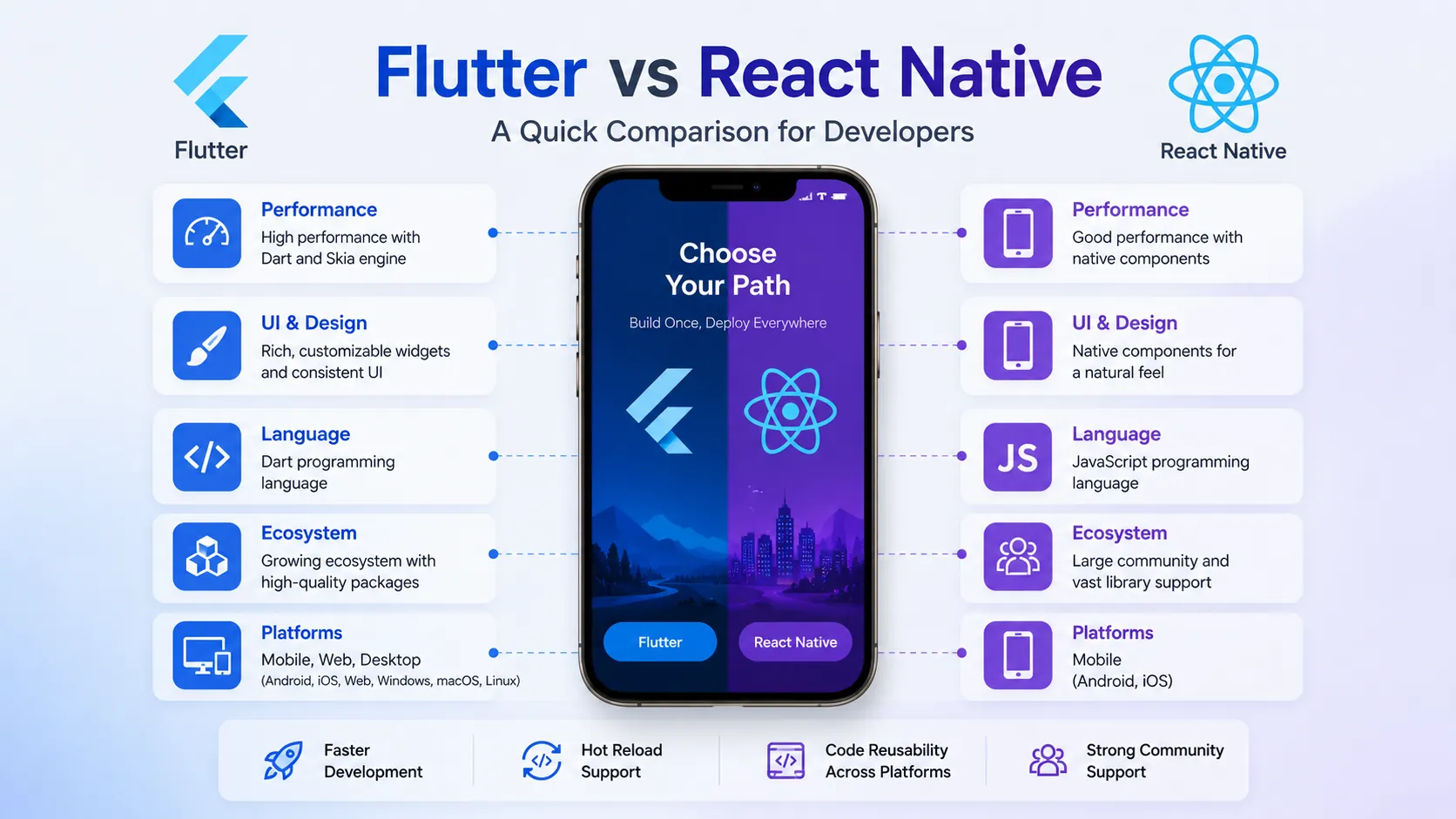
Because it controls rendering itself, animations are generally smoother and more predictable.
Flutter performs especially well in applications involving:
- Heavy animations
- Complex interfaces
- Gaming style experiences
- Interactive dashboards
React Native has also improved dramatically over the years.
With the introduction of the new architecture, performance has become significantly better than earlier versions.
For most business applications, users are unlikely to notice any difference between Flutter and React Native.
Development Speed
Both frameworks support Hot Reload, allowing developers to instantly see code changes.
Flutter's Hot Reload is known for being extremely fast and reliable.
React Native also provides an excellent development experience, especially for developers already familiar with React.
In real projects, development speed depends more on the team's experience than the framework itself.
A React developer will naturally build faster with React Native.
A Flutter developer will be more productive using Flutter.
Learning Curve
If you are completely new to programming, Flutter introduces two new concepts.
You need to learn:
- Dart
- Flutter widgets
Although Flutter documentation is excellent, beginners may need some time to understand widget trees and layout structures.
React Native may feel easier for developers who already know:
- HTML
- CSS
- JavaScript
- React
Since the syntax remains familiar, many web developers become productive within a short period.
Community and Ecosystem
Both frameworks have active communities.
Flutter has experienced incredible growth over the last few years.
Developers can find thousands of packages covering authentication, payments, databases, animations, notifications, maps, and much more.
React Native benefits from the massive JavaScript ecosystem.
Since JavaScript has existed for decades, developers have access to an enormous number of libraries, tutorials, courses, and community resources.
Finding solutions for common issues is rarely difficult in either ecosystem.
Third Party Libraries
Real applications depend heavily on third party packages.
Flutter provides high quality packages through its official package repository.
Many Google supported plugins receive regular updates.
React Native also offers an extensive ecosystem.
Because JavaScript has one of the largest open source communities in the world, developers have access to countless reusable libraries.
The important part is choosing actively maintained packages instead of outdated ones.
Application Size
Flutter applications are generally larger because the framework includes its own rendering engine.
React Native applications tend to produce slightly smaller installation sizes.
For modern smartphones, this difference rarely affects user experience.
However, if your application targets regions with slow internet connections or devices with limited storage, application size may become an important consideration.
Web Development Support
Flutter supports web applications alongside mobile and desktop platforms.
This allows teams to reuse a large portion of their code.
React Native primarily focuses on mobile development.
Although React Native Web exists, many companies prefer using traditional React for web applications.
If your primary goal includes desktop and web support from the same codebase, Flutter offers a stronger solution.
Developer Experience
Flutter provides excellent documentation.
Google maintains detailed guides, samples, and learning resources that make onboarding easier.
React Native also offers outstanding documentation and benefits from years of community knowledge.
Because millions of developers use JavaScript daily, beginners often find more tutorials, videos, and discussions online.
Job Opportunities in 2026
Many developers choose a framework based on career growth.
React Native currently has a slight advantage because JavaScript developers can work on:
- Websites
- Mobile applications
- Backend development with Node.js
- Desktop applications
- Serverless functions
This versatility increases job opportunities.
Flutter demand has also grown rapidly.
Companies building high performance mobile products increasingly look for Flutter developers because one codebase can support multiple platforms.
Both skills remain valuable in today's market.
Startup Perspective
For startups, speed matters.
React Native works particularly well if the company already has React developers.
The team can share knowledge between web and mobile development.
Flutter becomes attractive when startups want:
- Beautiful custom interfaces
- Consistent branding
- Multiple platforms
- Long term scalability
Both frameworks help startups reduce development costs.
Enterprise Development
Large organizations often evaluate more than performance.
They consider:
- Team availability
- Maintenance
- Security
- Long term support
- Integration
React Native is widely used because JavaScript developers are easier to hire.
Flutter is increasingly chosen for internal business applications and customer facing products requiring polished interfaces.
Which Framework is Better for Beginners?
The answer depends on your current skills.
If you already know JavaScript and React, React Native is the natural next step.
If you are starting from zero and want to focus only on mobile development, Flutter provides an excellent learning experience with consistent documentation.
Neither choice is wrong.
The important thing is becoming proficient rather than switching frameworks every few months.
Which Framework Should Startups Choose?
Flutter is an excellent choice when:
- Design is a priority.
- You want identical UI across platforms.
- You plan desktop support later.
- Your product relies on animations.
React Native is a strong choice when:
- Your team already uses React.
- Development speed is the highest priority.
- You need to hire JavaScript developers quickly.
- Your application follows mostly native platform designs.
Common Myths About Flutter and React Native
Many misconceptions still exist.
One common myth is that Flutter is only suitable for small applications.
In reality, many enterprise applications successfully use Flutter.
Another myth claims React Native is slow.
Modern React Native applications deliver excellent performance for most business use cases.
Some developers also believe one framework will replace the other.
The industry does not work that way. Different companies solve different problems, and both frameworks continue to evolve.
Best Framework Based on Your Goal
Choose Flutter if you want:
- Beautiful custom UI
- Excellent animation performance
- One codebase for mobile, desktop, and web
- Strong Google ecosystem
- Consistent design across platforms
Choose React Native if you want:
- Faster transition from web development
- JavaScript ecosystem
- Better alignment with React skills
- Easier hiring opportunities
- Large community support
Final Thoughts
There is no universal winner in the Flutter vs React Native debate.
Both frameworks are mature, production ready, and trusted by companies around the world.
Instead of asking which framework is objectively better, ask which framework helps you achieve your personal goals.
If your background is already in JavaScript or React, React Native offers an easier learning path and broader career flexibility.
If you enjoy creating polished user interfaces, smooth animations, and applications that look identical across platforms, Flutter is an outstanding choice.
Technology changes quickly, but strong programming fundamentals remain valuable regardless of the framework you choose. Focus on building real projects, understanding mobile architecture, improving problem solving skills, and writing clean code. Those abilities will have a much greater impact on your career than choosing Flutter or React Native alone.
A developer who builds quality applications consistently will always stand out more than someone who spends months debating which framework is slightly better. Start building, keep learning, and let practical experience guide your future decisions.