
Infrastructure as Code (IaC): Tools & Best Practices
Learn Infrastructure as Code (IaC) with Terraform, OpenTofu, AWS, practical examples, security best practices, CI/CD, and a step-by-step DevOps roadmap.
 Aditya Chavhan
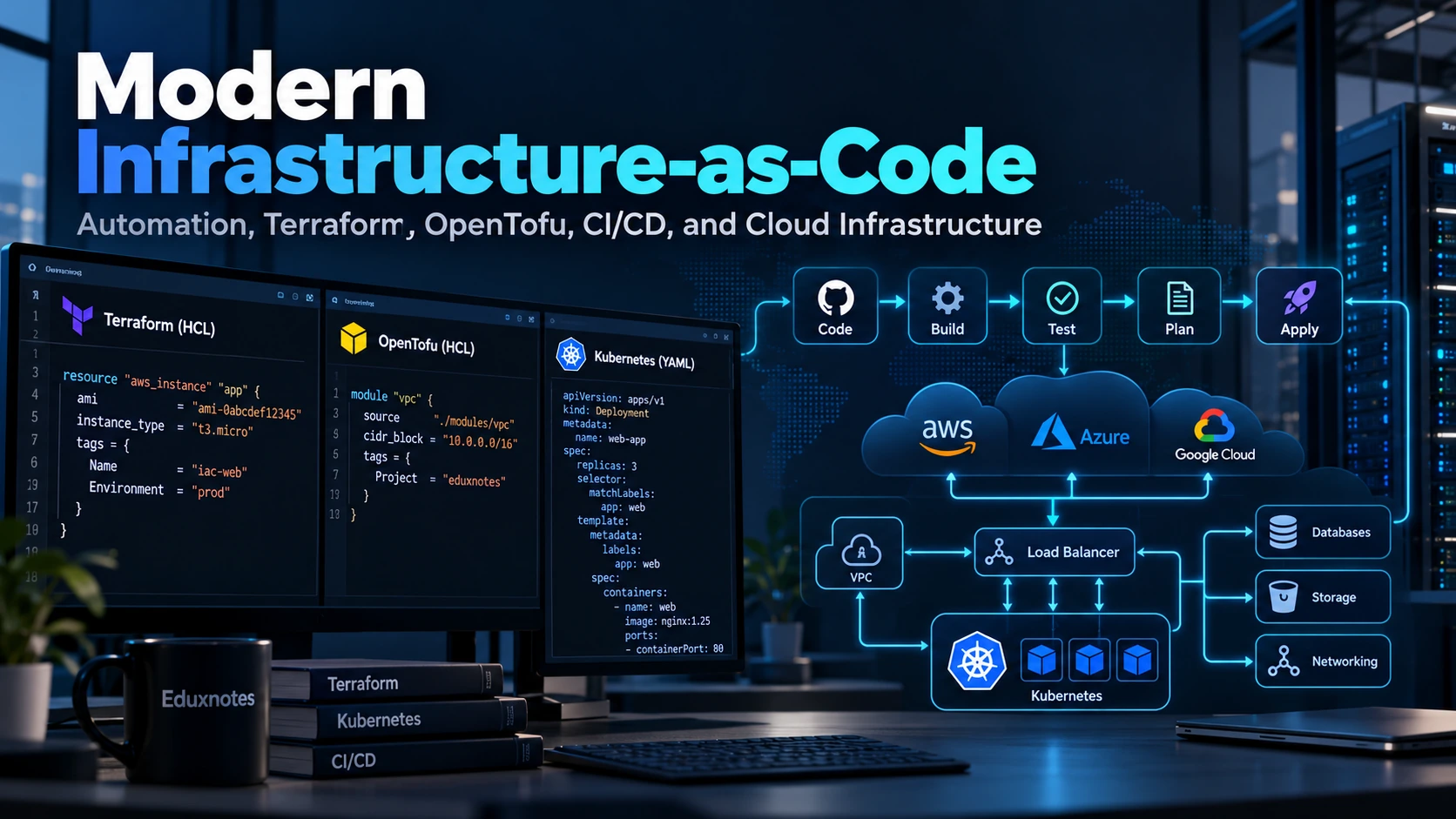
Managing cloud infrastructure has changed dramatically over the past decade. There was a time when setting up a server meant logging into a hosting dashboard, creating a virtual machine, configuring networking rules, installing software, and documenting every step manually.
That approach might work when a company has two or three servers. But what happens when the same company needs hundreds of servers, multiple cloud environments, automated deployments, and reliable disaster recovery?
Manually managing that infrastructure becomes difficult, expensive, and risky.
This is where Infrastructure-as-Code (IaC) comes in.
Infrastructure-as-Code allows engineers to define and manage infrastructure using configuration files rather than relying entirely on manual setup. Instead of creating cloud resources individually through a dashboard, teams can describe the infrastructure they need, review the proposed changes, and provision those resources through automation.
Modern Infrastructure-as-Code goes beyond creating servers. It connects cloud infrastructure, version control, security testing, CI/CD pipelines, configuration management, and platform engineering into a repeatable process.
In this guide, we will explore how modern IaC works, the tools used by DevOps engineers, practical Terraform examples, common mistakes, and the skills needed to manage production infrastructure.
What Is Infrastructure-as-Code (IaC)?
Infrastructure-as-Code is the practice of provisioning and managing computing infrastructure through machine-readable configuration files.
Infrastructure can include virtual machines, databases, storage buckets, private networks, load balancers, firewalls, container clusters, and cloud identity configurations.
In traditional infrastructure management, an administrator might manually create these resources using a cloud provider's web console.
With IaC, an engineer writes configuration files that describe the resources and their desired settings. An Infrastructure-as-Code tool then communicates with the relevant platform APIs to create or update those resources.
For example, imagine an application requires:
- A web server to run the application: Instead of manually launching an instance each time, a configuration defines its machine type, operating environment, network placement, and other required settings. The infrastructure tool can reproduce that configuration in another environment.
- A database to store application information: The database configuration can specify its engine, storage allocation, encryption settings, network restrictions, and backup requirements. These settings become part of a reviewable infrastructure definition rather than a collection of undocumented dashboard choices.
- A load balancer to handle incoming traffic: The infrastructure configuration can define how requests reach application servers, which health checks determine server availability, and which networking rules control access.
- Separate development and production environments: Reusable configurations make it easier to provision environments with consistent foundations while allowing important differences, such as instance sizes, scaling limits, and access permissions.
The main advantage is not simply automation. It is the ability to make infrastructure repeatable, reviewable, testable, and easier to maintain.
Why Modern Infrastructure-as-Code Matters
Consider a small software company that runs an application on a single cloud server.
Initially, the developer configures everything manually. The application works, and the setup seems manageable.
As the business grows, the company introduces a staging environment, a production database, additional application servers, and a backup system.
Eventually, it expands to another cloud region.
Now the team must remember how each resource was configured, which firewall rules were changed, and whether staging matches production.
A simple manual mistake could cause a deployment failure or security incident.
Modern IaC helps address these problems in several ways.
1. Consistent and Repeatable Infrastructure
Infrastructure definitions can be reused to create environments with similar configurations. This reduces differences caused by manual setup and makes it easier for engineers to understand how infrastructure is supposed to behave.
Consistency does not mean every environment must be identical. Production may require stronger availability controls or larger resources, while development uses smaller infrastructure to reduce costs.
The important point is that those differences are intentional and documented in configuration.
2. Better Collaboration Between Teams
Infrastructure files can be stored in Git repositories, allowing developers, DevOps engineers, and security teams to review changes before deployment.
For example, if an engineer proposes opening a network port to the internet, another team member can review that change through a pull request.
This creates a clearer history of infrastructure decisions.
3. Faster Environment Provisioning
Once a reusable infrastructure configuration is ready, engineers do not need to repeat the same manual installation process for every environment.
A new testing environment can be provisioned using an established configuration, subject to permissions, quotas, and resource availability.
This is especially valuable for applications that require multiple components to work together.
4. Improved Recovery Capabilities
Infrastructure definitions help teams rebuild environments after failures.
However, an important distinction exists: IaC can recreate infrastructure, but it does not automatically recover application data.
A database still needs a reliable backup and restoration strategy. Recreating an empty database server is not the same as restoring the information it previously contained.
5. Stronger Security Governance
Infrastructure definitions make many security settings visible before resources are created.
Teams can inspect IAM permissions, encryption requirements, firewall rules, and public access configurations using automated policy checks.
This does not make infrastructure secure automatically, but it creates opportunities to identify dangerous configurations earlier.
Traditional Infrastructure vs Modern Infrastructure-as-Code
| Traditional InfrastructureInfrastructure-as-Code | |
| Resources are often created manually. | Resources are declared in configuration files. |
| Repeating setups requires additional manual work. | Reusable configurations support repeatable provisioning. |
| Changes may be difficult to trace. | Git history and deployment records improve traceability. |
| Configuration differences can accumulate. | Desired configurations can be compared with actual infrastructure. |
| Review processes may be inconsistent. | Code reviews and automated checks can be integrated. |
| Rebuilding environments can be slow. | Documented infrastructure can be provisioned again through automation. |
The difference becomes more significant as infrastructure grows.
For a personal project, manual setup might be sufficient. For a company managing multiple environments and services, repeatable infrastructure management can become a major operational advantage.
How Infrastructure-as-Code Works
Most declarative IaC tools follow a process built around the idea of a desired state.
The desired state describes how infrastructure should be configured.
The tool examines that configuration, compares it with information about existing resources, and determines which changes are required.
A typical workflow contains five stages.
Step 1: Write the Infrastructure Configuration
An engineer creates configuration files describing required infrastructure resources.
These files may define cloud providers, networking resources, storage, compute instances, dependencies, and security settings.
Step 2: Validate the Configuration
Before provisioning resources, the configuration should be checked for syntax errors, unsupported arguments, incorrect references, and policy violations.
Validation helps catch many mistakes, although it cannot guarantee that every deployment will succeed.
Step 3: Generate an Execution Plan
Tools such as Terraform can generate a plan describing proposed changes.
The plan may indicate that resources will be created, modified, replaced, or destroyed.
Engineers should review the plan carefully, particularly when changes affect production databases, networking, or critical applications.
Step 4: Apply Approved Changes
Once the proposed changes are reviewed and approved, the infrastructure tool communicates with provider APIs to perform the required operations.
The tool considers dependencies when deciding the order in which resources should be managed.
Step 5: Maintain and Update Infrastructure
Infrastructure requirements change over time.
Engineers may need to increase capacity, change network configurations, update permissions, or retire unused resources.
By updating configuration files and repeating the review process, teams can manage infrastructure changes more systematically.
This workflow is commonly described in Terraform as Write → Plan → Apply.
Declarative vs Imperative Infrastructure Management
Understanding the difference between declarative and imperative approaches is essential.
Declarative Infrastructure
In a declarative approach, engineers describe the desired result rather than every operation needed to achieve it.
For example, a configuration may state that an application needs three servers.
The infrastructure tool determines the operations necessary to reach that target, based on its provider capabilities and the current managed state.
Terraform and OpenTofu primarily use declarative configuration models.
Imperative Infrastructure
In an imperative approach, engineers specify the steps a system should perform.
A shell script might instruct a server to install packages, create directories, update configuration files, and restart services.
This approach can provide detailed procedural control, but scripts must be carefully designed to handle repeated execution and partially completed operations.
Neither approach is universally better.
Declarative infrastructure is useful when resources have clear desired states, while imperative workflows are valuable for tasks that naturally require ordered procedures.
Many production systems combine both approaches.
Popular Modern Infrastructure-as-Code Tools
Choosing an IaC tool depends on the infrastructure being managed, the team's technical skills, and the operational requirements of the organization.
1. Terraform
Terraform is one of the best-known Infrastructure-as-Code tools.
It uses HashiCorp Configuration Language (HCL) to define infrastructure resources and works with providers that communicate with cloud platforms and other services.
Terraform can manage infrastructure across platforms such as AWS, Azure, and Google Cloud.
Its major strengths include reusable modules, resource dependency handling, execution plans, and integration with automation pipelines.
Terraform is particularly useful when teams need to manage different types of infrastructure through a consistent workflow.
2. OpenTofu
OpenTofu is an open-source Infrastructure-as-Code project that originated as a fork of Terraform.
It provides a familiar HCL-based workflow while developing its own features and project direction.
OpenTofu supports infrastructure provisioning, modules, providers, state management, and automated operations.
It also provides state and plan encryption capabilities, although encryption must be configured correctly and encryption keys must be protected.
Organizations evaluating Terraform and OpenTofu should consider compatibility, licensing, supported features, and long-term maintenance requirements.
3. Pulumi
Pulumi allows infrastructure to be defined using general-purpose programming languages such as TypeScript, JavaScript, Python, Go, and other supported languages.
This approach is attractive to development teams that prefer using programming-language constructs when building infrastructure components.
For example, a TypeScript developer can create infrastructure definitions using familiar language syntax, packages, and abstractions.
However, using a familiar programming language does not eliminate the need to understand cloud networking, permissions, state management, and deployment safety.
4. AWS CloudFormation
AWS CloudFormation is a native AWS service for defining and provisioning AWS infrastructure.
It uses templates to describe cloud resources and manages them as stacks.
CloudFormation is particularly relevant for teams whose infrastructure is primarily hosted on AWS.
AWS CDK provides another approach by allowing developers to define cloud infrastructure through supported programming languages, which is then synthesized into CloudFormation templates.
5. Ansible
Ansible is commonly used for configuration management, software installation, and operational automation.
It is particularly useful for configuring operating systems and applications after infrastructure has been provisioned.
For example, Terraform can create a virtual machine while Ansible installs Nginx, configures an application, and prepares the server.
Although their capabilities overlap in some areas, they often solve different parts of the infrastructure lifecycle.
6. Crossplane
Crossplane brings infrastructure management into a Kubernetes-oriented model.
It allows teams to manage infrastructure resources using Kubernetes APIs and custom resource definitions.
This can be useful for organizations building internal developer platforms where applications and infrastructure are managed through shared platform abstractions.
Crossplane is generally better approached after learning basic IaC and Kubernetes concepts.
Practical Example: Creating Infrastructure with Terraform
Let's explore a basic example that demonstrates how Terraform can define a real AWS resource.
Suppose we want to create a private S3 bucket for storing application assets or educational files.
We also want to block public access through S3 access-control settings.
The following example uses Terraform and the AWS provider.
File: main.tf
terraform {
  required_providers {
    aws = {
      source  = "hashicorp/aws"
      version = "~> 6.0"
    }
  }
}

provider "aws" {
  region = "ap-south-1"
}

variable "bucket_name" {
  description = "A globally unique S3 bucket name"
  type        = string
}

resource "aws_s3_bucket" "notes" {
  bucket = var.bucket_name

  tags = {
    Project     = "Eduxnotes"
    Environment = "Development"
    ManagedBy   = "Terraform"
  }
}

resource "aws_s3_bucket_public_access_block" "notes" {
  bucket = aws_s3_bucket.notes.id

  block_public_acls       = true
  ignore_public_acls      = true
  block_public_policy     = true
  restrict_public_buckets = true
}

output "bucket_name" {
  value = aws_s3_bucket.notes.id
}
This configuration defines the AWS provider, accepts a bucket name, creates an S3 bucket, and configures S3 public access blocking.
A real production deployment would also require appropriate IAM policies, encryption review, monitoring, and other security controls based on the application's needs.
Understanding the Terraform Commands
1. Initialize the project
terraform init
This command initializes the working directory and installs required provider plugins.
2. Format the configuration
terraform fmt
This formats Terraform configuration files using standard formatting conventions.
3. Validate the configuration
terraform validate
This checks the configuration for structural and syntax-related problems.
4. Preview the changes
terraform plan \
  -var="bucket_name=your-unique-bucket-name"
Terraform generates an execution plan showing the changes it expects to make.
5. Create the resources
terraform apply \
  -var="bucket_name=your-unique-bucket-name"
After reviewing the plan and confirming the operation, Terraform attempts to create the resources.
6. Remove the resources
terraform destroy \
  -var="bucket_name=your-unique-bucket-name"
This command proposes destroying resources managed by the configuration.
Important: This example requires properly configured AWS credentials and sufficient permissions. The S3 bucket name must be available. Creating or storing cloud resources can incur charges, and terraform destroy can permanently remove important resources or data. Never execute destructive commands against a production environment without reviewing the consequences.
The value of this workflow is that the infrastructure definition can be reviewed, version-controlled, and reused.
Understanding Terraform State Management
Terraform state is one of the most important concepts to understand before managing real infrastructure.
Terraform uses state information to associate resources defined in configuration files with resources managed through provider APIs.
When Terraform evaluates a new configuration, state helps it determine which existing objects correspond to managed resources.
For example, suppose a Terraform project creates a storage bucket.
Later, an engineer changes its configuration.
Terraform uses the available state and information retrieved from the provider to determine which actions are necessary.
Without correctly managed state, Terraform may lose track of resources or attempt unwanted operations.
Local State vs Remote State
Local state is stored on the machine where Terraform is executed.
This can be convenient for learning, but it becomes problematic when multiple engineers need to manage the same infrastructure.
Remote state stores state information in a shared backend or supported infrastructure management platform.
A production-ready state strategy should consider several requirements:
- Access control and encryption: State files can contain sensitive infrastructure information, including values that should not be publicly accessible. Teams should restrict access, use appropriate encryption, and avoid exposing state in source repositories or unsecured storage locations.
- State locking and concurrency management: Two engineers applying changes to the same infrastructure simultaneously can create conflicts. Supported state-locking mechanisms help prevent concurrent operations that could corrupt state or produce inconsistent results.
- Backups and recovery: State loss can cause serious operational problems. Remote storage should be configured with suitable backup, versioning, retention, and recovery procedures so that teams can recover from accidental deletion or corruption.
- Environment isolation: Development and production environments should not accidentally share the same state when they represent separate deployments. Clear state boundaries reduce the risk of a change intended for testing affecting production infrastructure.
State management is not an optional advanced detail. It becomes fundamental as soon as real infrastructure must be maintained reliably.
A Real-World Infrastructure-as-Code Architecture
Imagine a growing educational platform that hosts articles, downloadable notes, user accounts, and backend APIs.
The application starts on one server but eventually needs a more reliable cloud environment.
A possible production architecture could contain:
Infrastructure Layer
- A virtual private cloud with properly configured public and private subnets.
- An application load balancer that routes requests to available application instances.
- Compute resources that run frontend and backend services.
- A managed database deployed in a private network.
- Object storage for uploaded files and downloadable educational materials.
- IAM roles, security groups, encryption controls, and monitoring services.
Automation Layer
- Terraform or OpenTofu manages cloud networking, compute, storage, and other infrastructure resources.
- Ansible or image-building processes prepare the software environments where required.
- GitHub Actions or another CI/CD platform validates infrastructure changes and coordinates approved deployments.
- Security scanners inspect configurations for potentially dangerous settings.
- Monitoring tools collect operational metrics and help engineers investigate failures.
The resulting workflow might look like this:
Developer
    |
    v
Git Repository
    |
    v
Pull Request + Review
    |
    v
CI Validation and Security Checks
    |
    v
Terraform Plan
    |
    v
Deployment Approval
    |
    v
Terraform Apply
    |
    v
Cloud Infrastructure
    |
    +-- Networking
    +-- Application Servers
    +-- Load Balancer
    +-- Managed Database
    +-- Object Storage
    +-- Monitoring
This is a simplified example, not a complete production blueprint.
A real implementation would also need decisions about network boundaries, availability zones, disaster recovery, secret management, deployment identity, and operational ownership.
The important lesson is that infrastructure automation works best as part of a broader engineering process rather than as a collection of isolated Terraform commands.
Infrastructure-as-Code and CI/CD Pipelines
A modern infrastructure workflow should not depend on one engineer running commands from a personal laptop.
Instead, organizations often integrate infrastructure changes into CI/CD pipelines.
When an engineer proposes an infrastructure change, the pipeline can automatically check whether the configuration is properly formatted, valid, and compliant with relevant security rules.
The pipeline can also generate an execution plan for review.
After receiving the necessary approval, an authorized deployment process can apply the changes.
A well-designed infrastructure CI/CD pipeline typically includes:
- Source control and change review: Every infrastructure change begins with a version-controlled modification. Pull requests allow other engineers to inspect resource changes, discuss architectural decisions, and detect unnecessary or dangerous modifications before deployment.
- Automated validation and testing: The pipeline checks formatting, configuration validity, security policies, and applicable infrastructure tests. These checks reduce common mistakes, although integration testing may still be needed to identify problems that only appear in real environments.
- Execution plan review: Terraform or OpenTofu generates a plan showing intended changes. Reviewers can examine resource replacements, unexpected deletions, permission changes, and potential service interruptions before approving the deployment.
- Controlled deployment permissions: The deployment system receives only the access it needs. Short-lived credentials obtained through mechanisms such as OIDC are generally preferable to storing long-lived cloud access keys inside pipeline configuration.
- Deployment verification and operational monitoring: After applying changes, engineers verify that the intended resources and services are functioning correctly. Monitoring and alerting help identify unexpected behavior that configuration validation alone cannot detect.
This approach turns infrastructure deployment into a more controlled software engineering process.
Infrastructure-as-Code vs GitOps
Infrastructure-as-Code and GitOps are closely related, but they are not identical.
IaC primarily focuses on defining and managing infrastructure through code.
GitOps is an operational approach that uses version-controlled declarative configurations and automated reconciliation to manage deployed systems.
In Kubernetes environments, tools such as Argo CD and Flux can continuously compare desired application configurations stored in Git with the current cluster state.
When differences are detected, these tools can synchronize the environment according to configured policies.
For example, Terraform might provision an Amazon EKS cluster, while Argo CD manages application deployments inside that cluster.
This separation can be beneficial because cloud infrastructure and application deployment configurations often have different lifecycles.
However, GitOps tools should not be treated as automatic replacements for Terraform.
The correct architecture depends on which resources are managed, how reconciliation works, and which teams own infrastructure and applications.
Security Best Practices for Modern IaC
Infrastructure automation can provision hundreds of resources quickly.
That makes mistakes more dangerous when unsafe configurations are reused across environments.
Security must therefore be part of the infrastructure workflow from the beginning.
1. Never Hardcode Credentials
Cloud access keys, database passwords, and API tokens should not be embedded directly inside infrastructure files.
Sensitive values may accidentally appear in Git history, deployment logs, plans, or state files.
Use appropriate secrets management systems and secure workload authentication mechanisms instead.
2. Follow the Principle of Least Privilege
Every user, service, and automation pipeline should receive only the permissions necessary for its responsibilities.
A CI/CD pipeline that deploys one application generally should not have unrestricted administrative access to an entire cloud account.
Restricting permissions limits the potential impact of compromised credentials or configuration mistakes.
3. Scan Infrastructure Before Deployment
Tools such as Checkov, Trivy, and TFLint can help identify infrastructure configuration problems.
Security scanning can detect issues such as overly permissive network rules, missing security settings, and policy violations.
These tools are valuable, but their findings must be interpreted correctly. Automated scanning is not a substitute for architecture review or runtime security monitoring.
4. Protect Infrastructure State
Terraform state may expose sensitive information even when configuration outputs are marked sensitive.
Production teams should use secure state storage, appropriate access policies, and supported encryption and locking mechanisms.
State should not be committed to a public repository.
5. Review Destructive Changes
Some configuration changes cause cloud resources to be replaced rather than updated in place.
Replacing a database or storage resource can create serious availability and data-loss risks.
Review proposed changes carefully and establish backup, recovery, and change approval procedures before deploying to production.
6. Keep Providers and Modules Maintained
Infrastructure projects depend on providers, modules, and automation tools.
These dependencies should be reviewed for compatibility, security advisories, maintenance activity, and supported versions.
Version constraints and lock files help teams make upgrades more predictable.
Common Infrastructure-as-Code Mistakes to Avoid
Learning Terraform commands is relatively straightforward. Building a reliable infrastructure workflow requires understanding what can go wrong.
Here are several common mistakes.
- Managing everything in a single large configuration: A small project can start with one configuration file, but production infrastructure becomes difficult to maintain when networking, databases, applications, and permissions are tightly coupled. Organizing configurations into logical components and reusable modules makes ownership, review, and troubleshooting easier.
- Making manual changes without updating the code: Engineers sometimes modify resources directly through a cloud dashboard to resolve urgent problems. If the corresponding infrastructure definitions are not updated, the configured desired state and real environment can drift apart. Later automation runs may reverse those manual changes or produce unexpected results.
- Using the same state for unrelated environments: Sharing state across development, staging, and production can create confusing dependencies and increase the impact of mistakes. Separate deployments generally need clearly defined ownership and state boundaries, with access permissions that reflect the sensitivity of each environment.
- Assuming automated infrastructure is automatically secure: IaC tools execute the configurations they receive. If a configuration exposes a database to the internet or grants excessive permissions, automation may reproduce that weakness consistently. Security controls must be designed, reviewed, tested, and monitored.
- Ignoring cloud costs and cleanup: A configuration that creates managed databases, load balancers, NAT gateways, or large compute instances can generate charges. Engineers should estimate costs, apply budgets and alerts, remove unused development resources, and understand that deleting infrastructure can also delete valuable data.
- Treating infrastructure recovery as a complete disaster recovery strategy: Recreating servers and networking is useful, but business continuity may also require database restoration, object storage recovery, DNS failover, secret recovery, and documented recovery-time objectives. These procedures should be tested rather than assumed to work.
Avoiding these mistakes often contributes more to production reliability than adopting another automation tool.
Step-by-Step Roadmap to Learn Modern Infrastructure-as-Code
Beginners sometimes try to learn Terraform, Kubernetes, Ansible, Pulumi, and GitOps simultaneously.
That approach can make the subject unnecessarily confusing.
A better strategy is to develop infrastructure knowledge in stages.
Stage 1: Learn Infrastructure Fundamentals
Start with Linux commands, networking, DNS, HTTP, SSH, cloud computing, and basic security concepts.
Understand what virtual machines, subnets, security groups, load balancers, and managed databases actually do.
These concepts are essential because an IaC tool does not remove the need to understand the infrastructure being created.
Stage 2: Learn Terraform Basics
Install Terraform and understand configuration syntax, providers, resources, variables, outputs, and execution plans.
Begin with small examples rather than attempting a complete production architecture.
Practice reading plans and understanding resource dependencies.
Stage 3: Understand State and Modules
Learn how state works, how remote backends are configured, and how infrastructure is organized into reusable modules.
Build separate development and staging environments using intentional configuration differences.
This stage develops the skills needed to manage infrastructure beyond a personal experiment.
Stage 4: Build Cloud Infrastructure Projects
Create a small cloud environment with networking, compute resources, storage, and appropriate access controls.
Document the architecture and explain why each component exists.
Include cleanup procedures and monitor cloud costs during experimentation.
Stage 5: Add Automation and Security
Integrate infrastructure repositories with GitHub Actions or another CI/CD platform.
Introduce formatting checks, validation, security scanning, execution plan review, and controlled deployments.
Learn how to manage credentials securely and restrict automation permissions.
Stage 6: Explore Kubernetes and GitOps
After understanding cloud infrastructure, learn Docker, Kubernetes resources, Helm, and GitOps tools.
Practice provisioning infrastructure separately from deploying applications onto it.
This distinction becomes increasingly important in complex environments.
Stage 7: Learn Advanced Platform Engineering
Explore OpenTofu, Pulumi, Crossplane, policy-as-code, multi-cloud infrastructure, internal developer platforms, and self-service provisioning.
At this stage, the focus shifts from creating individual resources to designing reliable infrastructure workflows that other developers can use safely.
The Future of Infrastructure-as-Code
Infrastructure-as-Code continues to evolve as organizations demand faster delivery, stronger security, and simpler developer experiences.
Several developments are shaping its direction.
Platform engineering and self-service infrastructure are making it possible for development teams to request standardized environments without needing direct access to every underlying cloud setting. Platform teams can provide reusable infrastructure capabilities with predefined security and operational controls.
Policy-as-code and automated governance are becoming increasingly important as infrastructure grows. Organizations can define rules that evaluate configurations before deployment, helping teams enforce required tags, encryption settings, approved regions, and other standards.
Kubernetes-native infrastructure management offers another model in which infrastructure resources can be exposed through Kubernetes-style APIs. Projects such as Crossplane support this approach, particularly for organizations building internal platforms.
AI-assisted infrastructure development is also attracting attention. AI coding assistants can help draft configuration files, explain unfamiliar resources, and generate test cases. However, generated configurations can contain incorrect assumptions, outdated syntax, excessive permissions, and insecure defaults.
Human review, testing, documentation, and controlled deployment remain necessary.
The future of IaC is not simply writing fewer configuration files. It is building infrastructure systems that are easier to understand, safer to change, and more reliable to operate.
Frequently Asked Questions (FAQs)
1. What is Infrastructure-as-Code, and why is it important in DevOps?
Infrastructure-as-Code is a method of defining and managing computing infrastructure through configuration files rather than relying entirely on manual setup.
It is important in DevOps because it allows infrastructure changes to follow software development practices such as version control, peer review, automated testing, and continuous delivery.
For example, a DevOps engineer can define the infrastructure required for an application and store that configuration in Git. Other team members can review the changes, validate the configuration, and deploy approved updates through automation.
This improves consistency and makes infrastructure easier to maintain as applications grow. However, infrastructure automation still requires proper security controls, monitoring, and operational planning.
2. What is the difference between Terraform, OpenTofu, Ansible, and Pulumi?
Terraform and OpenTofu primarily use declarative configurations to provision and manage infrastructure resources through providers. Both use HCL-based workflows, although their development paths and supported features can differ.
Pulumi provides another infrastructure provisioning approach and allows engineers to define infrastructure using supported general-purpose programming languages, including TypeScript and Python.
Ansible focuses strongly on configuration management and operational automation. It can install packages, configure servers, and perform repeatable administrative tasks.
These tools are not always direct substitutes. A team may use Terraform to provision servers and networking, Ansible to configure operating systems, and GitOps tools to manage applications running on Kubernetes.
The best choice depends on the infrastructure, operational requirements, and experience of the team.
3. Is Terraform enough to become a DevOps engineer?
Terraform is an important DevOps skill, but learning Terraform alone is not enough to understand the complete DevOps workflow.
A DevOps engineer should also understand Linux, networking, Git, cloud computing, containers, CI/CD pipelines, monitoring, security fundamentals, and troubleshooting.
Terraform helps automate infrastructure provisioning, but it does not automatically solve application deployment, incident response, database recovery, or system observability.
A practical learning path is to begin with infrastructure fundamentals, learn Terraform, build cloud projects, and gradually introduce CI/CD, configuration management, security testing, and Kubernetes.
Hands-on projects that demonstrate these skills are generally more valuable than simply memorizing commands.
4. Can Infrastructure-as-Code be used with AWS, Azure, Google Cloud, and on-premises servers?
Yes. Infrastructure-as-Code can be used across multiple cloud platforms and certain on-premises environments, depending on the capabilities of the selected tool and its providers.
Terraform and OpenTofu support providers for many cloud services and infrastructure platforms. Pulumi also supports infrastructure provisioning across multiple environments through its provider ecosystem.
For example, one organization might manage networking resources on AWS, application infrastructure on Azure, and selected DNS services through another provider.
However, multi-cloud infrastructure is not automatically portable. Different cloud providers have different services, permissions, networking models, and operational characteristics.
A configuration designed for one cloud platform may require substantial changes before it can be deployed elsewhere.
5. What are the most important Infrastructure-as-Code best practices for production environments?
Production Infrastructure-as-Code should prioritize security, reliability, change management, and recovery.
Teams should store infrastructure definitions in version control, require reviews for important changes, use reusable modules, and maintain clear boundaries between environments.
Remote state should be protected through suitable access controls, encryption, locking, and backup procedures.
Automation pipelines should use restricted permissions and validate configurations before deployment. Execution plans should be reviewed carefully, especially when they contain destructive operations.
Organizations should also monitor infrastructure drift, estimate cloud costs, maintain recovery procedures, and document operational responsibilities.
Most importantly, production infrastructure should be treated as a continuously maintained system rather than a one-time deployment task.
Conclusion
Modern Infrastructure-as-Code has become an essential part of managing cloud infrastructure at scale.
It allows teams to define infrastructure through configuration files, track changes in version control, automate provisioning, and create more consistent environments.
Tools such as Terraform, OpenTofu, Pulumi, Ansible, and AWS CloudFormation provide different approaches to infrastructure automation, while CI/CD pipelines, security scanning, and GitOps extend these workflows into broader engineering practices.
However, successful IaC adoption depends on more than selecting a popular tool.
Engineers must understand the resources they are creating, secure their credentials and state files, review proposed changes, manage cloud costs, and maintain reliable recovery procedures.
For beginners, the most effective approach is to start with infrastructure fundamentals, practice Terraform on small projects, and gradually build toward cloud automation, CI/CD, and production operations.
The real goal of Infrastructure-as-Code is not just to automate infrastructure creation. It is to make infrastructure predictable, understandable, secure, and maintainable throughout its lifecycle.