C Language: Complete Guide for Beginners
Learn C Language with this complete beginner-friendly guide. Explore the history, features, syntax, advantages, applications, and core concepts of C programming.
C Language Overview
Introduction to C Language
C is one of the most popular programming languages in the world. It is known for its speed, simplicity, and powerful capabilities. Since its introduction, C has been used to develop operating systems, software applications, embedded systems, and many other technologies.
For beginners, C is often the first programming language to learn because it explains the basic concepts of programming in a practical way. Once you understand C, learning other programming languages becomes much easier.
Even after several decades, C continues to be used by students, software developers, engineers, and technology companies. Its reliability and performance make it a valuable skill for anyone interested in programming.
History of C Programming
C programming language was developed by Dennis Ritchie at Bell Laboratories during the early 1970s. The main purpose was to create a language that could be used for system programming while remaining easy to understand and maintain.
One of the biggest achievements of C was its use in rewriting the UNIX operating system. This made UNIX more portable and helped C gain worldwide recognition among developers and universities.
As computer technology evolved, C remained relevant because of its flexibility and performance. Today, it is still one of the most widely taught programming languages across the world.
What is C Language?
C is a general-purpose, procedural programming language that allows developers to create efficient and high-performance applications. It provides direct access to system resources, making it suitable for both simple and complex software projects.
The language follows a structured programming approach where programs are divided into small functions. This improves code readability and makes applications easier to manage.
C is also considered a middle-level programming language because it combines the features of both low-level and high-level programming. It offers hardware-level control while keeping the syntax simple enough for everyday programming.
Why Learn C Programming?
Learning C builds a strong programming foundation. It teaches important concepts such as variables, loops, functions, arrays, pointers, and memory management.
Unlike many modern languages, C helps programmers understand how software works internally. This knowledge improves logical thinking and problem-solving abilities.
Many programming languages, including C++, Java, Python, and JavaScript, become easier to learn after understanding C. That is why many colleges and universities include C in their computer science curriculum.
Key Features of C Language
C offers several features that make it one of the most trusted programming languages. These features have helped it remain relevant for many years.
Some of its important features include:
- Simple and easy-to-understand syntax
- High execution speed
- Efficient memory management
- Structured programming approach
- Rich standard library
- Portable across different platforms
- Support for functions
- Dynamic memory allocation
- Hardware-level programming support
These features allow developers to build reliable and high-performance software for different industries.
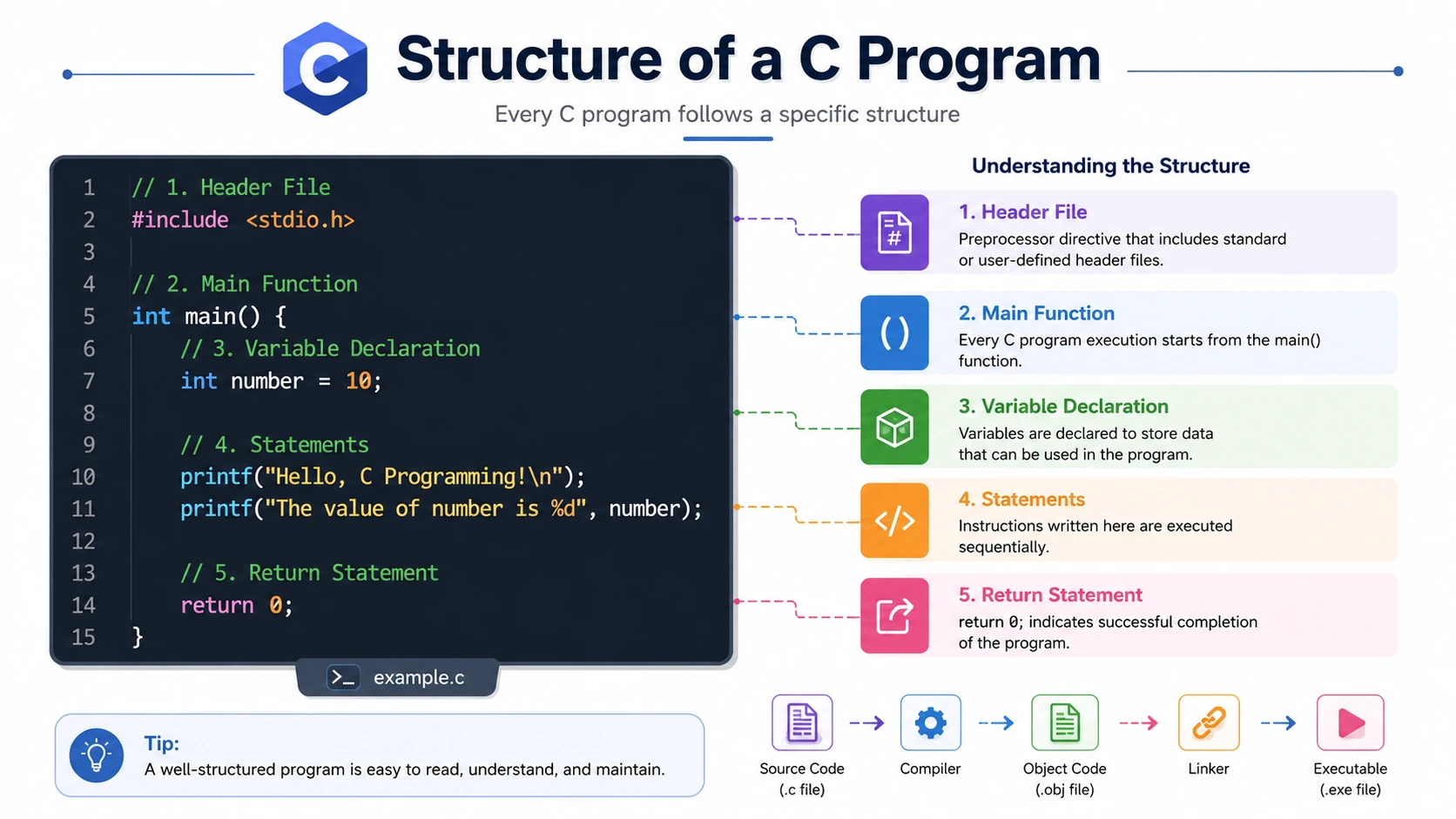
Simple and Easy to Understand
One reason why C is popular among beginners is its straightforward syntax. The language focuses on programming logic instead of hiding everything behind advanced frameworks.
Students can easily understand how programs are written, compiled, and executed. This practical learning approach helps build confidence from the beginning.
As programming skills improve, developers can apply the same concepts while learning advanced technologies and modern programming languages.
High Performance
C is famous for its fast execution speed. Programs written in C are compiled directly into machine code, allowing the computer to execute instructions efficiently.
Because of its performance, C is commonly used in applications where speed and resource optimization are important. It also consumes less memory compared to many high-level languages.
This combination of speed and efficiency makes C suitable for system software, embedded devices, networking applications, and performance-critical programs.
Structured Programming
C follows a structured programming model where programs are divided into multiple functions. Each function performs a specific task, making the overall application more organized.
This approach improves readability and simplifies debugging. Developers can modify one part of the program without affecting the remaining code.
Structured programming also encourages code reuse, which saves development time and improves software quality.
Portability
One of the biggest advantages of C is portability. A program written in standard C can usually run on different operating systems with only minor modifications.
This allows developers to create software that works across multiple platforms without rewriting the entire application.
Portability has played an important role in making C one of the most successful programming languages in history.
Where is C Language Used?
C continues to be used in many areas of software development because of its speed and flexibility.
Some common applications include:
- Operating systems
- Embedded systems
- Device drivers
- Database management systems
- Networking software
- Compilers
- Game engines
- IoT devices
- Robotics applications
- Industrial automation software
These real-world applications prove that C remains an important language even in modern software development.
Core Concepts of C Language
Understanding the core concepts of C is essential for writing efficient and error-free programs. These concepts form the foundation of almost every C application and help programmers solve problems using logical thinking.
As you continue learning, these topics will become the building blocks for creating simple programs as well as complex software.
Variables and Data Types
Variables are used to store data during program execution. Every variable has a specific data type that defines the kind of value it can hold.
C provides different data types such as int, char, float, and double. Choosing the correct data type helps improve memory usage and program performance.
Understanding variables and data types is one of the first steps toward writing meaningful C programs.
Operators
Operators perform calculations and comparisons between values. They allow programmers to manipulate data and control program behavior.
C supports a wide range of operators for different purposes, making programming more flexible and efficient.
Common categories include:
- Arithmetic operators
- Relational operators
- Logical operators
- Assignment operators
- Bitwise operators
- Increment and decrement operators
- Conditional operator
Control Statements
Control statements determine the flow of a program. They help execute different blocks of code based on specific conditions.
Decision-making statements make programs smarter by allowing different outputs for different situations.
Some commonly used control statements are:
ifif-elseelse-ifswitch
These statements are used in almost every real-world program.
Loops in C
Loops allow programmers to execute the same block of code multiple times without writing it repeatedly.
Using loops reduces code duplication and makes programs more efficient and easier to maintain.
The three main loops available in C are:
forloopwhileloopdo-whileloop
Choosing the correct loop depends on the problem being solved.
Functions
Functions divide a program into smaller and reusable parts. Instead of writing the same logic multiple times, developers can create a function once and call it whenever needed.
Functions improve code organization and make large applications easier to manage.
They also simplify testing, debugging, and future updates.
Arrays
Arrays allow multiple values of the same data type to be stored under a single variable name.
Instead of creating many individual variables, programmers can access elements using indexes.
Arrays are commonly used for storing lists of numbers, characters, and other related data efficiently.
Strings
A string in C is simply an array of characters that ends with a null character (\0).
Strings are used to store names, messages, addresses, and other text-based information.
The standard library provides several functions for handling strings, making common text operations much easier.
Pointers
Pointers are one of the most powerful features of C. They store the memory address of another variable instead of storing the actual value.
Although beginners may find pointers difficult at first, they become extremely useful for memory management, dynamic allocation, and efficient programming.
Pointers also play a major role in advanced topics like data structures and system programming.
Memory Management
C gives programmers direct control over memory allocation. This allows applications to use system resources more efficiently.
Dynamic memory allocation is mainly performed using standard library functions, enabling programs to allocate memory only when required.
Proper memory management improves both speed and resource utilization.
File Handling
Many applications need to store data permanently instead of keeping it only in memory.
C provides file handling functions that allow programmers to create, read, update, and delete files.
This feature is widely used in software like billing systems, management applications, and data processing programs.
Error Handling
Every program may encounter unexpected situations during execution. Proper error handling helps prevent crashes and improves software reliability.
By checking return values and validating user input, developers can build applications that behave more safely under different conditions.
Good error handling also makes debugging easier.
Advantages of C Language
C offers several advantages that have helped it remain one of the most respected programming languages.
Some of its major benefits include:
- Fast execution speed
- Efficient memory usage
- Portable across platforms
- Simple and structured syntax
- Strong programming foundation
- Large developer community
- Excellent compiler support
- Suitable for system-level programming
- Easy integration with hardware
- Reliable for performance-critical applications
These advantages make C a preferred choice for students, developers, and organizations worldwide.
Limitations of C Language
Like every programming language, C also has certain limitations.
It does not provide built-in support for object-oriented programming, automatic memory management, or advanced security features found in many modern languages.
Some common limitations include:
- No garbage collection
- Manual memory management
- Limited runtime error checking
- No built-in exception handling
- Less secure compared to modern languages
Despite these limitations, C remains highly valuable because of its speed, flexibility, and low-level control.
Why C is Still Relevant Today
Many people believe that newer programming languages have completely replaced C, but this is not true.
Modern operating systems, embedded devices, compilers, networking software, and database engines still rely on C because of its outstanding performance.
Learning C not only improves programming skills but also provides a deeper understanding of how computers and software actually work behind the scenes. This is one of the biggest reasons why C continues to be taught in universities and used in the software industry....