
Technical Interview Prep for Software Engineers
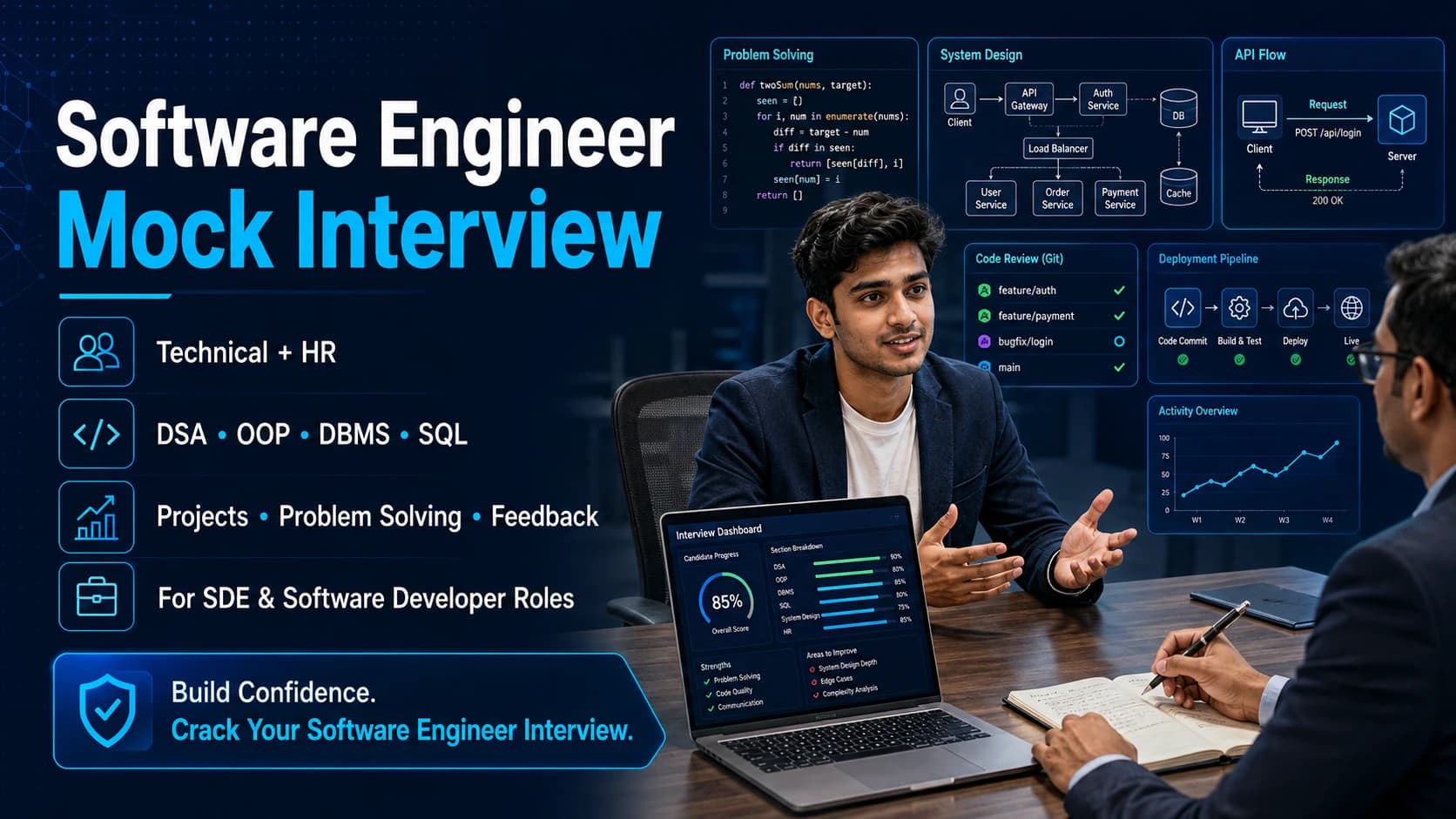
Prepare for your Software Engineer interview with a realistic weekly 50-minute mock interview for 1 month covering Data Structures & Algorithms, OOP, DBMS, SQL, Operating Systems, Computer Networks, coding concepts, projects, basic system design, technical scenarios, and HR questions with personalized feedback.
Your interview package
₹1,499- Role
- Software Engineer / Software Developer / SDE
- Format
- Technical
- Duration
- 50 minutes
- Sessions
- 4
Resume (optional)
What to expect
Preparing concepts is important, but being able to explain your thinking, solve problems under pressure, discuss your projects, and answer follow-up questions confidently is what matters during an actual Software Engineer interview.
Our Software Engineer Mock Interview is designed to simulate a realistic technical interview for candidates preparing for Software Engineer, Software Developer, SDE, Associate Software Engineer, Graduate Engineer, and entry-level development roles.
The session combines technical fundamentals, DSA, problem-solving, project discussions, basic system design, resume-based questions, and HR interview practice.
It is especially useful for freshers and students who have studied technical concepts but want to understand how well they can actually communicate that knowledge in an interview.
Don't just prepare answers. Practice explaining how you think.
What Will Be Covered?
1. Data Structures & Algorithms
DSA is one of the most important areas of Software Engineer interviews.
Questions may cover:
- Arrays
- Strings
- Hashing
- Linked Lists
- Stacks
- Queues
- Trees
- Binary Search Trees
- Heaps
- Graph fundamentals
- Recursion
- Sorting
- Searching
- Two pointers
- Sliding window
- Greedy concepts
- Dynamic Programming basics
- Time Complexity
- Space Complexity
- Big-O notation
The focus is not only on reaching the correct answer.
You may also be evaluated on:
- How you understand the problem
- How you explain your approach
- Choosing the correct data structure
- Handling edge cases
- Optimizing your solution
- Analyzing time complexity
- Analyzing space complexity
2. Problem-Solving & Coding Approach
Software engineering interviews frequently test the way candidates approach unfamiliar problems.
You may be asked to:
- Understand the problem statement
- Identify inputs and expected outputs
- Discuss a brute-force solution
- Improve the solution
- Select an appropriate data structure
- Analyze complexity
- Explain edge cases
- Walk through sample inputs
This section helps evaluate whether you can think like a developer instead of simply memorizing coding solutions.
3. Object-Oriented Programming – OOP
OOP concepts are commonly discussed in fresher Software Engineer interviews.
Questions may include:
- What is OOP?
- Class and Object
- Encapsulation
- Abstraction
- Inheritance
- Polymorphism
- Method Overloading
- Method Overriding
- Constructor
- Interface
- Abstract Class
- Association
- Aggregation
- Composition
- Access Modifiers
- SOLID principles basics
Example Question
“What is the difference between abstraction and encapsulation? Explain it using a practical example.”
The interviewer may ask follow-up questions to ensure that you actually understand the concept.
4. DBMS Interview Questions
Database fundamentals are important for almost every Software Engineer role.
Topics may include:
- What is DBMS?
- DBMS vs RDBMS
- Primary Key
- Foreign Key
- Candidate Key
- Super Key
- Normalization
- Denormalization
- ACID properties
- Transactions
- Indexes
- Joins
- Views
- Stored procedures basics
- Constraints
- Relationships
- Database design fundamentals
5. SQL Interview Questions
Candidates may also receive practical SQL questions.
Topics may include:
- SELECT
- INSERT
- UPDATE
- DELETE
- WHERE
- GROUP BY
- HAVING
- ORDER BY
- INNER JOIN
- LEFT JOIN
- RIGHT JOIN
- Aggregate functions
- Subqueries
- Primary and foreign keys
- Indexes
- Finding duplicate records
- Second highest salary
- Query optimization basics
Example
“How would you find the second highest salary from an employee table?”
You may be asked to explain different approaches instead of giving only one query.
6. Operating System Interview Questions
Important Operating System concepts may include:
- Process vs Thread
- Multithreading
- CPU Scheduling
- Deadlocks
- Race Conditions
- Synchronization
- Semaphores
- Mutex
- Paging
- Virtual Memory
- Memory Management
- Context Switching
- Process States
Example Question
“What is a deadlock and what conditions are required for a deadlock to occur?”
7. Computer Networks
Basic networking knowledge is useful for software developers, especially when building web applications and APIs.
Questions may include:
- OSI Model
- TCP/IP Model
- TCP vs UDP
- HTTP
- HTTPS
- DNS
- IP Address
- Ports
- Client-Server Architecture
- Request and Response
- REST APIs
- SSL/TLS basics
- Cookies
- Sessions
- HTTP Status Codes
- GET vs POST
- PUT vs PATCH
- Authentication vs Authorization
8. Programming Language Questions
The interview can be adapted around the programming language or technology mentioned in your resume.
Depending on your background, questions may involve:
- Java
- JavaScript
- Python
- C++
- C
- TypeScript
Possible areas include:
- Variables
- Functions
- Scope
- Data types
- Error handling
- Memory basics
- Async programming
- Language-specific OOP
- Collections
- Exception handling
- Language-specific features
Questions can be aligned with the candidate's primary programming language.
9. Software Development Fundamentals
You may also receive questions related to practical software engineering concepts.
Topics can include:
- SDLC
- Agile
- Scrum basics
- Git
- GitHub
- Version Control
- APIs
- REST
- JSON
- Authentication
- Authorization
- Testing fundamentals
- Debugging
- Error handling
- Clean code
- Code maintainability
- Development environments
- Deployment basics
10. Basic System Design
For fresher and entry-level candidates, system design will remain at an appropriate fundamental level.
Topics may include:
- Client-server architecture
- Database selection
- APIs
- Load balancing basics
- Caching
- Scalability
- Horizontal vs vertical scaling
- Authentication
- Database relationships
- Monolith vs microservices basics
- CDN basics
- Queues basics
Example Scenario
“How would you design a simple URL shortener?”
or
“How would you design the backend of a basic task management application?”
The objective is to evaluate your thought process rather than expecting senior-level architecture knowledge.
11. Software Engineering Scenario-Based Questions
Real interviews can include situations where you need to explain how you would approach a problem.
Examples include:
- An application suddenly becomes slow.
- An API takes several seconds to respond.
- Users are receiving duplicate records.
- A production deployment introduces a bug.
- A database query becomes slow.
- An application works locally but not in production.
- Two developers modify the same Git code.
- An API returns a 500 Internal Server Error.
- A feature works on desktop but fails on mobile.
- Application memory usage continuously increases.
You will be evaluated on your problem-solving process, debugging approach, prioritization, and communication skills.
12. Project-Based Interview Questions
Projects are extremely important for fresher Software Engineer interviews.
You may be asked:
- Tell me about your project.
- What problem does your project solve?
- What was your role?
- Which technologies did you use?
- Why did you select this technology stack?
- Explain your project architecture.
- How does the frontend communicate with the backend?
- How did you design the database?
- How did you implement authentication?
- What APIs did you build?
- What challenges did you face?
- How did you debug problems?
- How did you deploy the project?
- How would you scale the project?
- What would you improve if you rebuilt it?
The interviewer may ask multiple follow-up questions to check whether you genuinely understand the project.
13. Resume-Based Questions
Questions can also be asked based on the technologies, projects, internships, certifications, and skills mentioned in your resume.
For example, if you mention:
- React
- Node.js
- Java
- Python
- MySQL
- MongoDB
- AWS
- Docker
- Git
- REST APIs
you should be prepared to explain how and where you used them.
This helps identify skills that you may need to revise before your actual interview.
14. HR & Behavioral Round
The session can also include common HR questions such as:
- Tell me about yourself.
- Why do you want to become a Software Engineer?
- Why should we hire you?
- What are your strengths?
- What are your weaknesses?
- Tell me about a challenging project.
- Tell me about a technical problem you solved.
- How do you handle deadlines?
- How do you work with a team?
- How do you handle disagreements?
- How do you learn new technologies?
- Where do you see yourself in the next few years?
- Why are you interested in our company?
How the Software Engineer Mock Interview Works
- Introduction Round
- Start with a professional self-introduction similar to an actual interview.
- Technical Fundamentals
- Questions from programming and Computer Science fundamentals.
- DSA & Problem-Solving
- Evaluate your logical and coding approach.
- OOP, DBMS & SQL
- Core Software Engineer concepts are tested.
- OS & Computer Networks
- Important Computer Science fundamentals are discussed.
- Development & API Concepts
- Questions around practical software development.
- Project Deep Dive
- Explain architecture, technologies, challenges, and decisions.
- Basic System Design
- Solve an entry-level software architecture problem.
- Scenario-Based Questions
- Work through realistic debugging and software engineering problems.
- HR Round
- Practice behavioral and communication questions.
- Personalized Feedback
- Understand your strengths, weaknesses, and areas that require improvement.
Who Should Book This Mock Interview?
This package is ideal for:
- Software Engineer freshers
- Software Developer freshers
- SDE candidates
- Associate Software Engineer candidates
- Graduate Engineer candidates
- BCA students
- BSc Computer Science students
- BSc IT students
- BTech students
- BE students
- MCA students
- Final-year students
- Recent graduates
- Campus placement candidates
- Internship candidates
- Candidates preparing for their first Software Engineer interview
What You Will Gain
After completing this session, you should have a better understanding of:
- Your current Software Engineer interview readiness
- DSA strengths and weaknesses
- Problem-solving approach
- OOP knowledge
- DBMS and SQL concepts
- Operating System fundamentals
- Networking fundamentals
- Programming knowledge
- Project explanation ability
- Debugging approach
- Basic system design skills
- Communication skills
- HR interview readiness
- Topics that require additional preparation
Important Note
This service provides mock interview practice, interview preparation, and personalized feedback.
Booking the service does not guarantee a job offer, placement, company interview, or employment.
The purpose is to provide realistic practice and help candidates identify areas that require improvement before attending actual Software Engineer interviews.
What’s included
- ✓50 Minute weekly 1 for 1 month Live Cyber Security Mock Interview
- ✓Resume-Based Discussion
- ✓Personalized Interview Feedback
- ✓Strength & Weakness Analysis
- ✓Communication Skills Feedback
- ✓50 min weekly session and 4 session
- ✓50 Minute weekly 1 for 1 month Live Cyber Security Mock Interview
- ✓Project-Based Interview Questions