
DevOps Mock Interview
Prepare for your DevOps Engineer interview with a realistic weekly for 1 month 50-minute mock interview covering Linux, Git, CI/CD, Jenkins, Docker, Kubernetes, AWS, Terraform, monitoring, troubleshooting, DevOps projects, scenario-based questions, and HR rounds with personalized feedback.
Your interview package
₹1,499- Role
- DevOps Engineer / Cloud DevOps Engineer
- Format
- Mixed
- Duration
- 50 minutes
- Sessions
- 4
Resume (optional)
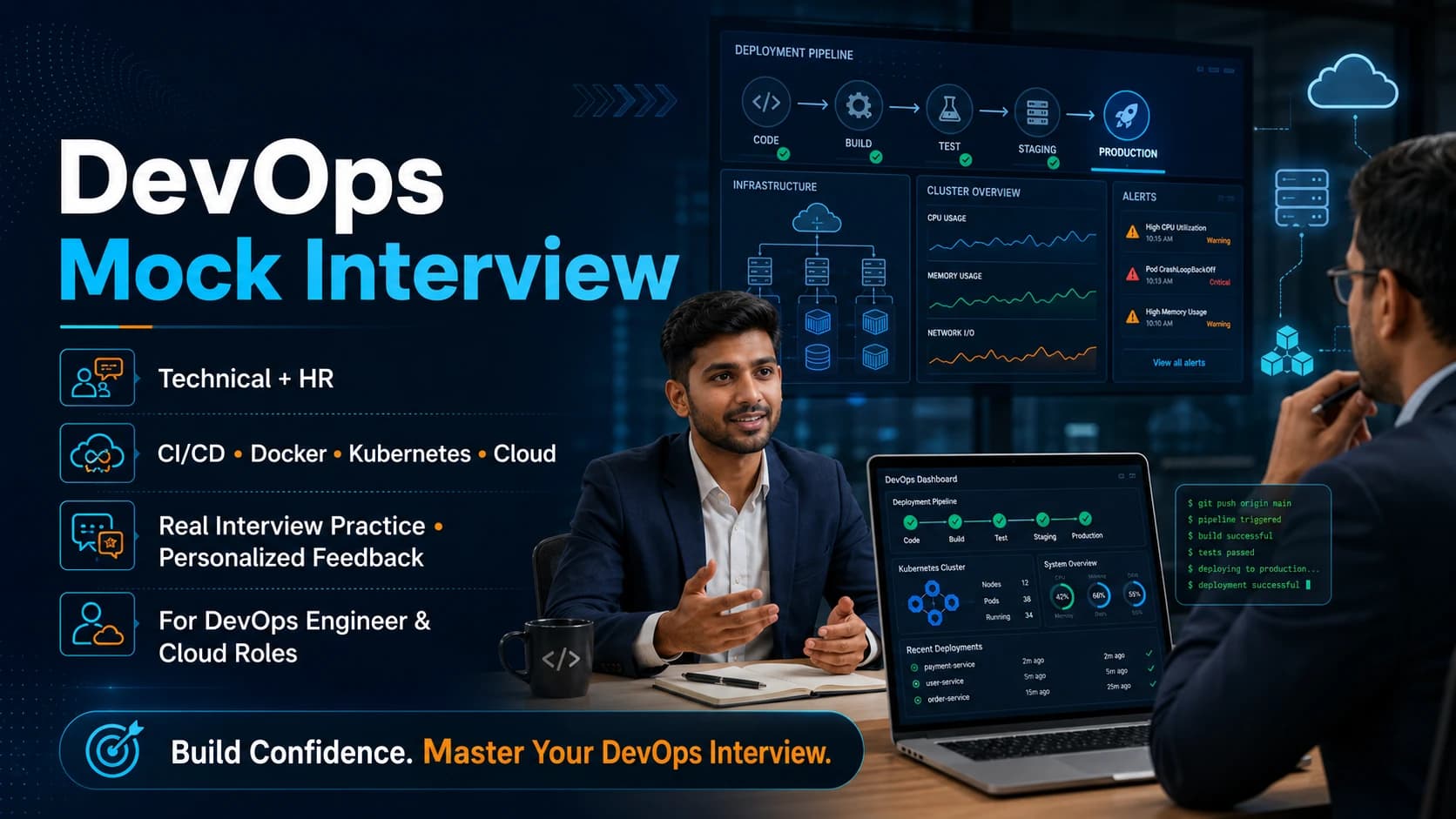
What to expect
DevOps interviews are not limited to definitions of Docker, Jenkins, Kubernetes, or AWS. Interviewers often want to understand how you think, troubleshoot problems, build deployment pipelines, work with cloud infrastructure, and handle real production scenarios.
The DevOps Mock Interview is designed to provide realistic interview practice for candidates preparing for DevOps Engineer, Cloud DevOps Engineer, Junior DevOps Engineer, Cloud Engineer, Platform Engineer, and related entry-level roles.
This session combines technical questions, practical DevOps scenarios, project discussions, troubleshooting questions, and HR interview practice so that you can understand where your preparation currently stands.
Whether you are a fresher, recent graduate, final-year student, or someone transitioning into DevOps, this session can help you identify weak areas before attending an actual interview.
Don't discover your weak areas during the real interview. Practice them before it.
What Will Be Covered in the DevOps Mock Interview?
1. DevOps Fundamentals
The interview starts by testing your understanding of fundamental DevOps concepts.
Topics may include:
- What is DevOps?
- DevOps lifecycle
- Continuous Integration
- Continuous Delivery
- Continuous Deployment
- Infrastructure automation
- DevOps culture
- Agile and DevOps
- Development and operations collaboration
- Automation in DevOps
- Deployment strategies
- DevOps best practices
You may also be asked to explain how DevOps practices improve software development and deployment processes.
2. Linux Interview Questions
Linux knowledge is extremely important for DevOps engineers because many production servers and cloud environments run Linux.
Questions may cover:
- Linux file system
- File permissions
- Users and groups
- SSH
- Processes
- Services
- Systemd
- Environment variables
- Package management
- Disk usage
- Memory usage
- CPU monitoring
- Linux networking
- Log files
- Cron jobs
- Shell commands
- Process troubleshooting
Example Scenario
“Your application is running on a Linux server but suddenly becomes unavailable. How would you investigate the problem?”
You will be expected to explain your troubleshooting process instead of simply giving one command.
3. Git & Version Control
Git is an essential part of modern DevOps workflows.
Interview questions may include:
- Git basics
- Git clone
- Git pull
- Git push
- Git fetch
- Git merge
- Git rebase
- Branching
- Merge conflicts
- Git reset
- Git revert
- Git stash
- Git tags
- Pull requests
- Branching strategies
You may also be asked how Git connects with automated CI/CD pipelines.
4. CI/CD Interview Questions
CI/CD is one of the most important areas of a DevOps interview.
Topics may include:
- Continuous Integration
- Continuous Delivery
- Continuous Deployment
- Pipeline stages
- Automated builds
- Automated testing
- Deployment pipelines
- Rollback strategies
- Pipeline failures
- Environment management
- Build artifacts
- Secrets management
You may receive questions such as:
“A deployment pipeline failed after the build completed successfully. How would you investigate the problem?”
5. Jenkins Interview Questions
If Jenkins is mentioned in your resume or projects, questions may cover:
- Jenkins architecture
- Jenkins pipelines
- Jenkinsfile
- Declarative pipelines
- Scripted pipelines
- Jenkins agents
- Build triggers
- Git integration
- Webhooks
- Environment variables
- Credentials management
- Pipeline stages
- Build failures
- Deployment automation
The interviewer may also evaluate whether you understand how Jenkins would be used in an actual development workflow.
6. Docker Interview Questions
Containers are another major part of DevOps interviews.
The session may include:
- What is Docker?
- Containers vs virtual machines
- Docker images
- Docker containers
- Dockerfile
- Docker Compose
- Docker volumes
- Docker networks
- Docker registry
- Docker Hub
- Port mapping
- Multi-stage builds
- Container logs
- Environment variables
- Container security basics
Example Scenario
“A Docker container starts and immediately exits. How would you troubleshoot it?”
You will need to explain your approach clearly and logically.
7. Kubernetes Interview Questions
For candidates who mention Kubernetes, questions can include:
- Kubernetes architecture
- Pods
- Deployments
- ReplicaSets
- Services
- Namespaces
- ConfigMaps
- Secrets
- Persistent Volumes
- Persistent Volume Claims
- Ingress
- Kubernetes networking
- Scaling
- Rolling updates
- Rollbacks
- Liveness probes
- Readiness probes
- Kubernetes logs
- kubectl basics
Scenario Example
“Your Kubernetes pod is showing CrashLoopBackOff. How would you investigate the issue?”
8. AWS & Cloud Interview Questions
Candidates preparing for DevOps roles are frequently expected to understand cloud infrastructure.
AWS-related topics may include:
- EC2
- S3
- IAM
- VPC
- Security Groups
- Load Balancers
- Auto Scaling
- Route 53
- CloudWatch
- RDS
- AWS networking
- Cloud security fundamentals
- High availability
- Scalability
- Cloud monitoring
You may also receive scenario-based questions.
Example
“Your application running on EC2 suddenly becomes unreachable. What would you check first?”
9. Terraform & Infrastructure as Code
Infrastructure as Code is becoming increasingly important in DevOps environments.
Questions may include:
- What is Infrastructure as Code?
- Terraform basics
- Providers
- Resources
- Variables
- Outputs
- Terraform state
- Remote state
- Terraform init
- Terraform plan
- Terraform apply
- Terraform destroy
- Modules
- State locking
- Infrastructure automation
- Terraform workflow
Scenario Example
“Two engineers are working with the same Terraform infrastructure. How would you safely manage the Terraform state?”
10. Monitoring & Logging
DevOps engineers need to understand application and infrastructure monitoring.
Questions may cover:
- Monitoring fundamentals
- Application logs
- Server logs
- Metrics
- Alerts
- Prometheus
- Grafana
- AWS CloudWatch
- ELK Stack basics
- CPU monitoring
- Memory monitoring
- Disk monitoring
- Application health
- Infrastructure monitoring
You may be asked how you would detect and troubleshoot production problems using logs and metrics.
11. Networking for DevOps
Basic networking knowledge is important for troubleshooting deployments and cloud infrastructure.
Topics may include:
- TCP/IP
- DNS
- HTTP vs HTTPS
- IP addresses
- Ports
- Firewalls
- Reverse proxies
- Load balancers
- SSL/TLS
- Domain configuration
- Network troubleshooting
- Private and public IPs
- VPC basics
12. Nginx & Reverse Proxy Concepts
Depending on your experience, the interview may include:
- What is Nginx?
- Reverse proxy
- Web server vs reverse proxy
- Load balancing
- SSL configuration
- HTTP to HTTPS redirects
- Proxying applications
- Domain routing
- Nginx configuration basics
13. Real DevOps Scenario-Based Questions
One of the most important parts of the mock interview is practical troubleshooting.
You may receive scenarios such as:
- Production application suddenly goes down.
- Server CPU usage reaches 100%.
- Server disk becomes full.
- CI/CD pipeline starts failing.
- Docker container keeps restarting.
- Kubernetes pod shows CrashLoopBackOff.
- Application works locally but fails in production.
- Deployment succeeds but the application returns 502 errors.
- SSL certificate stops working.
- DNS changes are not reflected.
- Cloud server is unreachable.
- A deployment introduces a bug.
- Database connectivity suddenly fails.
- Application response time becomes extremely slow.
You will be evaluated on your troubleshooting approach, reasoning, prioritization, and communication.
14. DevOps Project-Based Questions
If you have DevOps projects on your resume, you should be prepared to explain them properly.
Questions can include:
- Explain your DevOps project architecture.
- What problem does your project solve?
- Which technologies did you use?
- How did you create the CI/CD pipeline?
- How did you deploy the application?
- Why did you choose Docker?
- Did you use Kubernetes?
- How did you manage environment variables?
- How did you handle secrets?
- How did you monitor the application?
- How would you implement rollback?
- How would you scale the application?
- What problems did you face?
- How did you troubleshoot deployment failures?
The interviewer may continue asking follow-up questions to determine whether you genuinely worked on the project.
15. HR Interview Round
Technical knowledge is important, but communication and professional answers also matter.
The HR section may include questions such as:
- Tell me about yourself.
- Why did you choose DevOps?
- Why do you want to become a DevOps Engineer?
- Why should we hire you?
- What are your strengths?
- What are your weaknesses?
- How do you handle pressure?
- How do you approach production issues?
- How do you keep your DevOps knowledge updated?
- Where do you see yourself in the next few years?
- Are you comfortable learning new technologies?
How the DevOps Mock Interview Works
- Professional Introduction Round
- The session begins like a real job interview.
- DevOps Fundamentals
- Your fundamental understanding of DevOps is evaluated.
- Linux & Git Questions
- Questions test your operating system and version-control knowledge.
- CI/CD & Jenkins Round
- You may need to explain complete deployment pipelines.
- Docker & Kubernetes Round
- Containerization and orchestration knowledge is evaluated.
- Cloud & AWS Round
- Cloud infrastructure concepts and practical scenarios are discussed.
- Terraform & Infrastructure Round
- Infrastructure as Code concepts may be evaluated.
- Scenario-Based Troubleshooting
- Real-world infrastructure and deployment problems are presented.
- Project-Based Questions
- Questions can be asked based on projects and technologies mentioned in your resume.
- HR Round
- Communication, motivation, and career-related questions are discussed.
- Personalized Feedback
- You receive feedback about your strengths and areas that require improvement.
Who Should Book This DevOps Mock Interview?
This package is suitable for:
- DevOps Engineer freshers
- Junior DevOps Engineer candidates
- Cloud DevOps candidates
- Cloud Engineer candidates
- Students learning DevOps
- Final-year students
- BCA students
- BSc CS/IT students
- BTech/BE students
- MCA students
- Recent graduates
- Candidates switching to DevOps
- Candidates preparing for campus placements
- Candidates preparing for their first DevOps interview
What You Will Gain
After completing the mock interview, you should have a clearer understanding of:
- Your current DevOps interview readiness
- Weak technical areas
- Linux troubleshooting knowledge
- CI/CD understanding
- Docker knowledge
- Kubernetes fundamentals
- Cloud concepts
- Terraform knowledge
- DevOps troubleshooting approach
- Project explanation skills
- Communication skills
- HR interview readiness
Important Note
This package provides mock interview practice, preparation, and personalized feedback.
It does not guarantee a job, company interview, placement, selection, or employment offer.
The objective is to help candidates identify weaknesses and improve their preparation before appearing for actual DevOps interviews.
What’s included
- ✓50 min mock interview practive weekly 1 for 1 month
- ✓Communication Skills Feedback
- ✓Real DevOps Troubleshooting Scenarios
- ✓50 min mock interview practive weekly 1 for 1 month
- ✓Strength & Weakness Analysis